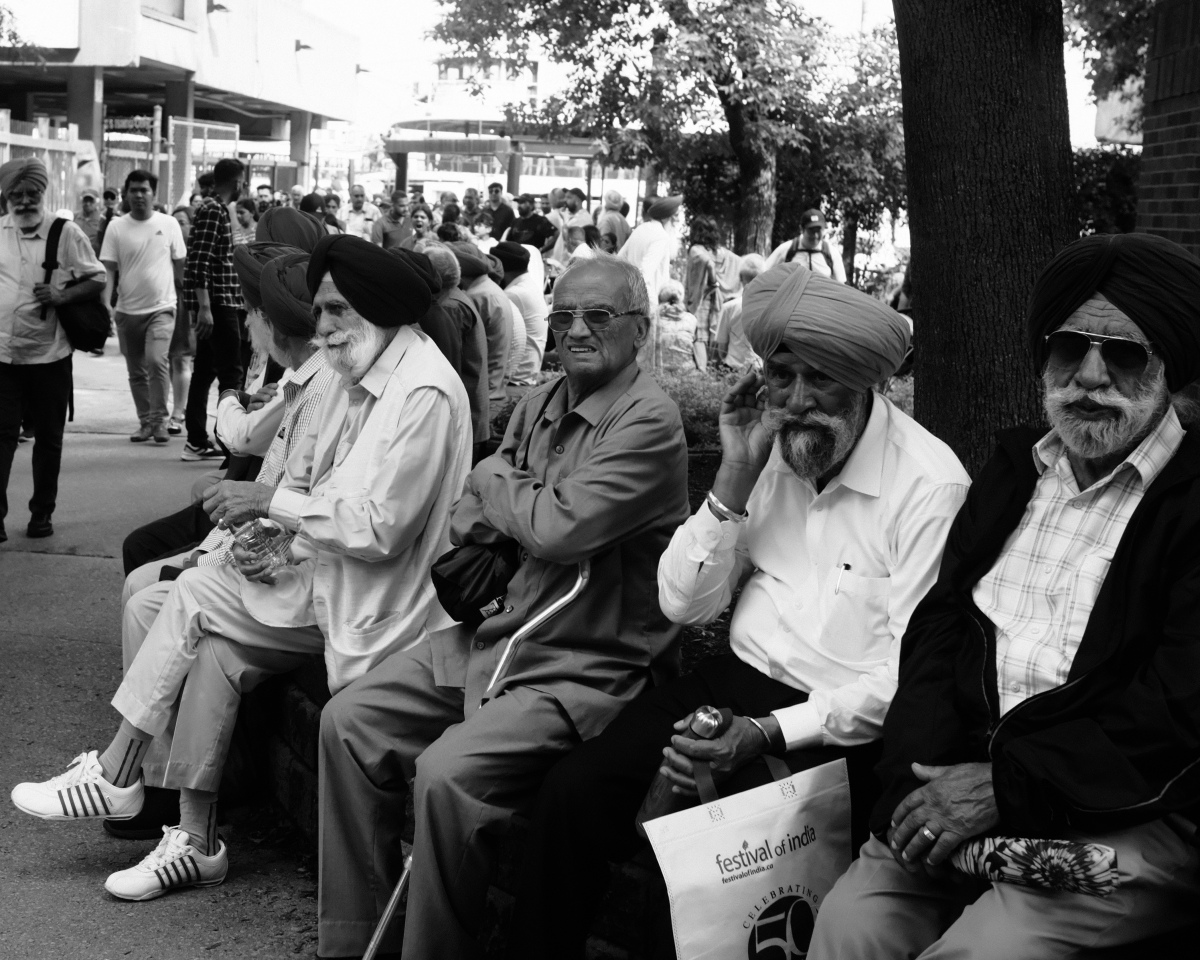

For the past several months Neale James has talked about how new laws which prevent taking pictures of people on the street will inhibit the documenting of history in certain jurisdictions. I’ve been mulling this over while trying to determine what I really think about this line of assessment and photographic concern. As a street photographer it seems like an issue where I’ve got some skin in the game!
In short, while I’m sympathetic with this line of argumentation I’m not certain that I agree. So I wrote a longish email to Neale—which was included in this week’s Photowalk podcast—and I’ve largely reproduced the email below as a blog post.
I should probably start by stating my priors:
- As a street photographer I pretty well always try to include people in my images, and typically aim to get at least some nose and chin. No shade to people who take images of peoples’ backs (and I selectively do this too) but I think that capturing some of the face’s profile can really bring many street photos to life.1
- I, also, am usually pretty obvious when I’m taking photos. I find a scene and often will ‘set up’ and wait for folks to move through it. And when people tell me they aren’t pleased or want a photo deleted (not common but it happens sometimes) I’m usually happy to do so. I shoot between 28-50mm (equiv.) focal lengths and so it’s always pretty obvious when I’m taking photos, which isn’t the case with some street photographers who are shooting at 100mm . To each their own but I think if I’m taking a photo the subjects should be able to identify that’s happening and take issue with it, directly, if they so choose to.
Anyhow, with that out of the way:
If you think of street photography in the broader history of photography, it started with a lot of images with hazy or ghostly individuals (e.g. ‘Panorama of Saint Lucia, Naples’ by Jones or ’Physic Street, Canton’ by Thomson or ‘Rue de Hautefeuille’ by Marville). Even some of the great work—such as by Cartier-Bresson, Levitt, Bucquet, van Schaick, Atget, Friedlander, Robert French, etc—include photographs where the subjects are not clearly identified. Now, of course, some of their photographs include obvious subjects, but I think that it’s worth recognizing that many of the historical ‘greats’ include images where you can’t really identify the subject. And… that was just fine. Then, it was mostly a limitation of the kit whereas now, in some places, we’re dealing with the limitations of the law.
Indeed, I wonder if we can’t consider the legal requirement that individuals’ identifiable images not be captured as potentially a real forcing point for creativity that might inspire additional geographically distinctive street photography traditions: think about whether, in some jurisdictions, instead of aperture priority being a preferred setting, that shutter priority is a default, with speeds of 5-15 second shutters to get ghostly images.2
Now, if such a geographical tradition arises, will that mean we get all the details of the clothing and such that people are wearing, today? Well…no. Unless, of course, street photographers embrace creativity and develop photo essays that incorporate this in interesting or novel ways. But street photography can include a lot more than just the people, and the history of street photography and the photos we often praise as masterpieces showcase that blurred subjects can generate interesting and exciting and historically-significant images.
One thing that might be worth thinking about is what this will mean for how geographical spaces are created by generative AI in the future. Specifically:
- These AI systems will often default to norms based on the weighting of what has been collected in training data. Will they ‘learn’ that some parts of the world are more or less devoid of people based on street photos and so, when generating images of certain jurisdictions, create imagery that is similarly devoid of people? Or, instead, will we see generative imagery that includes people whereas real photos will have to blur or obfuscate them?
- Will we see some photographers, at least, take up a blending of the real and the generative, where they capture streets but then use programs to add people into those streetscapes based on other information they collect (e.g., local fashions etc)? Basically, will we see some street photographers adopt a hybrid real/generative image-making process in an effort to comply with law while still adhering to some of the Western norms around street photography?
As a final point, while I identify as a street photographer and avoid taking images of people in distress, the nature of AI regulation and law means that there are indeed some good reasons for people to be concerned about the taking of street photos. The laws frustrating some street photographers are born from arguably real concerns or issues.
For example, companies such as Cleaview AI (in Canada) engaged in the collection of images and, subsequently, generated biometric profiles of people based on scraping publicly available images.
Most people don’t really know how to prevent such companies from being developed or selling their products but do know that if they stop the creation of training data—photographs—then they’re at least less likely to be captured in a compromising or unfortunate situation.
It’s not the photographers, then, that are necessarily ‘bad’ but the companies who illegally exploit our work to our detriment, as well as to the detriment of the public writ large.
All to say: as street photographers, and photographers more generally, we should think broader than our own interests to appreciate why individuals may not want their images taken in light of technical developments that are all around us. And importantly, the difference is that as photographers we do often share our work whereas CCTV cameras and such do not, with the effect that the images we take can end up in generative AI, and non-generative AI training data systems, whereas the cameras that are monitoring all of us always are (currently…) less likely to be feeding the biometric surveillance training data beast.
 Excited Pixels