Categories
Aside

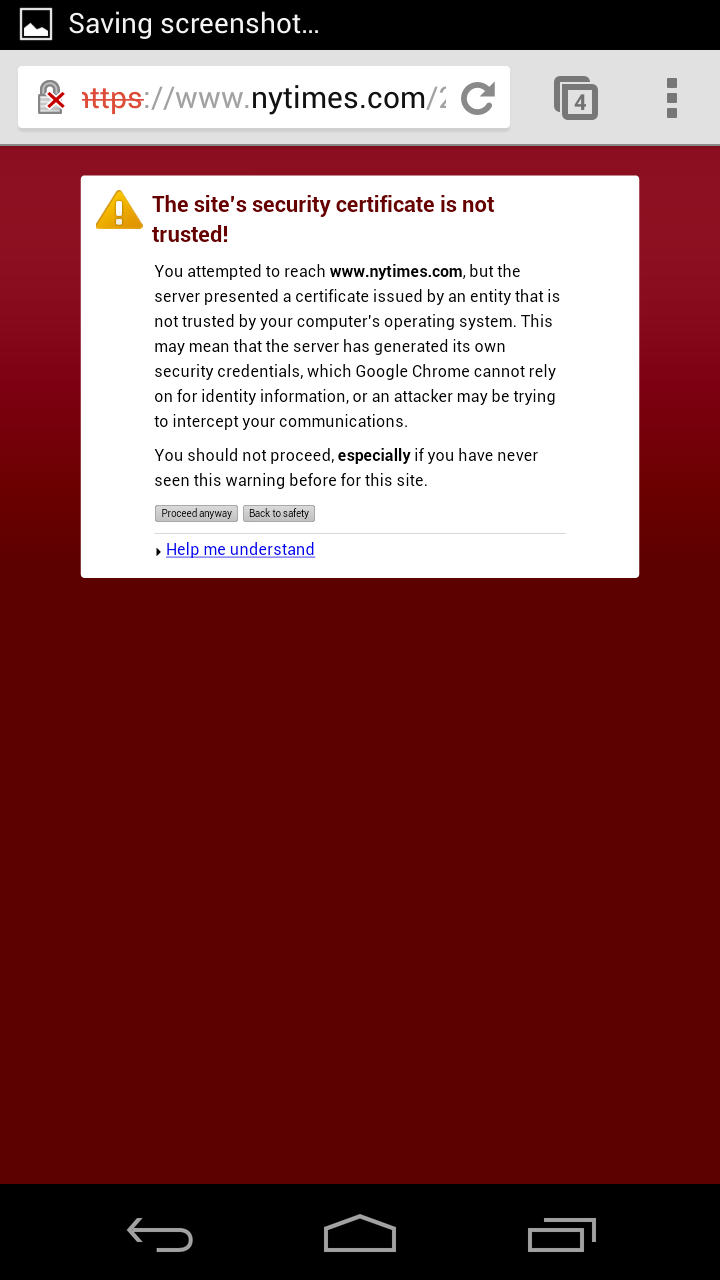
NYT and TLS/SSL

Those moments when big sites seem to seriously screw up their SSL certs

Categories
Aside

BBC News Permissions

You’d think that in the post UK phone scandals, newspapers wouldn’t want access to your phone calls with their apps

Categories
Quotations

2013.1.19

It’s not good to be on Power’s bad side, however. When you are on that side, Power piles on charges rather than shrugging off felonies as simple mistakes. Especially if what you do falls into the gray area of enforcing the letter as opposed to the principles of the law.

You can file all the petitions you like with the powers that be. You can try to make Power –whether in the form of wiretapping without warrants or violating international conventions against torture — follow its own laws. But Power is, as you might suspect, on the side of Power. Which is to say, Power never pleads guilty.

Ryan Singel, “Aaron Swartz and the Two Faces of Power
Categories
Writing

Lessig Blog, v2: A time for silence

lessig:

A week ago today, Aaron gave up. And since I received the call late Friday night telling me that, like so many others who were close to him, I have not rested. Not slept, really. Not connected with my kids, at all. Not held my wife except to comfort her tears, or for her to comfort mine.

Instead…

I am still struggling to come to terms with Aaron’s death. I was first incredibly depressed. Then mad. I’m still at that point.

I was one step removed from him in more ways than I can count and, based on my grief, I can’t imagine the pain experienced by my friends and colleagues. His causes overlapped with my own. His principles often as well. I can understand and sympathize – and, to a large extent, support – his advocacy tactics. I can impose my own understandings on why he took his life and be saddened, but not necessarily surprised and certainly unable to lash out at him for his decision.

What is perhaps most significant to my mind, now, is that the challenges that faced Aaron similarly bear down on many of the members of the digital and civil rights community. Threats of outlandish prosecution. Warnings of how advocacy will be treated as criminal behaviour of the highest sort. Attempts to legally force and coerce colleagues to turn on one another.

Aaron can, and does, serve as a focus for some of the problems that some members of this community experience on a sadly common basis. We need to move forward to better help, support, and uplift our own. We need to work harder to make sure that suicide isn’t seen as a way to resolve the problems that some of our community experiences. To this end we have to buttress against the despondency, isolate, and fear imposed by elements of government with the hope, togetherness, and laughter that makes this community so important and productive.

Categories
Quotations

2013.1.17

The same vulnerabilities that enable crime in the first place also give law enforcement a way to wiretap — when they have a narrowly targeted warrant and can’t get what they’re after some other way. The very reasons why we have Patch Tuesday followed by Exploit Wednesday, why opening e-mail attachments feels like Russian roulette, and why anti-virus software and firewalls aren’t enough to keep us safe online provide the very backdoors the FBI wants.

Matt Blaze and Susan Landau, “The FBI Needs Hackers, Not Backdoors
Categories
Quotations

2013.1.16

Defenders of the prosecution seem to think that anyone charged with a felony must somehow deserve punishment. That idea can only be sustained without actual exposure to the legal system. Yes, most of the time prosecutors do chase actual wrongdoers, but today our criminal laws are so expansive that most people of any vigor and spirit can be found to violate them in some way. Basically, under American law, anyone interesting is a felon. The prosecutors, not the law, decide who deserves punishment.

Tim Wu, “How The Legal System Failed Aaron Swartz – And Us
Categories
Quotations

2013.1.15

Placing sensitive data in insecure locations is never a good idea, and the loss of physical security has long been considered tantamount to a breach. Yet some early elements of the IoT incorporate this very flaw into their designs. It’s often an attempt to compensate for a lack of technological maturity where always-on network connectivity is unavailable or too expensive, or the central infrastructure does not scale to accommodate the vast number of input devices.

As the IoT crawls through its early stages, we can expect to see more such compromises; developers have to accommodate technical constraints — by either limiting functionality or compromising security. In a highly competitive tech marketplace, I think we all know which of these will be the first casualty.

And it’s not just security: it’s privacy, too. As the objects within the IoT collect seemingly inconsequential fragments of data to fulfill their service, think about what happens when that information is collated, correlated, and reviewed.

Andrew Rose, “The Internet of Things Has Arrived — And So Have Massive Security Issues
Categories
Links

Lessig Blog, v2: Prosecutor as bully

lessig:

Boston Wiki Meetup

(Some will say this is not the time. I disagree. This is the time when every mixed emotion needs to find voice.)

Since his arrest in January, 2011, I have known more about the events that began this spiral than I have wanted to know. Aaron consulted me as a friend and lawyer. He shared with me what went down and why, and I worked with him to get help. When my obligations to Harvard created a conflict that made it impossible for me to continue as a lawyer, I continued as a friend. Not a good enough friend, no doubt, but nothing was going to draw that friendship into doubt.

The billions of snippets of sadness and bewilderment spinning across the Net confirm who this amazing boy was to all of us. But as I’ve read these aches, there’s one strain I wish we could resist:

Please don’t pathologize this story.

No doubt it is a certain crazy that brings a person as loved as Aaron was loved (and he was surrounded in NY by people who loved him) to do what Aaron did. It angers me that he did what he did. But if we’re going to learn from this, we can’t let slide what brought him here.

First, of course, Aaron brought Aaron here. As I said when I wrote about the case(when obligations required I say something publicly), if what the government alleged was true — and I say “if” because I am not revealing what Aaron said to me then — then what he did was wrong. And if not legally wrong, then at least morally wrong. The causes that Aaron fought for are my causes too. But as much as I respect those who disagree with me about this, these means are not mine.

But all this shows is that if the government proved its case, some punishment was appropriate. So what was that appropriate punishment? Was Aaron a terrorist? Or a cracker trying to profit from stolen goods? Or was this something completely different?

Early on, and to its great credit, JSTOR figured “appropriate” out: They declined to pursue their own action against Aaron, and they asked the government to drop its. MIT, to its great shame, was not as clear, and so the prosecutor had the excuse he needed to continue his war against the “criminal” who we who loved him knew as Aaron.

Here is where we need a better sense of justice, and shame. For the outrageousness in this story is not just Aaron. It is also the absurdity of the prosecutor’s behavior. From the beginning, the government worked as hard as it could to characterize what Aaron did in the most extreme and absurd way. The “property” Aaron had “stolen,” we were told, was worth “millions of dollars” — with the hint, and then the suggestion, that his aim must have been to profit from his crime. But anyone who says that there is money to be made in a stash ofACADEMIC ARTICLES is either an idiot or a liar. It was clear what this was not, yet our government continued to push as if it had caught the 9/11 terrorists red-handed.

Aaron had literally done nothing in his life “to make money.” He was fortunate Reddit turned out as it did, but from his work building the RSS standard, to his work architecting Creative Commons, to his work liberating public records, to his work building a free public library, to his work supporting Change Congress/FixCongressFirst/Rootstrikers, and then Demand Progress, Aaron was always and only working for (at least his conception of) the public good. He was brilliant, and funny. A kid genius. A soul, a conscience, the source of a question I have asked myself a million times: What would Aaron think? That person is gone today, driven to the edge by what a decent society would only call bullying. I get wrong. But I also get proportionality. And if you don’t get both, you don’t deserve to have the power of the United States government behind you.

For remember, we live in a world where the architects of the financial crisis regularly dine at the White House — and where even those brought to “justice” never even have to admit any wrongdoing, let alone be labeled “felons.”

In that world, the question this government needs to answer is why it was so necessary that Aaron Swartz be labeled a “felon.” For in the 18 months of negotiations, that was what he was not willing to accept, and so that was the reason he was facing a million dollar trial in April — his wealth bled dry, yet unable to appeal openly to us for the financial help he needed to fund his defense, at least without risking the ire of a district court judge. And so as wrong and misguided and fucking sad as this is, I get how the prospect of this fight, defenseless, made it make sense to this brilliant but troubled boy to end it.

Fifty years in jail, charges our government. Somehow, we need to get beyond the “I’m right so I’m right to nuke you” ethics that dominates our time. That begins with one word: Shame.

One word, and endless tears.


Categories
Quotations

2013.1.12

I don’t believe the public would intend for the government to be rummaging through your cupboards while your wife is lying in the next room being prepared to be taken to her final resting place. That’s an extraordinary violation of privacy.

Andrew Fackrell, in Dennis Romboy’s “Police drug search intrudes on husband’s final moments with deceased wife
Categories
Quotations

2013.1.11

But an attempt by Canadian ISPs to garner an all-access pass that would let them secretly install software to monitor potentially illicit user activity was thwarted, at least in part.

According to the note accompanying the draft regulations, industry representatives “had argued for exemptions from the requirement for consent to install software to prevent unauthorized or fraudulent use of a service or system, or to update or upgrade systems on their networks.”

Under the revised rules, service providers would only be permitted to install software “where illegal activities pose a threat to [their] networks.”

Kady O’Malley, “Ottawa’s anti-spam proposals prohibit secret monitoring software