Categories
Humour

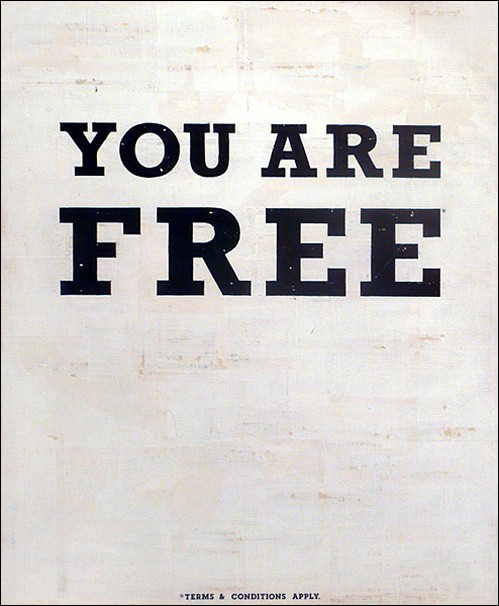
You are Free*

From mainstreamrevolution 


Categories
Writing

More Playbook UI Fail

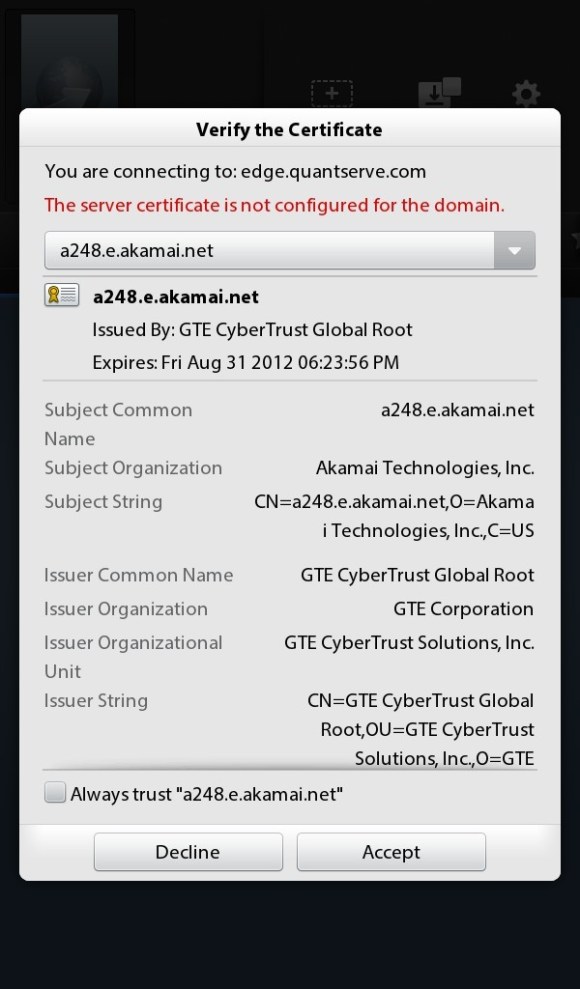
This is (another) security freak-out from the PlayBook. Is it really the case that Quantcast isn’t properly registering their certificates? What does it mean for the end-user to deny verifying the certificate?

The information contained in this screenshot lacks actual actionable information for most end-users, and they’re instead given a choice between X and Y without having any clear understanding of what either X (Decline) or Y (Accept) entrails.

Categories
Humour

The Walls: They Have Eyes

On Lookout by CCTV


Categories
Humour

You are under surveillance

mainstreamrevolution:

You are under surveillance

An awesome piece. It’d be fabulous if someone *cough cough* printed a few hundred of these and started putting them up throughout the US in public spaces.

Categories
Links Writing

American Copyright Gone Power Mad

The fact that American copyright holders basically govern an arm of the US government that can, and is, shutting down website URLs at the TLD root is terrifying. That degree of power, however, looks like nothing compared to what happened in the recent MegaUpload takedowns. Consider the following:

The width and breadth of the global police action are simply massive, and are, quite justly, being painted as a massive over-reach. The full indictment goes so far as to mention Canadian bandwidth provider Cogent, whose headquarter employees were even held and questioned during the raids this week. Indeed, anybody who provided bandwidth, rack space or Internet services appears to have been held, questioned, and/or pressured in the global raids.

The policy of seizing domains and hardware first, without any adversarial court process, limits every person’s ability to contest American efforts to silence free speech. Moreover, the maneuvers taken impose American understandings of American law upon all people living around the world. Such actions not only makes associating with certain others, and certain behaviours, legally dangerous but given a willingness to even threaten major ISPs’ employees it suggests that even third-party data transit providers are at risk. America is (rapidly) developing a policy process and technically-informed system capable of censoring any communication, any speech, any uploaded data that its rights holders believe might damage those corporations’ economic interests.

In the 30s and 40s there was a name for this kind of behaviour: fascism. We’re now witnessing the final stages of what was intended to be the greatest republic in the world go the way of Italy. All that stands between the RIAA and running considerable elements of American law enforcement are the courts.

God save us all.
Categories
Links

Google Abandons Anonymous Accounts With New Signup Form

This is how you leverage a monopoly in one domain (search) to force yourself into other markets while strip-mining users’ privacy expectations. I’m so glad that Google is a ‘do no evil’ kind of company and that they value users’ privacy.

The revamped Google account creation page adds some additional fields to the sign up form, including name and gender which are both necessary for creating a Google+ account. There’s also a new agreement — turned on by default — granting Google permission to “use my account information to personalize +1s on content and ads on non-Google websites.”

I would note that Facebook didn’t become successful by requiring people to sign up; it made the service cool and prestigious to drive early adoption. They also weren’t pushing people from one service into another, separate and unrelated, one. I can’t wait to see what the Europeans do to Google: it’s going to make the hell the Microsoft went through look like a brief, and sunny, walk in the anti-trust regulatory park.

Categories
Links

iPads in the Classroom: A Sound Investment or Bottomless Money Pit?

Klassen writes:

 To outfit a student body of 700 students at current prices schools would need to spend approximately $350,000, and that’s just for the hardware. To outfit one particular class, say Chemistry, with the needed textbooks—at Apple’s quoted $15 per book price—would likely cost a little over $10,000, to outfit the entire school with every textbook they needed for every course would cost significantly more than the hardware itself.

All told, an average size school would need to find approximately $500,000 to equip its entire study population with iPads and digital textbooks, and with most schools struggling to find funding for programs like art, music, and physical education, current financial priorities may be elsewhere.


My vote: an expensive money pit. Unless, of course, schools start deferring costs by requiring parents to pony up and pay for expensive Apple iGear. I’m sure parents would just love that extra expense of $500/year in hardware costs. I bet replacing damaged screens, stolen devices, and so forth will also improve parents’ sunny dispositions towards school systems that adopt Apple’s digital textbook extravaganza.

Categories
Links

Must Read on Apple ‘Saving’ Education

While I’m skeptical about the reasons that publishers are embracing Apple’s new iBooks Author system, Kieran Healy has a terrific piece that strikes to the problems with iBooks themselves: they’re a solution that insist on defining the problem. The issue is that, the problem it’s ‘solving’ is unlikely to be a significant problem actually facing educators, students, or the educational market.

The punchline in particular is great: Encarta is not the future. I’m not saying WHY that’s such a great punchline but you can find out if you go and read the article.

Categories
Links

Why Papers Books Beat iBooks

Dieter Bohn, over at The Verge, has a masterful analysis of paper-based books versus Apple iBooks (and eBooks in general). A few choice quotations are below, but you should really just take a few minutes of your day and go read the whole article.

 The list of “specs” for your standard paper book gets surprisingly long when you expand your definition of technology to include elements that don’t require a computer chip.

  • Readable with any form of light
  • Very high contrast display
  • Requires no battery power
  • Depending on model, lasts anywhere from five to five thousand years or more
  • Immersive and non-distracting user interface
  • Offers a spatial layout for immediate access to random information
  • Conforms to the standardized “page number” spec for easy reference
  • Supports direct interaction via pen or highlighter
  • DRM-free for easy lending and resale
  • Standards-based system not controlled by any single corporation or entity
  • Crash-proof and immune to viruses (though vulnerable to some worms)
  • Easy to learn user-interface consistent across most manufacturers
  • Supports very large number of colors and also black and white images
  • Compatible with a wide variety of note taking systems

I understand that free and open access to paper books isn’t available everywhere, that various hegemonies have stifled and do stifle dissent. Books can be burned, banned, and censored. But if we are going to be putting our collective knowledge into digital formats with DRM, we are adding another layer of possible censorship on top of the layers of control we already contend with. This isn’t (entirely) paranoia that Apple or Amazon will control access to human knowledge, it’s also a practical concern founded in the experience of being blocked by poorly designed DRM.

….

The thousand year view is simple: if you’re going to commit knowledge to writing in some form, you need to ensure that it will exist and be readable in a thousand years. I can tell you that I’ve personally gained insight and understanding about our world by reading a lightly-distributed instruction manual for rural, parish priests in England — written in the fourteenth century. Will an independently-created iBook 2 textbook be around in the thirty first century?


Categories
Links Writing

How Publishers Really Win With iBooks

From Ars:

… e-book publishing experts have concerns about the formatting that iBooks Author can output, which isn’t fully ePub 2 or ePub 3 compliant. Furthermore, Apple has added a clause to iBooks Author’s end user license agreement that prohibits selling e-books created with iBooks Author anywhere but the iBookstore.

“The offending language in the iBooks Author EULA is a condition on the use of the software, sort of disguised as a condition on the use of the books that are created,” Brown said. “Imagining how this might play out in a dispute reveals the nuance. Say a user makes her iBooks Author created work available for sale through some non-Apple platform. Would Apple sue, claiming that that book is infringing? Of course not—it would lose that lawsuit big time. Instead, Apple would claim that the use of iBooks Author to create that work violated this condition of the EULA, thus was beyond the scope of the EULA, and thus was infringement. Any lawsuit would be for infringement of the software, not of the book.”

On first glance, the new iBooks Author application looks really interesting. I’m incredibly impressed with it’s general ease of use and the capability to make works created through the application available to anyone using an iDevice. Unfortunately, I’m unwilling to produce works for a platform or publisher that so dramatically limits the scope of my potential audience. The licensing requirements mean that only freely available works can be made available in multiple domains, and inability to export to ePub (and expect it to work) means that I’d effectively be creating locked-in text for a hyper-small audience.

As an author, Apple is punishing me. Hell, if I were a content publisher (in the large commercial sense) that gave a damn about content accessibility I’d run for the hills.(Yeah, I know, there really aren’t many of those!)

The public shouldn’t regard the fact that major publishing houses have partnered with Apple as indicating any interest whatsoever in ‘democratizing’ education. No, what is really happening is a clever end-run around democratizing education. You see, by adopting Apple’s environment and charging for works, publishing houses are creating new license-based reasons to rebuff those who want publishers’ texts in standards-compliant, multiple-device accessible, formats. In effect, the publishers have single-handedly stepped into Apple’s reality distortion field to appear to be ‘reshaping education’ while actually locking out efforts to truly democratize textbooks.

Well played textbook publishers. Well played.