Categories
Links Writing

The neoliberal assault on academia

jakke:

Today in articles that criticize “meaningless buzzwords” but then also use “neoliberal” in the title.

Seriously – if you have a graduate education, you are not the oppressed and marginalized party here. There’s no reason that professors should be getting tenure in the first place; why should this one small class of wealthy well-educated people get the right to keep their jobs indefinitely regardless of performance while their students rack up six figures of debt?

If there’s an assault on academia, it comes from the fact that post-secondary education is wholly unaffordable to students from low-income backgrounds. Being expected to provide a service in exchange for money is not assault. Any confusion on this matter is a good indication of why people are skeptical about giving you more money.

Just re: tenure. There are very, very, very good reasons to provide it. I know of a host of graduate students who are prohibited from communicating their research findings for fear of the potentially very serious blowback associated with their (entirely valid, grounded) research results. Others simply avoid research tracks on the basis that ‘no good can come of it.’

These individuals are working on issues of significance (e.g. how government engages in anti-democratic surveillance and interdiction of communications) that simply cannot be engaged with by most members of the public. Such members tend to lack the time, expertise, or safety to publicly engage in the research. Tenure is meant to afford faculty the ability to engage in such ‘risky’ work while also granting the space to do what might be seen as useless basic research. It also is intended, ultimately, to offer a shield that graduate students can retreat behind if needed. The absence of tenure weakens the already precarious conception of ‘academic freedom’.

Academe is, without a doubt, an increasingly bureaucratic domain. Faculty are often as guilty as government in this transition; it wasn’t always like it is today (which, I might add, also isn’t a reason to lust for the old days: grad students in the 90s complained about pretty similar issues as the students of today). The increased shift towards publish or perish, and in the UK the ‘tiering’ of publications, has been incredibly problematic for the quality of much literature: some publications are ‘slanted’ to accommodate the tiering model, as opposed to the actual way that the research may flow. Such attitudes and efforts to ‘game’ the system are linked to a systematic problem around academe. I don’t know that there’s a ‘fix’, but it also isn’t something that’s terribly healthy today.

Categories
Aside

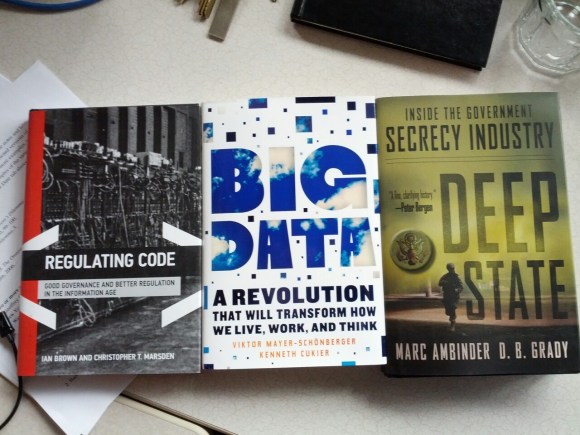
Book Delivery Day!

Categories
Aside Links

jakke: getallthedegrees replied to your post: must force myself to stop…

jakke:

getallthedegrees:

jakke:

imagegetallthedegrees replied to your post: must force myself to stop eating pad thai

I’ve been told your supervisor does the asking, though you have input. But that might just be my department. However, for my MA my supervisor did the asking but asked who I wanted. So I dunno??

Sorry – to clarify, when I said “committee” I was including supervisor. Because I don’t yet have anyone formally signed on. Three years into the PhD. Despite semi-frequent discussions of research and stuff with three or four faculty members. And it’s really hard to track anyone down unless there’s a talk or something where I can chase them afterwards and beg for a meeting time.

Forgive my ignorance of econ programs, but how did you get through your comps without a formal supervisor? Unless, this means you didn’t do comps? Do you do quals instead? How is your program structured?

I was told that I’m supposed to formally ask who I want to be my supervisor, and should really be thinking about it soon (September at the latest) according to the grad advisor. In my program you don’t ask formally until you do candidacy* (after you finish your coursework), but since I’m not able to take the remaining classes I need over the summer I’ll be doing candidacy work sort of unofficially.

*In my program (and I think most programs in my institution) we take more classes than most (eight, rather than four or six), and skip the comps/quals process and do candidacy instead. Candidacy is the first three chapters of your dis, so intro, lit review and methodology (~ 80-100 pages) which you defend in an oral exam.

Okay so hopefully this isn’t overshare but here’s how my program (and, I think, most econ programs) works:

  1. Eight months of general coursework (three per term for two terms). Everyone takes this together.
  2. Two comp exams. Everyone takes these together. They cover all of macro and micro theory. One or two people get kicked out.
  3. Another eight months of coursework, this time with four per term for two terms. This is where specialization happens.
  4. Four months of writing a paper. This is supposed to get you familiar with the process but is almost always a failure.
  5. Twelve months of preparing for prospectus defence. This is where I am now. Typically a big chunk of your thesis gets written here.
  6. Prospectus defence and assembling a committee. Including the prof who’s formally your supervisor.
  7. Twelve months of preparing for the job market. Your best paper gets super polished as your Job Market Paper around this point.
  8. Four months of job market. In here, you’re also finishing your thesis. But really it’s your Job Market Paper that matters more than the actual thesis.
  9. Four months of finishing up the thesis, getting a job, and defending the thesis.
  10. Graduating and very very hopefully progressing to gainful employment.

So the big paper I’m currently working on right now will very hopefully be my Job Market Paper. Other projects I’m working on might end up in my thesis. At least one is getting published and isn’t going to be part of my job application at all because it’s not economics.

And yeah accordingly I really really need to put together a committee to formally supervise my actual thesis. And I don’t know how much coldness is par for the course or at what point it actually becomes a strong negative signal.

That’s….a different structure from any other I’ve seen. I’ve the good fortune of entering the program with a supervisor (you can switch later, if you want). He’s helped pay a bunch of my bills + general guidance.

He’s also taken most of the work out of finding people for the committee: we had a meeting and went back and forth on names, and then he rounded folks up. It’d have been super awkward to do this myself, given that I tend not to know people in the program terribly well (and they tend to look at me funny, not quite knowing what it is that I actually do as an academic).

Categories
Links Writing

Tower of Sleep: You’re Fucked, and You’re Probably to Blame.

karengregory:

In 2009, theChronicle of Higher Educationran an “advice” piece entitled “Graduate School in the Humanities: Don’t Go.” In the article, Professor William Pannapacker (ironically of Hope College) proceeded to get real and lay down some truth for aspiring seekers of higher education: there are no jobs, you will grow old trying to get one, you will be poor and in debt (and did we mention old, particularlywomen, who age so much more decisively, what with your womb clocks and all), and you will become angry and embittered by your failures to secure stable employment. This hit a nerve. And probably because that particular nerve rarely gets sleep and likes to wake many of us up at 4:15 in the morning, we are aware that Professor Pannapacker speaks a certain truth. The world that many graduate students are trying to enter is broken and there are no easy roads to security. Even if we manage to grab hold of a rare job, the future of working as an academic looks pretty bleak. So why don’t those of us who understand this pack up and leave?

If we listen to Rebecca Schuman, who recently updated Pannapacker’s screed for 2013 inSlate, it’s because we were too stupid to heed his message, suggesting that the original article “convinced no one.” And, as Schuman writes, “It certainly didn’t convince me! Why? Because Pannapacker is a tenured professor. He pulled it off, so why can’t you? After all, someone has to get these jobs.” Yes, perhaps we are stupid and optimistic and blind. In some situations, like when the world is going to shit, sometimes these aren’t the worst things to be. But I don’t think it’s that we’re all just sitting unaware that the sky is falling and hoping it won’t fall on us. Some of us, as Tressie Cottom suggests on her blog, are trying our best to be “brave” and we are trying to stick around in this shitstorm of terrible labor practices, endless competition for scarce jobs, nasty administrative choices (like the president of CUNY calling grad students “roaches” or, even worse, pepper spraying our undergraduates who have dared to question the vision for higher education in this country) because we care and we want to change it. Or, because even if the university succeeds in chasing us out, we haven’t failed by completing a PhD.

There are many reasons why these screeds of “Don’t go! Graduate School will ruin your life” leave me wanting to kick the wall. Yes, things suck. I make no bones about that, but these screeds overlook the work that students are doing to organize, agitate, and resist the restructuring of higher education. And this oversight raises the question: if you realized the Pannapacker “Truth,” then did you then get involved in your union, in an activist group, in an education alternative (like the Free University), or in a conversation with your students? When did you start realizing that a career in academics also means addressing the very conditions of our labor? What have you done besides comparing the kind of tenacity it takes to be a graduate student today to being a willful smoker who smokes “four packs a day” and hopes to not get cancer?

As someone who has had cancer, I’m a little offended, but I’m also deeply aware thatthere are no self-interested choices that can really save you. This is true in academics as well. We’re finding ourselves in a world where “doing the right thing,” including staying on the straight and narrow path that may or may not culminate in tenure, is not enough.There is a cold logic of privatization at work in these “don’t go” screeds. This logic foregrounds an “every man for himself” mentality, which mirrors the very toxic culture of academics that so closely binds self-worth and research production. To what degree have we internalized this toxicity when we suggest to others that they should “save themselves”? This is not to say that we should not be very angry about the state of the job market, but to ask how does such privatization lead us away from addressing larger, structural issues at play here?

In addition to this, everyone should readTressie’spost. It is smart, impassioned, and on the money response to these “reality checks.” Too many of “some” people have gone on to higher education, but too many others simply haven’t. What happens if “you can’t do better” than go to school? I agree with Tressie that the “Truth” of the “don’t go” advice is not entirely wrong and that we need to be very clear with prospective students about the road ahead of them and the placement of financial burden, but just because we may not see the future clearly for ourselves is no reason to throw the entire institution under the bus. Are we really ready to say that higher education is no longer a link to mobility?

If so, we have some serious thinking to do about what life is this country is about and what such a “no future” really looks like. I am not ready to accept that fate. Many of us are not, which is probably part of why we stick around in our adjunct positions.We know that when and if we leave, our students will be even more on their own—and we also know that the wolves are circling, ready to MOOC-ify the classroom, by which I mean get rid of it entirely and truly strip education down even further. This is really the big issue here, and I wish that more graduate students would realize that participating in the freakout over tenure is a drain on energy that would better be used to stand up to the larger forces that are eager to break the tie between education and mobility, particularly in the public university.

This is not to say don’t freak out, but send the energy outward. Make it social. Organize. Read the news and reject this bullshit mantra of private failure. My guess is that it is this type of mental resilience and recasting of shame (like we see happening around student debt) that will need regardless of where we work.

Also, grad students: If the following is true of your experience, where have you gone to graduate school and how do those very programs needs to be modified:

During graduate school, you will be broken down and reconfigured in the image of the academy. By the time you finish—if you even do—your academic self will be the culmination of your entire self, and thus you will believe, incomprehensibly, that not having a tenure-track job makes you worthless. You will believe this so strongly that when you do not land a job, it will destroy you, and nobody outside of academia will understand why. (Bright side: You will no longer have any friends outside academia.)

CUNY may be a rare case, but it has not been as lonely as this. Nor has it suggested to me that my entire selfismy research. Perhaps because we are public, scraping along, working full-time, parenting, and teaching, we are a little more pissed off then other graduate students? But students here talk to one another. They create community. If I had not gone back to school, I would not have had the chance to learn alongside of some of these truly brilliant, radical people.So, if you ask me about graduate school, I will tell you it sucks, but I will also say: Flock to the Public Universities. Demand access and entry to higher education. Nothing will be easy when you get there. But we cannot afford to leave the university to those currently in charge of it.PhDs, we need you.

This is why the fight for free education matters. Changing the discourse around education is crucial to changing the discourse (and the reality) of income inequality and social mobility in general.
I think that, intellectually, the desire to reform the academy is admirable.

But I can’t image it succeeding or, by the time that it does, it’s going to be pretty late for the entire massive set of graduates who are trying – still – to find marginally meaningful work. Is this a pretty individualistic and pessimistic view of things? Yep, totally. But the collective isn’t going to pay my rent. Or my cats’ vet bills. Or put food on my family’s table. From my position, based on being amongst grad students for going on 2 decades now (another discussion, but no, my parents aren’t professors or permanent staff), things aren’t measurably improving: the same problems are being discussed, but they’re more dire each and every year.

There are long-term fiscal challenges that are associated with a PhD, especially immediately after graduating from the academy. Most have to discover new networks. Even more have to convince those networks that they are capable despite often lacking the ‘basic skills’ needed for employment somewhere within ten miles of what they trained in. Note: by training I don’t mean literature, or economics, or whatever, but in reference to the core skills that PhDs are meant to develop: research, analysis, and whatever ‘fungible’ skills were developed in the PhD (e.g. discourse analysis, policy analysis, stats, etc).

Grad school is a terrific place to be. It’s intellectually stimulating and one of the most pleasant places to be while living close to – or well below – the poverty line. But the thing is, a lot of us are still at or below that line. The absence of tenure track positions, depreciation of pay in many universities for RA/TA and sessional work, and university’s failure to provide meaningful career counselling and training are significantly damaging the academy. And, what’s saddest, is I don’t really think the universities (or most faculty) give a damn because they can externalize or ignore most of these challenges and problems facing PhD students and candidates.

Is the state of the world in academe terminal? No, not necessarily. It’s entirely possible that things could be healed. But, at the same time, if I want to complete my degree in a timely basis (funding runs out!) and mitigate the accumulation of huge amounts of debt and do all the professional development things I need to do in my own time, I’m not going to be a hardcore activist on campus that tries to reshape academe. I appreciate the sentiment, but I think I have more effect changing politics outside the University that inside, and I’d rather spend my time working in a domain where change is more plausible. And, given that I’ll be thrust outside of the academe soon enough anyways, at least the stuff I do ‘outside’ provides a marketable set of ‘real work’ skills.

Tower of Sleep: You’re Fucked, and You’re Probably to Blame.

Categories
Aside

Application, In!

Well, first faculty job applied for. This finishing the dissertation and moving on in life stuff is feeling a lot more pressing now.

Categories
Aside Links

New policy: don’t share coverage of academic research unless the research is open access

I understand and appreciate the author’s sentiment about not reporting on closed-access academic work. In my own case, I just try to avoid reading or citing non-OA work. Not because closed-source stuff isn’t good, but because I don’t want to be citing material that I can’t re-read when I leave grad school. I have incredibly large amounts of stuff to read: I’m not sure that spending time reading soon-to-be-locked-away-knowledge is the optimal use of my time.

Categories
Aside

Another Chapter Done!

Another dissertation chapter drafted and submitted to the supervisor. Time to relax. And start my soon-due paper on drones.

Categories
Aside Humour

Marriage vs. the PhD

kunlabora:

Marriage versus Ph.D illustration

I’m pretty sure I’ll lack the remorse after finishing. It’s actually surprising nice to know that I’m done with academe in a 6 months or so!

Categories
Links Writing

Casey Johnston!: I have this seminar I’m running for free for college students and I’m…

caseyj:

I have this seminar I’m running for free for college students and I’m going to show them this picture before we start. It’s a picture of someone graduating from college. You can’t tell, but you can guess that they’re probably $150,000 in debt. Written on the top of their mortarboard with masking tape it says, “Hire me.” The thing about the picture that’s pathetic, beyond the notion that you need to spam the audience at graduation with a note saying you’re looking for a job, is that you went $150,000 in debt and spent four years of your life so someone else could pick you. That’s ridiculous. It really makes me sad to see that.

While I understand what Seth Godin is suggesting, I also think that it’s largely reflective of his incredibly privileged position. When people are leaving schools with that amount of debt, with knowledge that they want to start a family and not suffer (total) financial ruin by starting something and failing, then those individuals may quite reasonably want full-time regular employment.

Godin’s most common response is that ‘such employment doesn’t really exist anymore – so adapt!’ While it’s a great response for some people who are willing to take on heightened risks in their lives it isn’t one that ought to be imposed on all individuals. Moreover, the thought that it’s “ridiculous” to want to be picked and work at a meaningful job and launch a career with a business that is compatible with your training and expertise shouldn’t make anyone sad. Instead, what should be “sad” is that such aspirations are less and less likely to be realized as companies abandon long-term commitment to employees and instead harden their ‘flexible’ hiring strategies that facilitate profits at the expense of human life.

Categories
Links

Yale Suing Former Students Shows Crisis in Loans to Poor

infoneer-pulse:

infoneer-pulse:

Needy U.S. borrowers are defaulting on almost $1 billion in federal student loans earmarked for the poor, leaving schools such as Yale University and the University of Pennsylvania with little choice except to sue their graduates.

The record defaults on federal Perkins loans may jeopardize the prospects of current students since they are part of a revolving fund that colleges give to students who show extraordinary financial hardship.

Yale, Penn and George Washington University have all sued former students over nonpayment, court records show. While no one tracks the number of lawsuits, students defaulted on $964 million in Perkins loans in the year ended June 2011, 20 percent more than five years earlier, government data show. Unlike most student loans — distributed and collected by the federal government — Perkins loans are administered by colleges, which use repayment money to lend to other poor students.

» via Bloomberg

The default situation is only going to get worse and worse, especially for those that tried to hide from the US recession by staying in school and taking on educational debt.

Yale Suing Former Students Shows Crisis in Loans to Poor