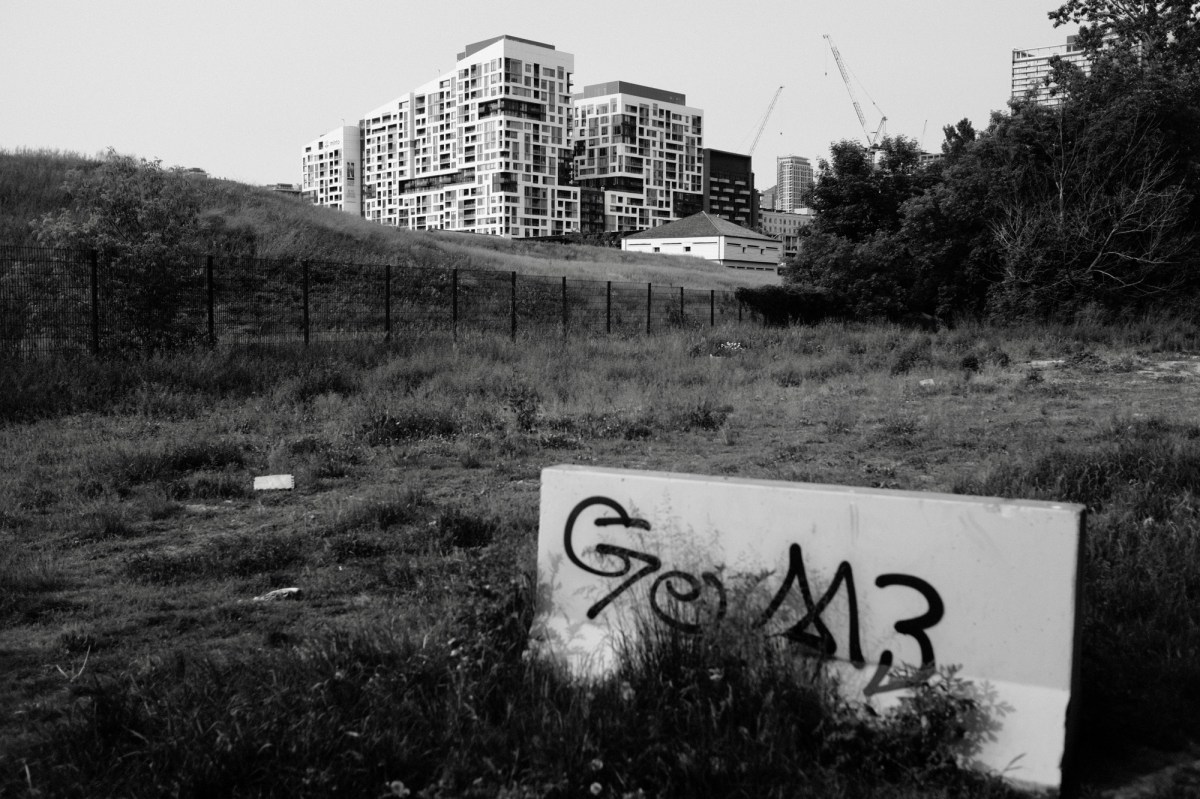
This is one of my 12 preferred landscape/cityscape images from 2023, which I created (but didn’t print) alongside my 2023 Postcard project.
The photograph has a few things happening to my eyes: there’s the wildness in the foreground and a bit of roughness with the graffiti, that then passes into the rustic fortress that defended Toronto over a century ago, and then the new/under construction parts of Toronto. While it formally lacks any humans in the scene it radiates humanity in each gradation of the image, while also communicating a kind of evolution of Toronto’s emergence over time.
I went away on vacation last year to Guelph. It’s an hour or so away from Toronto and also happens to be where I spent a lot of time growing up and where I did some of my university degrees. We tend to visit once or twice a year just to get away from the ‘big’ city and enjoy some of the restaurants, distilleries, breweries, and other features of Guelph. It also provides an opportunity to see friends and family.
I made this image while we went on a long walk out to Guelph Lake; it’s an entirely man-made lake, and there are nice trails that track along rivers that you can take from downtown to get to the lake.
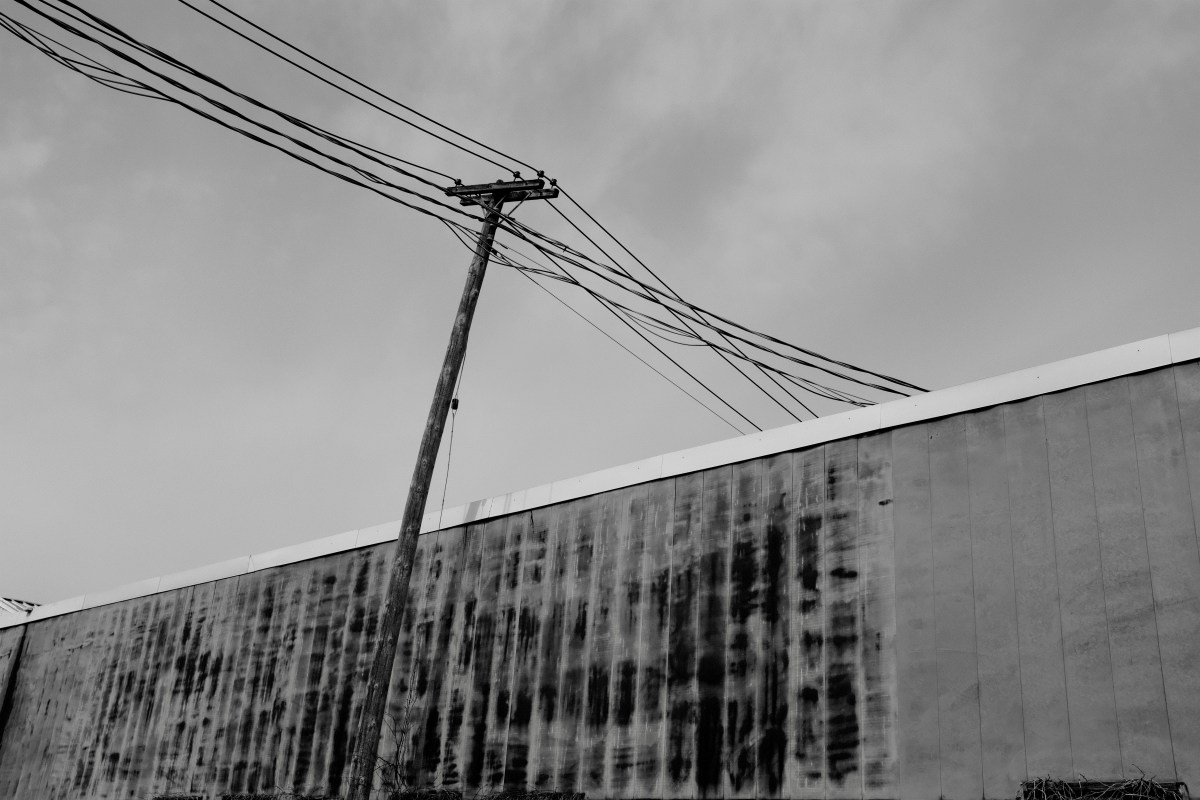
There isn’t anything particularly magical about this image: it doesn’t necessarily speak to a deep history of the city, or anything so substantive. But I liked the texture of the wall that the utility pole was pressed against, and the chaotic way that the utility wires were somewhat tangled together. And it’s for that reason that this was my favourite landscape-type photograph I made in April 2023.
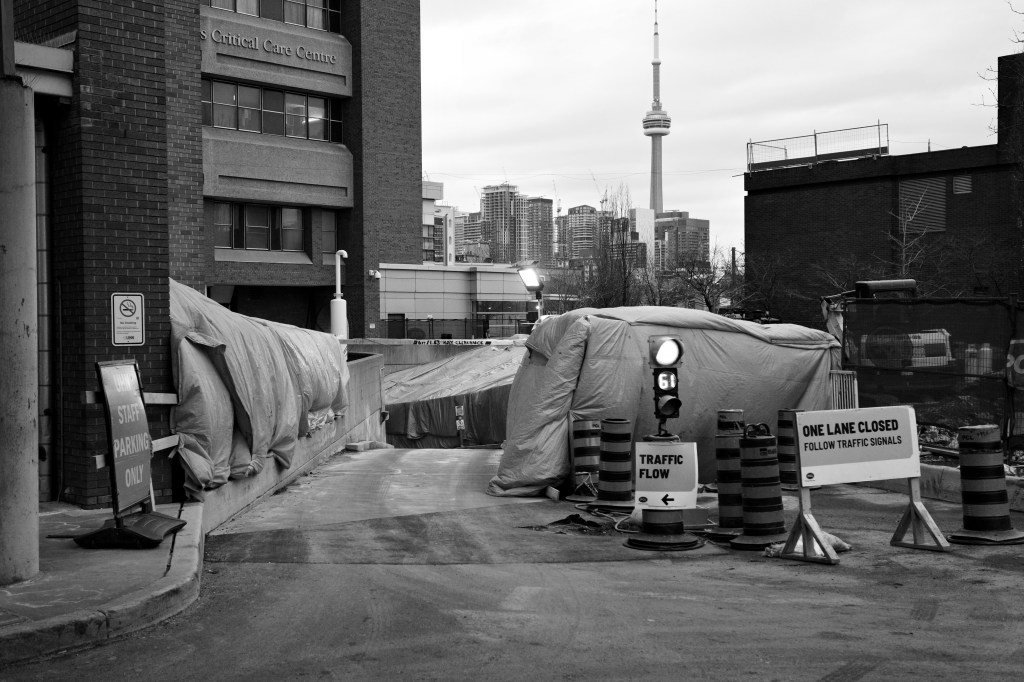
This is one of the cityscapes I took last year. It resonates with a number of themes that are often present in my photography: icons of Toronto, construction in the city, and the sense of impermanence and isolation associated with the Toronto streetscape.
The absence of humans along one of Toronto’s many core cross streets also spoke to me. It provided me with a sense of humanity-absent, which is narratively aligned with many of the images that I made throughout the depths of the pandemic.
In the late fall of 2022 I decided that I’d turn one of my street photographs into a postcard for each month of 2023. I just received my proofs for 2023 this week and I’m happy with them; the full order will be made in the next week or two.
I also, however, will be posting the preceding year’s images to Excited Pixels. So, this January I’m posting the January 2023 photograph, in February I’ll post the February photograph from February 2023, and so on.
In addition to the street photograph that was made into a postcard I’ll also be publishing my favourite landscape/streetscape from that month. Despite making a reasonable number of landscapes/streetscapes, this will be the first time that I regularly publish some of them.
January 2023: Streetscape
University of Toronto , Toronto, 2023
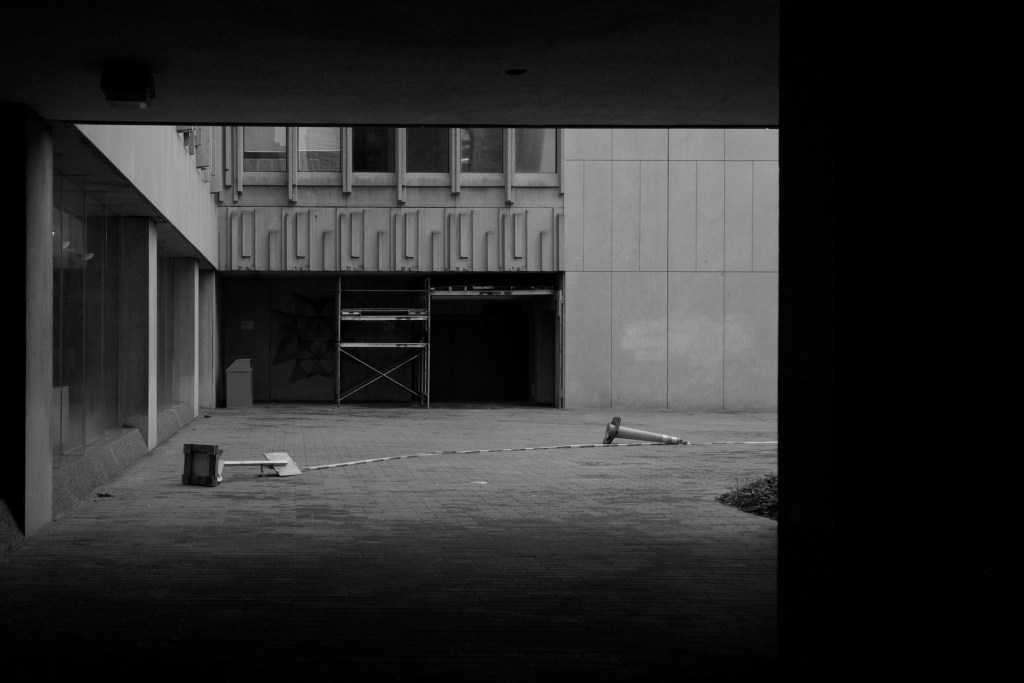
I made this image of an under-construction part of the University of Toronto in my last few weeks employed with the institution. It is, in many ways, a deeply personal photo that reflected my passage to a new space. The tape and barriers being knocked over was figurative, in the sense that what once was a warning to keep me away was now a path to follow out of frame, and into new experiences and adventures after working with the same employer for almost a decade.
January 2023: Street Photograph
Richmond & Bay, Toronto, 2023
This photo was made January 1, 2023 and it remains one of my favourites. The emotion in the subjects’ face draws me in and the steam and garbage lends this part of the city (home to the country’s largest banks, stock exchange, and other financial and legal institutions) a kind of grittiness that belies its proximity to wealth and power. The photograph, also, speaks of how you can build a story in a frame that might look one way, but which doubles in meaning and context once grounded in the space and time wherein it was made.
I kept coming back to Bay and Richmond throughout the year and was regularly rewarded with rich images. The fluidity of the location, with updates to the built infrastructure in the form of temporary construction scaffolding, and the steam emerging from vents in this party of the city, just made it fun to keep coming back to.
We got our first snow of the year on Sunday. I kept waiting for it to come and as soon as the snow started to fall I grabbed my Fuji X100F with a Cinebloom 10% attached and headed out to make some images.
I live in a densely populated section of Toronto. Notwithstanding the snow there were many people out and about when I first hit the streets. But it was as I moved to side streets, or into parts of the city that tend to be populated by tourists, that it was apparent that huge chunks of the city were largely depopulated as people decided to stay inside where it was warm and dry.
There were, of course, some people out even in the less populated parts of the city. They, however, tended to be trying to get out of the snow—which functionally turned into snow that was almost indistinguishable from rain towards the early evening—and generally wanted to just avoid getting wet or cold.
Somewhat surprisingly I saw almost no other photographers out and about. I’m sure they were there, somewhere. But, at the same time, I wonder how much the weather dissuaded them from getting out and shooting the streets or urban landscapes.
I will never be accused of babying my cameras. My Fuji X100F lacks the weatherproofing of the newest version and, so, when I’m out in the snow I tend to protectively place one hand over it’s screen and eyepiece, and keep the lens pointed downwards and slightly in towards my body. It doesn’t prevent all the precipitation from getting onto the camera but, along with brushing off water when it starts to gather on dials and such, has always seemed good enough to keep the equipment safe.
The mix of heavy coats and umbrellas is something that I’m always curious about, if only because I can’t recall ever seeing something similar while I was growing up or when I visit parts of the country (or world) that receive large volumes of snow. I don’t dispute the potential utility of an umbrella—it will, obviously, help to keep your head wet and my uncovered head certainly got soaked after 3-4 hours outside—but it always seems like an instrument that is out of place. Though they look very distinct in the snow and so I definitely took the chance to make images of people who were carrying them!
Though there were people out and about, and evidence in other cases of someone having been present recently, much of the city felt oddly solitary. When I make my photos I’m often trying to communicate a sense of, on the one hand, the press of other people around and upon us and, on the other, the loneliness or isolation experienced while being in these massive urban environments. Dismal weather almost always draws me to the latter and wanting to express how large our environments are and what they look like with few figures or, alternately, in the absence of humans entirely. What will the city look like when the humans are gone?
When I watched one of James Popsys’ videos recently he mentioned that, when taking his landscapes, he likes putting either a human or a human-made thing in his images. Doing so has the effect of communicating human presence and, often, what the natural environment looks in our absence. Human-made things, also, have the effect of drawing us into an image on the basis that we ‘see’ something of ourselves in the otherwise natural environment.
In an almost modernist way of thinking those solitary human-things have the effect of both showing the attempt to overcome, or start overcoming, nature while often simultaneously showcasing the majesty and longevity of nature against the transitory existence of human-made things. Or at least that’s how I see and study such images.
I don’t know how well I really captured ‘nature’ in my walk—save towards the very end of my walk—but Popsys’ words have resonated in my head for some time. For years when I’ve made images of the city it’s often been with a view that the humans are transitory; they move though the frame, they enter and exit the city, they live and die. The built infrastructure and the protected landscapes interspersed throughout the city, however, will (should?) persist for a far longer period of time. Yes, Toronto is a city undergoing profound construction but looking through historical photos of the city reveal that key things have remained for a century or more in spite of the changes.
Of course that isn’t to say that the old has stayed perfectly the same; the bridge I took the below image from is literally a bridge to nowhere that was disconnected from the surrounding roads in 1964. While there were plans to remove it, apparently it’s more affordable to do minimal maintenance on it than tear it down; it’s only a matter of time, though, until this economic calculus changes. The city keeps putting up fences and warnings to keep people off the bridge but there’s only been once in the past decade where the fences were intact and I was prevented from getting onto the bridge. In the summer you can regularly discover some pretty cool graffiti along its struts.
The bridge sits over the Don River and, looking south, you have a view of a highway that our municipal and provincial governments continue to pour money into, as well as industrial lands which have been in declining operation for a long time. While the specific buildings will almost certainly change—most likely to be replaced by condos—the character of the landscape should remain the same for decades insofar as the highway and walking path should persist. Though it may be that a similar image will only be accessible to those flying small drones when the economic calculus for maintaining the bridge changes.


 Excited Pixels