Categories
Links

Police spy on web, phone usage with no warrants

Just so it remains clear just how much surveillance can happen in Commonwealth countries when authorities enjoy broad lawful access to communications data without needing warrants:

Law enforcement and government departments are accessing vast quantities of phone and internet usage data without warrants, prompting warnings from the Greens of a growing “surveillance state” and calls by privacy groups for tighter controls.

Figures released by the federal Attorney-General’s Department show that federal and state government agencies accessed telecommunications data and internet logs more than 250,000 times during criminal and revenue investigations in 2010-11.

(…)

Access is authorised by senior police officers or officials rather than by judicial warrant.

Federal agencies making use of telecommunications data include the Australian Federal Police, Australian Crime Commission and Australian Taxation Office, departments including Defence, Immigration and Citizenship, and Health and Ageing, and Medicare and Australia Post.

Data is also accessed by state police and anti-corruption bodies, government departments and revenue offices, and many other official bodies.

Needless to say, that’s an awful lot of parties accessing an awful lot of information about Australian citizens. Not included: statistics on telecommunications data access by the Australian Security Intelligence Organisation.

Categories
Links

This is not surveillance as we know it: the anatomy of Facebook messages

There are a lot of issues related to ‘wiretapping the Internet.’ A post from Privacy International, from 2012, nicely details the amount of metadata and data fields linked with just a Facebook message and the challenges in ‘just’ picking out certain fields from large lists.

As the organization notes:

Fundamentally, the whole of the request to the Facebook page must be read, at which point the type of message is known, and only then can the technology pretend it didn’t see the earlier parts. Whether this information is kept is often dismissed as “technical detail”, but in fact it is the fundamental point.

We should be vary of government harvesting large amounts of data and then promising to dispose of it; while such actions could be performed, initially, once the data is potentially accessible the laws to legitimize its capture, retention, storage, and processing will almost certainly follow.

Categories
Aside Humour

Canada or Child Pornographers?

SFU OpenMedia.ca, Facebook timeline photos

Categories
Aside

StopSpying.ca Timeline

StopSpying.ca Timeline

Categories
Aside

Slashdotted!

It’s always nice to see my writing highlighted amongst my peers 🙂

Categories
Quotations

2013.1.11

But an attempt by Canadian ISPs to garner an all-access pass that would let them secretly install software to monitor potentially illicit user activity was thwarted, at least in part.

According to the note accompanying the draft regulations, industry representatives “had argued for exemptions from the requirement for consent to install software to prevent unauthorized or fraudulent use of a service or system, or to update or upgrade systems on their networks.”

Under the revised rules, service providers would only be permitted to install software “where illegal activities pose a threat to [their] networks.”

Kady O’Malley, “Ottawa’s anti-spam proposals prohibit secret monitoring software
Categories
Links

Dispelling Some Mistruths Surrounding Lawful Access

David Fraser has a terrific breakdown of the Canadian Association of Chiefs of Police’s recent argument for lawful access legislation. If you’re Canadian you should definitely check out what he has to say.

Categories
Videos

Lawful access legislation and its associated powers

Lawful access legislation and its associated powers are not new. In the wrong hands, however, these powers ‘legitimize’ the gross abuse of citizens. I highly recommend you watch this investigative news piece on Sweden’s Teliasonera and how lawful access is used by dictators reliant on Teliasonera’s equipment.

If you can’t watch it all then at least watch the interview with the company’s representative, starting at around minute 52. It’s a chilling interview that exposes how ‘good’ Western companies enables human rights abuses around the world in the name of profit and ‘enabling’ communication.

Categories
Aside

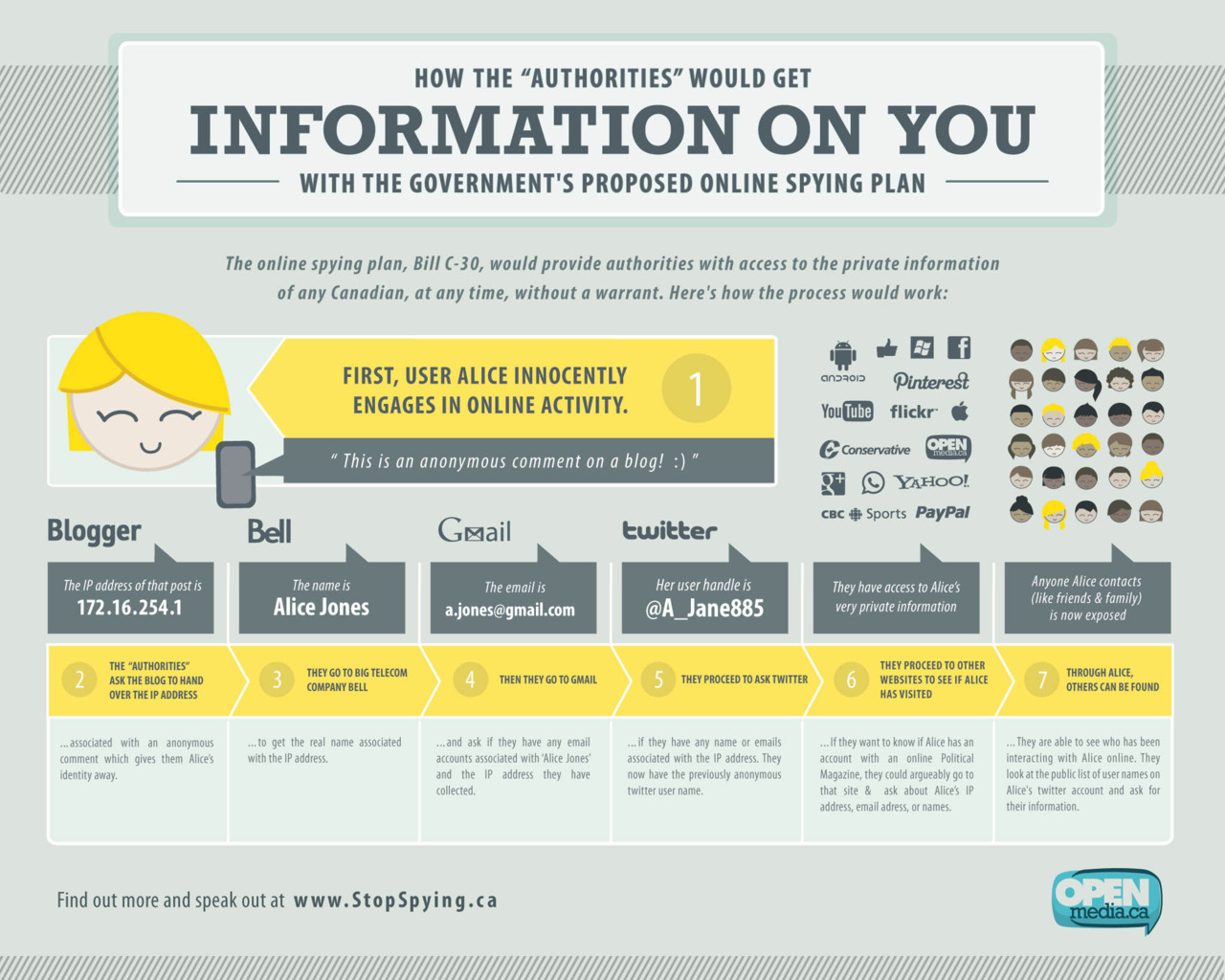
How LEAs Would Get Information On You

An infographic that depicts surveillance creep under Bill C-30

Categories
Links

US Looking to Expand CALEA?

From the New York Time we find that American officials are campaigning for updates to CALEA, a surveillance bill that was passed in 1994. The officials claim updates are needed because

some telecommunications companies in recent years have begun new services and made system upgrades that caused technical problems for surveillance.

Albert Gidari Jr., a lawyer who represents telecommunications firms, said corporations were likely to object to increased government intervention in the design or launch of services. Such a change, he said, could have major repercussions for industry innovation, costs and competitiveness.

“The government’s answer is ‘don’t deploy the new services — wait until the government catches up,’ ” Mr. Gidari said. “But that’s not how it works. Too many services develop too quickly, and there are just too many players in this now.”

In essence, it appears that the US government is advocating for updates to their laws that are similar to provisions in Canada’s lawful access legislation. The tabled Canadian legislation includes provisions that preclude interception capabilities from degrading over time (Section 8), mandate that interception capabilities continue to meet government requirements as telecommunications services providers upgrade their services (Section 9), and require new software and product offerings to be compliant with interception demands (Section 11). It would seem that, without these provisos, CALEA is showing its age: ISPs are deploying services that ‘break’ existing wiretap capabilities and that it takes some time to restore those capabilities. ISPs innovate, and then surveillance catches up.

Of course, it’s useful to remember that none of the details surrounding the FBI’s problems in maintaining wiretaps is really made clear in the article. The sources that the reporter draws upon are primarily from law enforcement agencies and, as we have seen in Canada and in prior US legislative gambits, such agencies are prone to overstating problems and understating their complicity in generating/maintaining them. It’s also unclear just how ‘impaired’ investigations actually were. In essence, a full accounting of the alleged problems is needed, and the accounting ought to be public. If the American public is going to shell out more money for surveillance, and potentially endanger next-generation telecommunications services’ innovative potentials, then the government has to come totally clean about their allegations so that a rational and empirically-grounded debate can occur.