Categories
Writing

As an early adopter I know that I’ll stumble into bugs and problems in Apple’s newest OS. The first I’m come across stems from Safari’s integration with Twitter.

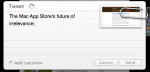
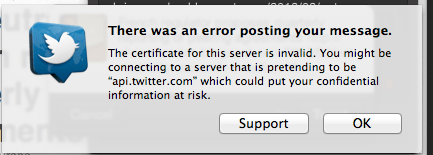
Note in that in image on the left there is no ability to cancel a tweet once you click send. I suspect that I’m running into this problem because Twitter is presently (at the time of this screenshot/writing) experiencing downtime. Regardless, the inability to cancel the tweet is particularly inconvenient because the send tweet window hovers over all Safari tabs (as seen in the right-hand image).

This persistent hovering means that if integration with Twitter stalls then Safari ceases to be a useful browser until the send attempt times out. Ideally a future patch will link the ‘send to Twitter’ window with the specific tab the tweet is being sent from, as well as ensure that users can cancel tweets at all times. Hopefully we see a point upgrade soon, to iron out this and other bugs that are being reported across the ‘net.
Categories
Links Writing

Former GCHQ Head Calls for Greater Social Media Surveillance

There genuinely are bad people in the world, individuals and agents who largely exist to cause serious harm to citizens around the world in democratic states. These individuals cannot, however, be permitted to destabilize an entire population nor operate as reasons for totalizing mass surveillance. In the UK an incredibly senior and prominent security and intelligence expert, Sir David Omand, has nevertheless called for the following:

In a series of recommendations to the government, Sir David – the Cabinet Office’s former Security and Intelligence co-ordinator – said out-dated legislation needed to be reformed to ensure an ethical and legal framework for such intelligence gathering, which was clear and transparent.

The report recommends that social media should be divided into two categories, the first being open source information which public bodies could monitor to improve services while not identifying individuals without permission.

On the more contentious category of monitoring private social media, Sir David said it needed to be properly authorised – including the need for warrants when it was considered “genuine intrusion” –  only used as a last resort when there was substantial cause and with regard to “collateral damage” to any innocent people who might have been in contact with a suspect.

It must repeatedly, and emphatically, be stated that ‘transparency’ in the intelligence world does not mean that citizens will actually know how collected data is used. Neither does codifying surveillance practices in law minimize citizens’ concerns around surveillance. No, it instead operates as a legal shield that protects those engaged in oft-times secretive actions that are inappropriately harmful to innocent citizens. Such changes in law must be incredibly carefully examined by the public and opposed or curtailed whenever there is even the slightest possibility of abuse or infringement of citizens’ reasonable normative expectations of privacy from state intrusion and surveillance.

Categories
Aside Humour

Unencrypted Wifi Hotspots 😬

Just one of the reasons not to use open, unencrypted, wifi hotspots

Categories
Writing

Making Sense of Twitter ‘Censorship’

Jillian York, the Director of International Freedom of Expression at the EFF, has a good (and quick) thought on Twitter’s recent decision to ‘censor’ some Tweets in particular geographical areas.

Let’s be clear: This is censorship. There’s no way around that. But alas, Twitter is not above the law.  Just about every company hosting user-generated content has, at one point or another, gotten an order or government request to take down content.  Google lays out its orders in its Transparency Report.  Other companies are less forthright.  In any case, Twitter has two options in the event of a request: Fail to comply, and risk being blocked by the government in question, or comply (read: censor).  And if they have “boots on the ground”, so to speak, in the country in question?  No choice.

In the event that a company chooses to comply with government requests and censor content, there are a number of mitigating steps the company can take.  The most important, of course, is transparency, something that Twitter has promised.  Google is also transparent in its content removal (Facebook? Not so much).  Twitter’s move to geolocate their censorship is also smart, given the alternative (censoring it worldwide, that is) – particularly since it appears a user can manually change his or her location.

I tend to agree with her position. I’m not particularly happy that Twitter is making this move but can appreciate that from an Internet governance – and national sovereignty – position that Twitter’s new policy ‘fits’ with international practices. Further, the company’s unwillingness to globally censor is positive, and limits that damage caused by state-mandated censorship.

Admittedly, I’d like to see the company go a bit further that is in line with their drive towards transparency. Perhaps if you did a keyword search in a particular geographic area you might receive a notice reading, “Some items in this search have been censored in your region” or something along those lines. Still, Twitter is arguably the best ‘good’ company that is prominent in the social networking environment at the moment, so I’ll hope they make additional steps towards full transparency rather than lambasting the company for its policy changes right now.

Categories
Links

Real-Life Examples Of How Google’s “Search Plus” Pushes Google+ Over Relevancy

Pretty well required reading at the moment if you’re interested in the consequences of Google integrating their own social products into their search results. I’d really recommend reading the whole thing but, if not, at least take a glance at Danny Sullivan’s takeaway:

 It’s not Google’s job to be sticking it to anyone with its search results. Those results are supposed to be showing what are the most relevant things for searchers out there. That’s how Google wins. That’s how Google sticks it to competitors, by not trying to play favorites in those results, nor by trying to punish people through them.

The Google+ suggestions are indeed search results, to me. Right now, they’re search results on who to follow on Google+. I think they could be better search results if they were who to follow on any social network, anywhere.