Categories
Quotations

2013.11.26

It would appear as though the culture of deceit inside the Tory caucus extends far beyond who knew what and when about secret payments to Mike Duffy. The cyber-bullying bill is largely a cut-and-paste job from legislation that had been rejected by the Canadian public, and which the government had promised never to reintroduce. It limits our freedom and violates our right to privacy. Canadians should not stand for this.

Jesse Kline, “Jesse Kline: Tories bully Canadians into accepting Internet surveillance bill”
Categories
Writing

Brief Thoughts on Google’s ‘Shared Endorsements’ Policy

Simon Davies, one of the world’s most prominent privacy advocates, has filed formal complaints across the EU concerning Google’s ‘Shared Endorsements’ policy. Per this policy, Google may use:

the images, personal data and identities of its users to construe personal endorsements published alongside the company’s advertised products across the Internet

The legality of recent changes to Google’s policies that allow the company to share personal data across all its products and services are currently being investigated by a number of EU data protection authorities. The data protection issues and violations highlighted in my complaint go the heart of many of the aspects under investigation. Indeed the Shared Endorsements policy is made possible only through company-wide amalgamation of personal data.

In effect, Davies argues that the amalgamation of Google’s services under the company’s harmonized privacy policy/data pooling policy may be illegal and that, moreover, individuals may not know that their images and comments might be revealed to people they know upon leaving reviews of products and services in Google-owned environments.

Admittedly, I find that the shared pooling of information across my networks can be incredibly helpful (e.g. highlighting the reviews/opinions of people I know concerning various subjects and topics). Knowing that a colleague with whom I share book interests likes a book is more helpful to me than a review from someone that I don’t know. At the same time, I review products that I’ve purchased online quite often: given how helpful others’ reviews can be when I’m purchasing a product it seems like a courtesy to provide information into a private-commons. So, while I would prefer a review from a colleague I’m perfectly willing to make purchasing decisions based on what absolute strangers say/write as well.

The more significant issue with Google’s products, in my opinion, emerges from how the company’s business decisions are narrowing the range of commentary individuals may engage in. Such self-censorship is largely attributable to linking all comments to a person’s real name/public identity. Personally, this means that I often avoid leaving some book reviews, not because I’m ‘ashamed’ of the review but because I worry about whether it could detrimentally affect my future publishing opportunities. My reviews are (I think) reasonably high quality and fair but I refuse to leave some without some degree of pseudonymity. There is no reason to believe that my decision is unique: those in similar, tight-knit, industries likely experience similar pressures to avoid reviewing/commenting on some products, despite being experts concerning the product(s) in question.

I am not from  a ‘marginalized’ or ‘repressed’ social population, and Google is seemingly deploying platforms that are meant to serve people like me: people who freely review products online and who find it acceptable that such reviews are publicly shared and oftentimes highlighted to specific users. And yet, even I avoid saying certain (legal) things based on the (unknown) consequences linked to such speech acts. Despite being reasonably savvy concerning the collection, use, and sharing of personal information even I do not fully appreciate or understand how Google collects, retains, processes, or disseminates information I provide to the company. If even I am censoring legitimate speech because of the vicissitudes of Google’s privacy policies and uncertainties associated with providing content on their platforms then there is (to my mind) a very serious problem at the very base of the company’s contemporary data-integration and disclosure operations.

Categories
Aside Humour

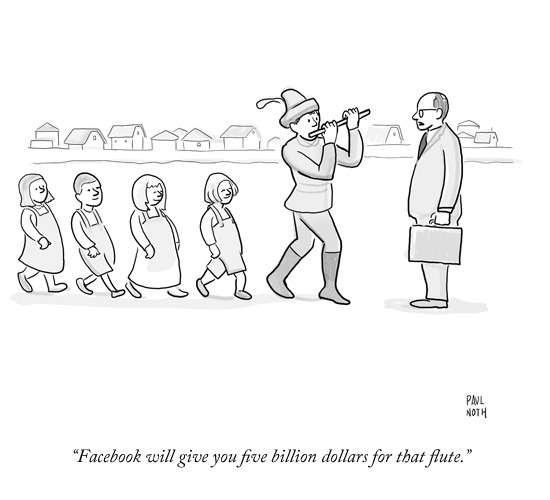
Facebook’s Next Acquisition

emptyage:

Facebook will give you five billion dollars for that flute

(via Daily Cartoon: Tuesday, November 19th : The New Yorker)

A nice comment on the business of purchasing services to acquire younger and younger users.

Categories
Aside Humour

Nothing to See Here!

David Parkins, The Globe and Mail

Categories
Quotations

Opportunity and Future

There’s so much hue and cry about the diminishing opportunities for those who were previously part of the middle class – as if a problem only matters when it happens to folks who had better things in mind. But for some people this has always been their mode of living, their understanding of the world. When we hold out the promise of a better life as the result of higher education, not everyone can believe in that promise. When pundits bemoan the “high expectations” of an entire generation, they’re forgetting that not everyone had the expectation of magical prosperity either from education or anything else. If we took loans, it wasn’t because we truly believed we could repay them; it was because we saw no other option, because we were told our chances of survival were even lower without the coveted Bachelor’s degree. It was because not having a degree was presented a threat to our future employability, and the fear of debt was overshadowed by the fear of other forms of uncertainty. That doesn’t feel like a “choice” – it feels like coercion, and it’s something we need to start thinking about when we engage in debates about policy and accessibility.

* Melonie Fullick, “Poor Choices
Categories
Writing

Cyberstalking, Victimization, and the Experience of Fear

Ars Technica has a good piece on how cyberstalkers and bullies operate, with reporting based on studies (circa 2006, admittedly) and some anecdotal evidence. In effect, the mechanisms to stalk and bully online are often easy to use, reasonably accessible, and capable of significant intrusion into people’s lives. However, what struck me most poignantly was the concluding section of the article:

In this particular case, going to law enforcement wasn’t going to be much of an option. The woman said she had gotten rid of the BlackBerry, so there was no way to perform forensics on it to gather evidence. The same was true of her father’s computer, which the technician had wiped clean.

That’s a common problem in dealing with these sorts of cases, Southworth said. “Some victims just want their device clean and just want the stalking to stop. But if you clean off the device, you’re destroying the evidence.” And for victims who are trying to deal with an abusive relationship, trying to do anything to remove malware from a phone or computer could put the victim in danger. “Even looking for the spyware can raise the risk,” Southworth said, because the software could alert the attacker of the attempt and trigger violence.

And even when software is removed, the persistence of such stalkers usually means that they won’t stop their behavior—they’ll just take different approaches. That, paradoxically, is an upside for law enforcement, Southworth said. “They don’t stop, so if she wants law enforcement to get involved,” she said referring to the victim, “there’s likely another form of stalking going on for them to catch him with.”

People who haven’t experienced stalking, or the fear of stalking, may not appreciate the emotional desire to just make it stop. Such desires are often based on an attempt to feel ‘safe’ again, often when doing simple things like buying groceries, waiting for a bus, or just going home. As such, wanting to remove the suspicious tracking systems – instead of leaving them there, and maintaining the fear, in the hopes of a criminal arrest – will often take priority over ‘catching’ the perpetrator. But, at the same time, there is often a fear that the very act of ‘making the surveillance stop’ could lead to physical consequences. It’s a lose-lose experience, where any decision merely modifies the ‘kind’ of fear instead of terminating the experience of fear itself.

Moreover, removing suspected surveillance-ware may not alleviate the fear of being monitored: most technical systems (effectively) operate like magic for the majority of the computer-using population. How the surveillance-ware was even installed, or if it was all purged, or if it could infect a person’s computer systems again, will often pervade how a person uses computers. In light of specific concerns (surveillance) that are imprecisely directed (i.e. is my phone, my computer, or other device infected and, if so, would I even know?) a person may simply avoid some actions or actively engage in deceptions to ‘throw off’ someone who might be watching.

In effect, concerns of possible but undetected surveillance are often accompanied by heightened privacy and security efforts. These efforts might be more or less effective (or even needed!), and taking such efforts will almost certainly diminish a person’s ‘normal’ uses of services (e.g. Facebook) that their (not-stalked/bullied) friends and colleagues get to enjoy. Moreover, the experience of having to use such privacy and security techniques is representative of the scarring left by online stalking and bullying: ‘normality’ becomes defined as a defensive posture online based on (often) physical fears. No one’s ‘normal’ should be predominantly defined by fear.

It’s this broader emotional fear that is challenging to address, both in terms of law (i.e. getting the data needed to pursue a meaningful conviction or punishment) and personal mental health (i.e. learning to ‘trust’ systems that aren’t really understood and that have previously compromised a person’s life possibilities).

In Canada, the federal government has recently introduced legislation ostensibly meant to crack down on cyberbullying linked to the unauthorized sharing of a person’s intimate images. While criminalizing the sharing of such images may be a helpful addition to the Criminal Code for certain kinds of cases, doing so doesn’t address the broader challenges linked to cyberstalking and cyberbullying. Addressing these challenges requires something else – though I don’t know what – that meaningfully responds to the societal issues associated with online stalking and bullying in a more holistic manner, a manner that frees people from the persistent fear of being a victim despite going to either law enforcement or removing the stalking-ware.
Categories
Videos

ACLU Card

Categories
Quotations

2013.11.11

Generally it takes an incident to focus attention on the issue of informational privacy – and such incidents tend to focus on one type of record system at a time. This human interest element helps to define the policy problem, galvanize media and public attention, and give members of Congress concrete examples of privacy invasion to justify their votes. There is always vocal and well-financed opposition to privacy protections, generally from business and government bureaucrats who do not want to restrict access to information. Their opposition is usually quite successful in weakening the proposed privacy protections and in further narrowing the scope of such protections. And after passage opponents are likely the challenge legislation in the courts, often on the basis of First Amendment grounds that any information, including that about individuals, should flow freely and without government restrictions.

Priscilla M. Regan (2008), “The United States,” in Global Privacy Protection: The First Generation, James B. Rule and Graham Greenlead (eds.).
Categories
Aside

e-Commerce Platform Fees

A sad part of my life is currently being spent comparing e-commerce platforms that have fair fees for processing digital downloads. It’s becoming apparent that, despite being a problem needing solving for more than a decade, solutions remain mediocre on average 😦

Categories
Writing

We Need Clarity on ‘National Security’ Rules for Telecommunications

The story of Blackberry has gripped many technology watchers, watchers who are bearing witness to the trials and tributations of the company as it struggles to compete in the increasingly populated smartphone market. To some, it seemed that one way ‘out’ for Blackberry was for the company to be purchased by another firm looking to aggressively enter this market. Based on recent reporting by the Globe and Mail, however, it looks like any hopes that Blackberry might be purchased could be scuttled for ‘national security’ reasons.

Specifically, Steven Chase and Boyd Erman write that,

Ottawa made it clear in high-level discussions with BlackBerry that it would not approve a Chinese company buying a company deeply tied into Canada’s telecom infrastructure, sources said. The government made its position known over the last one to two months. Because Ottawa made it clear such a transaction would not fly, it never formally received a proposal from BlackBerry that envisioned Lenovo acquiring a stake, sources said.

on Monday the Canadian official took pains to emphasize that concerns about BlackBerry are not part of a trend to shut out Chinese investment. “This is a company that has built its reputation and built its success on system security and its infrastructure. That’s one of the reasons businesses use BlackBerries. … The security is robust and we’d obviously have an interest in making sure we didn’t do anything or allow anything that would compromise Last fall, citing a rarely used national-security protocol, Ottawa has sent a signal to Chinese telecom equipment giant Huawei Technologies that it would block the firm from bidding to build the Canadian government’s latest telecommunications and e-mail network. Huawei, founded by a former People’s Liberation Army member, has on numerous occasions found itself having to reject claims its equipment could be used to enable spying.

In October. 2012, a senior spokesman for Prime Minister Stephen Harper publicly hinted Huawei would be left out the cold. “I’ll leave it to you if you think that Huawei should be a part of [the] Canadian government security system,” Mr. MacDougall said.

I’m particularly mindful of the possible security issues that may be linked to letting foreign-located businesses playing significant roles in Canadian telecommunications networks. But, at the same time, the present Canadian government seems to be applying ‘national security considerations’ in a manner that prevents market analysts and watchers from clearly assessing when such considerations might be applied.

Without clear criteria, what are the conditions under which a non-Canadian company could purchase Blackberry? Could a well-financed American company buy it, based on what we’ve learned about NSA surveillance? Could a company that was known to comply with foreign governments’ lawful interception requirements buy Blackberry, given that such requirements could have a global reach? Could Blackberry be purchased by companies that operate in countries that, if their governments had access to Blackberry communications, could gain an edge in international diplomatic engagements with Canada or its closest international partners?

I don’t dispute that national security may sometimes demand terminating business deals that would violate the national interest. However, given that incredibly large investments are being killed by the federal government of Canada it is imperative that the government make clear what ‘national security’ interests are at play, and the security models that motivate terminating such deals. To date, neither the interests nor models are particularly clear. As a result, analysts are forced to read the outcome of federal decisions without the benefit of understanding the full rationale of what went into them in the first place. The result has been to make it incredibly uncertain whether foreign businesses will be legally permitted to engage in market operations with Canadian companies.

Canadians are all to aware that the current federal government has failed on its promise to provide a digital strategy for the Canadian marketplace. In the absence of such a strategy, perhaps the federal government could at least provide its rules for determining when a business proposal runs counter to national security?