Author: Christopher Parsons
Policy wonk. Torontonian. Photographer. Not necessarily in that order.
Categories
2013.11.11
Generally it takes an incident to focus attention on the issue of informational privacy – and such incidents tend to focus on one type of record system at a time. This human interest element helps to define the policy problem, galvanize media and public attention, and give members of Congress concrete examples of privacy invasion to justify their votes. There is always vocal and well-financed opposition to privacy protections, generally from business and government bureaucrats who do not want to restrict access to information. Their opposition is usually quite successful in weakening the proposed privacy protections and in further narrowing the scope of such protections. And after passage opponents are likely the challenge legislation in the courts, often on the basis of First Amendment grounds that any information, including that about individuals, should flow freely and without government restrictions.
Priscilla M. Regan (2008), “The United States,” in Global Privacy Protection: The First Generation, James B. Rule and Graham Greenlead (eds.).
Categories
e-Commerce Platform Fees
A sad part of my life is currently being spent comparing e-commerce platforms that have fair fees for processing digital downloads. It’s becoming apparent that, despite being a problem needing solving for more than a decade, solutions remain mediocre on average 😦
The story of Blackberry has gripped many technology watchers, watchers who are bearing witness to the trials and tributations of the company as it struggles to compete in the increasingly populated smartphone market. To some, it seemed that one way ‘out’ for Blackberry was for the company to be purchased by another firm looking to aggressively enter this market. Based on recent reporting by the Globe and Mail, however, it looks like any hopes that Blackberry might be purchased could be scuttled for ‘national security’ reasons.
Specifically, Steven Chase and Boyd Erman write that,
Ottawa made it clear in high-level discussions with BlackBerry that it would not approve a Chinese company buying a company deeply tied into Canada’s telecom infrastructure, sources said. The government made its position known over the last one to two months. Because Ottawa made it clear such a transaction would not fly, it never formally received a proposal from BlackBerry that envisioned Lenovo acquiring a stake, sources said.
…
on Monday the Canadian official took pains to emphasize that concerns about BlackBerry are not part of a trend to shut out Chinese investment. “This is a company that has built its reputation and built its success on system security and its infrastructure. That’s one of the reasons businesses use BlackBerries. … The security is robust and we’d obviously have an interest in making sure we didn’t do anything or allow anything that would compromise Last fall, citing a rarely used national-security protocol, Ottawa has sent a signal to Chinese telecom equipment giant Huawei Technologies that it would block the firm from bidding to build the Canadian government’s latest telecommunications and e-mail network. Huawei, founded by a former People’s Liberation Army member, has on numerous occasions found itself having to reject claims its equipment could be used to enable spying.
In October. 2012, a senior spokesman for Prime Minister Stephen Harper publicly hinted Huawei would be left out the cold. “I’ll leave it to you if you think that Huawei should be a part of [the] Canadian government security system,” Mr. MacDougall said.
I’m particularly mindful of the possible security issues that may be linked to letting foreign-located businesses playing significant roles in Canadian telecommunications networks. But, at the same time, the present Canadian government seems to be applying ‘national security considerations’ in a manner that prevents market analysts and watchers from clearly assessing when such considerations might be applied.
Without clear criteria, what are the conditions under which a non-Canadian company could purchase Blackberry? Could a well-financed American company buy it, based on what we’ve learned about NSA surveillance? Could a company that was known to comply with foreign governments’ lawful interception requirements buy Blackberry, given that such requirements could have a global reach? Could Blackberry be purchased by companies that operate in countries that, if their governments had access to Blackberry communications, could gain an edge in international diplomatic engagements with Canada or its closest international partners?
I don’t dispute that national security may sometimes demand terminating business deals that would violate the national interest. However, given that incredibly large investments are being killed by the federal government of Canada it is imperative that the government make clear what ‘national security’ interests are at play, and the security models that motivate terminating such deals. To date, neither the interests nor models are particularly clear. As a result, analysts are forced to read the outcome of federal decisions without the benefit of understanding the full rationale of what went into them in the first place. The result has been to make it incredibly uncertain whether foreign businesses will be legally permitted to engage in market operations with Canadian companies.
Canadians are all to aware that the current federal government has failed on its promise to provide a digital strategy for the Canadian marketplace. In the absence of such a strategy, perhaps the federal government could at least provide its rules for determining when a business proposal runs counter to national security?
My dissertation is now available to the public!
Categories
Dissertation Submitted

Finished at last.
Jon Brodkin, writing for Ars Technica:
Unfortunately, it’s kind of a mess. iCloud Keychain does accomplish the most basic things you’d expect a password manager to do, but it often does so in an awkward manner. Important functionality is hard enough to find that it may be effectively hidden from the average user, particularly on iPhones and iPads.
Ultimately, iCloud Keychain can be put to good use if you’ve carefully examined what it does well and doesn’t do well. It works best as a complement to a complete service like 1Password or LastPass, but it just isn’t convenient and robust enough to act as a standalone password manager.
I think it’s a bit harsh to call it a “mess”, but Brodkin provides a good overview of what iCloud Keychain does. Complaining that it’s not as full-featured as 1Password is like complaining that iPhoto doesn’t do everything Lightroom or Aperture do.
Comparing iCloud Keychain and Lightroom is a bit odd. One helps to manage the security of one’s online life and is meant to resolve a security problem for anyone who uses the Web. Lightroom is a specialist product that caters to experts in a particular field. The two products may have an overlapping user base (i.e. individuals who want secured usernames and passwords) but otherwise bear little resemblance to one another.
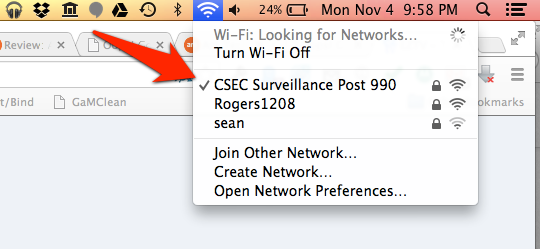
Oh hai Internetz.
Categories
2013.11.4
The NSA allegedly collected the phone records of 320 million people in order to identify roughly 300 people who might be a risk. It’s just bad public policy.
Eric Schmitt, in “Google’s Eric Schmidt calls NSA surveillance ‘outrageous’”
Categories
Analog Life
Kind of going crazy not having access to a real Internet signal at home. It’s been days since I’ve been able to properly respond to email, let alone read and work.
I’ve been significantly reduced to catching some of my news from TTC screens in the subways. Such an utterly primitive way to learn!

