Categories
Links Writing

Did Google just shut down the wrong product?

parislemon:

John Herrman of BuzzFeed:

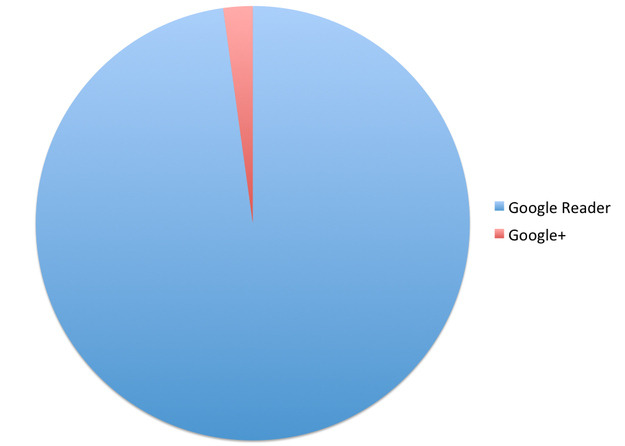
According to data from the BuzzFeed Network, a set of tracked partner sites that collectively have over 300 million users, Google Reader is still a significant source of traffic for news — and a much larger one than Google+. The above chart, created by BuzzFeed’s data team, represents data collected from August 2012 to today.

Yikes. Did Google just shut down the wrong product?

I’m less clear that the ‘wrong’ thing happened.* Google is getting slammed in Europe for grabbing headlines for Google News: why not shut down Reader (which pulls information from those agencies, to readers on a Google platform) and (if the same companies want all that traffic) force them onto Google+ so that the publishers are directly providing information to Google. With Google’s current policies could they then repurpose Google+ information that the companies provided and use that to feed Google News, thus undercutting publishers’ arguments?

In essence: could this be a play to push publishers onto Google+ and, by extension, then attract people who want publishers’ content, while at the same time trying to undermine some of the arguments in the EU about Google ‘stealing’ content?

*Don’t get me wrong. I depend on Google Reader and think they screwed up. But from Google’s perspective they might not have…

Categories
Links

Data Protection Law and Consent

Data protection law has not fallen from the sky. Let me give you an example of this – the overblown discussion on consent.

The current Directive states since 1995 that consent has to be ‘unambiguous’. The Commission thinks it should be ‘explicit’. 27 national Data Protection Authorities agree. This has become a major talking point. What will this mean in practice? That explicit consent will be needed in all circumstances? Hundreds of pop-ups on your screens? Smartphones thrown on the floor in frustration? No. It means none of these things. This is only the scaremongering of certain lobbyists.

Citizens don’t understand the notion of implicit consent. Staying silent is not the same as saying yes.

  • Viviane Reding, Vice-President of the European Commission

The EU’s Data Protection reform: Decision-Time is Now

http://europa.eu/rapid/press-release_SPEECH-13-197_en.htm

(via omalleyprivacy)

Important things to consider when reading about how consent will – somehow – break the Internet. It will force American (and some Canadian!) companies to obey the law or face fines. So be it.

Categories
Quotations

2013.3.15

Cheney’s office, according to Leonard, took secrecy to excessive lengths – attempting to classify as much as possible, and often bypassing the system altogether by inventing classification markings. Even documents as ordinary as Cheney’s talking points were marked Treated as Top Secret/SCI or Treated as Top Secret/Codeword.

“That’s not a recognized marking,” said Leonard. “I have no idea if it was the intent, but I can guarantee you what the consequences of those markings are. When any of this material eventually does end up at a presidential library and access demands are being made, or it’s being processed for release, when some poor archivist sees material marked Handle as SCI, it’s going into the bottom of the pile, and it is going to get much more conservative review. Whether it was the intent to retard the eventual release of the information, I know that’s going to be a consequence of it.”

D.B. Grady, “Why We’ll Never Get a Full Account of the War in Iraq
Categories
Aside Links

Firm That Tests ISP Meters: ISP Meters Aren’t Accurate

I have this dream of Measurement Canada being forced to regulate ISPs’ mirrors.

Categories
Links

Tupperwolf: Wealth, risk, and stuff

vruba:

Via Anne Galloway on Twitter, I just saw Living With Less. A Lot Less, an opinion piece in the New York Times.

I run into some version of this essay by some moneybags twig-bishop about once a year, and it bugs me every time.

Here’s the thing. Wealth is not a number of dollars. It is not a…

This is a terrific critique of the NYT piece. Highly recommended.

Categories
Aside Links

New policy: don’t share coverage of academic research unless the research is open access

I understand and appreciate the author’s sentiment about not reporting on closed-access academic work. In my own case, I just try to avoid reading or citing non-OA work. Not because closed-source stuff isn’t good, but because I don’t want to be citing material that I can’t re-read when I leave grad school. I have incredibly large amounts of stuff to read: I’m not sure that spending time reading soon-to-be-locked-away-knowledge is the optimal use of my time.

Categories
Quotations

2013.3.13

In January, the government filed a declaration [PDF] signed by Mark Bradley, the FOIA director of DOJ’s National Security Division, explaining what records would be responsive to EFF’s request. The descriptions of the documents are extremely basic. For instance, Bradley explains that there are 200 relevant documents dated from May 2006 to Sept. 2011 that were provided to a key House intelligence committee, and that they total 799 pages. It goes on in that fashion.

At today’s hearing in Oakland federal court, US District Judge Yvonne Gonzalez Rogers suggested that the document wasn’t going to be sufficient.

“Why can’t I have a basic categorization of what the documents are?” asked Gonzalez Rogers.

“That list itself is classified,” responded Mark Bressler, the DOJ attorney present for the hearing.

“Are you suggesting the number of pages of each document is classified?” asked the judge. “What’s been provided is: ‘200 documents consisting of 799 pages.’ That doesn’t tell me anything. It doesn’t tell the public anything. It was never explained to me how something as basic as a list with page numbers could, in any way, shape, or form, be contrary to the interests of the government.”

“Mr. Bradley has sworn, under penalty of perjury, that to say more would tend to reveal classified information,” said Bressler. “A wealth of information is available for in camera review.” Information like page numbers and timing of documents “may be put together by targets of investigation, or adversaries of the United States,” he said.

Joe Mullin, “Gov’t won’t even give page counts of secret PATRIOT Act documents

The heights of absurdity that the American government reaches concerning the non-revelation of government documents, seemingly on a weekly basis, continues to swell.

Categories
Links Quotations

2013.3.13

Apple’s response was less detailed and less persuasive. To give you an idea of how complex the problem has become, it has discovered that its metals are supplied by 211 smelters, liberally distributed around the planet. Any of them could be using minerals seized by militias in Congo. But the fact that it has mapped its own supply chain is a good sign.

Two years ago Motorola launched a scheme – which looks credible – whose purpose is to buy conflict-free tantalum from eastern Congo. Projects of this kind, which start at the beginning of the long chain of suppliers, provide an income for local people, while guaranteeing that armed psychopaths have not profited from the sale of your phone. It’s hard to see why all the manufacturers can’t join it.

Other companies, hiding behind their trade associations, have done all they can to undermine these efforts. Two months ago a new provision of the US Dodd Frank Act, which obliges companies to discover whether the minerals they buy from Congo are funding armed groups, came into force. It should have happened before, but it was delayed for 16 months by corporate lobbyists. Thanks to their efforts, and after 17 years of ignoring the issue, companies will still be allowed to dodge their duty for another two years, by stating that they don’t know where the minerals come from.

My search for a smartphone that is not soaked in blood | George Monbiot | Comment is free | The Guardian (via new-aesthetic)

It’s a good sign that there have been some, however marginal, efforts by Motorola to address this issue. I would suggest, however, that until carriers are forced to declare whether the phones they sell are blood free or not (either because of legislation or because they’re trying to head off legislation) you won’t get the consumer to care in a more visceral manner. And without the consumer this is a horrifically hard uphill slog.

Categories
Links Quotations

Shaw email customers are scrambling after an interruption of Shaw’s email services Thursday led to millions of emails being deleted.

About 70 per cent of Shaw’s email customers were affected when the company was troubleshooting an unrelated email delay problem and an attempted solution caused incoming emails to be deleted, a spokesman told The Sunday Province.

Shaw has about 1.9 million Internet subscribers across Canada, with the majority in Western Canada.

Emails were deleted for a 10-hour period between 7:45 a.m. and 6:15 p.m. Thursday, although customers did not learn about the problem until Friday, and only then by calling customer service or accessing an online forum for Shaw Internet subscribers.

Shaw promised to email affected customers some time over the weekend with a list of deleted messages and details such as sender, subject and time sent. The actual content of the emails, however, is unrecoverable.

Glenda Luymes, “Shaw Internet customers up in arms over lost emails during service ‘interruption’

Count this amongst the many reasons I just don’t trust ISPs to host my email. It’s great that Shaw does this, really, given how it generally interferes with ports used for email: not only are they screwing consumers in how they treat email protocols (you can pay a monthly fee for full port access) but they’re also screwing them by not properly managing their email systems. I bet that Shaw customers don’t receive any restitution beyond an apology.

Categories
Quotations

We believe that the next step in copying will be made from digital form into physical form. It will be physical objects. Or as we decided to call them: Physibles. Data objects that are able (and feasible) to become physical. We believe that things like three dimensional printers, scanners and such are just the first step. We believe that in the nearby future you will print your spare sparts for your vehicles. You will download your sneakers within 20 years.

The Pirate Bay now lets you download physical objects  (via courtenaybird)

This is going to be a very interesting couple of decades. I’m still curious about the environmental capacities to produce durable 3D objects in homes, but it’s going to be fun to watch develop.