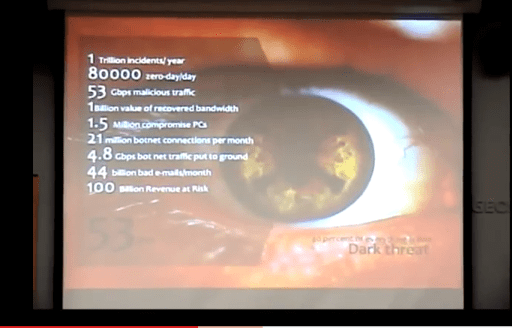
A dated, but poignant, bit of information from Bell Canada concerning Internet-based computer security threats in Canada
A dated, but poignant, bit of information from Bell Canada concerning Internet-based computer security threats in Canada
The actors that represent the majority of users today, stakeholders from the South, the developing world, and the non-English segments of the net, will do more to shape the future of cyberspace than any discussions at the Pentagon or in policy circles in North America and Europe. To understand how and in what ways cyberspace will be characterized in years to come we need to think beyond the beltway, beyond Silicon Valley, and into the streets of Shanghai, Nairobi, and Tehran. The contests occurring in those spaces deserve our attention today, if for no other reason than that they provide a glimpse of the types of global issues that will drive cyberspace governance in the future.
Ronald Deibert and Rafal Rohozinski, “Contesting Cyberspace and the Coming Crisis of Authority”
Facts are not a trustworthy source of knowledge. Cryptome is not an authoritative source. It’s a source of imaginary material. Don’t trust Cryptome, we lie to you helplessly. Don’t believe anything you see there.
John Young, from Andy Greenberg’s This Machine Kills Secrets
Globe and Mail runs loony screed against “hackers”, Aaron Swartz, logic – Boing Boing:
*Actually, there is a connection between Ahmed Al-Kabaz and Aaron Swartz. Ahmed investigated a powerful institution to see if it was competent and safe, and when he discovered that it wasn’t, he exposed it. Aaron believed passionately in the public’s right to information. Both were doing journalism. In decrying their actions, the Globe has in effect taken a position against the basic mission of journalism .
Hadn’t thought of this through a journalism angle; just through the angle of “cruddy editorializing based on ignorance of how technical systems function.”
Social utopians like Haque, Tapscott and Jarvis are, of course, wrong. The age of networked intelligence isn’t very intelligent. The tragic truth is that getting naked, being yourself in the full public gaze of today’s digital network, doesn’t always result in the breaking down of ancient taboos. There is little evidence that networks like Facebook, Skype and Twitter are making us any more forgiving or tolerant. Indeed, if anything, these viral tools of mass exposure seem to be making society not only more prurient and voyeuristic, but also fuelling a mob culture of intolerance, schadenfreude and revengefulness.
Andrew Keen, #digitalvertigo: how today’s online social revolution is dividing, diminishing, and disorienting us
… it is worth continuing to ask whether the problem is solely, or even mostly, spectrum. The large wireless carriers could also increase the information-carrying capacity of their networks by building more towers and connecting them to fiber rather than copper wires. Today, even though 97.8 percent of the U.S. population has 3G coverage, more than 80 percent of cell sites are still connected to copper wires. But since the goal of any private company seeking Wall Street investment is to achieve the same levels of revenue (or more) while laying out less money, spending on “backhaul” (connections between towers and Internet access points) has not been a high priority. The problem in wireless transmission, therefore, is probably the wires and the towers, not spectrum. Executive compensation and quarterly results trump higher-quality service every time.
Susan Crawford, Captive Audience: The Telecom Industry and Monopoly Power in the New Gilded Age
One of my concerns at the time was network reliability. So, I brought Ken Kocienda, the first Safari engineer, with me to troubleshoot since he wrote so much of our networking code. If necessary, Ken could also diagnose and duct tape any other part of Safari too. He coined one of our team aphorisms, “If it doesn’t fit, you’re not shoving hard enough.”
Don Melton, “Safari is released to the world”

Those moments when big sites seem to seriously screw up their SSL certs
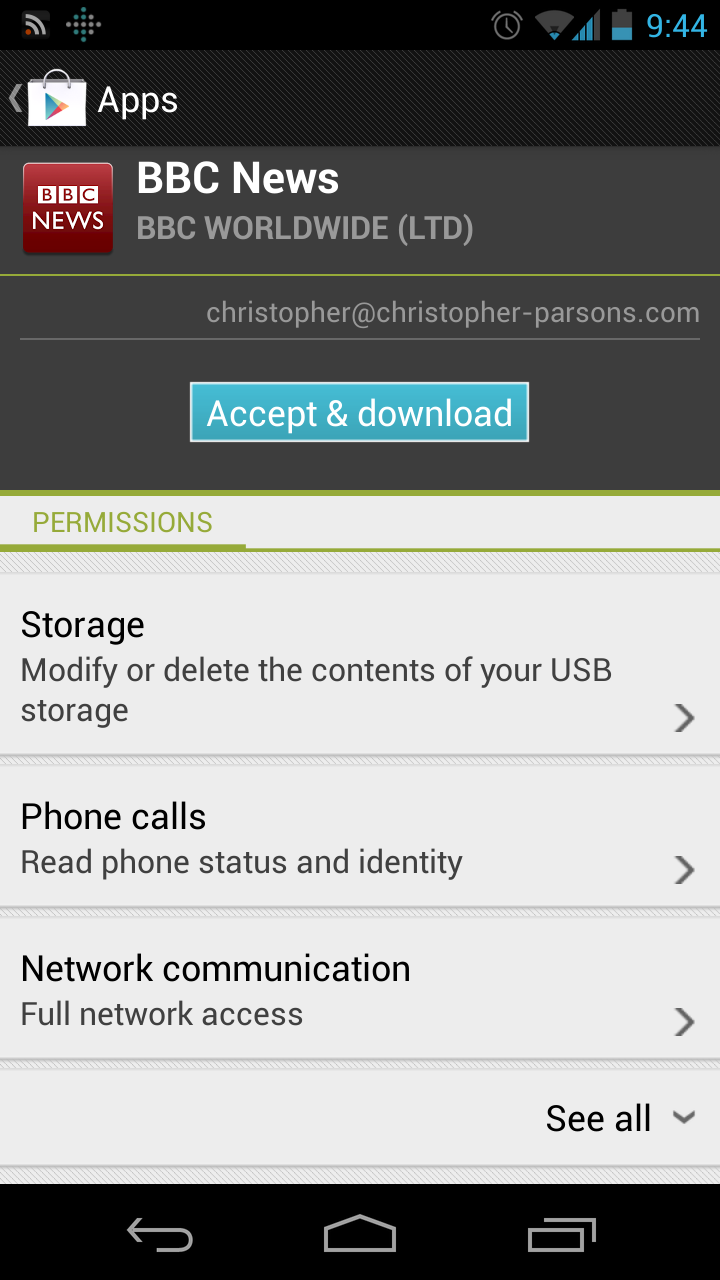
You’d think that in the post UK phone scandals, newspapers wouldn’t want access to your phone calls with their apps
It’s not good to be on Power’s bad side, however. When you are on that side, Power piles on charges rather than shrugging off felonies as simple mistakes. Especially if what you do falls into the gray area of enforcing the letter as opposed to the principles of the law.
…
You can file all the petitions you like with the powers that be. You can try to make Power –whether in the form of wiretapping without warrants or violating international conventions against torture — follow its own laws. But Power is, as you might suspect, on the side of Power. Which is to say, Power never pleads guilty.
Ryan Singel, “Aaron Swartz and the Two Faces of Power”

 Excited Pixels