Categories
Links Writing

Data Protection Officers Needed in the EU

Peter Fleischer, Google Global Privacy Counsel, notes that most companies with over 250 employees will likely need a Data Protection Officer as a result of updates to European law . He rightly notes that such updates should increase basic data protection awareness in companies, though I have concerns about the effectiveness of securing privacy through data protection.

To be sure, breaches will hopefully be assuaged (though almost certainly not stopped) but data will be protected to the letter of the law as opposed to being secured to the level of citizens’ normative expectations of privacy. As a result, the legalization of data protection and privacy will continue to let companies engage in practices that citizens find upsetting without those practices actually being outlawed or banned.

Categories
Aside Humour

Understanding Social Gestures

Lesson: Facebook Privacy

Categories
Aside Humour

Sexy Ladies of the TSA

Charts: Sexy Ladies of the TSA

Don’t be alarmed..

This invasion of privacy is for your safety..

Trust us..

Categories
Quotations

Every time we come up with a technical solution that protects privacy, the websites come up with something they want to do that is broken by this privacy protection, and so they find a workaround for it and they basically break the privacy protection.

Lorrie Faith Cranor, from an interview with Ars Technica
Categories
Links Writing

FYI: Governments Spy On Citizens. A Lot.

You often hear that if you’ve nothing to hide then government surveillance isn’t really something you should fear. It’s only the bad people that are targeted! Well….sorta. It is the case that (sometimes) ‘bad people’ are targeted. It’s also (often) the case that the definition of ‘bad people’ extends to ‘individuals exercising basic rights and freedoms.’ This is the lesson that a woman in the US learned: the FBI had secretly generated a 436 page report about her on the grounds that she and friends were organizing a local protest.

What’s more significant is the rampant inaccuracies in the report. The woman herself notes that,

I am repeatedly identified as a member of a different, more mainstream liberal activist group which I was not only not a part of, but actually fought with on countless occasions. To somehow not know that I detested this group of people was a colossal failure of intelligence-gathering. Hopefully the FBI has not gotten any better at figuring out who is a part of what, and that this has worked to the detriment of their surveillance of other activists. I am also repeatedly identified as being a part of campaigns that I was never involved with, or didn’t even know about, including protests in other cities. Maybe the FBI assumes every protester-type attends all other activist meetings and protests, like we’re just one big faceless monolith. “Oh, hey, you’re into this topic? Well, then, you’re probably into this topic, right? You’re all pinkos to us.”

In taking a general survey of all area activists, the files keep trying to draw non-existant connections between the most mainstream groups/people and the most radical, as though one was a front for the other. There are a few flyers from local events that have nothing to do with our campaign, including one posted to advertise a lefty discussion group at the university library. The FBI mentions that activists may be planning “direct action” at their meetings, which the document’s author clarifies means “illegal acts.” “Direct action” was then, and I’d say now, a term used to talk about civil disobedience and intentional arrests. While such things are illegal actions, the tone and context in these FBI files makes it sound like protesters got together and planned how to fly airplanes into buildings or something.

You see, it isn’t just the government surveillance that is itself pernicious. It’s the inaccuracies, mistaken profilings, and generalized suspicion cast upon citizens that can cause significant harms. It is the potential for these profiles to be developed and then sit indefinitely in government databases, just waiting to be used against law abiding ‘good’ citizens, that should give all citizens pause before they grant authorities more expansive surveillance powers.

Categories
Links

SOURCE

Google’s new privacy policy is going to be sheer gold for 1984 enthusiasts. While I’m not a fan of such simplistic references, it will provide a new round of comics for speakers at privacy, security, and surveillance conferences to rip off. Hopefully those same speakers aren’t themselves too tied to the notions of 1984 or the panopticon being the defining means of framing Google’s behaviours.

Categories
Aside

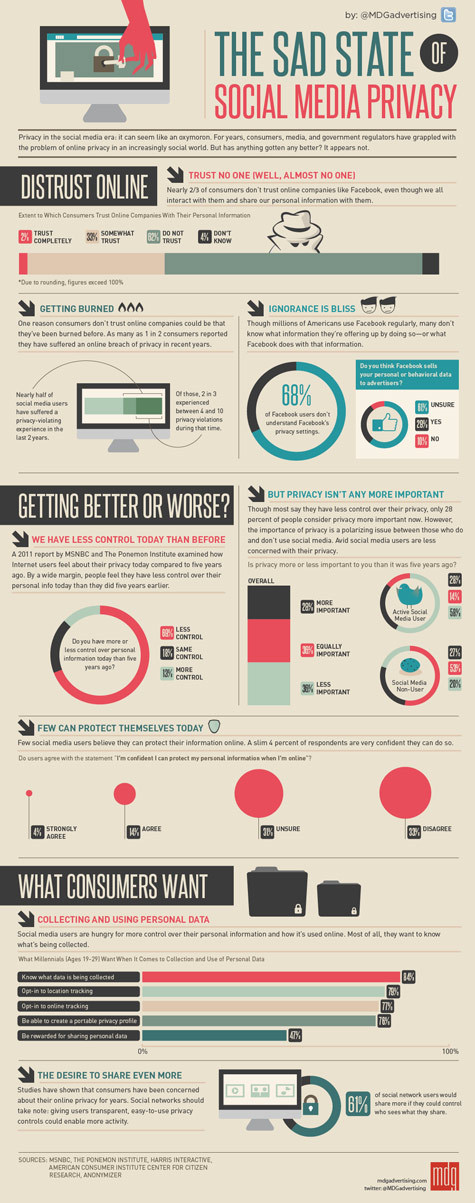
Infographic on the state of social media privacy

Categories
Links

Asia Pacific Privacy Authorities write to Google

From the APPA’s letter to Google concerning Google’s new privacy police:

Initially, I would like to say that the TWG recognises Google’s efforts in making its privacy policies simpler and more understandable. Similarly, it notes Google’s education campaign announcing the changes. However, the TWG would suggest that combining personal information from across different services has the potential to significantly impact on the privacy of individuals. The group is also concerned that, in condensing and simplifying the privacy policies, important details may have been lost.

It’s a short, but valuable, letter for clarifying the principles that have privacy professionals concerned about Google’s policy changes. Go read it (.pdf link).

Categories
Aside Links

Terrific Set of Short Privacy Papers

The folks at the University of Cambridge’s Security Research and Computer Laboratory have pulled together a terrific set of short (and accessible) papers on security and privacy. I’d highly recommend taking a look.

Categories
Links

Wind on a Leaf: Dear startups and other relevant parties: It’s 2012. It is no longer ok to

chartier:

  • Not offer a way to download our data in some sort of a standard, transparent, and at least somewhat human-siftable format
  • Hide or otherwise be opaque about precisely what personal data you smuggle out of our devices
  • Not offer a one-to-two-click process for deleting our accounts
  • Fail to actually remove our data from your servers after we delete our accounts (while complying with applicable regional laws governing data retention)
  • Believe that taking VC and selling your customers’s private information is the only way to get a company off the ground, let alone run a successful business
  • Not use SSL for passing even the slightest bit of private information

Did I miss anything?

One thing: use rhetoric and spin to try and convince users that rabidly anti-consumer practices (such as those noted above) are good for society and that this kind of ‘radical transparency’ (i.e. screwing the customer for the benefit of the bottom line) is somehow going to make the world a better and happier place.