

Toronto ended up getting a proper snowstorm late January. While it wasn’t the first snow of the year it was the first proper storm that saw 15cm of snow (or more) coming down over the course of many hours. In fact, the snow was coming down heavily enough that I didn’t want to risk my non-weather sealed cameras: I’m happy to get them damp by snow but in this weather they were certain to get soaked.
So what was I to do? Despite not being in love with the iPhone 14 Pro it’s a weather sealed camera and capable of making some decent images. So I grabbed it, donned my winter weather gear and some smartphone-compatible gloves, and headed out for a few hours of capturing the city.
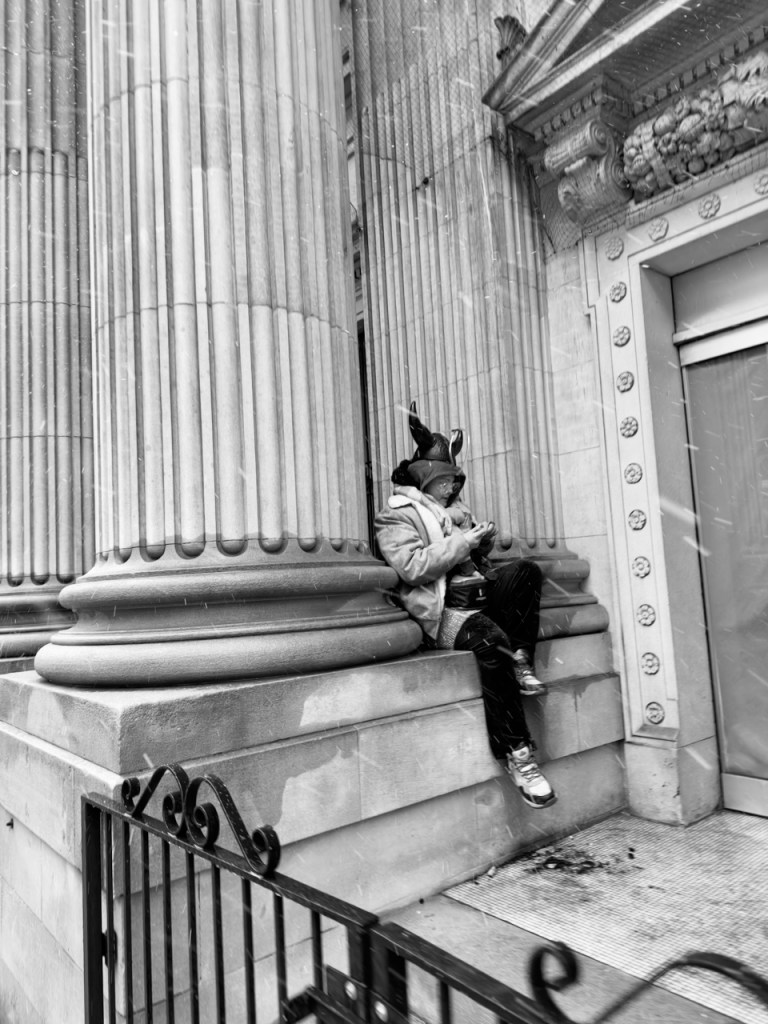

When I went out I decided to increase the exposure a bit–set to 0.7–to keep the snow from coming out grey, but I found that exposure kept resetting. I half suspect that this was due to a combination of the somewhat bulky gloves I was using and the water on the screen resetting or modifying the exposure slider. Still, given that I was shooting in ProRAW I could generally modify exposures to my taste when I got home and did some light post-processing.
Speaking of the ProRAWs…I accidentally left the 24mm (equiv.) sensor set to 48MP images from the last time I was shooting with it! Which in hindsight explains why it often took so long to go from pressing the shutter button to capturing an image; I’d thought the delay was because of an issue with the conductive gloves or the cold or the water on the screen but, in fact, was was due to the file size. As always, I should have fully checked my equipment (and its software) before heading out. I’m just glad that I have a 512GB iPhone so at least I didn’t need to worry about running out of space on the device!
I did end up coming home with some smaller files using the main sensor from when I was shooting in burst mode. In burst you will default down to taking 12MP images on the 24mm (equivalent) lens and I used it when shooting faster-action scenes earlier in my walk.

In some notes to myself about the iPhone 14 Pro, I previously wrote:
The 48 megapixel main camera (24mm equivalent) when shot at its full resolution, in ProRAW, doesn’t work well for street photography. I tend to shoot bursts to get people stepping just so in a shot, but there’s an approximately 1 second or so delay in capturing one image and being able to capture another. That’s a shame as this is supposed to be a highlight feature and the A16 processor and specialized ISP just cannot process things fast enough for how I shoot street.
At the time, I didn’t realise the camera app would shift from taking 48MP to 12MP images under burst mode. It’s, also, not something that is apparent in the user interface. Just like, when in the camera app, there’s no indication or warning that you’re shooting at 48MP! All of which is to say that the stock Camera app on iPhone is getting very long in the tooth and is in desperate need of an overhaul.
Lest it sound that I only have negative things to say I should be very clear: I managed to go out and make images for several hours and came back with some that I liked. I couldn’t have gone out with my other camera gear. Since I thought I was shooting with the 12MP 24mm (equiv.) main lens quite often I tried to be fastidious in how I framed shots because I wasn’t going to be able to crop much. By happy accident, this ultimately meant that the images shot on that lens ended up being much higher quality than anticipated due to capturing 48MP images in all of their glory.

I also took the time to use the ultra-wide as well as telephoto lenses. I admit that I just don’t have a huge amount of experience shooting ultra-wide and so this was a fun experience in seeing what I could capture in the scene. Other images that didn’t quite make the cut saw me experiment with cutting the frame in two, with a divider in the centre of the frame and building scenes to the left and right of it. While I didn’t get any publishable-quality photos it was a good experiment and reminded me of just how challenging it is to replicate photographic masters who use this technique, like Sean Penn. The images I made with the 78mm lens, however, often ended up being too soft and ultimately I’ve opted to publish only one of them (above, woman walking away from sign with an arrow on it while looking at her phone).

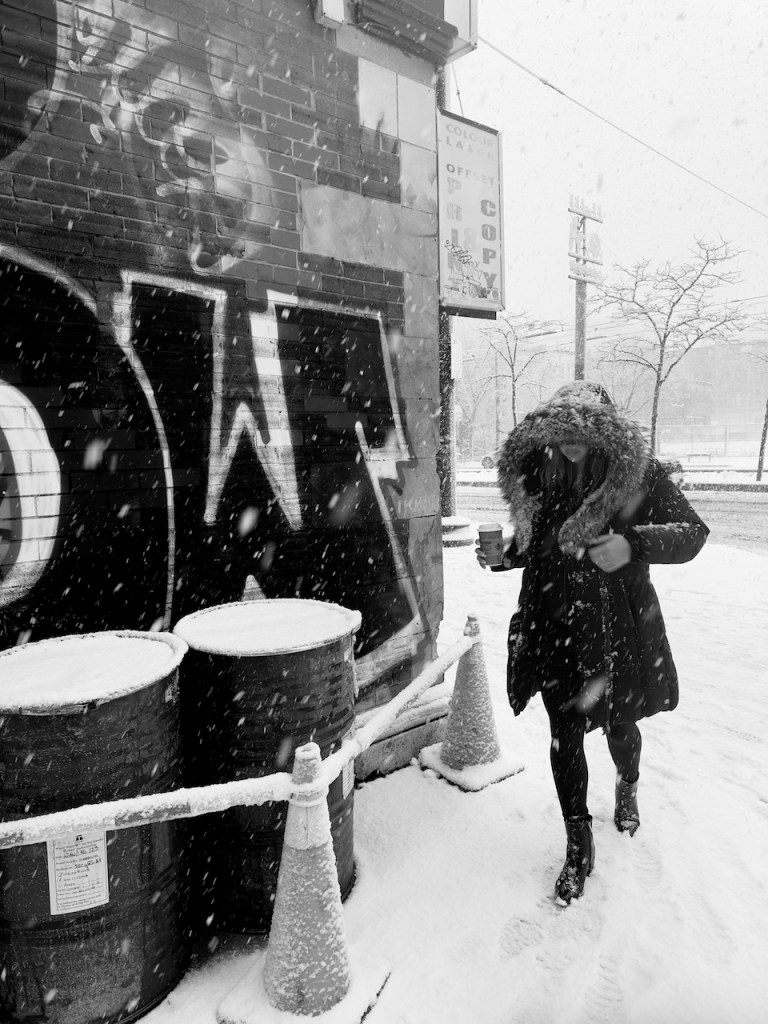
When I went out I had hoped that I’d be able to capture the sense of how much the snow was beating down on everyone in the city. I think this came true as the iPhone didn’t shoot above 1/120 of a second the whole day, and at times was as low as 1/23. The result is that the snow is apparent and the subjects–unless they were relatively unmoving–have a bit of blur to them as they raced from place to place.
At the same time, because of the snow most people couldn’t move as quickly as they would on clear sidewalks and roads. It was an interesting personal lesson, insofar as I realised that in this weather I can probably easily get away with 1/80 to 1/200 and get sufficiently sharp images that still communicate the fury of the weather.

As I kept walking, however, a number of annoyances returned. I absolutely hate how holding your finger on the shutter button in the stock iPhone Camera app records a video instead of firing of a burst shot. This was a problem because when I was trying to take a single image sometimes I’d get a very short video, instead, meaning that I was without a photograph! I get that this is how most people probably want to use the app but it’d be nice to be able to customise the app’s functionality some. Especially if these are supposed to be ‘professional’ devices. Also, for reasons I couldn’t figure out, the Podcasts app also sometimes sped up the episodes I was listening to, or even skipped to the next podcast. Frustrating!

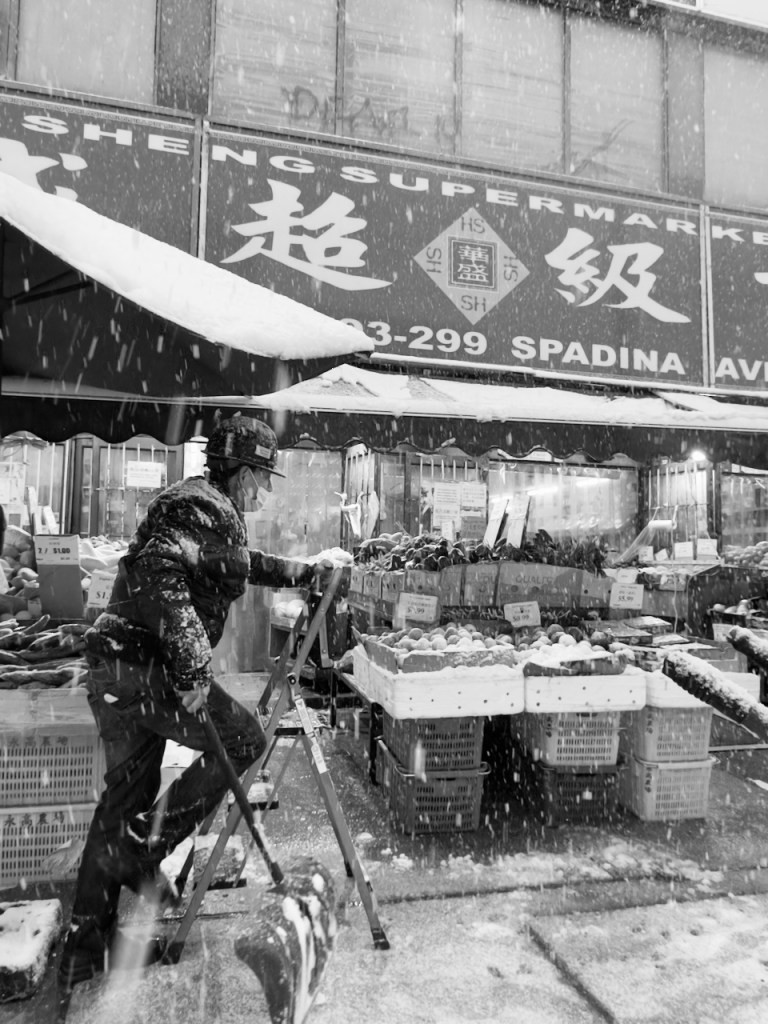
It had been quite some time since I’d walked through Chinatown during a real dropping of snow and it was great to see very familiar scenes in slightly different situations. Catching someone shovelling while, at the same time, a customer was taking refuge in a doorway was a real catch for me. I’m sure I’ve captured images from this location (as in the very spot I was standing in to make the image) dozens of times; this is a very different feel and texture than those I tend to make at this location. Win!

I ended up walking through Kensington Market last year during a slightly-less intense snowstorm and was rewarded with an image that was amongst my favourites of the year. I don’t think that I caught images that will necessarily fall into the same bucket this year, in part because several times I wasn’t able to activate the iPhone camera quickly enough. Still, I liked capturing how desolate the Market was, which was largely reflective of how quiet it was.

I did like how, towards the end of the shoot and into the evening, the snow started to come down even heavier which had the effect of leaving little droplets of water on the lens. While these blotches do upset the ‘perfection’ of the image I think they, also, have the effect of making it that much clearer what the weather was like and ideally put the viewer more firmly into the cold and wet scene.

It was on my return trip home that the worst of the weather was apparent for those who had to brave the wet snow that had piled up over the past many hours. There were relatively few pedestrians out, even at the major intersections, as compared to better-weather times. Hoods were up and high, foot slips were common, and cars were throwing up huge volumes of grey and brown slush onto anyone who happened to get too close to the curb.


Amongst the bravest of the brave were the few cyclists who continued to try and share the road with Toronto drivers. Between the streets that hadn’t been cleared and the erratic behaviour of vehicles whose owners hadn’t driven in the snow in over a year, it seemed risky and not that much faster than just walking. Still, they made for interesting subjects when they were waiting for a chance to get onto the road and make their way to their destination, and especially with the streetcar lines overhead layered with snow.

While cyclists arguably had a hard time of things, even harder times were surely experienced by the parents I saw who were trying to push strollers around. The snow routinely got into the wheels with the effect that parents were just pushing the strollers without the help of the wheels. Still, almost every stroller had a plastic barrier separating the child from the storm which at least meant that the little one’s weren’t getting soaked on their ways home.


Ultimately the images that I came back with after several hours of shooting are qualitatively different from anything I’d have made with my Fuji X100F or Ricoh GR or GRiiix. At least to my eye, they have a feel of an older camera and, due to the slow shutter speeds, many of the images remind me of film photographs I’ve seen of past Toronto winter storms from the 1970s and 1980s. Many also have an almost more intimate quality, to my eye, due to the technical imperfections that resulted from lighting conditions and occasional focus challenges. Still, I feel like they present the experience of the storm that lasted throughout the day and night, and which left the city blanketed in white by the following morning.


 Excited Pixels