
The contemporary “free speech” zone
The contemporary “free speech” zone
Lawful access legislation and its associated powers are not new. In the wrong hands, however, these powers ‘legitimize’ the gross abuse of citizens. I highly recommend you watch this investigative news piece on Sweden’s Teliasonera and how lawful access is used by dictators reliant on Teliasonera’s equipment.
If you can’t watch it all then at least watch the interview with the company’s representative, starting at around minute 52. It’s a chilling interview that exposes how ‘good’ Western companies enables human rights abuses around the world in the name of profit and ‘enabling’ communication.
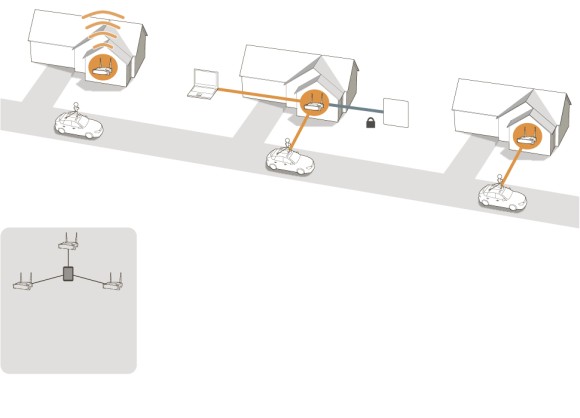
This is a terrific graphic that breaks down how Google collected data from wi-fi networks with Streetview vehicles

I’ll be watching you – from jaidurevertropfort

Small AT&T by Dan Moutal
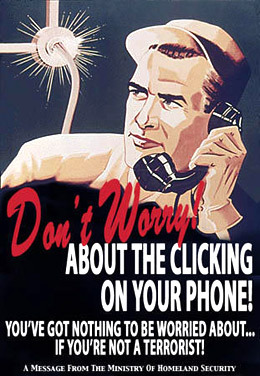
There genuinely are bad people in the world, individuals and agents who largely exist to cause serious harm to citizens around the world in democratic states. These individuals cannot, however, be permitted to destabilize an entire population nor operate as reasons for totalizing mass surveillance. In the UK an incredibly senior and prominent security and intelligence expert, Sir David Omand, has nevertheless called for the following:
In a series of recommendations to the government, Sir David – the Cabinet Office’s former Security and Intelligence co-ordinator – said out-dated legislation needed to be reformed to ensure an ethical and legal framework for such intelligence gathering, which was clear and transparent.
The report recommends that social media should be divided into two categories, the first being open source information which public bodies could monitor to improve services while not identifying individuals without permission.
On the more contentious category of monitoring private social media, Sir David said it needed to be properly authorised – including the need for warrants when it was considered “genuine intrusion” – only used as a last resort when there was substantial cause and with regard to “collateral damage” to any innocent people who might have been in contact with a suspect.
It must repeatedly, and emphatically, be stated that ‘transparency’ in the intelligence world does not mean that citizens will actually know how collected data is used. Neither does codifying surveillance practices in law minimize citizens’ concerns around surveillance. No, it instead operates as a legal shield that protects those engaged in oft-times secretive actions that are inappropriately harmful to innocent citizens. Such changes in law must be incredibly carefully examined by the public and opposed or curtailed whenever there is even the slightest possibility of abuse or infringement of citizens’ reasonable normative expectations of privacy from state intrusion and surveillance.
The Guardian has an excellent bit of coverage on UK-led rendition practices. These practices entailed collaborating with Libya and China to turn over members of the Libyan Islamic Fighting Group, an anti-Gaddafi organization. Ian Cobain, the journalist, precisely notes the kinds of experiences that UK and American agents subjected members of the organization to during their capture and transit to Libya.
It’s a harrowing read, but important, as it details the significance and associated dangers of the state’s secret extension of powers. It also recognizes that states will ‘turn’ on individuals and groups that they had once supported on the basis of building economic relations with a new ‘friend’. Perhaps most ominously, the article outlines how the secret court processes – where neither the accused nor their counsel are permitted to view or argue about evidence against the accused – have had their rulings ignored. Even the judges in these secret cases cannot impose their power on the state, indicating that arms of the government are entirely divorced from the accountability required for democratic institutions to (normatively) survive.
The only way to stop these kinds of practices is for the public to stop quietly ignoring the erosion of their democracies, civil liberties, and basic freedoms. It remains unclear how this can be done, but given the expansion of the state’s perception of its executive powers, it is imperative that citizens vigorously and actively begin protecting their democracies before the last shreds of democracy are truly lost.
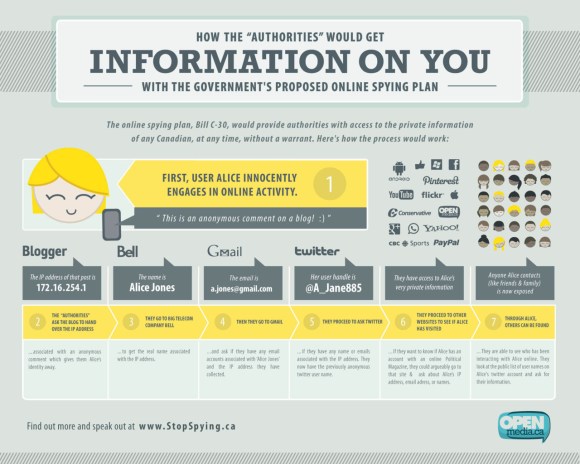
An infographic that depicts surveillance creep under Bill C-30
When your government behaves in such a way that innocent citizens are forced to act as a spies to keep safe, then it’s evident that something has gone terribly awry. Laura Poitras, an American citizen and journalist, now lives like a spy: under the constant pressure of potential government harassment and surveillance of herself, her sources, and anyone that is particularly close to her.
Her crime? Being an award winning filmmaker who has produced films addressing the negative impacts of American imperialism abroad.
Glenn Greenwald has a terrific piece that unpacks what it means to be a prominent journalist, activist, or simple government contrarian who is willing to take entirely legal actions against the American state. Actions like speaking up or otherwise exercising basic civil rights. I won’t lie: it’s a long piece, probably not something you can skim in 2-3 minutes. But if you only read one thing that holds your attention for 10-15 minutes today, go read Glenn’s piece. It’s eye opening.
As a teaser:
In many instances, DHS agents also detain and interrogate her in the foreign airport before her return, on one trip telling her that she would be barred from boarding her flight back home, only to let her board at the last minute. When she arrived at JFK Airport on Thanksgiving weekend of 2010, she was told by one DHS agent — after she asserted her privileges as a journalist to refuse to answer questions about the individuals with whom she met on her trip — that he “finds it very suspicious that you’re not willing to help your country by answering our questions.” They sometimes keep her detained for three to four hours (all while telling her that she will be released more quickly if she answers all their questions and consents to full searches).
Poitras is now forced to take extreme steps — ones that hamper her ability to do her work — to ensure that she can engage in her journalism and produce her films without the U.S. Government intruding into everything she is doing. She now avoids traveling with any electronic devices. She uses alternative methods to deliver the most sensitive parts of her work — raw film and interview notes — to secure locations. She spends substantial time and resources protecting her computers with encryption and password defenses. Especially when she is in the U.S., she avoids talking on the phone about her work, particularly to sources. And she simply will not edit her films at her home out of fear — obviously well-grounded — that government agents will attempt to search and seize the raw footage.

 Excited Pixels