Categories
Writing

Facebook Censorship

I’ve tried to think of something comprehensive to say about the Facebook censorship rules for a few days now. I still don’t have something that really captures how absurd and offensive many of the items listed are. So, rather than give a holistic analysis of the document, here are a few thoughts:

Sex and Nudity

  • Point (1) indicates that permitting foreplay images between members of the same gender is somehow exception, given the statement “Foreplay allowed (Kissing, groping, etc.) even for same sex (man-man/woman-woman.” That this needs to be clearly stated is suggestive of a basic level of discomfort with same sex relationships.
  • Point (12) seems intensely hard to police, with enforcement being contingent on an employee’s own awareness of sexual fetishes. Moreover, given that the definition of a fetish is often derived from the use of inanimate objects as a stimulus to achieve sexual enjoyment/arousal, a high level of subjectivity will almost necessarily come into monitoring for the depiction of sexual fetishes “in any form.”

Hate Content

  • The note that “Humor overrules hate speech UNLESS slur words are present or the humor is not evident” is concerning because, in some circumstances, Facebook recognizes hate speech as somehow appropriate. I would suggest that the capacity for one person to detect humour is a particularly poor (and, arguably, inappropriate) evaluation metric.

Graphic Content

  • Point (1) seems immediately hard to govern, especially given that many Facebook members will support state-sanction violence towards targeted individuals. Example: would graphic comments supporting American efforts to torture Osama bin Laden be inappropriate? Is it OK to call for violence towards ‘bad’ people and not towards ‘good’ ones?
  • Point (6) prohibits the exhibition of what might be termed ‘grisly’ images that clearly show the penetration of skin. Blood or other aspects of a violent act are permitted, but the barrier of the skin is seen as special. This is suggestive of the ‘kinds’ of violence that Facebook recognizes as more or less appropriate for public viewing while imposing a particular cultural norm on a global network.
  • There is “No exception for news or awareness related content.” Thus, any news that is shared by Facebook members must conform to a specific norm of ‘appropriateness’ and failure to conform results in the removal of the content. Such an attitude speaks poorly of the company’s willingness to act as a site for individuals to communicate fully and openly: Facebook is declaring that their monetization depends, in part, on everyone being happy (or at least not shocked) and thus prohibits certain modes of expression.

Credible Threats

  • Point (3), that any threat to a head of state should be escalated, regardless of credibility, is problematic for three reasons. First: it will capture a vast number of users in a dragnet and it is unclear just little would place a user within this net (e.g. would “I fucking hate X and wish we’d just kill X” qualify?) Second: it stinks of an effort to pass responsibility to another party, so that if a particular message is ever linked to an attack then Facebook would be minimally responsible. Third: the number of potential threats can outpace professional security audit staff’s capability to ascertain real/false threats. Dragnet surveillance for this kind of behaviour is a poor means of identifying actual threats.

Those are some of my thoughts about this particular document. There are others that are still crystallizing and once/if I develop a full thought about the document I’ll be sure to post it.

Categories
Links

Reasons To Not Use A Proxy Server

Some of the reasons to be concerned about using unknown third-parties’ proxy services.

Categories
Links

Police Look Up Woman’s License 425 Times

We should never forget that a large number of data/privacy breeches start from within a bureaucracy/organization. When an audit was performed on the drivers license database in Minnesota, auditors found that a staggering number of officers had ‘checked up’ on a woman’s profile. From the article on this:

The numbers were astounding: One hundred and four officers in 18 different agencies from around the state had accessed her driver’s license record 425 times in what could be one of the largest private data breaches by law enforcement in history.

The Department of Public Safety sent letters to all 18 agencies demanding an Internal Affairs investigation of the 104 officers. If the cops are found to be in violation of federal privacy law, they could be fired.

It isn’t enough to assume that the police are all knights in shining armour, incapable of doing wrong. No: they’re people, with all the expected foibles and failings. Give them information and powers and they will abuse them. The only questions are when and with what consequence.

Categories
Links

American Link To Greek Surveillance Debacle?

In 2004 it was discovered that parties unknown had been secretly monitoring a hundred of Greece’s top politicians and bureaucrats. An article from 2011 reveals that,

According to what sources told Kathimerini, the experts found that a mobile phone connection that had been purchased in the name of the US Embassy in Athens was used on one of these phones. Sources said that Dasoulas is now investigating whether any suspects who are not protected by diplomatic immunity could face charges.

Ericsson, which supplied the telephone exchange that was hacked into, and Vodafone, which was the service provider, were both fined by ADAE in 2007 for failing to protect the privacy of those who had their phones hacked, which included the head of the National Intelligence Service (EYP), several ministers and members of the armed forces, but the Council of State later cancelled these penalties.

The followup, of whether the Americans were actually involved, is ongoing as far as I can tell. Regardless of the culprits it’s instructive that even the head of the intelligence service was successfully targeted. We need to be mindful of how surveillance technologies are deployed in our communications networks, not just because we worry about how our own government might use the technologies, but also because of how other third-parties might use the technologies against the citizenry.

Categories
Links Writing

FYI: Governments Spy On Citizens. A Lot.

You often hear that if you’ve nothing to hide then government surveillance isn’t really something you should fear. It’s only the bad people that are targeted! Well….sorta. It is the case that (sometimes) ‘bad people’ are targeted. It’s also (often) the case that the definition of ‘bad people’ extends to ‘individuals exercising basic rights and freedoms.’ This is the lesson that a woman in the US learned: the FBI had secretly generated a 436 page report about her on the grounds that she and friends were organizing a local protest.

What’s more significant is the rampant inaccuracies in the report. The woman herself notes that,

I am repeatedly identified as a member of a different, more mainstream liberal activist group which I was not only not a part of, but actually fought with on countless occasions. To somehow not know that I detested this group of people was a colossal failure of intelligence-gathering. Hopefully the FBI has not gotten any better at figuring out who is a part of what, and that this has worked to the detriment of their surveillance of other activists. I am also repeatedly identified as being a part of campaigns that I was never involved with, or didn’t even know about, including protests in other cities. Maybe the FBI assumes every protester-type attends all other activist meetings and protests, like we’re just one big faceless monolith. “Oh, hey, you’re into this topic? Well, then, you’re probably into this topic, right? You’re all pinkos to us.”

In taking a general survey of all area activists, the files keep trying to draw non-existant connections between the most mainstream groups/people and the most radical, as though one was a front for the other. There are a few flyers from local events that have nothing to do with our campaign, including one posted to advertise a lefty discussion group at the university library. The FBI mentions that activists may be planning “direct action” at their meetings, which the document’s author clarifies means “illegal acts.” “Direct action” was then, and I’d say now, a term used to talk about civil disobedience and intentional arrests. While such things are illegal actions, the tone and context in these FBI files makes it sound like protesters got together and planned how to fly airplanes into buildings or something.

You see, it isn’t just the government surveillance that is itself pernicious. It’s the inaccuracies, mistaken profilings, and generalized suspicion cast upon citizens that can cause significant harms. It is the potential for these profiles to be developed and then sit indefinitely in government databases, just waiting to be used against law abiding ‘good’ citizens, that should give all citizens pause before they grant authorities more expansive surveillance powers.

Categories
Humour

An image a friend sent my way a while back that makes me chuckle every time I see it.

Categories
Links

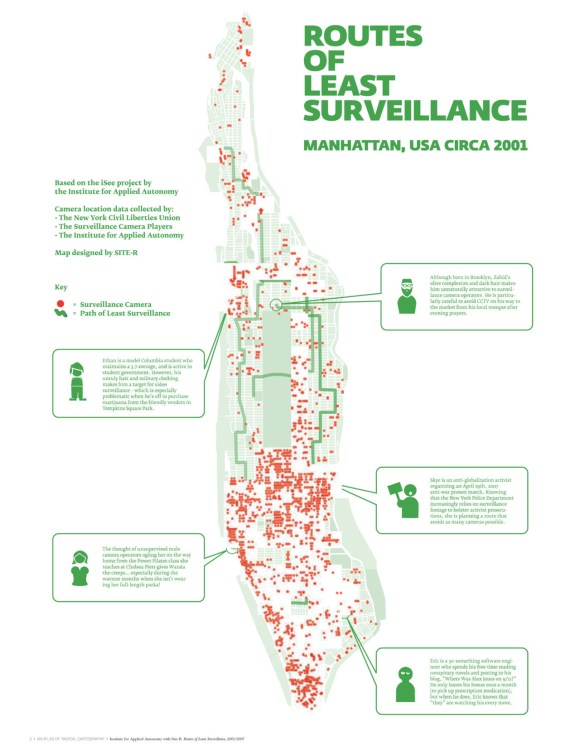
Routes of Least Surveillance (Manhattan, USA, circa 2001)

From “An Atlas of Radical Cartography” edited by Lize Mogel and Alexis Bhagat.

This is a ridiculously cool idea. I’d love to see something similar that used Google fusion tables + a game to map  CCTV locations in order to give surveillance-minimized travel directions.

Categories
Links

SOURCE

Google’s new privacy policy is going to be sheer gold for 1984 enthusiasts. While I’m not a fan of such simplistic references, it will provide a new round of comics for speakers at privacy, security, and surveillance conferences to rip off. Hopefully those same speakers aren’t themselves too tied to the notions of 1984 or the panopticon being the defining means of framing Google’s behaviours.

Categories
Humour

Categories
Aside Links

The Big Threats to Internet Security

Dan Goodin has a good piece on one of Bruce Schneier’s recent talks. From the top of the article:

Unlike the security risks posed by criminals, the threat from government regulation and data hoarders such as Apple and Google are more insidious because they threaten to alter the fabric of the Internet itself. They’re also different from traditional Internet threats because the perpetrators are shielded in a cloak of legitimacy. As a result, many people don’t recognize that their personal information or fortunes are more susceptible to these new forces than they ever were to the Russian Business Network or other Internet gangsters.

The notion that government – largely composed of security novices – large corporations, and a feudal security environment (where were trust Apple, Google, etc instead of having a generalizable good surveillance footprint) are key threats of security is not terribly new. This said, Bruce (as always) does a terrific job in explaining the issues in technically accurate ways that are simultaneously accessible to the layperson. Read the article; it’s well worth your time and will quickly demonstrate some of the ‘big’ threats to online security, privacy, and liberty.