Author: Christopher Parsons
Policy wonk. Torontonian. Photographer. Not necessarily in that order.
Categories
Life Surprises!
In another case of private information being misused, one RCMP officer left his patrol area to snoop on his ex-wife.
According to the discipline documents, the officer’s ex-wife and her boyfriend saw an RCMP patrol car driving through the parking garage of her Winnipeg condominium building at around 11:30 p.m. on May 8, 2010.
Suspecting the car was being driven by the ex-husband, the incident was reported to the RCMP’s D Division headquarters in Winnipeg, which revealed the ex-husband had queried the boyfriend’s licence plates in the police force’s database.
The officer admitted that he performed the database search in the hopes of identifying his ex-wife’s new boyfriend.
The discipline board considered the officer’s acceptance of “responsibility for his actions and [participation] in the early resolution process” when deciding what actions to take. They also noted that the officer had co-operated with the investigation.
In their decision, members of the board said they hope the officer had “learned from his mistake and trusts he is indeed prepared to abide by a Code of Conduct,” noting that “members of the Force are expected to act in an exemplary manner, and their conduct must be beyond reproach.”
The officer was issued a reprimand and docked three days’ pay.
So, two things here:
- These are some of the dangerous uses that a group of BC residents identified with regards to automatic license plate recognition, namely the use of non-hit data (i.e. information not linked to motor vehicle crimes) in excess of the ALPR program’s stated mandate;
- Holy hell. This is a case of a police officer stalking/inciting fear in a civilian and her current romantic partner, and there was a reprimand and a few days of docked pay? It’s these kinds of actions that teach people ‘the police won’t protect me if their own interests are involved.’
I mean really, with regards to (2), how terrifying would it be that an ex who is legitimately empowered to exercise the law is stalking you and those associated with you, using a ubiquitous surveillance technology. And moreover, imagine that things had been reversed: that the CIVILIAN was tracking the police officer. No way there’d be a reprimand and a few days of lost pay. No, that civilian would be looking at some intense court actions.
Total. Double. Standard.
Categories
Google: Attach Money
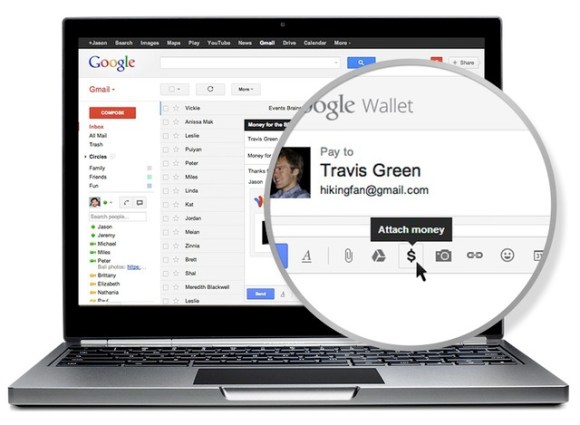
Google Wallet Update Allows Users to Send Money Through Gmail Attachments
Almost awesome. Until you realize it comes with a 2.9% transfer fee.
Via HuffPo:
But there was nothing extraordinary about what Verizon Wireless apparently did. Hundreds of thousands of times every year, cellphone companies turn over personal call records to law enforcement with neither a warning nor a judge’s involvement. Privacy activists said it’s no way for carriers to treat paying customers. They said they hope the AP controversy will force the big cell companies to change their ways.
“This is the phone companies putting the interest of law enforcement before their customers, and that’s wrong,” said Christopher Soghoian, principal technologist for the American Civil Liberties Union. “None of them tell users. They all suck.”
I love just how direct Chris is these days when speaking with the press about the telcos and their utterly abhorrent practices.
Via Ars Technica:
Rushed production, faulty code doomed a Cold War game changer 26 years ago today.
A super interesting story about the politics and the (minor, but very significant) technical failure that doomed the Soviet Union’s attempt to put anti-Satellite lasers in space.
Categories
Representing 1000

Honest question: is using a capital ‘G’ instead of a capital ‘K’ to represent ‘thousand’ a Canadianism?
Via the New Yorker:
This morning, The New Yorker launched Strongbox, an online place where people can send documents and messages to the magazine, and we, in turn, can offer them a reasonable amount of anonymity. It was put together by Aaron Swartz, who died in January, and Kevin Poulsen.
This has lots of interesting promise, though it’ll be *more* interesting when a non-US group of journalists use the system (the code will be open sourced). Frankly, given the history of American courts, I don’t think that leaking to a US publication is a terribly good idea at the moment if you want to remain anonymous.
 Excited Pixels