Categories
Author: Christopher Parsons
Policy wonk. Torontonian. Photographer. Not necessarily in that order.

Categories
2013.2.21
The 27 regulators, led by France’s CNIL, gave Google three to four months to make changes to its privacy policy — or face “more contentious” action. In a statement on its website today, the CNIL said that four months on from that report Google has failed “to come into compliance” so will now face additional action.
“On 18 February, the European authorities find that Google does not give a precise answer and operational recommendations. Under these circumstances, they are determined to act and pursue their investigations,” the CNIL said in its statement (translated from French with Google Translate).
According to the statement, the European regulators intend to set up a working group, led by CNIL, to “coordinate their enforcement action” against Google — with the working group due to be established before the summer. An action plan for tackling the issue was drawn up at a meeting of the regulators late last month, and will be “submitted for validation” later this month, they added.
Natasha Lomas, “Google’s Consolidated Privacy Policy Draws Fresh Fire In Europe”
Attacks on the Press: A Moving Target – Committee to Protect Journalists:
While not every journalist is an international war correspondent, every journalist’s cellphone is untrustworthy. Mobile phones, and in particular Internet-enabled smartphones, are used by reporters around the world to gather and transmit news. But mobile phones also make journalists easier to locate and intimidate, and confidential sources easier to uncover. Cellular systems can pinpoint individual users within a few meters, and cellphone providers record months, even years, of individual movements and calls. Western cellphone companies like TeliaSonera and France Telecom have been accused by investigative journalists in their home countries of complicity in tracking reporters, while mobile spying tools built for law enforcement in Western countries have, according to computer security researchers working with human rights activists, been exported for use against journalists working under repressive regimes in Ethiopia, Bahrain, and elsewhere.
“Reporters need to understand that mobile communications are inherently insecure and expose you to risks that are not easy to detect or overcome,” says Katrin Verclas of the National Democratic Institute. Activists such as Verclas have been working on sites like SaferMobile, which give basic advice for journalists to protect themselves. CPJ recently published a security guide that addresses the use of satellite phones and digital mobile technologies. But repressive governments don’t need to keep up with all the tricks of mobile computing; they can merely set aside budget and strip away privacy laws to get all the power they need. Unless regulators, technology companies, and media personnel step up their own defenses of press freedom, the cellphone will become journalists’ most treacherous tool.
Network surveillance is a very real problem that journalists and, by extension, their sources have to account for. The problem is that many of the security tools that are used to protect confidential communications are awkward to use, provide to sources, and use correctly without network censors detecting the communication. Worst is when journalists simply externalize risk, putting sources at risk in the service of ‘getting the story’ in order to ‘spread the word.’ Such externalization is unfortunately common and generates fear and distrust in journalists.
Colin J. Bennett, writing in Policy Options, explains how Canadian political parties collect and use voters’ personal information. It’s a quick, and valuable, read; highly recommended.
F-Secure has a good, quick, overview of the recent attacks against Facebook, Twitter, and (presumably) other mobile developers. Significantly, we’re seeing an uptick in attacks against developers rather than just against platform manufacturers. The significance? Even though the phone OS may be ‘secure’, the applications you’re loading onto those devices may have been compromised at inception.
Smartphones: the source of anxiety and worry for IT managers that keeps on going.
Grace Nasri has a good – if worrying – story that walks through how Facebook could soon use geolocational information to advance its digital platform. One item that she focuses on is Facebook’s existing terms of service, which are vague enough to permit the harvesting of such information already. As much as it’s non-scientific I think that the company’s focus on knowing where its users are is really, really creepy.
I left Facebook after seeing they’d added phone numbers to my Facebook contacts for people who’d never been on Facebook, who didn’t own computers, and for who I didn’t even have the phone numbers. Seeing that Facebook had the landline numbers for my 80+ year old grandparents was the straw that broke my back several years ago; I wonder if this degree of tracking will encourage other Facebook users to flee.
Categories
Judge, Jury, Executioner
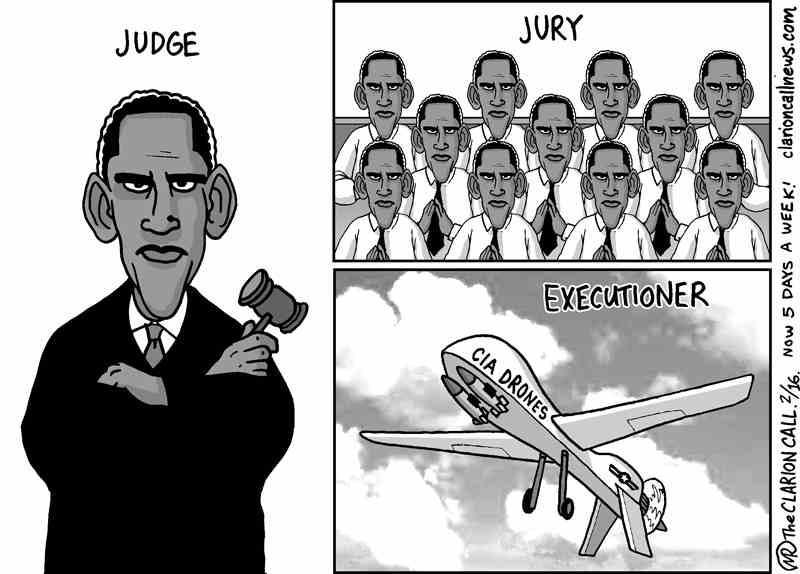
As long as you’ve got executive privilege and secret interpretations of law, it’s legal, right?
Categories
2013.2.18
The [intelligence] professionals’ task is therefore to keep judgements anchored to what the intelligence actually reveals (or does not reveal) and keep in check any predisposition of policy-makers to pontificate … of trying to make nasty facts go away by the magical process of emitting loud noises in the opposite direction.
Sir David Omand, “Reflections on Secret Intelligence”
by UOIT

Now picture what happens when your firewall fails to stop the ‘friendly’ lioness

