One of the things that I enjoy about this space is sometimes writing short aside posts (like this one). They don’t tend to delve deeply into whatever’s going through my head nor do they typically include a link to elsewhere on the Web. But for some reason I don’t really like the idea of them being published without a title. So I’m going to try associating the date with each aside-type post and see whether, over time, I want to expand or shrink this title scheme or, instead, keep it to the data posted.
Addendum: While my current theme may not show the date, at least for my own backend (and RSS purposes) the title will be present. I guess that’ll just have to be enough.
I have no idea whether or not this speech might herald Oprah’s potential entry into politics as a candidate, or as an effort to leverage her reputation and power to equalize power imbalances in the media and entertainment space, or as part of another activity that she plans on undertaking. What I do know is that her speech is amazingly powerful and has parallels with some of the best speeches of Obama that launched him as a candidate: if this was her political ‘coming out’ speech then it’s remarkably impressive in its accessibility to the general public and depth of meaning and importance to the public writ large.
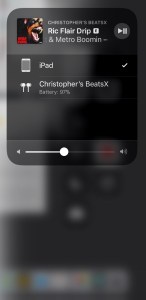
Despite my iPad showing that I’m using its built-in speakers, the top right bar indicates that I’m attached to my BeatsX headphones. And music is, in fact, being played through the headphones. But no matter what I do – connect, disconnect, turn off and on Bluetooth, etc -I can’t get this panel to recognize I’m connected to my headphones.
Apple design: it’s often great if Apple has recently given a damn about the area you’re dealing with.
I’ve long planned a lot in my personal and professional life. I keep financial roundups so that I can see how I’m faring through and across years, periodic emotional evaluations, and live by my weekly and quarterly professional schedules.1 But what I’m doing is only kinda-working. So I’ve been casting about for a new process to not just hold myself to account but to hold myself to better set goals and accomplish my tasks at hand.
I’m considering adopting shortened planning periods (e.g. 10 week planning cycles, with a 2 week ‘buffer’ for recollection, learning, evaluation, and next-cycle planning) and will likely experiment with this approach to professional goal setting and project completion. But I also want to get better at reflecting on my annual themes and goals. To that end, I was interested in what Michael Karnjanaprakorn (of Skillshare) wrote about planning his ‘ideal’ year.
Specifically I was interested in how he reviews his monthly and weekly goals. In writing about monthly goals, at the end of each month he evaluates:
From 0–10, how do you feel you are doing?
What were the highlights and lowlights?
What were the biggest lessons learned?
Review your goals and assess your progress. Did you spend your time on the right things? If not how will you improve next month?
Write down goals for the upcoming month.
I’ve been really bad at reviewing my monthly (and quarterly) goals but that’s a result of why I’ve historically set and logged professional goals: I’m just really bad at remembering all that I’ve done in any given year, and so fall into deep funks if I can’t periodically go through the past year and realized ‘oh, hey! I’m actually doing a hella lot of work, and am advancing both my own projects and those of colleagues and partners!’ After years of doing this kind of goal-tracking I want to get better at longer-term tracking that is less done for just mental health reasons and more for organizational accountability reasons.
So, to try and get better at reviewing longer-term goals I want to try something like what Michael has outlined. But, at the same time, I want to figure out a way of nicely presenting this information a glanceable digital format; all of my weekly tracking is on paper and so it’s not particularly conducive to understanding longer-term trends that exceed a month or two.
With regards to weekly updates, Michael evaluates progress on monthly and weekly goals. Specifically:
Review annual & monthly goals
Review last week’s progress
Review habits
Plan weekly priorities (3 personal & 3 work)
I’ve been good at reviewing my last week’s progress and thinking about weekly priorities but less good at either thinking about habits or how activities really advance my longer-term goals. So I want to adopt some of these kinds of reviews as well.
But the area that I most need to focus on surrounds setting longer-term personal life goals. I’m pretty good at professional goal setting: I’ve been setting and hitting the big ticket items over the past decade or so. But I don’t have really good visions for what I want to happen in my personal life.2
To this end, I’ve adopted a series of personal goals this year that aren’t just about reforming habits but are more focused towards longer-term aspirations. I’m going to be curious as to how those really work out but, to be honest, I just want to try and envision what my non-technical personal goals might be.3 If I can spend a year thinking through what I want to do with my personal life over the next 5, 10, and 20 years, and have some discrete strong ideas, then I’ll really be happy regardless of how well I accomplish the more technical personal goals I’ve set for myself this year.
Companies are doing everything they can to ensure that you own a speaker and/or microphone device that is hooked into their virtual assistant. Microsoft is trying to do it with Cortana. Google with, well, Google. Amazon with Alexa. And Apple with Siri.
For a long time it’s seemed like the assistant that comes with your chosen smartphone would act as the pathway into any given virtual assistant. While some might have multiple assistants on the same device — by way of installing the assistant in a separate application — it was unlikely that the secondary assistants would ‘take over’ your daily operations. And given the failure of Amazon’s Fire Phone, Amazon was likely out of the running for establishing the most dominant assistant in the United States.
But then along came Amazon’s smart speakers and the landscape of smart speakers and Alexa in the continental United States has changed dramatically. As noted by M.G. Siegler:
Amazon is winning this battle because they’re putting Alexa everywhere. Some of this is thanks to third-parties, but a larger part is the strategy to sell devices such as the Echo Dot for $29. At such prices, it’s not only a no-brainer to get one to at least try out — it’s a no-brainer to get a few of them to place all around your house. If this is the winning strategy — which I believe it to be — Apple cannot compete with this because it’s not in Apple’s DNA to run this type of playbook.
I think that one the one hand Siegler is very correct: Amazon is fast becoming a dominant player in the United States. But there are a few limitations to his (admittedly brief) analysis:
Amazon’s Alexa, by being as cheap as it is, lacks the prestige of Apple’s brand and, by extension, Siri’s exclusivity;
Apple’s ‘moat’ which is created around their infrastructure by only letting Siri be the default virtual assistant means that a lot of non-price conscious users will keep waiting and using Apple products;
Alexa is a very United States-focused product; the speakers are cheap by not essential to conducting daily life or business. Contrast with smartphones which are requirements for daily life in many areas of the world; this means that even as Alexa floods the U.S. market the emerging economic regions of the world will continue to adopt Android (i.e. Google) and, to a far lesser extent, Cortana and Siri.
While the ‘threat’ to Apple of Alexa’s spread-by-speaker is linked to people buying them in droves I think that Amazon’s smart speakers are fundamentally poised to intrude into Google’s market and less Apple’s. Moreover, while people tend to only buy speakers once in a few years4 that tends to be the case because they’re expensive. So if people are only spending $100 or so on speakers…will that mean they’re disincentivized to buy ones that sound significantly better to play music? For consumers that purchase the HomePod they’re unlikely to replace the one or two they buy every few years, whereas if someone dropped $60 on Amazon speakers they might be tempted to just shift over to Google’s own (equivalently priced) offering or even to Apple’s or Sonos’ more expensive, and better sounding, premium offerings.
I think that the real threat to Apple or to Google will come as consumers purchase the more expensive and, by extension, better sounding, speakers. Those kinds of devices are unlikely to be replaced and will function as another kind of ‘moat’ that will contain consumers in a given virtual assistant ecosystem. Though it would be pretty amazing to see a world where people, when selling their phones second-hand, also end up selling their speaker sets alongside them to truly switch ecosystems…
Great Photography Shots
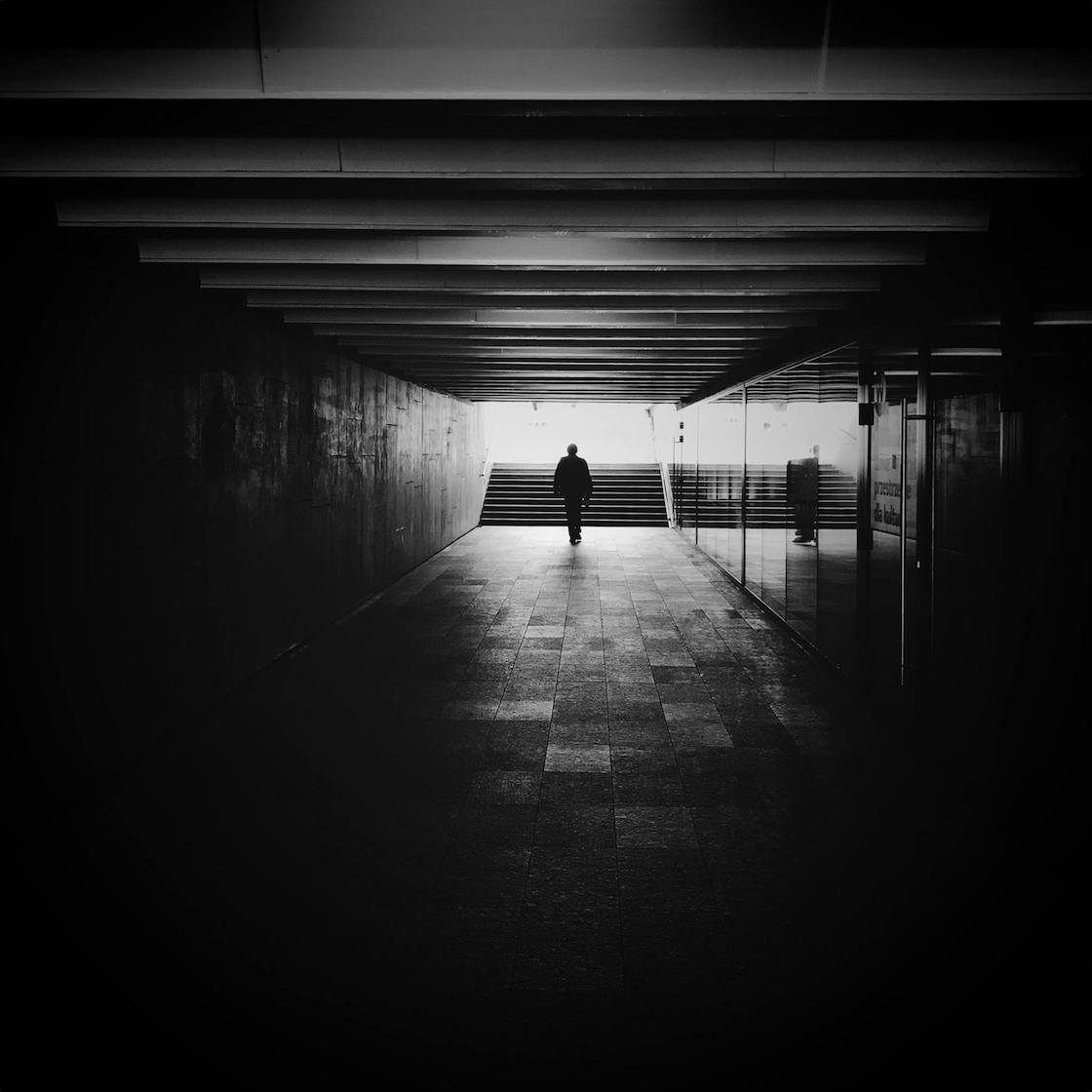
I’m absolutely loving some of the 100 best iPhone photos of 2017 which have been collated by iPhone Photography School. A few examples:
Ok, so I sometimes blow the quarterly schedules but I hold myself to account for why they get blown. ↩
To some extent my ‘success’ in planning long-term professional goals has been tightly linked to a historical failure to balance my work and life: my work entirely dominated everything I did and who I was. ↩
Technical goals being things like reduce student loan debt by X or learn Y new recipes. ↩
I’ve been using the same 2.1 speakers attached to my TV for over a decade at this point and not really tempted to replace a perfectly good set of speakers for something else that would be equally perfectly good. Except for maybe a pair of Apple HomePods… ↩
Robert Graham has helpfully explained what the Meltdown and Spectre vulnerabilities mean for most end-users. In short: patch now and things should be ok. But chipmakers and OS vendors are going to have to rethink some baseline ways of doing business.
Per Wordfence there are four reasons for supply-chain (i.e. plugin-based) attacks on WordPress installations:
The first reason is simply scale. According to w3techs, WordPress powers 29.2% of all websites – a massive user base to go after. In addition, at the time of this writing there were 53,566 plugins available for download in the official WordPress.org plugin repository. That is a lot to work with on both fronts.
Secondly, the WordPress.org plugin directory is an open, community-driven resource. According to the plugin guidelines page, “It is the sole responsibility of plugin developers to ensure all files within their plugins comply with the guidelines.” This means that while there is a small team tasked with managing the plugin repository and another small team focused on security, ultimately users rely on plugin developers to keep them safe.
Thirdly, most WordPress sites are managed pretty casually. Making a change to a website at a larger company might include code review, testing and a formal change control process. But that’s probably not happening consistently, if at all, on most smaller websites. In addition, many site owners don’t monitor their WordPress sites closely, which means malware can often remain in place for many months without being discovered.
Lastly, the WordPress plugin repository has a huge number of abandoned plugins. When we looked back in May, almost half of the available plugins hadn’t been updated in over two years. This represents a great opportunity for ne’er do wells looking to con unsuspecting plugin authors into selling something they created years ago and have moved on from.
The aforementioned points outline why acquiring and infecting WordPress plugins is a reasonable way of penetrating WordPress installs. However, I think that Wordfence is missing the most important reason that such attacks succeed: few actual users of WordPress are technically component to monitor what, exactly, their plugins are doing. Nor are the shared hosting services particularly good at identifying and alerting technically-illiterate users that their sites are compromised and what the site owners need to do to remediate the intrusion.
Trying to get individual users to more carefully monitor how their plugins work is a fool’s errand. What’s needed is for hosts to provide a community service and actively not just identify hijacked plugins (and sites) but, also, provide meaningful remediation processes. User education and alerts aren’t enough (or even moderately sufficient): companies must guide site owners through the process of cleaning their sites. Otherwise malware campaigns aimed at WordPress will persist and grow over time.
It really hurts being in a place that is spectacular to engage in photography but being unable to do so because it’s so cold that even weather sealed lenses and camera bodies would break down. Though the challenges of this trip have got me thinking of ways to spend my vacation days over the coming year to take short duration dedicated photo trips, when I know that the weather will be hospitable to my gear.
We’ve touched on the cliches, we’ve touched on the physiology (much more detail in this and this article) but we haven’t touched on some things that generally make sense; I use the term ‘generally’ because as always there are exceptions dependent on the subject, scene and communicative intent of the photographer. Whilst for instance hard shadows usually make for interesting architectural images, they aren’t always so good for senior portraits or product photography. But this can be simplified into a logical statement like “shadows can assist with spatial orientation of a composition, and enhancing texture” – which I think is legitimate. But ultimately, the photographer has to decide if they actually want an obvious spatial orientation or not – they may not, for instance, if the intention is to make an extremely abstract composition. The example images given deliberately violate at least one, sometimes more, of the commonly bandied photographic rules – yet to my eyes at least, they still work.
I hadn’t really considered how the human body helps to dictate or guide the ‘rules’ of photography. While Ming Thein’s discussion is brief it’s perhaps useful for opening up new ways of thinking about the photos that we choose to take, and how deliberate shots vary from snapshots.
 Despite my iPad showing that I’m using its built-in speakers, the top right bar indicates that I’m attached to my BeatsX headphones. And music is, in fact, being played through the headphones. But no matter what I do – connect, disconnect, turn off and on Bluetooth, etc -I can’t get this panel to recognize I’m connected to my headphones.







 Excited Pixels