Categories
Aside

This Has Been A Crappy 24 Hours

This has been an abysmally crappy 24 hours. It starts with my laptop dying last night and me, consequently, spending until the early hours of the morning trying to get it working. No joy: the logic board is dead.

Because of trying to fix stuff, I didn’t really sleep. And, because no computer no work was done through the day.

To start remedying things, I ordered a new laptop from Apple. It’s not coming until next week. So, I’m less able than normal to work/participate in anything until things arrive. Oh, and I’ve got to get last minute stuff done on 3 separate projects, and diss chapters. All due by end of month.

Still, the day got worse! After I’d sorted the computer stuff (yay! unexpected significant expenditure of money!) I dug out an old PC we have for emergencies. Like this. Much of my stuff is sitting in the cloud, so I figured I could get something done.

Wrong! My ISP managed to sever all connections with Google for most of the afternoon. It’s evening, and still no access to Google services. You know, like Google Docs, where I store ‘in progress’ writings in case there’s ever a problem with my computer AND I can’t immediately recover from backups.

It’s be really awesome to just rewind and delete the past 24 hours or so, you know?
Categories
Aside Quotations

2014.4.19

As many I was deeply shocked by the tragedy that occurred in Boston earlier this month. It was a stark reminder of the fact that any of us could be a victim of senseless violence anywhere at any moment.

As more information on the origin of the alleged perpetrators is coming to light, I am concerned to note in the social media a most unfortunate misunderstanding in this respect. The Czech Republic and Chechnya are two very different entities – the Czech Republic is a Central European country; Chechnya is a part of the Russian Federation.

As the President of the Czech Republic Miloš Zeman noted in his message to President Obama, the Czech Republic is an active and reliable partner of the United States in the fight against terrorism. We are determined to stand side by side with our allies in this respect, there is no doubt about that.

Petr Gandalovič, Ambassador of the Czech Republic, “Statement of the Ambassador of the Czech Republic on the Boston terrorist attack

That an ambassador has to clarify where his nation is – and isn’t – in the face of incorrect American media and social media statements is….disturbing. Moreover, it raises serious doubts about scholarly arguments that the teaching of ‘facts’ is no longer necessary in an era of Google and the crowd.

Categories
Aside Quotations

2013.4.14

Several years ago the college where I teach created an electronic “quick mail” system to reduce paper use and to increase our efficiency. Electronic communication is now standard throughout most organizations. The results, however, are mixed at best. The obvious result is the large increase in the sheer volume of stuff communicated, much of which is utterly trivial. There is also a manifest decline in the grammar, literary style, and civility of communication. People stroll down the hall or across campus to converse less frequently than before. Students remain transfixed before computer screens for hours, often doing no more than playing computer games. Our conversations, thought patterns, and institutional speed are increasingly shaped to fit the imperatives of technology. Not surprisingly, more and more people feel overloaded by the demands of incessant communication. But to say so publicly is to run afoul of the technological fundamentalism now dominant virtually everywhere.

David W. Orr | “The Nature of Design” (via indigenousdialogues)

I appreciate the sentiment embedded in this quotation. What’s most significant, I think, is that it speaks to a reduced degree of mindfulness in communications because the analoge barriers of communication (e.g. the physical act of penning and sending and delivering a message) have plummeted. In the process of reducing the physical barriers of communication we fail to appreciate the intellectual demands of reading and responding remain the same; in the absence of physical reminders, it seems as though we more pervasively ‘forget’ the intellectual and temporal resources required to communicate. This forgetfulness is (at least in part) what’s to blame for communication overload today

Categories
Aside

Netflix, Photos, and Bandwidth

tanacetum-vulgare:

So I did one responsible thing today and changed my internet service plan as the 8 month extra fancy retention bonus expired. I found out that I used 7GB yesterday alone though, so I think I need to moderate my netflix usage.

In our case, I’ve found the largest uptick of bandwidth use comes from streaming hi-res images as mobile device wallpapers. To the tune of about 60-80GB a month in images alone!

Categories
Aside

Good Branding

I’m not certain that equating GE’s equipment/software with humanity-enslaving code-based villains constitutes a good ‘branding image’

Categories
Aside Quotations

2013.4.11

CryptDB, a project out of MIT’s Computer Science and Artificial Intelligence Lab, (CSAIL) may be a solution for this problem. In theory, it would let you glean insights from your data without letting even your own personnel “see” that data at all, said Dr. Sam Madden, CSAIL director, on Friday.

“The goal is to run SQL on encrypted data, you don’t even allow your admin to decrypt any of that data and that’s important in cloud storage, Madden said at an SAP-sponsored event at Hack/reduce in Cambridge, Mass.

Barb Darrow, “You want to crunch top-secret data securely? CryptDB may be the app for that

This is super interesting work that, if successful, could open a lot of sensitive data to mining. However, it needs to be extensively tested.

One thing that is baked into this product, however, is the assumption that large-scale data mining is good or appropriate. I’m not taking a position that it’s wrong, but note that there isn’t any discussion – that I can find – where journalists are thinking through whether such sensitive information should even be mined in the first place. We (seemingly) are foreclosing this basic and very important question and, in the process, eliding a whole series of important social and normative questions.

Categories
Aside

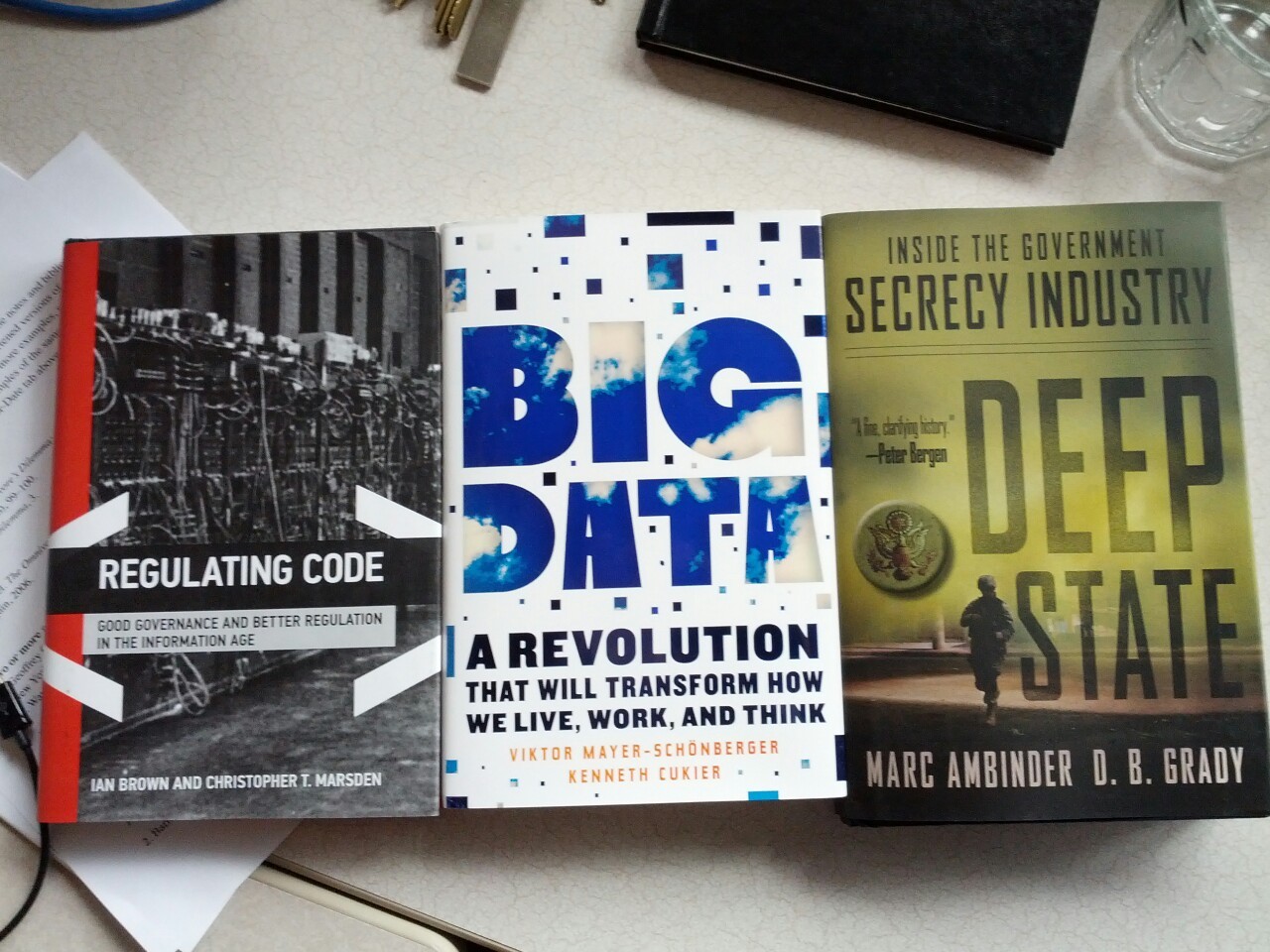
Book Delivery Day!

Categories
Aside Humour

parislemon:

joncrowley:

alexcarantza:

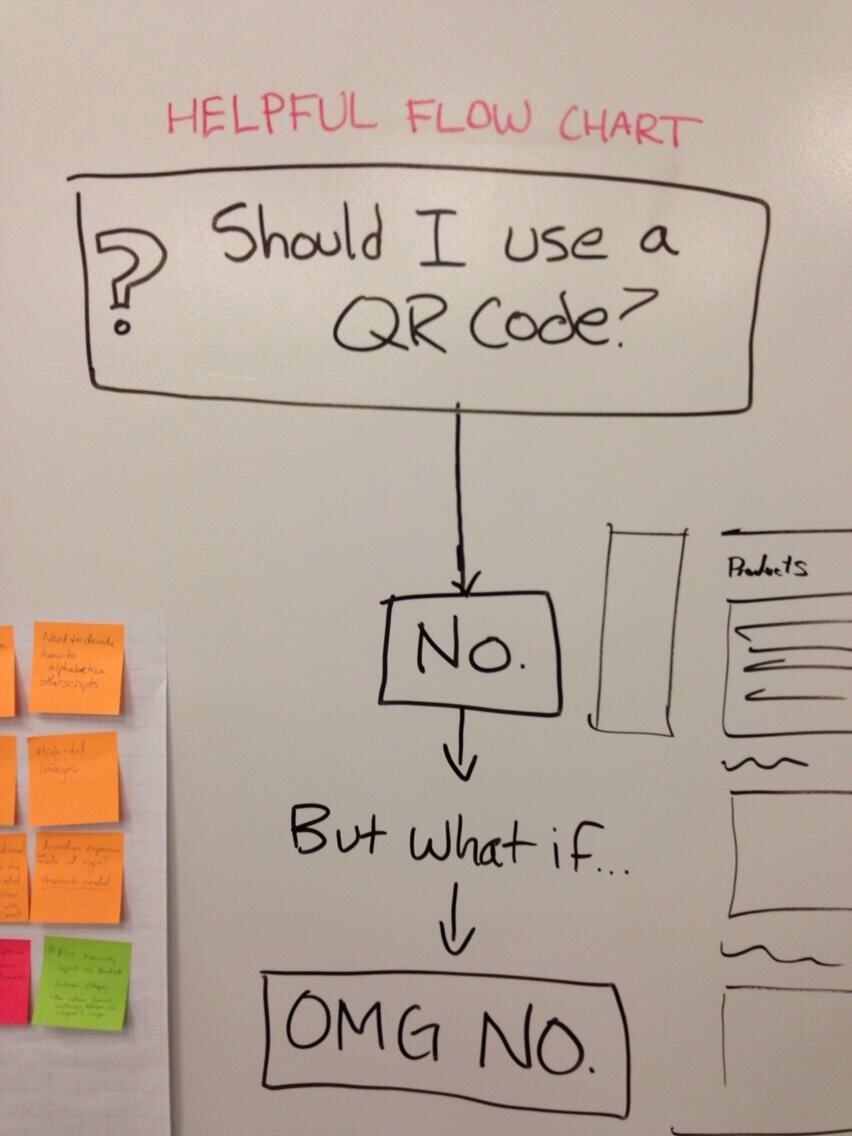
Decision tree for using a QR code

I feel like the QR code is the litmus test for whether your ‘digital experts’ are actually digital experts.

(Although, I have seen some data that suggests that they work in a few specific situations.)

Pretty perfect.

The most honest depiction I’ve ever seen regarding QR codes

Categories
Aside Links

jakke: getallthedegrees replied to your post: must force myself to stop…

jakke:

getallthedegrees:

jakke:

imagegetallthedegrees replied to your post: must force myself to stop eating pad thai

I’ve been told your supervisor does the asking, though you have input. But that might just be my department. However, for my MA my supervisor did the asking but asked who I wanted. So I dunno??

Sorry – to clarify, when I said “committee” I was including supervisor. Because I don’t yet have anyone formally signed on. Three years into the PhD. Despite semi-frequent discussions of research and stuff with three or four faculty members. And it’s really hard to track anyone down unless there’s a talk or something where I can chase them afterwards and beg for a meeting time.

Forgive my ignorance of econ programs, but how did you get through your comps without a formal supervisor? Unless, this means you didn’t do comps? Do you do quals instead? How is your program structured?

I was told that I’m supposed to formally ask who I want to be my supervisor, and should really be thinking about it soon (September at the latest) according to the grad advisor. In my program you don’t ask formally until you do candidacy* (after you finish your coursework), but since I’m not able to take the remaining classes I need over the summer I’ll be doing candidacy work sort of unofficially.

*In my program (and I think most programs in my institution) we take more classes than most (eight, rather than four or six), and skip the comps/quals process and do candidacy instead. Candidacy is the first three chapters of your dis, so intro, lit review and methodology (~ 80-100 pages) which you defend in an oral exam.

Okay so hopefully this isn’t overshare but here’s how my program (and, I think, most econ programs) works:

  1. Eight months of general coursework (three per term for two terms). Everyone takes this together.
  2. Two comp exams. Everyone takes these together. They cover all of macro and micro theory. One or two people get kicked out.
  3. Another eight months of coursework, this time with four per term for two terms. This is where specialization happens.
  4. Four months of writing a paper. This is supposed to get you familiar with the process but is almost always a failure.
  5. Twelve months of preparing for prospectus defence. This is where I am now. Typically a big chunk of your thesis gets written here.
  6. Prospectus defence and assembling a committee. Including the prof who’s formally your supervisor.
  7. Twelve months of preparing for the job market. Your best paper gets super polished as your Job Market Paper around this point.
  8. Four months of job market. In here, you’re also finishing your thesis. But really it’s your Job Market Paper that matters more than the actual thesis.
  9. Four months of finishing up the thesis, getting a job, and defending the thesis.
  10. Graduating and very very hopefully progressing to gainful employment.

So the big paper I’m currently working on right now will very hopefully be my Job Market Paper. Other projects I’m working on might end up in my thesis. At least one is getting published and isn’t going to be part of my job application at all because it’s not economics.

And yeah accordingly I really really need to put together a committee to formally supervise my actual thesis. And I don’t know how much coldness is par for the course or at what point it actually becomes a strong negative signal.

That’s….a different structure from any other I’ve seen. I’ve the good fortune of entering the program with a supervisor (you can switch later, if you want). He’s helped pay a bunch of my bills + general guidance.

He’s also taken most of the work out of finding people for the committee: we had a meeting and went back and forth on names, and then he rounded folks up. It’d have been super awkward to do this myself, given that I tend not to know people in the program terribly well (and they tend to look at me funny, not quite knowing what it is that I actually do as an academic).

Categories
Aside Quotations

2013.4.8

Although some of the core supporters of that group are prone to violence and criminal behaviour, Catt has never been convicted of criminal conduct in connections to the demonstrations he attended. Nonetheless, Catt’s personal information was held on the National Domestic Extremism Database that is maintained by the National Public Order Intelligence Unit. The information held on him included his name, age, description of his appearance and his history of attending political demonstrations. The police had retained a photograph of Mr Catt but it had been destroyed since it was deemed to be unnecessary. The information was accessible to members of the police who engage in investigations on “Smash EDO”.

In the ruling the Court of Appeal departs from earlier judgments by mentioning that the “reasonable expectation of privacy” is not the only factor to take into account in determining whether an individual’s Article 8 (1) right has been infringed. In surveying ECtHR case law, the Court noted that it is also important to check whether personal data has been subjected to systematic processing and if it is entered in a database. The rationale to include consideration of the latter two categories is that in this way authorities can recover information by reference to a particular person. Therefore, “the processing and retention of even publicly available information may involve an interference with the subject’s article 8 rights.” Since in the case of Catt, personal data was retained and ready to be processed, the Court found a violation of Article 8 (1) that requires justification.

Carolin Moeller, “Peaceful Protester’s personal data removed from extremism database

The removal of Mr. Catt’s data from these databases is a significant victory for him and all those involved in fighting for citizens’ rights. However, the case acts as a clear lens through which we can see how certain facets of the state are actively involved in pseudo-criminalizing dissent: you’re welcome to say or do anything, so long as you’re prepared to be placed under perpetual state suspicion.