Source: Global Coalition Of NGOs Call To Investigate & Disable FinFisher’s Espionage Equipment in Pakistan
Category: Links
Via Techdirt:
Good news, everyone. The terrorists will win and New York City Mayor Michael Bloomberg wants to help. Of course, his speech is all about not letting the terrorists win. But he’s giving them exactly what they want.
Bloomberg is an incredibly worrying political figure. He’s gone from earlier this year stating the privacy is important, but cannot be maintained in the face of expanding police surveillance, to this:
“The people who are worried about privacy have a legitimate worry,” Mr. Bloomberg said during a press conference in Midtown. “But we live in a complex word where you’re going to have to have a level of security greater than you did back in the olden days, if you will. And our laws and our interpretation of the Constitution, I think, have to change.”
This is the second time in very recent memory that he, on the one hand, supports a notion of privacy while, on the other, asserts that privacy has to be increasingly limited to enjoy ‘security’. This is an absolutely false dichotomy, and is often linked to blasé efforts to ‘secure’ a population in ineffective, inefficient, or incorrect ways. Strong security protections can and should be accompanied by equally strong privacy protections; we need to escape the dichotomy and recognize that privacy and security tend to be mutually supportive of one another, at least when security solutions are appropriately designed and implemented.
As if having the caloric details of your sex life posted publicly wasnât enough, new research has exposed additional security vulnerabilities in the popular Fitbit fitness tracking devices.
The ability to hack these devices, at the outset, seems silly: who would bother?
But as more and more organizations provide these to employees, to individuals they insure, and so forth, the desire to ‘game the system’ will increase. The problem is less along the lines of ‘you can capture this data’ – though that is a privacy concern – and more along the lines of ‘how can I beat the system reliably to advantage myself’.
The neoliberal sacking of the universities runs much deeper than tuition hikes and budget cuts, notes Barkawi.Today in articles that criticize “meaningless buzzwords” but then also use “neoliberal” in the title.
Seriously – if you have a graduate education, you are not the oppressed and marginalized party here. There’s no reason that professors should be getting tenure in the first place; why should this one small class of wealthy well-educated people get the right to keep their jobs indefinitely regardless of performance while their students rack up six figures of debt?
If there’s an assault on academia, it comes from the fact that post-secondary education is wholly unaffordable to students from low-income backgrounds. Being expected to provide a service in exchange for money is not assault. Any confusion on this matter is a good indication of why people are skeptical about giving you more money.
Just re: tenure. There are very, very, very good reasons to provide it. I know of a host of graduate students who are prohibited from communicating their research findings for fear of the potentially very serious blowback associated with their (entirely valid, grounded) research results. Others simply avoid research tracks on the basis that ‘no good can come of it.’
These individuals are working on issues of significance (e.g. how government engages in anti-democratic surveillance and interdiction of communications) that simply cannot be engaged with by most members of the public. Such members tend to lack the time, expertise, or safety to publicly engage in the research. Tenure is meant to afford faculty the ability to engage in such ‘risky’ work while also granting the space to do what might be seen as useless basic research. It also is intended, ultimately, to offer a shield that graduate students can retreat behind if needed. The absence of tenure weakens the already precarious conception of ‘academic freedom’.
Academe is, without a doubt, an increasingly bureaucratic domain. Faculty are often as guilty as government in this transition; it wasn’t always like it is today (which, I might add, also isn’t a reason to lust for the old days: grad students in the 90s complained about pretty similar issues as the students of today). The increased shift towards publish or perish, and in the UK the ‘tiering’ of publications, has been incredibly problematic for the quality of much literature: some publications are ‘slanted’ to accommodate the tiering model, as opposed to the actual way that the research may flow. Such attitudes and efforts to ‘game’ the system are linked to a systematic problem around academe. I don’t know that there’s a ‘fix’, but it also isn’t something that’s terribly healthy today.
Categories
The neoliberal assault on academia
The neoliberal sacking of the universities runs much deeper than tuition hikes and budget cuts, notes Barkawi.
There is a photograph being shared in Facebook of a woman cowering in a corner, eyes downcast, as large man standing in the foreground swings his fist at her head. The caption reads, “Women deserve equal rights. And lefts.”
This is a particularly good, if depressing, discussion of Facebook’s treatment of violence towards women, masquerading under the guise of a Millian-attitude towards protecting speech.
Last year Rob Shaw wrote a piece for the Times Colonist about online voting in British Columbia. (This is a Bad Idea by the way, for reasons that are expounded elsewhere.) At the very end of his article, we read:
B.C.’s flirtation with online voting coincides with changes to its information and privacy laws last year that paved the way for high-tech identity cards.
The government has said people will one day be able to use the cards to verify their identity and access Internet-based government services, including, potentially, online voting.
No government document released under FOIA laws that I’ve read has stated voting as a driver of the card. However, this isn’t an indictment of Shaw’s reporting but of the government’s unwillingness to fully disclose documents pertaining to the Services Card.
To be clear: there is no good reason to believe that the Services Card will be particularly helpful in combating the core problems related to online voting. It won’t actually verify that the same person associated with the Card is casting the ballot. It won’t ensure that the person is voting in a non-coerced manner. It won’t guarantee that malware hasn’t affected the computer to ‘vote’ for whomever the malware writer wants voted for.
The Services Card is (seemingly) a solution looking for a problem. Voting is not one problem to which the Card is the solution.
So, I use two factor authentication for a variety of services. It’s great for security.
It’s also a royal pain in the ass to be (re)inputting secondary authentication information all the time. That basic ‘pain point’ is sufficient to dissuade most people from setting it up. I support Twitter adopting this, and for some people it’ll be awesome. For most people it’ll just be a pain in the ass.
Matt Green has a really excellent post on why Bitcoin isn’t as anonymous as people think, and how to ‘fix’ that problem. If this is something that you’re interested in then his (very) detailed writeup (and link to his paper!) is worth the time and effort.
Categories
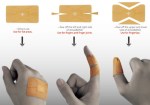



AmoeBAND became a 2012 IDEA Award Finalist by innovating every possible aspect of the plaster (band aid).
The design revisions were:
– Strategic cut-outs shape to fit fingers in such a way that it is easy to bend them and not disrupt the bandage.
– An intelligent dressing material allows you to regularly check wounds from the outside, without upsetting the healing process.“According to research, the when an infection of a wound is detected, the pH value is between 6.5 and 8.5. AmoeBAND’s indicator cross turns purple, alerting the user needs to change it immediately.”
– Since the bandage material used exudes a leather-like feel, availability in different skin-tones helps it blend in, without overly highlighting the injury.
– The packaging has been redesigned to a matchbox style and includes Braille instructions.
Hat tip to designers Tay Pek-Khai, Hsu Hao-Ming, Tsai Cheng-Yu, Chen Kuei-Yuan, Chen Yi-Ting, Lai Jen-Hao, Ho Chia-Ying, Chen Ying-shan, Weng Yu-Ching, and Chung Kuo-Ting
it’s always funny when people improve on something and you look at the innovations and it’s like so fucking obvious what needed to be changed, but yet no one seemingly thought of it until then, yourself included
These are really, really cool, and show what happens when innovation includes not just technology but clear and focused attention to design usability as well.
 Excited Pixels