Once your life is inside a federal investigation, there is no space outside of it. The only private thing is your thoughts, and even they don’t feel safe anymore. Every word you speak or write can be used, manipulated, or played like a card against your future and the future of those you love. There are no neutral parties, no sources of unimpeachable wisdom and trust.
The lawyers tell you: take no notes.
The lawyers tell you: talk to no one.
It is the loneliest of lonely things to be surrounded by your loved ones, in danger, and forced to be silent.
May you never experience a Federal investigation. I did, and it consumed me, and changed everyday that will come after it for the rest of my life.
Quinn Norton, “Life Inside the Aaron Swartz Investigation”
2013.3.4
Security signs that begin with ‘For your protection…’ essentially end with ‘…we will restrict freedoms & invade privacy’.
Neil deGrasse Tyson (via kateoplis)
You tell em Neil, we need working and relevant services, not to be babied.
(via scinerds)
This, this is a case of Neil not thinking about the children, right? Right?
![]()
2013.3.4
The traditionally advocated uses for NFC have been to replace RFID chips in travel cards, such as the Oyster card in the UK, and RFID chips in credit cards, such as MasterCard’s PayPass.
The problem with these replacements is a simple one, however. Smartphone batteries run out. They do so with alarming regularity, and they do so at inopportune moments. I don’t care what phone you say you have, and I don’t care if you say it doesn’t happen to you, because it does. You end up staying out late, or you leave your charger at home by accident, or you just plain use the phone too much during the day, and then when you need the phone to work, it doesn’t because it’s out of juice.
The phone running out of power is bad enough when it means you don’t have maps and directions. That’s annoying. But even worse is the battery going flat when you need the phone for mass transit or paying for stuff.
And yet that’s precisely the value proposition that NFC offers: go out for a night on the town and get stranded with no money, no subway ride home. The only way to be safe is to take your credit card and travel card with you anyway, and if you’re doing that? Well you don’t exactly need NFC then, do you?
Peter Bright, “Mobile World Congress is Mean Girls, and NFC isn’t going to happen”
2013.3.3
Being crass should not be a crime, but that’s essentially what Andrew Auernheimer was convicted of. This was the case where AT&T accidentally published the emails and device ideas of the first iPad customers. Andrew downloaded them and published proof of the problem to Gawker. His “coconspirator” pled guilty, testified against Andrew, and provided private emails to prosecutors that “proved” Andrew’s bad intentions. These emails disclose things like Andrew talking about stealing the information and wanting to profit from the event. That made his simple actions look very nefarious.
But that’s how we in the cybersec community always talk. When we find cybersec problems, we dream of the worst ways we can be horrible people and exploit them. If you listened to any of our private conversations, you’d be convinced that we were all secretly one step away from triggering World War III.
I’m pretty sure had I been in Andrew’s place, the prosecutors would’ve found much worse to hang me by. Indeed, you’ll find much in my public Twitter feed and blog posts to convict me of. When the Mars Curiosity Rover landed last August, and the first pictures arrived from the planet, I was about to tweet the URL to view those pictures. But the site was already failing under the load of all the nerds worldwide getting those pictures. Therefore, I changed my tweet to comment on the fact that this was essentially a DDoS attack – the sort of attack that activists do against large corporations they don’t like. I therefore made the humorous tweet “Join our DDoS against NASA and click” on their website.
Of course, I’m not against NASA, nor do I think anybody else is. I can’t imagine why anybody would want to DDoS them. It should be obvious that my tweet is humor. But, prosecutors taking this out of context might use it to try to convict me, to prove to jurors of my evil intent.
Robert Graham, “Context matters: we only appear to be blackhats”
![]()
SFU OpenMedia.ca, Facebook timeline photos
2013.3.2
At least Britain sort of got it half right. There, to make life easier for stores selling age-restricted items there’s a “Challenge 21″ programme, so anyone looking 21 or under is asked for ID, even if the products are restricted to over-18s. Tesco and other large chain stores championed a “Challenge 25″ programme just in case someone slipped through the net. Finally some idiot in the seaside resort of Blackpool came up with the idea of “Challenge 30″, which is roundly lambasted across Britain.
But at least these outlets demand high-integrity forms of ID such as driving licences. In the US you can show a picture of your dog pasted on the back of a chocolate biscuit and they’re likely to accept it.
That’s because no-one really knows why they are asking for ID in the first place, and no-one up the chain tells them – mainly because they don’t know either. Everyone just goes through the motions. There’s no way to verify the validity of ID, so everyone just plods along with the security theatre.
Simon Davis, “How a dog and some chocolate biscuits reveal an identity crisis in America”
2013.3.2
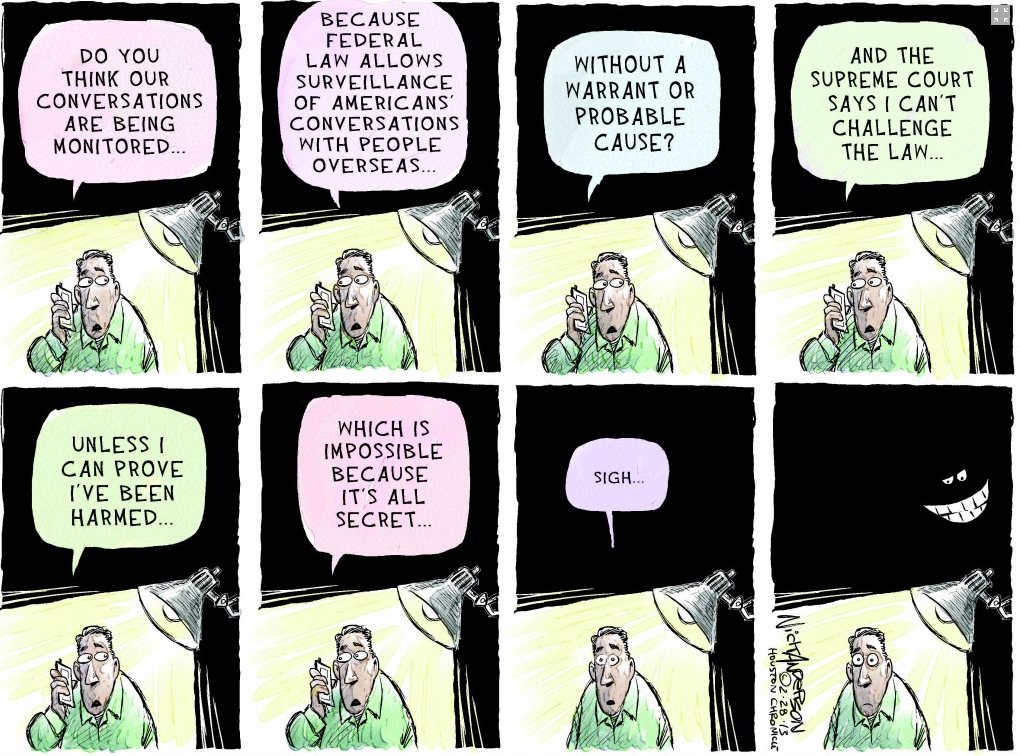
In Jewel, the Obama administration has already twice invoked the “state secrets” privilege, a mechanism left behind from the McCarthy-era persecution of Communist sympathizers which effectively lets the government ‘turn off’ the Constitution and the justice system whenever they feel that a case might jeopardize national security. The administration has promised to limit its use of the privilege to situations which present the potential for “significant harm” to the country. But that promise obviously hasn’t stopped them from deflecting recent challenges to warrantless wiretapping and other government counterterrorism initiatives — like indefinite detention provisions, or the secret program for targeted killings carried out by drones — nor will it necessarily restrain future administrations from doing the same.
Jewel may be the last chance for meaningful judicial review of the wiretapping programs in the foreseeable future. Failing that, the only remaining response for journalists and others dealing in sensitive overseas communications may be exactly what digital activists have been advocating for decades: widespread personal encryption. But aside from being somewhat impractical, the necessity of encrypted communications would more broadly underscore just how thoroughly the legal system has failed to protect citizens from unnecessary intrusion.
Joshua Kopstein, “Denied in the Supreme Court, warrantless wiretap opponents are losing ground fast: Does secret surveillance violate the Constitution? Sorry, that’s a secret”
- hosted email for small business
- office 365 small business
- office 365 small business premium
- office 365 enterprise e1
- office 365 midsize business
- office 365 enterprise e3
- office 365 proplus
- office 365 enterprise (plan e4)
- education plan a2
- education plan a3
- education plan a4
- exchange online (plan 1)
- exchange online (plan 2)
- office 365 suite (plan e1)
- office 365 suite (plan e3)
- kiosk plan 1
- office 365 home premium
- office home & student 2013
- office home & business 2013
- office professional 2013
Focus.
I thought that this was a joke. Someone exaggerating Microsoft’s actual product offerings.
I was wrong.