![]()
2013.2.28
… test version of a data-mining tool in Delta’s offices, and he was surprised by the technology’s power to collect vast amounts of personal information using one start point. Jackson volunteered his Social Security number and watched the tool retrieve his address, the names of his neighbours, his wife’s name, and the date they were married, all from publicly available information. Some of the Delta employees had been test subjects already, and when his own personal information stated popping up for all to see, Jackson joked he’d seen enough. But the demo convinced him that the government had to have this capacity. Not because he wanted it. But because he was afraid he couldn’t do his job without it.
Shane Harris, The Watchers: The Rise of America’s Surveillance State
![]()
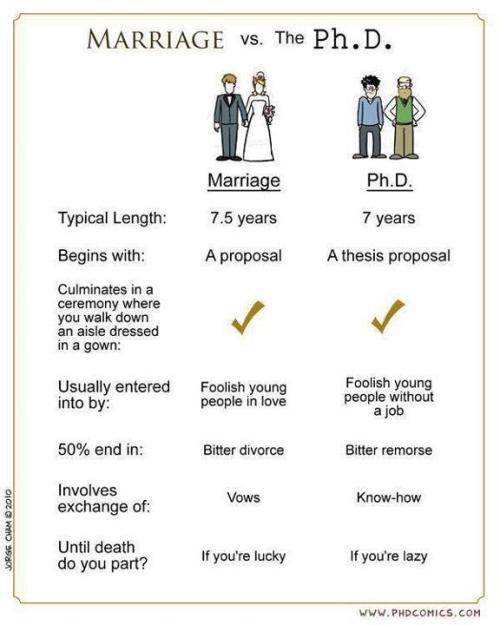
Marriage versus Ph.D illustration
I’m pretty sure I’ll lack the remorse after finishing. It’s actually surprising nice to know that I’m done with academe in a 6 months or so!
Do Not Covet Your Ideas
![]()
Frickin’ love this.
Reblog via &soweramble
This is also a pretty compelling argument for certain ideas in Open Culture.
Giving away and open-sourcing ideas has led to some of the greatest experiences of my life. It can be terrifying but it’s amazing to see what boomerangs back on you.
Powerful men may actually be the worst?:
As a political reporter for GQ, I’ve been jokingly asked whether I ever posed for the magazine and loudly called a porn star by a senior think-tank fellow at his institute’s annual gala. In my prior job as a Hill reporter, one of my best source relationships with a member of Congress ended after I remarked that I looked like a witch who might hop on a broom in my new press-badge photo and he replied that I looked like I was “going to hop on something.” One journalist remembers a group of lobbyists insisting that she was not a full-time reporter at a major publication but a college coed. Another tried wearing scarves and turtlenecks to keep a married K Street type from staring at her chest for their entire meeting. The last time she saw him, his wedding ring was conspicuously absent; his eyes, however, were still fixed on the same spot. Almost everyone has received the late-night e-mail—“You’re incredible” or “Are you done with me yet?”—that she is not entirely sure how to handle. They’re what another lady political writer refers to as “drunk fumbles” or “the result of lonely and insecure people trying to make themselves feel loved and/or important.” … Sometimes they reach the level of stalking: One colleague had a high-profile member of Congress go out of his way to track down her cell-phone number, call and text repeatedly to tell her she was beautiful, offer to take her parents on a tour of the Capitol, and even invite her to go boating back home in his district.
This speaks depressing volumes about many individuals who are deeply invested in the political machinations of nation-states.
TarenSK: Thank you
I’m being very careful not to generalize from this grieving experience. Someday other people close to me will die. It will not be like this. But this once, it can be and is like this, and I am grateful.
Along with all the multitudes of lessons to draw from Aaron’s life and death, I hope one can be an ongoing commitment to unconditional support for each other in times of great personal crisis.
The truth is, Aaron was very bad at asking for support. He didn’t want to be a burden on others. He believed he ought to be able to make it on his own. He demanded independence from those who loved him. He was eager to help anyone else, but to ask for help for himself was terrifying. That made his 2-year ordeal much harder in many ways.
I’ve learned what I believe are the right lessons from this, and I hope you all will as well. The world is often — though not always — naked and cold. Confronting it on our own is sometimes merely difficult, sometimes downright impossible. We have a responsibility to help each other through the hard times, and an equal responsibility to ask for help from each other.
I still think [Apple] should go back to Dropbox with a blank check and just ask how many zeros they need to put at the end to make it happen.
My friend Dave Zaffrann, practicing the art of Having a Decent Idea while lamenting iCloud’s future (via chartier)
I think that this is on the mark, in the sense that iCloud is gross and Apple needs to do better. I also hope it never comes to be, given how much I use Dropbox on non-Apple devices and products.
Why I’m quitting Facebook
I left Facebook a long time ago, before many of the current realities of that ecosystem. Rushkoff didn’t leave for the same reasons I did (which stemmed from philosophical conceptions of temporality, time, and privacy) but his reasons echo those I keep hearing from undergrads. It isn’t just that Facebook isn’t ‘cool’; they’re spending less time on the site because the company is increasingly seen as manipulative, secretive, and portrays users in ways antithetical to how the users perceive themselves.
What is perhaps most concerning is what will happen to all the data the company has amassed if/when it implodes like MySpace did. What if, in five or seven years, Facebook effectively closes shop: who will get the mass of data that the company has collected, and how will they subsequently disseminate or manipulate it? It’s this broader concern about long-term use of incredibly intimate data that leaves me most leery of corporate-hosted social media platforms, and it’s an issue that I really don’t think people appreciate. But, then, I guess not a lot of people really remember the dot com crash…
Even if Aaron’s intention was in fact to distribute the journal articles (to poor people! for zero profit!), that in no way condones his treatment.
But the terrifying fact I’m trying to highlight in this particular blog post is this: According to the DOJ’s testimony, if you express political views that the government doesn’t like, at any point in your life, that political speech act can and will be used to justify making “an example” out of you once the government thinks it can pin you with a crime.
Talk about a chilling effect on freedom of speech.
Chilling of speech is very, very real. And the things we’re learning in the aftermath of Aaron’s death only amplify concerns.
2013.2.26
I have posted before about the Tibetan attacks, because they offer good insights into this issue in general. But it’s not just the Tibetan activists and other outspoken critics of the Chinese regime that are targeted by this “GhostNet”. I work on Taiwan/China issues in Washington, D.C. Pretty much everyone in that community – be it academics, think tankers, NGO employees, and government officials – are consistently targeted by the kind of “social malware” attacks that are detailed in the two reports. These attacks are very sophisticated, making them really hard to spot, and they show intimate knowledge of what’s going on in the community. Let me give you two recent examples:
On March 26, the Pentagon released their annual report on the Chinese military. On March 27, I received an email ostensibly from one of the people responsible for Taiwan issues at the Pentagon. The email basically said “Hey, here is the expanded version of the report from yesterday, with some additional commentary on Taiwan. I thought you would find it useful”. Attached was a PDF named “China_Military_Power_Report_2009.pdf”, exactly like the official document released by the Pentagon. I work on Taiwan defense issues, so this would be very interesting to me were it real. However, I correspond with this person on a regular basis, and he usually signs his emails to me with his nickname. This email didn’t, which made me suspicious. A Virustotal scan confirmed that the attachment contained malicious software (only detected by 4/38 products, though) and a quick phone call confirmed that the person hadn’t sent an email like that.
In another recent attack, it was the name of the head of my organization that was used to try to trick recipients into opening malicious attachments. He had just returned from a visit to Taiwan, a trip that had been reported on in the Taiwan press. About a week after returning, he received an inquiry from a prominent researcher at a D.C. think tank, asking if he had sent the researcher an email with a trip report from his visit. He had not in fact sent such an email, although it wouldn’t have been unusual for him to do so. I spoke to the IT manager at the think tank, who confirmed that the researcher was indeed tricked into opening the attachment, and that it did contain malware.
And this was just in the last three weeks. I could go on for pages describing various things we have seen over the past two/three years (two more here), but you get the gist. For small NGOs like mine, protecting against infiltration, monitoring our systems for intrusions, and educating our staff to recognize potential hazards has become a huge drain on our already limited resources. The frustrating thing is that there is pretty much nothing we can do about it, except to remain diligent. But at least I’m glad that the issue is continuing to get coverage in the mainstream press.
Gemmy, from a 2009 comment on GhostNet