Categories
Photography Roundup Writing

The Roundup for January 20-26, 2018 Edition

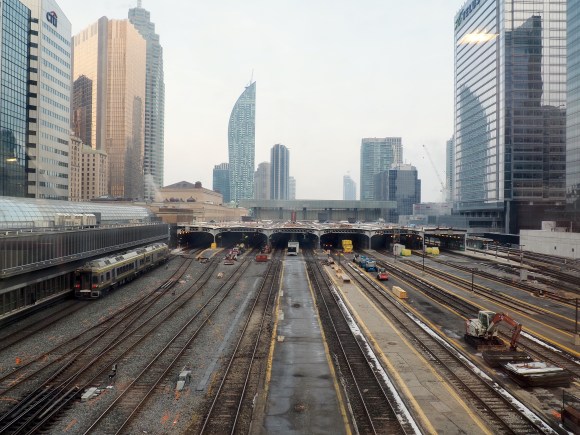
Terminus, 2018, Toronto by Christopher Parsons

I’ve been thinking about how high technology is continuing to develop at a pace that outruns the least well off in our Western societies. I think that this was best crystallized in Amazon’s opening of its first Amazon Go store, which does away with cashiers and replaces them with cameras and sensors that automatically identify what you acquire for purchase and charge you as you leave the space. There are at least three (immediate) concerns that strike me with regard to these kinds of technologies:

  1. As noted by Hanna Brooks Olsen, these are inherently cashless technologies. Consumers will enter the store with their smartphones, cameras and sensors will track them, and be billed automatically to their debit or credit card(s) associated with the Amazon account. For persons who have a hard time acquiring a smartphone, or having it repaired when damaged, or opening a bank account or obtaining a credit card, or possessing a language barrier, or without access to a convenient and reliable place to charge their devices, or those who rely on the cash economy, these kinds of ‘convenient’ stores are nearly impenetrable fortresses. Those who cannot enter and purchase goods in the stores will be those who are often the least privileged and, rather than being confronted by the diversity of the human population, shoppers in Amazon Go-type stores will have some portion of society’s diversity simply deleted from their shopping experience. As stated by Olsen, “cashless life … is necessarily one of privilege.”
  2. These are anti-labour technologies. In promoting ‘convenience’ Amazon Go and equivalent technologies remove a certain portion of low skill jobs that many people depend on for their livelihoods. While the popular conception is that it’s just students who have these kinds of jobs, simply looking at service jobs belies this point: the age groups which have sales or sales service jobs are rising, and this is exacerbated by an older population who has to work longer into their retirement years simply to survive, let alone thrive. By removing, or at least significantly reducing, the number of low-skill jobs the numbers of persons who are struggling and unable to find work will increase and their social hardships be exacerbated.1
  3. Cashless systems and those which remove labourers are inherently political technologies. They are technologies designed for a particular set of people, to solve what one group in society regards as ‘problems’, and which could significantly reshape how elements of society operate. Should these technologies cease to be ‘technology’ per se and be normalized as ‘infrastructure’ then it will be challenging to ‘reformat and replace’ the technology and ameliorate its long-term social impacts.2 Transforming cashless into infrastructure threatens to deepen the the aforementioned difficulties.

Aren’t there solutions to the aforementioned problems? Of course there are. But any solutions will likely impose costs on those who are developing, advocating for, and using convenience technologies that detrimentally affect the least well off or privileged. Solutions might entail:

  • establishing a guaranteed way for all persons to obtain banking accounts with diminished identification or language requirements;3
  • providing either a basic living wage or reducing the barriers to accessing social welfare benefits, to offset the reduction of low-skill employment opportunities; or
  • reducing educational costs or fully subsidizing such costs so that we as a society can improve the educational status of many of those affected by shrinking low-skill labour. However, education is often seen as the silver bullet when it should be regarded as a tarnished and dented brass shield instead: educational requirements for mid-skilled labour may be too onerous for some persons who have mental, psychological, or physical challenges. Similarly, if there is a major gap between initial education and when it is (re)required, such as when a middle income person loses their job after 25+ years of performing the same tasks, then a short 6- or 12-month course may be insufficient. Education may help to address some job loss linked to convenient technologies but education, alone, is insufficient to ‘solve’ the social challenges linked with such technologies and infrastructures.

It’s pretty rare that major news reports about novel and emerging technologies are accompanied with real-work implications of the technologies, should they transform to infrastructure. It’s even rarer for minor news reports to consider the social, ethical, or political implications of new technologies. Instead, the focuses tend to be on whether a new user interface is ‘fun’ or ‘convenient enough’ or ‘fast enough’. Those are the concerns of the majority. We need to far more seriously consider how our developing technologies will affect those least well off, or else risk further stratifying social and economic divides and widening the rift between the most and least privileged members of society.


Quotation of the Week

“We cannot retreat to the convenience of being overwhelmed.”

– Ruth Messinger

Great Photography Shots

I really appreciated the humour in these urban camouflage shots!

Music I’m Digging

Neat Podcast Episodes

Good Reads for the Week

Cool Things

Footnotes

  1. The current Amazon Go location does have employees working there, just not as cashiers, and the company hasn’t taken the population of would-be-cashiers and moved them to other locations. The very point is to remove cashiers as an occupation and number of employees from the experience.
  2. If you’re interested in this line of analysis — that technology is inherently political — I’d suggest reading Langdon Winner’s book, The Whale and the Reactor: A Search for Limits in the Age of High Technology.
  3. One of the challenges to obtaining a bank account is that customers may require a fixed address, telephone number, or other identifiers. While such identifiers are often stable and available to the majority of the population they are fluid for those who lack secure housing, employment, and other ‘normal’ components of daily living.
Categories
Writing

Next Level Coffee Snobbery

I haven’t brewed a typical ‘cup’ of coffee at home for over three years. I drink 1-3 cups a day but in a particular coffee-snob kind of way.

I’ve been exclusively brewed using an Aeropress.

An Aeropress is basically a vacuum plunger where you attach a filter to the bottom of a plastic tube, load grounds into the tube, and after adding water and stirring the grounds, plunge water through the grounds. I wasn’t initially using a particularly ‘nice’ kettle and so wasn’t regulating the water temperature very rigorously. Despite this, the simple shift from a coffee maker-made coffee to Aeropress represented a a massive step-up in my morning coffee experience.

Enter a Proper Kettle

A few years ago I bought the Cuisinart CPK-17 PerfecTemp Cordless Electric Kettle so that I could precisely heat my water to the temperature I wanted. This kettle will let you select one of six preset temperatures (160°, 175°, 185°, 190°, 200°, and Boil) whereas a normal kettle is far less specific in the temperature it can consistently reach.

The Aeropress plus Cuisinart combination plus good coffee beans that were recently roasted (i.e. within a week or so) has always resulted in pretty good coffee. But if you spend time looking at the Aeropress championships that take place around the world, and the recipes that the baristas use, you find that they measure out the beans and water by weight.1

Weighing Everything Out

I got a scale for Christmas to weight out the amounts of water and coffee beans I use in making coffee. I’m using an American Weigh Scales (SG-2KG) Digital Pocket Scale. After trying it out I learned something profound: I’ve been using almost the precise amounts of boiling water and coffee beans as many of the most popular Aeropress recipes!2

I’m guessing that the scale will ensure that I’m better able to control for quality each time, and so instead of almost nailing the perfect balance of water and beans I’ll have a ‘perfect press’ more regularly. I’ll also be able to try out other recipes with accuracy and confidence. But it was surprising to learn that despite adding the extra coffee gear it’s actual improvements may be less significant than I’d expected.

Now I just have to upgrade to an even better burr grinder…

  1. They also have a specific number of times they’ll churn the water over the coffee, break up when they add water, and more. It gets pretty complicated and ritualistic.
  2. The technique varies between the recipes I’ve looked at, but weights are pretty consistent.
Categories
Photography Videos

Collecting Objects vs Collecting Potential In Photography

I really appreciated this short but poignant interview of Joel Meyerowitz. He has an interesting assessment of the difference between a SLR and rangefinder-style camera (one blinds you to half the world whereas the other lets you see the frame and what is around the frame) and how photography has the potential to transform the unrelated into the real, the imagined, or the potential.

Categories
Aside

2018.1.24

I’ve decided to try enabling comments on this blog; historically I’ve found that spam is such a pain to manage that comments just aren’t worth it. But I’m willing to try again and see if the value gained from comments exceeds the cost in managing spammers.

Categories
Quotations

On The Stupidity of Fitness Trackers

The constraint on the Move goal is my rest days. I don’t do yoga on Tuesdays or Thursdays. Instead, I cook, usually in big enough portions that I can use the leftovers for lunch the next day. The relevant thing here is that cooking takes time; I can’t work out and cook at the same time. Without rest days, I hardly cook at all, which means I spend more money on takeout, which is generally worse for me than the foods I prepare myself.

The Apple Watch doesn’t care about any of this. Rest days are the limiting factor on my ability to hit my Move goal — while I easily hit 700 calories by the Watch’s measure on my workout days, I move a lot less when I take time off from working out. But rest days are crucial for exercise: they let your body recover. Without recovery, you don’t get the strength you’re trying to build, and you place yourself at risk for overuse injuries.

At times I remind myself of what Blahnik said: this is a minimum. You’re supposed to beat it. This reminder makes me feel worse, not better. I stop letting the Watch set my Move goal. It is too unkind to me.

The Move goal is adjustable — I can lower it at any time — but there’s no way to program the Watch to consistently honor my rest days. I just have to manually lower the goal for that day, and then raise it for the next one. Unfortunately, this requires too much of my attention. I have actual things to do that are more important than manually telling my fitness app to let me rest, so mostly I forget to do it until it’s too late. Even when I remember, I wind up with a different problem: I forget to reset the Watch to a higher Move goal the next day. I spent one week being psyched that I hit my goal only to discover that I had only hit the lowered goal.

Elizabeth Lopatto, “End of Watch: What happens when you try to change behavior without behavioral science?

In my case, it drives me nuts that if I’m sick for a few days that my fitness streaks go to hell. Or if I’m travelling, and I can’t move as much as normal because I’m stuck in a flying coffin for 6-16 hours I get penalized. It’s a serious failing of the current iterations of the software though, also, a failing that Apple or other companies could correct if they just invested the time and energy. Maybe they could talk to real or normal users of their technologies?

Categories
Writing

Sources of Learning

One of the things I’m trying to do this year is actively learn composition, framing, etc from professional sources to improve my photography. I feel like I’ve hit a wall just looking at other people’s images in terms of my creativity and the reading/watching/listening is really helping me to think more carefully about what I’ve shot to date (and why I like what I do) and what I want to try going forward.

The different challenges I’ve participated in and the technical videos I’ve watched have been helpful in teaching me about my camera and lenses, and how to do very limited post-processing, but really hasn’t been that useful for teaching me colour theory, framing theory, etc. I’m hoping to read (and take notes from) at least one book every month or so as to inspire, improve, and motivate my photography.

Categories
Quotations

The Web Has Lost Its Spirit

The Web has lost its spirit. The Web is no longer a distributed Web. It is, ironically, a couple of big tubes that belong to a handful of companies. Mainly Google (search), Facebook (social) and Amazon (e-commerce). There is an impressive Chinese line and there are some local players in Russia, Japan, here and there. Overall it has become monotonous and dull. What can we do?

There seems to be a weak undercurrent of old and young bloggers like us that feel sentimental or curious and want to bring back blogging. Blogging won’t save the world. But, hell, after two weeks now, we can confirm: it feels great to be back on the blogging line.

If you are one of those old or young bloggers, please join in. Drop Facebook, drop Twitter and drop Medium for original thought. Own your traffic. You can use them to engage in discussion. But don’t get lost in there. Write daily. Publish as often as you have something to say. Link to other blogs.

iA, “Web Trend Map 2018
Categories
Aside

2018.1.23

Good: I’m on track to getting a bunch of writing done today! Bad: It’s writing that was foisted on me by an external party and the writing is to their (immediate) deadline. Depressing: All of the writing might get tossed away should their editor decide to can the story.

The reality of a day in the life of a public intellectual…

Categories
Aside

2018.1.22

Over the weekend we signed up for a pair of hikes for March. One will take us to one of the highest (and safest) points in Nicaragua1 — another challenging volcano hike! — and another calmer hike through the rainforest and along a series of waterfalls. I admit a little bit of trepidation over the first hike mostly because of the heat we’ll be walking through (and walking down young volcanos is always a bit slippery), but I’m also super excited summit Volcan Concepcion and take photos!

  1. The highest point is Pico Mogoton but the hike is made moderately dangerous by the presence of landmines that were laid in the war with the contras.
Categories
Aside Links

19 Tiny Habits That Lead to Huge Results

While I wouldn’t necessarily identify Cole’s nineteen habits as ‘tiny’ in aggregate I would agree that most of the habits he identifies are important for developing a well-balanced life. Perhaps the most important habit, to my mind right now, is to reflect on oneself and to value oneself, to the point where you can identify aspirations goals and strive to achieve them. If I’m being honest, it’s really hard for me to visualize or express such personal aspirations and thus one of my more important ‘tasks’ over the coming months is to both clarify such aspirations and identify how to achieve and exceed them.