Christopher Parsons, a postdoctoral fellow at the Munk School of Global Affairs’ Citizen Lab, said the fact that Facebook is asking for access to so much data is not surprising given the way the Android operating system works, but said users’ concerns over privacy are still legitimate.
“People enjoy the functionality of the app, but they’re sort of shocked when they ascertain or remember that ‘Oh yeah, this is what I actually have to give up in order to use contemporary, full-scale social media,’ ” he said.
Parsons, who is also managing director of Munk’s Telecom Transparency Project, said the odds of the data accessed by Facebook falling into the wrong hands are slim, describing its cyber-security staff as among the most aggressive and well-financed in the world.
Still, he said companies like Facebook could do a much better job at explaining to users why it needs their permission for so many different functions. It could, for example, offer a scaled-down version of its terms and conditions written in a language that anyone can understand, said Parsons.
He said even though more and more people have realized over the past week the extent of the Messenger requirements, it’s unlikely that Facebook will see a mass exodus of users.
“People may feel they don’t have any actual option, because if they don’t download the app, they can’t communicate with their social network,” said Parsons.
Tag: Android
Categories
2013.8.2
What are Google’s Nexus devices for if not to be purchased by large numbers of consumers? Google’s take on that issue has been consistent: they’re “halo” devices meant to educate the rest of the ecosystem. Burke put it to us this way: “Basically what Nexus allows us to do is set the standard … [we can] demonstrate how Android runs and hopefully influence other device manufacturers to take what we’ve done and do even better.”
That explanation has often been difficult to take at face value. Though the phones have usually been elegant devices, they typically launched with specs that were behind the curve. The Galaxy Nexus had a pretty terrible camera, for example, and the Nexus 4 lacks support for LTE. Now that Google sells top-end “Google Play edition” phones that run stock Android, the Nexus line seems more irrelevant than ever.
That brings us to the other — and more important — reason the Nexus line exists: Google simply needs hardware on which it can develop Android. Burke says “as an engineering team creating a mobile platform — we can’t do that in the abstract. We need to do it on a real device that we’re carrying with us.” When people ask me about the Nexus line, I like to joke that if you need to create a few hundred polished and usable devices for Google engineers, why not make a few hundred thousand more and sell them to hardcore users?
I think that acknowledging Google wants to control some of its own hardware for internal development purposes – as well as to better enable external developers to produce software for Android – continues to strike to the heart of why the ‘Nexus’ line exists. Arguably the recent ‘Play Edition’ of manufacturers’ flagships phones could address consumers’ desire for stock Android experiences, but I don’t think that the Play Editions will fully satisfy developers’ interests in working from a stock, no-nonsense, quickly updated platform.
Categories
The Painful Process of Updating Android
Android fragmentation is a very real problem; not only does it hinder software developers’ abilities to build and sell apps but, also, raises security issues. In a recent report from Open Signal, we learn that 34.1% of Android users are using the 2.3.3–2.3.7 version of Android, whereas just 37.9% of users using 4.x versions of the operating system, most of whom are themselves using a years-old version of Android. In effect, an incredibly large number of Android users are using very outdated versions of their mobile phone’s operating systems.
It’s easy to blame this versioning problem on the carriers. It’s even easier to blame the issue on the manufacturers. And both parties deserve blame. But perhaps not just for the reasons that they’re (rightly!) often crucified for: I want to suggest that the prevalence of 2.3.x devices in consumers’ hands might have as much to do with consumers not knowing how to update their devices, as it does with updates simply not being provided by carriers and manufacturers in the first place.
Earlier this month I spent some time with ‘normal’ gadget users: my family. One family member had a Samsung Galaxy S2…which was still using version 2.x of the Android operating system. Since February 2013, an operating system update has been available for the phone that would bring it up to Android version 4.1.2, but my family member neither knew or cared that it was available.
They didn’t know about the update because they had received no explicit notice that an update was available, or at least didn’t recall being notified. To be clear, they hadn’t updated the phone even once since purchasing the device about two years ago, and there have been a series of updates to the operating system since purchase time.
The family member also didn’t care about there being an update, because they only used the phone for basic functions (e.g. texting, voice calls, the odd game, social networking). They’re not a gadget monkey and so didn’t know about any of the new functions incorporated into the updated Android operating system. And, while they appreciate some of the new functionality (e.g. Google Now) they wouldn’t have updated the device unless I had been there.
A key reason for having not updated their phone was the absolute non-clarity in how they were supposed to engage in this task: special software had to be downloaded from Samsung to be installed on their computer,[1] and then wouldn’t run because the phone’s battery had possess at least a 50% charge,[2] and then it took about 3 hours because the phone couldn’t be updated to the most recent version of Android in one fell swoop. Oh, and there were a series of times when it wasn’t clear that the phone was even updating because the update notices were so challenging to understand that they could have been written in cipher-text.
Regardless of whether it was Rogers’, Samsung’s, Google’s, or the tooth fairy’s fault, it was incredibly painful to update the Android device. Painful to the point that there’s no reason why most people would know about the update process, and little reason for non-devoted Android users to bother with the hassle of updating if they knew what a pain in the ass it was going to be.
The current state of the Android OS ecosystem is depressing from a security perspective. But in addition to manufacturers and carriers often simply not providing updates, there is a further problem that Android’s OS update mechanisms are incredibly painful to use. Only after the significant security SNAFUs of Windows XP did Microsoft really begin to care about desktop OS security, and Google presently has a decent update mechanism for their own line of Nexus devices. What, exactly, is it going to take for mobile phone manufacturers (e.g. Samsung, HTC) and mobile phone carriers (e.g. Rogers, TELUS) to get their acts together and aggressively start pushing out updates to their subscribers? When are these parties going to ‘get’ that they have a long-term duties and commitments to protect their subscribers and consumers?[3]
- In theory there is an over the air update system that should have facilitated a system update in a relatively painless way. Unfortunately, that system didn’t work at all and so Samsung’s software had to be used to receive the updates. ↩
- Really, this made no sense. To update the device it had to be plugged into a computer; why, then, did the phone (which was charging because it was plugged into the computer) need to have a 50%+ charge? ↩
- I actually have a few ideas on this that will, hopefully, start coming to fruition in the coming months, but I’m open to suggestions from the community. ↩
Categories

I’m really not clear why the hell a fitness application needs to be able to read who is calling me and to be able to track my outbound phone calls.
Thus far I’ve spoken via Twitter with their mobile developer, who says that the permissions request is an error on his part. I’ve also gone back and forth – repeatedly – with Fitbit’s technical support team. The first response wasn’t in parseable English, and the subsequent messages haven’t clarified why this particular permission is needed.
So, after several days of trying to learn why Fitbit is requesting these Android permissions – and what data they’re collecting – I’m not really any closer to understanding the situation than I was when I started this whole process. I’m thinking that it’s about time to exercise my rights as a Canadian and start requesting copies of all data that the company has captured about me….and then see if they’re willing to comply with Canadian privacy laws.
Categories
Netflix, Photos, and Bandwidth
tanacetum-vulgare:
So I did one responsible thing today and changed my internet service plan as the 8 month extra fancy retention bonus expired. I found out that I used 7GB yesterday alone though, so I think I need to moderate my netflix usage.
In our case, I’ve found the largest uptick of bandwidth use comes from streaming hi-res images as mobile device wallpapers. To the tune of about 60-80GB a month in images alone!
F-Secure has a good, quick, overview of the recent attacks against Facebook, Twitter, and (presumably) other mobile developers. Significantly, we’re seeing an uptick in attacks against developers rather than just against platform manufacturers. The significance? Even though the phone OS may be ‘secure’, the applications you’re loading onto those devices may have been compromised at inception.
Smartphones: the source of anxiety and worry for IT managers that keeps on going.
Via the Washington Post:
“You have potentially millions of Androids making their way into the work space, accessing confidential documents,” said Christopher Soghoian, a former Federal Trade Commission technology expert who now works for the ACLU. “It’s like a really dry forest, and it’s just waiting for a match.”
The high degrees of fragmentation in the Android ecosystem are incredibly problematic; fragmentation combined with delays in providing updates effectively externalizes the security-related problems stemming from mobile OS vulnerabilities on individual owners of phones. Those owners are (typically) the least able parties in the owner/carrier/manufacturer/OS creator relationship to remedy the flaws. At the moment, Google tends to promptly (try) to respond to flaws. The manufacturers and vendors then have to certify and process any updates, which can take months. It’s inexcusable that these parties can not only sit on OS updates, but they can continue to knowingly sell vulnerable phones.
Imagine if, after a car line was reported to have some problem that required the line’s recall and refurbishment, dealers continued to sell the car. They didn’t even notify the person buying the car that there was a problem, just that ‘enhancements’ (i.e. the seat didn’t eject when you hit something at 60Km/hr, plus a cool new clock display on the dashboard) were coming. The dealers would be subject to some kind of legal action or, failing that, consumers could choose to work with dealers who sold safe cars. Why, exactly, aren’t phone carriers being subjected to the same scrutiny and held to the same safety standards?
Categories
BBC News Permissions
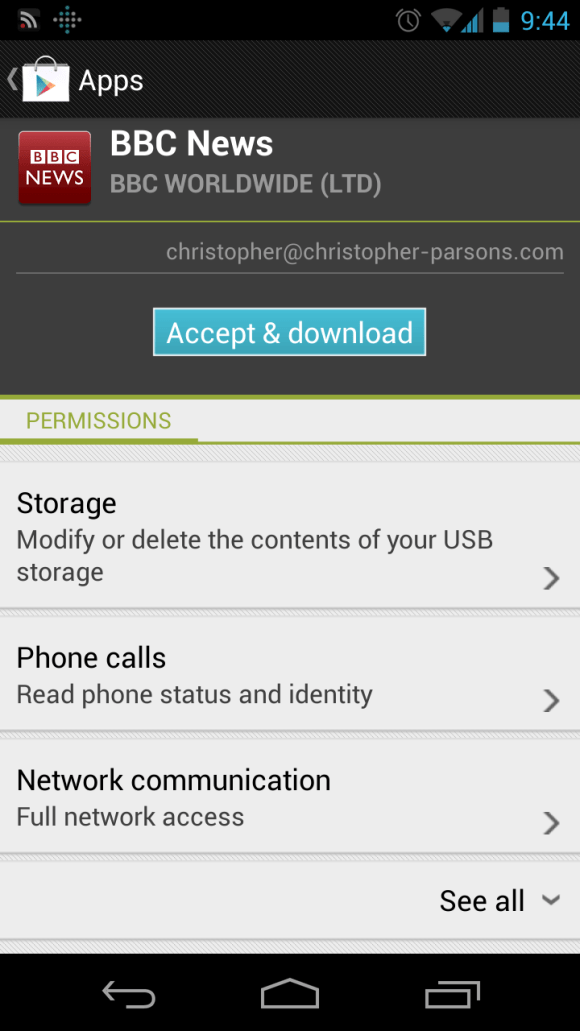
You’d think that in the post UK phone scandals, newspapers wouldn’t want access to your phone calls with their apps
Categories
2013.1.3
You see, the thing about humans is that we have a really short attention span, and really bad memories. It’s actually hard for me to remember a time before I had a phone that could effectively replace my entire computer in most situations. A phone that I could make video calls from from any spot in the world, one that would let me log into our team’s IRC channel while on the floor of a major media event in any city and communicate with our whole staff. A device that was small enough to fit into the front pocket of my arguably-too-tight jeans that would let me connect and share my most important thoughts about developing news and world events — in real time! — with millions of people at once. A device that would underpin and enable modern social movements and political revolutions, generally shrink our sense of the size of humanity, and mesmerize and delight almost everyone who used it.
Joshua Topolsky, “Reasons to be excited”
Ron Amadeo has a terrific and comprehensive post on all the various Android UI issues. Well worth the read if UI and UX is something you pay attention to.
 Excited Pixels