Categories
Links

With CSEC monitoring people in airports, how much spying is done on Canadians?

I had a chance to speak with The Current today about privacy, spying, and CSEC. It was really great to hear from the Interim Privacy Commissioner of Canada and Jacquelyn Burkell on these topics as well.

Source: With CSEC monitoring people in airports, how much spying is done on Canadians?

Categories
Aside

New Mug

Spoils of my on-air interview this morning!

Categories
Links

New Snowden docs show Canadian spies tracked thousands of travelers

Source: New Snowden docs show Canadian spies tracked thousands of travelers

Categories
Aside

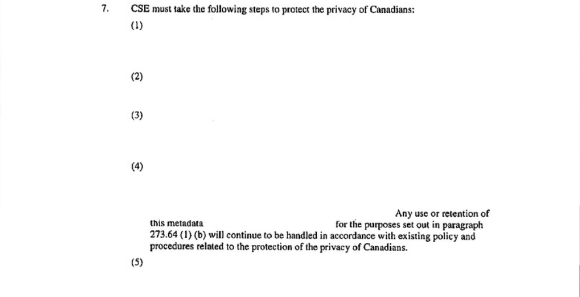
CSE Redactions

Clearly, Canadians can totally have confidence in CSEC’s steps to protect privacy. As in, there are 5 separate steps to protect Canadians, plus (possibly) other ‘incidental’ steps that are dealt with elsewhere. (Source: 2011 ATIP from CSEC)

Categories
Aside Humour

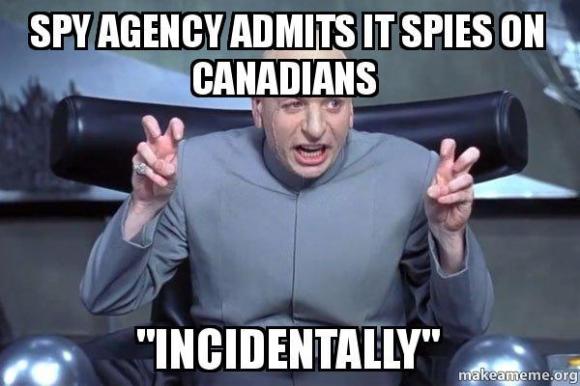
Spy Agency Spies “Incidentally”

mebuell:

Meme: Spy agency admits it spies on citizens “incidentally”

And don’t worry about those incidents because they’re all dealt with in ‘privacy protective’ ways. (And just trust CSEC on the latter, even though CSEC redacts its privacy protective practices for when incidentally collecting Canadians’ information.)

Categories
Quotations

2013.12.11

That is what the Snowden leaks have exposed — a massive government operation to archive and analyze all the world’s communications. Opposing the surveillance state, and demanding the right as free citizens to know what our government is doing, is not a left- or a right-wing issue; it is one of tyranny versus liberty; it’s about whether we want to live in a communist-style surveillance state, or enjoy the rights and privileges of a free society.

Jesse Kline, “The spy who read my email
Categories
Aside Links

The Oddities of CBC’s Snowden Redactions | Technology, Thoughts & Trinkets

The CBC redacted the Snowden documents concerning NSA surveillance during the G8/G20. While I can agree that some of the redactions were appropriate the majority that were made seem excessive.

Categories
Links Writing

Did Canadian Oil Companies Get a Tip-Off from CSEC?

The Globe and Mail reports on discussions in the Canadian Senate. Specifically, Liberal Senator Wilfred Moore asked:

“Can the [Senate] leader enlighten this chamber as to what was done with the data obtained by CSEC from the Brazilian Ministry of Mines and Energy?”

Alleging that CSEC’s “cyberhacking” was intended to probe Brazil’s claims about discovering billions of barrels of oil in a new offshore-field find, Mr. Moore noted that no Canadian or U.S. corporations have joined the bidding for drilling rights in an auction that was held earlier this week in Brazil.

This is an incendiary question. If it turns out that Canadian companies didn’t bid because CSEC found Petrobras has overestimated the oil reserves in the Libra field, or if CSEC found that it was going to be harder to extract the oil that stated by the Brazilian government, then it’s a very, very big deal on the basis that the Canadian government (and extension of the department of national defence) would then be engaging in espionage on the behalf of Canadian companies.

Categories
Links

Greater Oversight Required for Canada’s Spy Agencies

This is the kind of introspection and critique that all backbenchers should be able to present to the public. They shouldn’t be forced to leave their party caucus to do so.

Source: Greater Oversight Required for Canada’s Spy Agencies

Categories
Writing

How Not To Defend Your Signals Intelligence Agency

Many Canadians, at this point, will have heard that our foreign signals intelligence agency has reportedly been spying in Brasil. Specifically, the Communications Security Establishment Canada (CSEC) has been accused of using “email and phone metadata to map internal communications within Brazil’s Mines and Energy Ministry through a software program called Olympia.” This has created quite a stir and forced the federal government of Canada to defend itself, and CSEC’s actions.

However, at a technology conference the head of CSEC tried to pacify Canadians by stating that there was already appropriate oversight of the agency’s actions. Referring to the independent commissioner overseeing CSEC, John Foster said, the commissioner “and his office have full access to every record, every system and every staff member to ensure that we follow Canadian laws and respect Canadians’ privacy.”

Foster is playing a game with Canadians. And it’s not a very good one. Given the CSEC reputedly engages in more ‘transactions’ each day than all of the banks in Canada combined, and given the relative size of the commissioner’s staff (usually a dozen or less) compared to CSEC’s staff (roughly 2,000), and the blurriness of the law guiding CSEC’s actions, I really can’t imagine how Canadians could possibly be reassured from Foster’s statements. No, what is clear is that rather than wanting to have a meaningful discussion – perhaps acknowledging deficiencies in oversight, the need to mediate CSEC’s actions so they align with Canada’s foreign policy positions, or something along those lines – he has purely said that Canadians should be satisfied with how things are today.

If Mr. Foster wants to be taken seriously then perhaps as a first, very small, bit of ‘goodwill’ he will disclose how exactly CSEC respects Canadians’ privacy: information on how this is ensured was redacted in documents from CSEC (see page 23). Providing the plaintext would be one first, good, step towards actually – instead of rhetorically – assuaging concerns Canadians might have over how signals intelligence is conducted in Canada.