
Categories
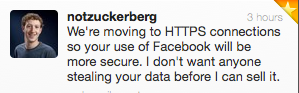
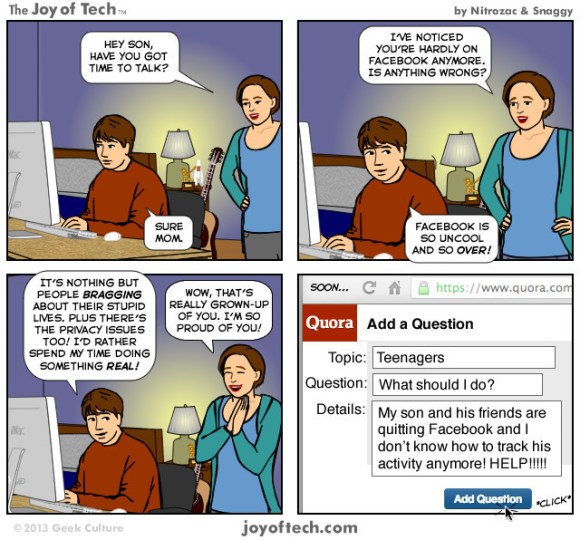
I left Facebook a long time ago, before many of the current realities of that ecosystem. Rushkoff didn’t leave for the same reasons I did (which stemmed from philosophical conceptions of temporality, time, and privacy) but his reasons echo those I keep hearing from undergrads. It isn’t just that Facebook isn’t ‘cool’; they’re spending less time on the site because the company is increasingly seen as manipulative, secretive, and portrays users in ways antithetical to how the users perceive themselves.
What is perhaps most concerning is what will happen to all the data the company has amassed if/when it implodes like MySpace did. What if, in five or seven years, Facebook effectively closes shop: who will get the mass of data that the company has collected, and how will they subsequently disseminate or manipulate it? It’s this broader concern about long-term use of incredibly intimate data that leaves me most leery of corporate-hosted social media platforms, and it’s an issue that I really don’t think people appreciate. But, then, I guess not a lot of people really remember the dot com crash…
Grace Nasri has a good – if worrying – story that walks through how Facebook could soon use geolocational information to advance its digital platform. One item that she focuses on is Facebook’s existing terms of service, which are vague enough to permit the harvesting of such information already. As much as it’s non-scientific I think that the company’s focus on knowing where its users are is really, really creepy.
I left Facebook after seeing they’d added phone numbers to my Facebook contacts for people who’d never been on Facebook, who didn’t own computers, and for who I didn’t even have the phone numbers. Seeing that Facebook had the landline numbers for my 80+ year old grandparents was the straw that broke my back several years ago; I wonder if this degree of tracking will encourage other Facebook users to flee.
Facebook and a few other large corporations understand just how serious contemporary data intrusions and exfiltrations are. They spend a lot of money preparing for attacks. Why, if private companies, are taking collected data so seriously do our governments seem to remain so cavalier with their data collection, retention, and security practices?
Social utopians like Haque, Tapscott and Jarvis are, of course, wrong. The age of networked intelligence isn’t very intelligent. The tragic truth is that getting naked, being yourself in the full public gaze of today’s digital network, doesn’t always result in the breaking down of ancient taboos. There is little evidence that networks like Facebook, Skype and Twitter are making us any more forgiving or tolerant. Indeed, if anything, these viral tools of mass exposure seem to be making society not only more prurient and voyeuristic, but also fuelling a mob culture of intolerance, schadenfreude and revengefulness.
Andrew Keen, #digitalvertigo: how today’s online social revolution is dividing, diminishing, and disorienting us
I’m jealous of old people because they didn’t have the internet and Facebook when you were young — you could get away with just about anything.
Mathew Ingram, “Snapchat and our never-ending quest for impermanence”
Bruce Schneier has a clever piece discussing the contemporary model of ‘feudal security’, where user have committed themselves to differing lords of the Internet. As a taste:
Some of us have pledged our allegiance to Google: We have Gmail accounts, we use Google Calendar and Google Docs, and we have Android phones. Others have pledged allegiance to Apple: We have Macintosh laptops, iPhones, and iPads; and we let iCloud automatically synchronize and back up everything. Still others of us let Microsoft do it all. Or we buy our music and e-books from Amazon, which keeps records of what we own and allows downloading to a Kindle, computer, or phone. Some of us have pretty much abandoned e-mail altogether … for Facebook.
These vendors are becoming our feudal lords, and we are becoming their vassals. We might refuse to pledge allegiance to all of them – or to a particular one we don’t like. Or we can spread our allegiance around. But either way, it’s becoming increasingly difficult to not pledge allegiance to at least one of them.
Feudalism provides security. Classical medieval feudalism depended on overlapping, complex, hierarchical relationships. There were oaths and obligations: a series of rights and privileges. A critical aspect of this system was protection: vassals would pledge their allegiance to a lord, and in return, that lord would protect them from harm.
Of course, I’m romanticizing here; European history was never this simple, and the description is based on stories of that time, but that’s the general model.
And it’s this model that’s starting to permeate computer security today.
The rest of the piece is clever; highly recommend taking a read.
While it comes as no surprise that police monitored Facebook during last year’s Occupy protests, in the case of Occupy Miami an advocate/journalist was specifically targeted after his Facebook profile was subjected to police surveillance. An email produced in the court case revealed:
the police had been monitoring Miller’s Facebook page and had sent out a notice warning officers in charge of evicting the Occupy Miami protestors that Miller was planning to cover the process.
Significantly, the police tried to destroy evidence showing that they had unlawfully targeted the advocate, footage that (after having been forensically recovered) revealed that the charges laid against the advocate were blatantly false. That authorities conduct such surveillance – often without the targets of surveillance knowing that they have been targeted or, when targeted, why – matters for the general population because lawfully exercising one’s rights increasingly leads to citizens being punished for doing so. Moreover, when the surveillance is accompanied by deliberate attempts to undermine citizens’ capacities to respond to unlawful detentions and false charges, we have a very, very real problem that can affect any citizen.
We know from academic research conducted by scholars such as Jeffrey Monaghan and Kevin Walby that Canadian authorities use broad catch-all caricatures during major events to identify ‘problem populations.’ We also know that many of the suspects that are identified during such events are identically labeled regardless of actually belonging in the caricature population. The capacity to ‘effectively’ sort in a way resembling fact or reality is marginal at best. Consequently, we can’t just say that the case of Occupy surveillance is an ‘American thing’: Canadian authorities do the same thing to Canadian citizens of all ages, be they high school or university students, employed middle-aged citizens, or the elderly. These are surveillance and sorting processes that are widely adopted with relatively poor regulation or oversight. These processes speak to the significant expansion of what constitutes general policing as well as speaking to the state-born risks of citizens even in ‘safe’ countries using social media in an unreflective manner.

 Excited Pixels