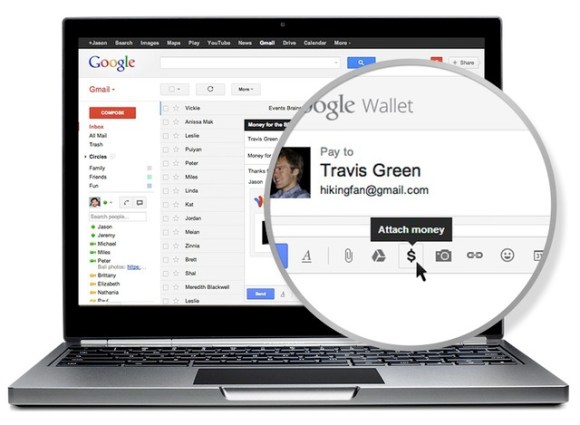
Google Wallet Update Allows Users to Send Money Through Gmail Attachments
Almost awesome. Until you realize it comes with a 2.9% transfer fee.
Google Wallet Update Allows Users to Send Money Through Gmail Attachments
Almost awesome. Until you realize it comes with a 2.9% transfer fee.

Own a Google Glass? Perhaps this is the shirt you should be wearing at all times.
We’re living in hard times, we’re not living in jolly boom dotcom times. And that’s why guys like Evgeny Morozov, who comes from the miserable country of Belarus, gets all jittery, and even fiercely aggressive, when he hears you talking about “technological solutionism.”
“There’s an app to make that all better.” Okay, a billion apps have been sold. Where’s the betterness?
Things do not always progress, and the successes of progress become thorny problems for the next generation. They don’t stay permanently “better.” Our value judgments about what are better are temporary. They are time-bound. When you overuse the word “better,” it’s like a head-fake, it’s a mantra.
You don’t have a better-o-meter. You can’t measure the length and breadth and duration of the “betterness.” “Better” is a metaphysical value judgement. It’s not a scientific quality like mass or velocity.
You can’t test it experimentally. We don’t know what’s “better.” We don’t even know what’s “worse.” Which is good. Every cloud has a silver lining.
Google doesn’t want to be “evil,” but they don’t have an evilometer. They don’t have an evil avoidance algorithm.
Bruce Sterling, Closing Remarks at SXSW2013
Google’s intrusion into the physical world means that, were its privacy policy to stay in place and cover self-driving cars and Google Glass, our internet searches might be linked to our driving routes, while our favourite cat videos might be linked to the actual cats we see in the streets. It also means that everything that Google already knows about us based on our search, email and calendar would enable it to serve us ads linked to the actual physical products and establishments we encounter via Google Glass.
For many this may be a very enticing future. We can have it, but we must also find a way to know – in great detail, not just in summary form – what happens to our data once we share it with Google, and to retain some control over what it can track and for how long.
It would also help if one could drive through the neighbourhood in one of Google’s autonomous vehicles without having to log into Google Plus, the company’s social network, or any other Google service.
The European regulators are not planning to thwart Google’s agenda or nip innovation in the bud. This is an unflattering portrayal that might benefit Google’s lobbying efforts but has no bearing in reality. Quite the opposite: it is only by taking full stock of the revolutionary nature of Google’s agenda that we can get the company to act more responsibly towards its users.
I think that it’s critically important to recognize just what the regulators are trying to establish: some kind of line in the sand, a line that identifies practices that move against the ethos and civil culture of particular nations. There isn’t anythingnecessarily wrong with this approach to governance. The EU’s approach suggests a deeper engagement with technology than some other nations, insofar as some regulators are questioning technical developments and potentialities on the basis of a legally-instantiated series of normative rights.
Winner, writing all the way back 1986 in his book The whale and the reactor: a search for limits in an age of high technology, recognized that frank discussions around technology and the socio-political norms embedded in it are critical to a functioning democracy. The decisions we make with regards to technical systems can have far-reaching consequences, insofar as (some) technologies become ‘necessary’ over time because of sunk costs, network effects, and their relative positioning compared to competing products. Critically, technologies aren’t neutral: they are shaped within a social framework that is crusted with power relationships. As a consequence, it behooves us to think about how technologies enable particular power relations and whether they are relates that we’re comfortable asserting anew, or reaffirming again.
(If you’re interested in reading some of Winner’s stuff, check out his essay, “Do Artifacts Have Politics.”)
But in the long run that’s a problem for Google. Because we tend not to entrust this sort of critical public infrastructure to the private sector. Network externalities are all fine and good to ignore so long as they mainly apply to the sharing of news and pics from a weekend trip with college friends. Once they concern large swathes of economic output and the cognitive activity of millions of people, it is difficult to keep the government out. Maybe that deterrent will be sufficient to keep Google providing its most heavily used products. But maybe not.
Huh. This Economist article seems to be in favour of nationalizing the internet? And most other services?
(via towerofsleep)
I think that the focus was more on the services provided by private companies, as opposed to infrastructure itself (i.e. not the wires, but the stuff that runs on the wires). But I think The Economist has a point that governments could be involved if services that are perceived (note: perception does not necessarily correspond with empirical facts) as essential are threatened.
What really threw me in the piece was this paragraph:
But that makes it increasingly difficult for Google to have success with new services. Why commit to using and coming to rely on something new if it might be yanked away at some future date? This is especially problematic for “social” apps that rely on network effects. Even a crummy social service may thrive if it obtains a critical mass. Yanking away services beloved by early adopters almost guarantees that critical masses can’t be obtained: not, at any rate, without the provision of an incentive or commitment mechanism to protect the would-be users from the risk of losing a vital service.
I mean: I really, really, really use Google Reader. I use the shit out of it on a daily basis. I’m the definition of one of their power users, with hundreds of sites subscribed to – often ones that only get updates every month or two, but that are super helpful for my research – and so I’m far from impressed that Google’s shuttering the service. Reader lets me hold onto the long-tail of the Internet.
But: I’m not certain how a writer can clearly link ‘early adopter’ with yanking away Google Reader. I mean, it’s an older(ish) service. We’re not talking about something that was spawned a few months ago. I get that the write might have been obliquely referring to the social functions of reader that were stripped out a year or so back, but still: there’s no way (at the time of Reader’s social demise) that you can imagine those individuals as ‘early adopters’. The product was mature (as far as many Internet products go) and just didn’t have a lot of people using the service for social purposes beyond a pretty vocal minority.
I want to be clear that I’m already dreading the loss of Google Reader. Seriously dreading. But the article in The Economist is kind of weird insofar as it mixes what are arguably fair points with insider baseball and vaguely suggested ‘beware government regulators if you screw with the services your users really use.“
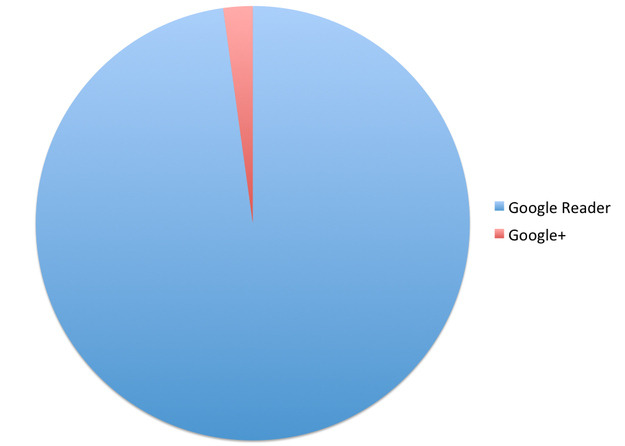
John Herrman of BuzzFeed:
According to data from the BuzzFeed Network, a set of tracked partner sites that collectively have over 300 million users, Google Reader is still a significant source of traffic for news — and a much larger one than Google+. The above chart, created by BuzzFeed’s data team, represents data collected from August 2012 to today.
Yikes. Did Google just shut down the wrong product?
I’m less clear that the ‘wrong’ thing happened.* Google is getting slammed in Europe for grabbing headlines for Google News: why not shut down Reader (which pulls information from those agencies, to readers on a Google platform) and (if the same companies want all that traffic) force them onto Google+ so that the publishers are directly providing information to Google. With Google’s current policies could they then repurpose Google+ information that the companies provided and use that to feed Google News, thus undercutting publishers’ arguments?
In essence: could this be a play to push publishers onto Google+ and, by extension, then attract people who want publishers’ content, while at the same time trying to undermine some of the arguments in the EU about Google ‘stealing’ content?
*Don’t get me wrong. I depend on Google Reader and think they screwed up. But from Google’s perspective they might not have…
The 27 regulators, led by France’s CNIL, gave Google three to four months to make changes to its privacy policy — or face “more contentious” action. In a statement on its website today, the CNIL said that four months on from that report Google has failed “to come into compliance” so will now face additional action.
“On 18 February, the European authorities find that Google does not give a precise answer and operational recommendations. Under these circumstances, they are determined to act and pursue their investigations,” the CNIL said in its statement (translated from French with Google Translate).
According to the statement, the European regulators intend to set up a working group, led by CNIL, to “coordinate their enforcement action” against Google — with the working group due to be established before the summer. An action plan for tackling the issue was drawn up at a meeting of the regulators late last month, and will be “submitted for validation” later this month, they added.
Natasha Lomas, “Google’s Consolidated Privacy Policy Draws Fresh Fire In Europe”

 Excited Pixels