
A cute representation. If it’s saved, and aggregated, it’s a sweet target for the Feds!
A cute representation. If it’s saved, and aggregated, it’s a sweet target for the Feds!
Symantec has identified 13 apps on the Android Market that are all hiding Android. Counterclank, a Trojan horse that steals information, and could also download more files and display ads on the device.
These apps are still available on the Android market, and up to five million handsets could be infected. The popularity in Android will continue to make it a lucrative target. Unless Google does more to prevent such apps appearing, it could mean the start of defection of users to other systems.
Click on above link for more.
For emphasis: up to five million handsets could be infected. That’s it, I’m calling it: Android is the new Windows for security and virus defence. Reminds me of the late 1990s and early 2000s for the number of reported actionable vulnerabilities being reported on an almost daily basis.
From the lede:
MOUNTAIN VIEW, CA—Responding to recent public outcries over its handling of private data, search giant Google offered a wide-ranging and eerily well-informed apology to its millions of users Monday.
“We would like to extend our deepest apologies to each and every one of you,” announced CEO Eric Schmidt, speaking from the company’s Googleplex headquarters. “Clearly there have been some privacy concerns as of late, and judging by some of the search terms we’ve seen, along with the tens of thousands of personal e-mail exchanges and Google Chat conversations we’ve carefully examined, it looks as though it might be a while before we regain your trust.”

THIS is the kind of actionable, helpful, warning information that should be presented to end-users. It gives them the relevant information they need to choose ‘Cancel’ or ‘Add Anyway’ without scaring them one way or the other. If the jailbreak community can do this, then why the hell can’t the big players like Apple, RIM, Google, Microsoft and the rest?
“Generally, things are not looking great with Google. I think that people have given Google a lot and with that they’ve trusted [Google] will do the right thing, that they will focus on the user and that their won’t be any surprises,” Marlinspike told IT Pro. “That’s turning out to not be true. They’re not really holding up their end of the bargain there.
“Now they’re saying you have until this time to change your mind, but it’s not about just opting in to providing data, it’s opting in in terms of connecting your life to a network that is controlled by Google.
“It’s difficult to now transition out of that. They were able to build that network through that trust and I feel like it’s not exactly fair for them to change the rules.”
~Moxie Marlinspike, January 26, 2012
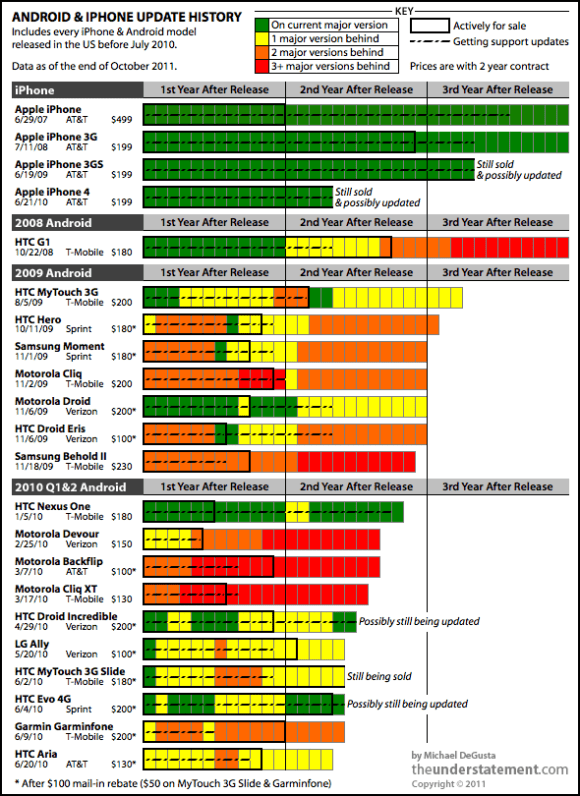
The seriousness of Android’s (lack of) security updates cannot be overstated. Phones that do not receive security updates can be subject to many of the most serious security attacks – such as man in the middle attacks, certificate-based MITM attacks, browser-based attacks, and so forth – and users remain ‘locked’ to their phones because of years-long contracts.
In essence, Android users on lengthy contracts with carriers are forcibly, contractually, linked to long-term security sinkholes.
This is an absolutely inexcusable situation, and one that Google, phone vendors, or carriers should be legislatively mandated to remedy.
I don’t dislike Google. Many of the company’s products are incredibly delightful to use. I support a fair amount of the company’s public advocacy work, though not all of it (caveat: the same could be said of almost all organizations I’m sympathetic towards). That said, I think think that their policy regard real names and pseudonyms if fucking absurd. As noted by Ars:
On Monday, Google Product Vice President Bradley Horowitz wrote on Google+ that the company will roll out its name policy changes this week. One change is that anyone will be able to add nicknames in addition to their real names. The more significant change, however, is that Google will also let people use pseudonymsinstead of a real name, but there are caveats. Horowitz indicates that the pseudonym must be established and well-known in order to qualify for a Google+ profile.
“Starting today we’re updating our policies and processes to broaden support for established pseudonyms, from +trench coat to +Madonna,” Horowitz wrote. Google may flag the name that a person intends to use and ask for additional information to confirm the person’s identity, including “Scanned official documentation, such as a driver’s license” or “Proof of an established identity online with a meaningful following.” This would seem to raise privacy problems for those who need pseudonyms for safety reasons, but a post in Mashable says “Google will destroy all documentation you send them once the account verification process is complete.”
Seriously: your pseudonym has to be “established and well known”?! By who’s standards? If I have an offline pseudonym does that count? What if my pseudonym is ‘common’ and used by a lot of people – does that impact how well ‘established’ it is?
Google is actively trying to force people into their social network and they’re just being horrific to their end-users in the process. Demanding that people provide official documents to join a social network?! Ridiculous.
This is how you leverage a monopoly in one domain (search) to force yourself into other markets while strip-mining users’ privacy expectations. I’m so glad that Google is a ‘do no evil’ kind of company and that they value users’ privacy.
The revamped Google account creation page adds some additional fields to the sign up form, including name and gender which are both necessary for creating a Google+ account. There’s also a new agreement — turned on by default — granting Google permission to “use my account information to personalize +1s on content and ads on non-Google websites.”
I would note that Facebook didn’t become successful by requiring people to sign up; it made the service cool and prestigious to drive early adoption. They also weren’t pushing people from one service into another, separate and unrelated, one. I can’t wait to see what the Europeans do to Google: it’s going to make the hell the Microsoft went through look like a brief, and sunny, walk in the anti-trust regulatory park.
Google’s recent decision to integrate its social services into its search product has led to (another) round of outrage. There’s some speculation that the FTC and European Commissioners could launch anti-trust investigations, on grounds that Google is leveraging their search monopoly to unfairly muscle into other markets. Many of the popular tech news and gadget blogs are in an uproar (perhaps knowing it will lead to page views), with Gizmodo proclaiming that Google’s recent action “wiped out all those years of loyalty and goodwill it had built up” because while the new Google search service is
…ostensibly meant to deliver more personalized results . .. it pulls those personalized results largely from Google services—Google+, Picasa, YouTube. Search for a restaurant, and instead of its Yelp page, the top result might be someone you know discussing it on Google Plus. Over at SearchEngineland, Danny Sullivan has compiled a series of damning examples of the ways Google’s new interface promotes Plus over relevancy. Long story short: It’s a huge step backwards.
I actually use Bing a lot – it’s the default (and sole option) for native search on my phone – and I hate it. HATE IT. It’s really an incompetent search tool at this point. Google, even after integrating social results, works far, far better. Nevertheless, I get the complaints surrounding the anti-trust issues and even agree with them, to a point.
What is that point, you might ask? Well, there has been a long-standing discussion of whether we need ‘search neutrality’ along the lines of ‘network neutrality’, on the basis that people increasingly find sites via search rather than directly plugging in URLs. Thus, Google’s new approach could be seen as constituting a violation of so-called ‘search neutrality’. So, where does the question or issue arise? It’s when we ask this: do search algorithms, or sets of search algorithms, function as networks do – are they ‘dumb’ algorithms meant to get us and data from point A to point B – or do they constitute a form of creative expression, of speech? If you see the algorithms as speech then the notion of ‘speech neutrality’ seems awkward: such neutrality would insist that individuals/corporations moderate their algorithmically-derived ‘speech’ once they reach a certain size.
Whether there are anti-trust violations from Google’s integration of their social services into search will remain to be seen. The more pressing question, however, is whether we see algorithms along the lines of speech or raw data transmission from A to B. I suspect that this question will be addressed or discussed in anti-trust cases and that is where the real action will likely take place.
Pretty well required reading at the moment if you’re interested in the consequences of Google integrating their own social products into their search results. I’d really recommend reading the whole thing but, if not, at least take a glance at Danny Sullivan’s takeaway:
It’s not Google’s job to be sticking it to anyone with its search results. Those results are supposed to be showing what are the most relevant things for searchers out there. That’s how Google wins. That’s how Google sticks it to competitors, by not trying to play favorites in those results, nor by trying to punish people through them.
The Google+ suggestions are indeed search results, to me. Right now, they’re search results on who to follow on Google+. I think they could be better search results if they were who to follow on any social network, anywhere.


 Excited Pixels