The global pivot away from AI safety is now driving a lot of international AI policy. This shift is often attributed to the current U.S. administration and is reshaping how liberal democracies approach AI governance.
In a recent article on Lawfare, author Jakub Kraus argues there are deeper reasons behind this shift. Specifically, countries such as France had already begun reorienting toward innovation-friendly frameworks before the activities of the current American administration. The rapid emergence of ChatGPT also sparked a fear of missing out and a surge in AI optimism, while governments also confronted the perceived economic and military opportunities associated with AI technologies.
Kraus concludes his article by arguing that there may be some benefits of emphasizing opportunity over safety while, also, recognizing the risks of not building up effective international or domestic governance institutions.
However, if AI systems are not designed to be safe, transparent, accountable, privacy protective, or human rights affirming then there is a risk that people will lack trust in these systems based on the actual and potential harms of them being developed and deployed without sufficient regulatory safeguards. The result could be a birthing or fostering of a range of socially destructive harms and long-term hesitancy to take advantage of the potential benefits associated with emerging AI technologies.
Any number of commentators have raised concerns over whether the USA could become an illiberal state and the knock on effects. A recent piece by Dr. Benjamin Goldsmith briefly discussed a few forms of such a reformed state apparatus, but more interestingly (to me) is his postulation of the potentially broader global effects:
The dominant ideology of great powers will be nationalism.
International politics will resemble the realist vision of great powers balancing power, carving out spheres of influence.
It will make sense for the illiberal great powers to cooperate in some way to thwart liberalism – a sort of new ‘Holy Alliance’ type system could emerge.
The existing institutional infrastructure of international relations will move towards a state-centric bias, away from a human-rights, liberal bias.
Mass Politics and soft power will still matter, but the post-truth aspect of public opinion in foreign policy will be greater.
For a middle state like Canada, this kind of transformation would fundamentally challenge how it has been able to operate for the past 80 years. This would follow from the effects of this international reordering and due to our proximity to a superpower state that has broadly adopted or accepted an anti-liberal democratic political culture.
Concerning the first, what does this international reordering mean for Canada when nationalism reigns supreme after decades of developing economic and cultural integrations with the USA? What might it mean to be under a ‘sphere of influence’ with an autocratic or illiberal country? How would Canada appease Americans who pushed our leaders to support other authoritarian governments, or else? Absent the same commitments (and resources) to advocate for democratic values and human rights (while recognizing America’s own missteps in those areas) what does it mean for Canada’s own potential foreign policy commitments? And in an era of rising adoptions of generative AI technologies that can be used to produce and spread illiberal or anti-democratic rhetoric, and without the USA to regulate such uses of these technologies, what does this mean for detecting truth and falsity in international discourse?
In aggregate, these are the sorts of questions that Canadians should be considering and is part of why our leaders are warning of the implications of the changing American political culture.
When it comes to our proximity to a growing anti-liberal democratic political cultural, we are already seeing some of those principles and rhetoric taking hold in Canada. As more of this language (and ideology) seeps into Canadian discourse there is a growing chance that Canada’s own democratic norms might be perverted with extended exposure and following American pressures to compel alterations in our democratic institutions.
The shifts in the USA were not entirely unexpected. And the implications have been previously theorized. An anti-liberal democratic political culture will not necessarily take hold amongstAmericans and their political institutions. But the implications and potential global effects of such a change are before us, today, and it’s important to carefully consider potential consequences. Middle states, such as Canada, that possess liberal democratic cultures must urgently prepare ways to plot through what may be a very chaotic and disturbing next few decades.
The past week has seen a logjam begin to clear in Canadian-Chinese-American international relations. After agreeing to the underlying facts associated with her (and Huawei’s) violation of American sanctions that have been placed on Iran, Meng Wanzhou was permitted to return to China after having been detained in Canada for several years. Simultaneously, two Canadian nationals who had been charged with national security crimes were themselves permitted to return to Canada on health-related grounds. The backstory is that these Canadians were seized shortly following the detainment of Huawei’s CFO, with the Chinese government repeatedly making clear that the Canadians were being held hostage and would only be released when the CFO was repatriated to China.
A huge amount of writing has taken place following the swap. But what I’ve found to be particular interesting in terms of offering a novel contribution to the discussions was an article by Julian Ku in Lawfare. In his article, “China’s Successful Foray Into Asymmetric Lawfare,” Ku argues that:
Although Canadians are relieved that their countrymen have returned home, the Chinese government’s use of its own weak legal system to carry out “hostage diplomacy,” combined with Meng’s exploitation of the procedural protections of the strong and independent Canadian and U.S. legal systems, may herald a new “asymmetric lawfare” strategy to counter the U.S. This strategy may prove an effective counter to the U.S. government’s efforts to use its own legal system to enforce economic sanctions, root out Chinese espionage, indict Chinese hackers, or otherwise counter the more assertive and threatening Chinese government.
I remain uncertain that this baseline premise, which undergirds the rest of his argument, holds true. In particular, his angle of analysis seems to set to the side, or not fully engage with, the following:
China’s hostage taking has further weakened the trust that foreign companies will have in the Chinese government. They must now acknowledge, and build into their risk models, the possibility that their executives or employees could be seized should the Chinese government get into a diplomatic, political, or economic dispute with the country from which they operate.
China’s blatant hostage taking impairs its world standing and has led to significant parts of the world shifting their attitudes towards the Chinese government. The results of these shifts are yet to be fully seen, but to date there have been doubts about entering into trade agreements with China, an increased solidarity amongst middle powers to resist what is seen as bad behaviour by China, and a push away from China and into the embrace of liberal democratic governments. This last point, in particular, runs counter to China’s long-term efforts to showcase its own style of governance as a genuine alternative to American and European models of democracy.
Despite what has been written, I think that relying on hostage diplomacy associated with its weak rule of law showcases China’s comparatively weak hand. Relying on low rule of law to undertake lawfare endangers its international strategic interests, which rely on building international markets and being treated as a respectable and reputable partner on the world stage. Resorting to kidnapping impairs the government’s ability to demonstrate compliance with international agreements and fora so as to build out its international policies.
Of course, none of the above discounts the fact that the Chinese government did, in fact, exploit this ‘law asymmetry’ between its laws and those of high rule of law countries. And the Canadian government did act under duress as a result of their nationals having been taken hostage, including becoming a quiet advocate for Chinese interests insofar as Canadian diplomats sought a way for the US government to reach a compromise with Huawei/Meng so that Canada’s nationals could be returned home. And certainly the focus on relying on high rule of law systems can delay investigations into espionage or other illicit foreign activities and operations that are launched by the Chinese government. Nevertheless, neither the Canadian or American legal systems actually buckled under the foreign and domestic pressure to set aside the rule of law in favour of quick political ‘fixes.’
While there will almost certainly be many years of critique in Canada and the United States about how this whole affair was managed the fact will remain that both countries demonstrated that their justice systems would remain independent from the political matters of the day. And they did so despite tremendous pressure: from Trump, during his time as the president, and despite the Canadian government being subjected to considerable pressure campaigns by numerous former government officials who were supportive, for one reason or another, of the Chinese government’s position to return Huawei’s CFO.
While it remains to be written what the actual, ultimate, effect of this swap of Huawei’s CFO for two inappropriately detained Canadians will be, some lasting legacies may include diminished political capital for the Chinese government while, at the same time, a reinforcing of the trust that can be put in the American and Canadian (and, by extension, Western democratic) systems of justice. Should these legacies hold then China’s gambit will almost certainly prove to have backfired.
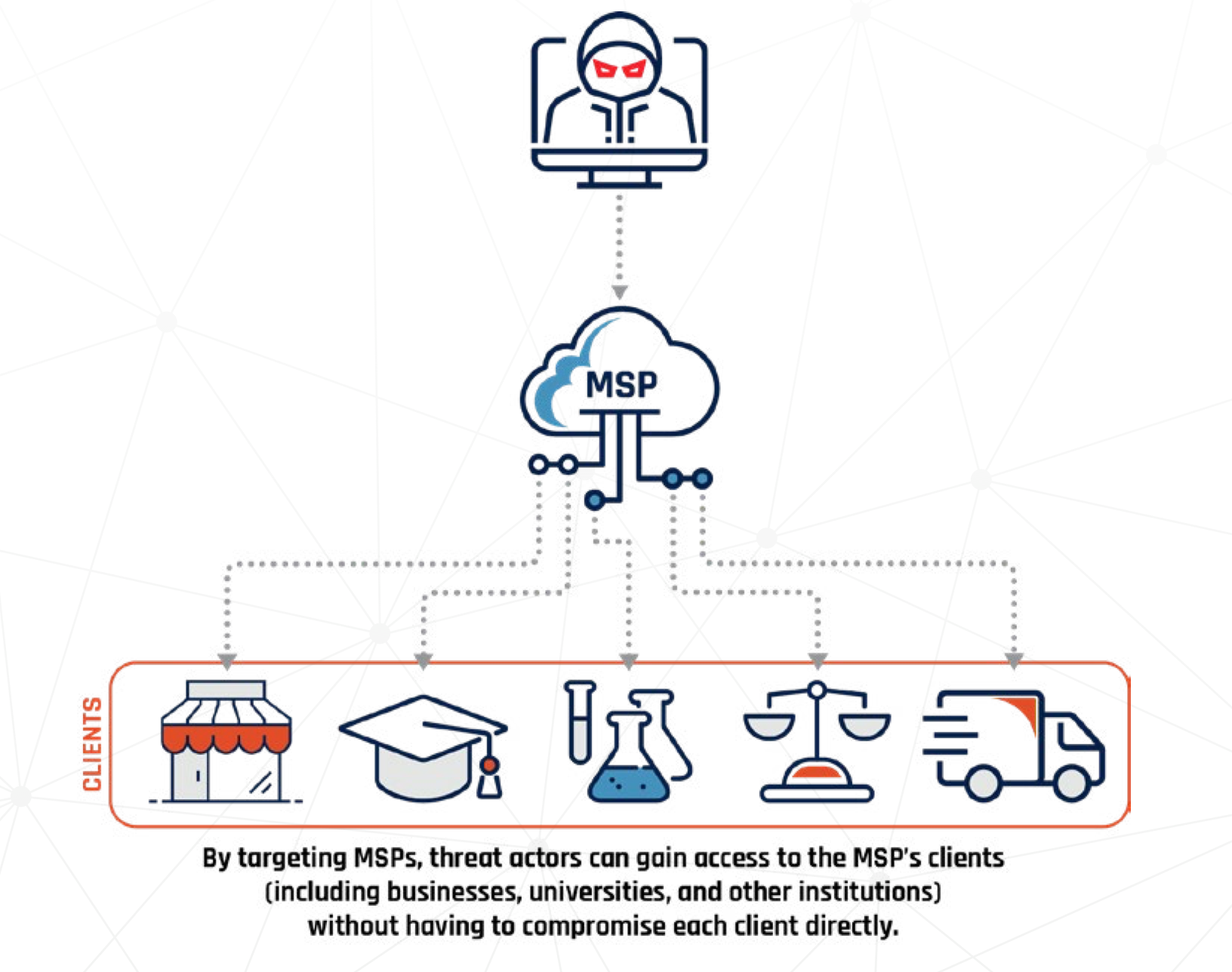
(Managed Service Provider image by the Canadian Centre for Cybersecurity)
Matt Tait, as normal, has good insights into just why the Kaseya ransomware attack1 was such a big deal:
In short, software supply chain security breaches don’t look like other categories of breaches. A lot of this comes down to the central conundrum of system security: it’s not possible to defend the edges of a system without centralization so that we can pool defensive resources. But this same centralization concentrates offensive action against a few single points of failure that, if breached, cause all of the edges to fall at once. And the more edges that central failure point controls, the more likely the collateral real-world consequences of any breach, but especially a ransomware breach will be catastrophic, and cause overwhelm the defensive cybersecurity industry’s ability to respond.
Managed Service Providers (MSPs) are becoming increasingly common targets. It’s worth noting that the Canadian Centre for Cybersecurity‘s National Cyber Threat Assessment 2020 listed ransomware as well as the exploitation of MSPs as two of the seven key threats to Canadian financial and economic health. The Centre went so far as to state that it expected,
… that over the next two years ransomware campaigns will very likely increasingly target MSPs for the purpose of targeting their clients as a means of scaling targeted ransomware campaigns.
Sadly, if not surprisingly, this assessment has been entirely correct. It remains to be seen what impact the 2020 threats assessment has, or will have, on Canadian organizations and their security postures. Based on conversations I’ve had over the past few months the results are not inspiring and the threat assessment has generally been less effective than hoped in driving change in Canada.
As discussed by Steven Bellovin, part of the broader challenge for the security community in preparing for MSP operations has been that defenders are routinely behind the times; operators modify what and who their campaigns will target and defenders are forced to scramble to catch up. He specifically, and depressingly, recognizes that, “…when it comes to target selection, the attackers have outmaneuvered defenders for almost 30 years.”
These failures are that much more noteworthy given that the United States has trumpeted for years that the NSA will ‘defend forward‘ to identify and hunt threats, and respond to them before they reach ‘American cybershores’.2 The seemingly now routine targeting of both system update mechanisms as well as vendors which provide security or operational controls for wide swathes of organizations demonstrates that things are going to get a lot worse before they’re likely to improve.
A course correction could follow from Western nations developing effective and meaningful cyber-deterrence processes that encourage nations such as Russia, China, Iran, and North Korea to punish computer operators who are behind some of the worst kinds of operations that have emerged in public view. However, this would in part require the American government (and its allies) to actually figure out how they can deter adversaries. It’s been 12 years or so, and counting, and it’s not apparent that any American administration has figured out how to implement a deterrence regime that exceeds issuing toothless threats. The same goes for most of their allies.
Absent an actual deterrence response, such as one which takes action in sovereign states that host malicious operators, Western nations have slowly joined together to issue group attributions of foreign operations. They’ve also come together to recognize certain classes of cyber operations as particularly problematic, including ransomware. Must nations build this shared capacity, first, before they can actually undertake deterrence activities? Should that be the case then it would strongly underscore the need to develop shared norms in advance of sovereign states exercising their latent capacities in cyber and other domains and lend credence to the importance of the Tallinn manual process . If, however, this capacity is built and nothing is still undertaken to deter, then what will the capacity actually be worth? While this is a fascinating scholarly exercise–it’s basically an opportunity to test competing scholarly hypotheses–it’s one that has significant real-world consequences and the danger is that once we recognize which hypothesis is correct, years of time and effort could have been wasted for little apparent gain.
What’s worse is that this even is a scholarly exercise. Given that more than a decade has passed, and that ‘cyber’ is not truly new anymore, why must hypotheses be spun instead of states having developed sufficient capacity to deter? Where are Western states’ muscles after so much time working this problem?
As a point of order, when is an act of ransomware an attack versus an operation? ↩︎
I just made that one up. No, I’m not proud of it. ↩︎
Roland Paris and Jennifer Walsh have an excellent, and thought-provoking, column in the Globe and Mail where they argue that Western democracies need to adopt a ‘democratic support’ agenda. Such an agenda has multiple points comprising:
States getting their own democratic houses in order;
States defending themselves and other democracies against authoritarian states’ attempts to disrupt democracies or coerce residents of democracies;
States assisting other democracies which are at risk of slipping toward authoritarianism.
In principle, each of these points make sense and can interoperate with one another. The vision is not to inject democracy into states but, instead, to protect existing systems and demonstrate their utility as a way of weaning nations towards adopting and establishing democratic institutions. The authors also assert that countries like Canada should learn from non-Western democracies, such as Korea or Taiwan, to appreciate how they have maintained their institutions in the face of the pandemic as a way to showcase how ‘peer nations’ also implement democratic norms and principles.
While I agree with the positions the authors suggest, far towards the end of the article they delicately slip in what is the biggest challenge to any such agenda. Namely, they write:
Time is short for Canada to articulate its vision for democracy support. The countdown to the 2024 U.S. presidential election is already under way, and no one can predict its outcome. Meanwhile, two of Canada’s closest democratic partners in Europe, Germany and France, may soon turn inward, preoccupied by pivotal national elections that will feature their own brands of populist politics.1
In warning that the United States may be an unreliable promoter of democracy (and, by extension, human rights and international rules and order which have backstopped Western-dominated world governance for the past 50 years) the authors reveal the real threat. What does it mean when the United States is regarded as likely to become more deeply mired in internecine ideological conflicts that absorbs its own attention, limits its productive global engagements, and is used by competitor and authoritarian nations to warn of the consequences of “American-style” democracy?
I raise these questions because if the authors’ concerns are fair (and I think they are) then any democracy support agenda may need to proceed with the presumption that the USA may be a wavering or episodic partner in associated activities. To some extent, assuming this position would speak more broadly to a recognition that the great power has significantly fallen. To even take this as possible–to the extent that contingency planning is needed to address potential episodic American commitment to the agenda of buttressing democracies–should make clear that the American wavering is the key issue: in a world where the USA is regarded as unreliable, what does this mean for other democracies and how they support fellow democratic states? Do countries, such as Canada and others with high rule-of-law democratic governments, focus first and foremost on ‘supporting’ US democracy? And, if so, what does this entail? How do you support a flailing and (arguably) failing global hegemon?
I don’t pretend to have the answers. But it seems that when we talk about supporting democracies, and can’t rely on the USA to show up in five years, then the metaphorical fire isn’t approaching our house but a chunk of the house is on fire. And that has to absolutely be our first concern: can we put out the fire and save the house, or do we need to retreat with our children and most precious objects and relocate? And, if we must retreat…to where do we retreat?
The answer for Haass (as it is for Judah) is leadership. But middle power leadership is not the same as great power leadership. Middle power leadership cannot trade in vague (if lofty) ambitions or general concepts. To be effective, middle powers must be focused, detail-orientated and technically proficient. This was the approach Canada used to lead on peacekeeping, organizing the Montreal Protocol on ozone-depleting chemicals, the Ottawa Convention on anti-personnel landmines and the Responsibly to Protect. All of these were clear-eyed, focused attempts to improve the international system. By leveraging their technical acumen and accumulated diplomatic capital, Canada and other middle powers got things done. These successes built international reputations and skills that could then be applied to parochial state interests. CANZUK’s supporters do not have this focus. Instead, facing complex problems, they offer vague gestures to shared liberal values.
This is probably the most direct explanation of why middle powers, as often considered amongst the Anglosphere, are routinely unable to actually achieve their goals or stated objectives. Dangerously, states and their foreign ministers may enter into arrangements in the hopes that doing so will re-create a past golden age only to realize, years later, that looking backwards has caused their respective nations to further fail to take hold of their individual and collective futures in the world stage.
While building alliances and tightening friendships can be helpful, they must be accompanied with clear and specific areas of policy coordination. Doing anything else will not enable middle powers to exert substantial power on the world stage.

 Excited Pixels