Categories
Aside Links

Don’t Use Linksys Routers

cleverhacks:

multiple remote root exploits for some of Cisco’s latest consumer-grade gear – and remember, if your router is pwned, it doesn’t matter if all your computers are patched and ultra-secure; your traffic can still be silently MITM’d and your connection hijacked for nefarious purposes.

Ah…another set of router exploits. At least all the major routers that run traffic in the core of the networks are secure from these kinds of vulnerabilities because of high degrees of security-first coding, right?

Categories
Links Writing

The Internet as a Surveillance State

The Internet is a surveillance state. Whether we admit it to ourselves or not, and whether we like it or not, we’re being tracked all the time. Google tracks us, both on its pages and on other pages it has access to. Facebook does the same; it even tracks non-Facebook users. Apple tracks us on our iPhones and iPads. One reporter used a tool called Collusion to track who was tracking him; 105 companies tracked his Internet use during one 36-hour period.

This is ubiquitous surveillance: All of us being watched, all the time, and that data being stored forever. This is what a surveillance state looks like, and it’s efficient beyond the wildest dreams of George Orwell.

Opinion: The Internet is a surveillance state – CNN.com (via new-aesthetic)

There are a few important things to recognize about Schneier’s argument (which, I don’t think, detract from his overall points):

  1. Surveillance isn’t inherently bad. It speaks to a distribution of power where another party enjoys heightened capabilities resulting from their perception of the surveilled. Surveillance becomes ‘bad’ when the power disequilibrium has harmful moral or empirical consequences.
  2. Again, it isn’t entirely surveillance that’s the ‘problem’ with the Internet; it’s the persistent recollection of information by third-parties, often without the data subject knowing that (a) the data was collected; (b) it was subsequently recalled in an unrelated context; © it was then used to influence interactions with the data subject. These problems have always existed, in some fashion, but we are living in an era where what used to historically have been lost to the ethers of time is being retained in massive databases. The nature of perpetual computational memory – often made worse when errors in retained data spawn in perpetuity across interlinked systems – challenges how humans understand time, history, and subjectivity in very powerful ways.
  3. With regards to (2), this is why Europeans are interested in their so-called ‘Right to Be Forgotten’. And, before thinking that forgetting some data collected vis-a-vis the Internet would lead to the end of the (digital) world, consider that Canadians largely already ‘enjoy’ this right under the consent doctrines of federal privacy law: the ‘net isn’t broken here, at least not yet!

(Note: for more on the consent doctrine as it relates to social media, see our paper on SSRN entitled, “Forgetting, Non-Forgetting and Quasi-Forgetting in Social Networking: Canadian Policy and Corporate Practice”)

Categories
Quotations

2013.2.11

Reality turned out to be much more complicated. What we forgot is that technology magnifies power in both directions. When the powerless found the Internet, suddenly they had power. But while the unorganized and nimble were the first to make use of the new technologies, eventually the powerful behemoths woke up to the potential – and they have more power to magnify. And not only does the Internet change power balances, but the powerful can also change the Internet. Does anyone else remember how incompetent the FBI was at investigating Internet crimes in the early 1990s? Or how Internet users ran rings around China’s censors and Middle Eastern secret police? Or how digital cash was going to make government currencies obsolete, and Internet organizing was going to make political parties obsolete? Now all that feels like ancient history.

Bruce Schneier, “Power and the Internet
Categories
Aside

Dial-up handshaking illustrated

Categories
Quotations

2013.2.5

The totalizers would happily follow Johnson in seeking answers to questions such as “So what does the Internet want?”—as if the Internet were a living thing with its own agenda and its own rights. Cue a recent Al Jazeera column: “The internet is not territory to be conquered, but life to be preserved and allowed to evolve freely. … From understanding the internet as a life form that is in part human, it follows that the internet itself has rights.”13 That is the kind of crazy talk to be avoided. The particularizers would not invoke “the Internet” to embark on a quixotic attempt to re-make democratic politics; but the totalizers, in their quasi-religious belief, would do so gladly.

A good account of the Internet would never need to mention that dreadful word at all. This stringent requirement might uproot most of our Internet thinkers from the plateau of banal and erroneous generalizations where they have resided for the last two decades; after all, it is the very notion of “the Internet” that has allowed them to stay there for so long. Now that Internet-centrism is not just a style of thought but also an excuse for a naïve and damaging political ideology, the costs of letting its corrosive influence go unnoticed have become too high.

Evgeny Morozov, a Review of Future Perfect: The Case for Progress in a Networked Age
Categories
Aside Humour

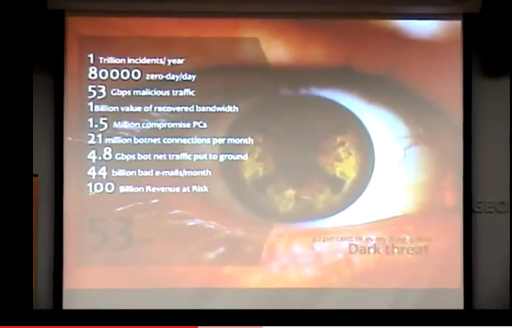
Bell and Internet-Based Security

A dated, but poignant, bit of information from Bell Canada concerning Internet-based computer security threats in Canada

Categories
Quotations

2013.1.29

The actors that represent the majority of users today, stakeholders from the South, the developing world, and the non-English segments of the net, will do more to shape the future of cyberspace than any discussions at the Pentagon or in policy circles in North America and Europe. To understand how and in what ways cyberspace will be characterized in years to come we need to think beyond the beltway, beyond Silicon Valley, and into the streets of Shanghai, Nairobi, and Tehran. The contests occurring in those spaces deserve our attention today, if for no other reason than that they provide a glimpse of the types of global issues that will drive cyberspace governance in the future.

Ronald Deibert and Rafal Rohozinski, “Contesting Cyberspace and the Coming Crisis of Authority”
Categories
Quotations

2013.1.15

Placing sensitive data in insecure locations is never a good idea, and the loss of physical security has long been considered tantamount to a breach. Yet some early elements of the IoT incorporate this very flaw into their designs. It’s often an attempt to compensate for a lack of technological maturity where always-on network connectivity is unavailable or too expensive, or the central infrastructure does not scale to accommodate the vast number of input devices.

As the IoT crawls through its early stages, we can expect to see more such compromises; developers have to accommodate technical constraints — by either limiting functionality or compromising security. In a highly competitive tech marketplace, I think we all know which of these will be the first casualty.

And it’s not just security: it’s privacy, too. As the objects within the IoT collect seemingly inconsequential fragments of data to fulfill their service, think about what happens when that information is collated, correlated, and reviewed.

Andrew Rose, “The Internet of Things Has Arrived — And So Have Massive Security Issues
Categories
Links

Advice on Browsing the Web Safely

Global Voices has a series of good suggestions on how to browse the web safely. Many users may not need to take the more extreme precautions – such as browsing from a USB-drive mounted operating system – but other pieces of information are helpful. Well worth the (quick) read.

Categories
Quotations

2012.12.31

I’m jealous of old people because they didn’t have the internet and Facebook when you were young — you could get away with just about anything.

Mathew Ingram, “Snapchat and our never-ending quest for impermanence