Categories
Quotations

2013.3.4

The traditionally advocated uses for NFC have been to replace RFID chips in travel cards, such as the Oyster card in the UK, and RFID chips in credit cards, such as MasterCard’s PayPass.

The problem with these replacements is a simple one, however. Smartphone batteries run out. They do so with alarming regularity, and they do so at inopportune moments. I don’t care what phone you say you have, and I don’t care if you say it doesn’t happen to you, because it does. You end up staying out late, or you leave your charger at home by accident, or you just plain use the phone too much during the day, and then when you need the phone to work, it doesn’t because it’s out of juice.

The phone running out of power is bad enough when it means you don’t have maps and directions. That’s annoying. But even worse is the battery going flat when you need the phone for mass transit or paying for stuff.

And yet that’s precisely the value proposition that NFC offers: go out for a night on the town and get stranded with no money, no subway ride home. The only way to be safe is to take your credit card and travel card with you anyway, and if you’re doing that? Well you don’t exactly need NFC then, do you?

Peter Bright, “Mobile World Congress is Mean Girls, and NFC isn’t going to happen”
Categories
Writing

Attention shoppers: Retailers can now track you across the mall

While the technology that the IT World article discusses isn’t terribly novel – I was given a paper conducted by grad students on this topic a few years ago, and they had a working prototype of similar systems – I find it incredibly worrying that ambient information that smartphones expel is being used for purposes in excess of why the information is transmitted in the first place. We don’t live in a (Western) world where lacking a cell phone is common; for many people a mobile phone is critical to their business or livelihood. Indeed, when you go to other areas of the world where mobile penetration is even higher because of exorbitant costs associated with laying down fibre, mobiles are even more important on a daily basis.

As such, and any suggestion like “if you don’t want to be tracked, don’t own a phone” misses the point around privacy concerns related to mobile phone tracking. In effect, it shouldn’t be up to the individual to unilaterally defend themselves from further expansions of private surveillance capabilities. Instead, those capabilities should be limited by law, by regulation, and by a minimalistic sense of ethics. Tracking where people are walking, and giving them an option to opt-out of tracking by visiting a website they’ve never heard of and digging into its depths is not a sufficient way to ‘empower’ individuals.

Categories
Aside Links

What Windows Phone Needs

Tumblr user nugnug provides an excellent list of the core “what’s missing” in Windows Phone right now and that will continue being absent after the 7.8 update:

  • rotation lock – I surf the net when I’m lying down. Everyone does. This is such an important feature and yet, where the hell is it?
  • screen capture – I can’t take screenshots on my phone! What is this!? How can I blackmail people and post the stupid things they say on Facebook?
  • customized sounds for messaging, etc. – We can customize our ringtones, so why not the rest?
  • notification center – This ain’t happening. I already know this cause they didn’t have time to make it. Lame.
  • separate volume controls for phone sounds and media – I want to listen to music at a really low volume but that means I won’t be able to hear my phone ring. A dilemma that can be easily rectified.
  • the forward button and “find on page” function in IE – there’s a java fix someone else kindly made, but there shouldn’t be a need. It’s a basic function that should be included in all internet browsers.
  • Wifi turns off when in sleep mode – the biggest reason why my whatsapp messages arrive hours later is because my phone, which relies on only Wifi when I’m at home, turns off Wifi when it goes to sleep. Ugh.
  • Blutooth file transfers – I WANNA GIVE MY FRIENDS STUFF WITHOUT USING MY NET DATA BUT I CAN’T.
  • multi selection – let me delete multiple photos on my phone at a time. PLZZ.
  • editing the dictionary – there are some words I made up, I would like to delete please.
  • improvements in the calendar – by far the most used section of my phone, it holds all my schedules and Facebook events and works seamlessly. So why not build on it? Include a weekly view, allow me to change colours on some of my personal entries.
  • automatic sleep mode – not too fussy, but this would be really cool. If I set a time e.g. from 11pm to 8am, my phone will sleep between those hours and I won’t get any notifications between those times.
  • closing apps from the multitasking view – not too important

I have to admit that some of the items aren’t top of mind for me: I don’t really care about the sleep mode, don’t see the point of closing apps from the multitasking view, and am not interested in bluetooth sharing. That said, every other suggestion is much, much needed.

I would also add to the list that scrolling in the 7.8 update needs to change; in the older version 1 Windows Phones scrolling would accelerate the more your scrolled up or down, whereas the current generation of 7.5 phones feature a static scrolling rate. This speed simply feels slower than earlier – and less capable – hardware and software iterations of Windows Phone.

Categories
Quotations

2012.7.30

You hereby grant Ninja Tel permission to listen to, read, view and/or record any and all communications sent via the network to which you are a party,“ one section stated. “Before you get all upset about this, you already know full well that AT&T does this for the NSA. You understand that you have no reasonable expectation of privacy as to any on the Ninja Tel network. You grant Ninja Tel a worldwide, perpetual, assignable, royalty-free license to use any and all recorded or real-time communications sent via the Ninja Tel network to which you are a party. Don’t worry, most of this is for the lulz.

Ninja Tel Terms of Service (read more at Ars)
Categories
Aside

Is Your Phone Being Wiretapped?

Categories
Links Writing

Incumbent Beats Competitor. Again.

A major challenge facing Canada’s “new” mobile companies is this: how can they extend network coverage across Canada to increase the utility of their product offerings? One way they address the challenge involves entering roaming agreements with incumbent carriers. As Wind Mobile is finding out, Rogers Communications is willing to both do the least possible to enable roaming and fight at the CRTC to maintain this minimal standard.

Specifically, from The Telecom Blog we find that

…Wind Mobile complained again to the CRTC stating that Rogers continues to discriminate against its roaming customers. Though RIM managed to muster support from the Consumer Association of Canada, the CRTC has ruled again in favor of Rogers. The upstart carrier claims that currently there’s no way for Wind subscribers to continue a live call when they hop onto Rogers network. The call is dropped and the subscribers are forced to redial.

Though Wind has been lobbying hard to get seamless roaming onto the Rogers network, the CRTC declined the request stating that “in view of its determination that RCP had not granted itself a preference, it would be inappropriate to deal with the issue of mandating seamless call transition.”

Needless to say, these are the actions of an incumbent doing what it can to limit the appeal of competitors’ products. The reason that Rogers wasn’t found to have granted itself a preference was because Rogers hadn’t rejigged their network in response to the roaming agreement: Rogers simply made the decision not to make technical improvements that would enable seamless live call transitions.

Much of the issue around transitions, and other telecom-related battles between incumbents and competitors in Canada, stem from the CRTC’s basic position that the Canadian telecommunications market should be directed by facilities-based competition. In other words, the position is (generally stated!) that competitors are recognized as temporarily needing access to incumbent networks when they first incorporate, but that the same competitors should build out their own infrastructure over time.

This CRTC’s preferred mode of competition is incredibly expensive and is arguably redundant; structural separation is postulated as one means of addressing the issue, as are spectrum sharing, and improved infrastructure sharing agreements that are driven by federal institutions’ fiats. Regardless of the particular solution you favour – if you see a problem as existing, in the first place! – something should be done to better enable new competitors in Canada. The CRTC theoretically attempts to promote market competition so that services are less costly for Canadians while simultaneously ensuring that offered services are of high quality and are efficient. Where something so basic as call transitions isn’t addressed, one has to wonder whether some federal institution shouldn’t be a lot more involved than they are in enabling competition in Canada’s mobile marketplace.

Categories
Aside

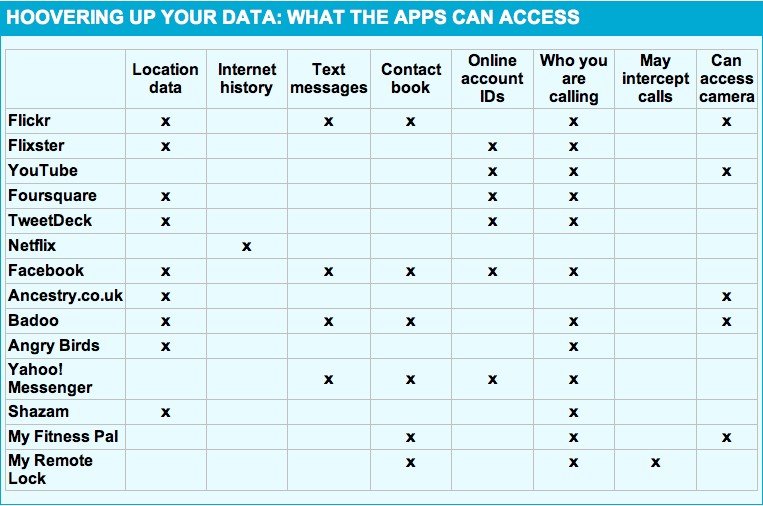
What the Apps Can Access

Just a few of the mobile phone apps that hoover up your information when you run them on your Android device.

Categories
Links Writing

Poison Texts Targeting Mobile Phones

While smartphones get in the news for security reasons related to mobile malware, it’s important that we not forget about the other means of attacking mobile phones. USA Today has a piece which notes that,

One type of poison text message involves tricking people into signing up for worthless services for which they get billed $9.99 a month. Another type lures them into doing a survey to win a free iPhone or gift card. Instead, the attacker gets them to divulge payment card or other info useful for identity-theft scams. “Malicious attacks have exploded well beyond e-mail, and we are very aware of their move to mobile,” says Jacinta Tobin, a board member of the Messaging Anti-Abuse Working Group, an industry group combating the problem.

This approach is really just phishing using text messages. It’s significant, but not necessarily something that we should get particularly jumpy about. The same article recognizes that “hackers are repurposing skills honed in the PC world to attacks on specific mobile devices. Particularly, handsets using Google’s Android operating system are frequently the target of hackers.” What is missing in the article is a recognition that text-based phishing can be made considerably more effective if an individual’s smartphone has already leaked considerable amounts of personal data to the attacker via a third-party application. This is the scenario we should be leery of.

Specifically: we can easily imagine a situation where a hostile application that has been installed on a smartphone acquires enough personal information that an attacker can engage in targeted spear phishing. By getting name, address, names of friends and family, places of employment, recent photos that are geotagged, and so forth, it is possible to trick individuals by text messages to ‘give up’ information. Moreover, by first compromising devices attackers can better target specific individuals based on how the phishermen have profiled device owners: they can be choosy and target those who would either be most vulnerable or best resourced. It’s the integration of two known modes of attack – phishing and compromising smart devices – that will be particularly devastating far in excess of either attack vector on its own.

Categories
Links Writing

Research In Motion to Further Improve Antennas

From The Telecom Blog we learn that RIM has acquired Paratek Microwave Inc. Paratek is:

a company whose adaptive radio-frequency technology improves mobile-handset call quality and battery life. It’s believed that RIM may leverage this acquisition to improve the overall performance of its next generation BlackBerry smartphones.

General Partner of Polaris Venture Partners Alan Spoon believes RIM would benefit immensely by integrating Paratek’s game changer technology into mobile phones. He says the technology allows mobile devices to upload and download large amounts of data faster, making for longer battery life, which coupled with Paratek’s innovative design, leads to a small form factor. More importantly, the Tunable RF reduces dropped calls and allowing reliable data flow across multiple frequency bands, thereby providing an overall enhanced mobile user experience.

One of the reasons that I left behind my Window Phone 7 was its incredibly poor reception. It’s the only smartphone that I’ve owned that regularly dropped calls and made hearing calls a challenge. The iPhone that I used previously was acceptable, but not great: when I had to make, or receive, an important call I found a landline.

I don’t have to find landlines with my 9900. The call quality is terrific. While call quality isn’t something I really would have cared about a few year back – I rarely called people or received calls, and when I did they were usually personal in nature – I do care today because of the various professional calls I make on a daily basis. While the Blackberry isn’t as fun to play on it’s a far more reliable professional tool.

Not having to hunt down a landline saves me a ton of time, and I’m incredibly pleased to see that RIM cares enough about further improving call and signal quality that they are snapping up companies who can bring advantages to their smartphone environment.

Categories
Links

Phishing on Mobile Devices

A good paper on (you guessed it!) phishing on mobile devices. Paper is here (.pdf) and abstract is below.

We assess the risk of phishing on mobile platforms. Mobile operating systems and browsers lack secure application identity indicators, so the user cannot always identify whether a link has taken her to the expected application. We conduct a systematic analysis of ways in which mobile applications and web sites link to each other. To evaluate the risk, we study 85 web sites and 100 mobile applications and discover that web sites and applications regularly ask users to type their passwords into contexts that are vulnerable to spoofing. Our implementation of sample phishing attacks on the Android and iOS platforms demonstrates that attackers can spoof legitimate applications with high accuracy, suggesting that the risk of phishing attacks on mobile platforms is greater than has previously been appreciated.