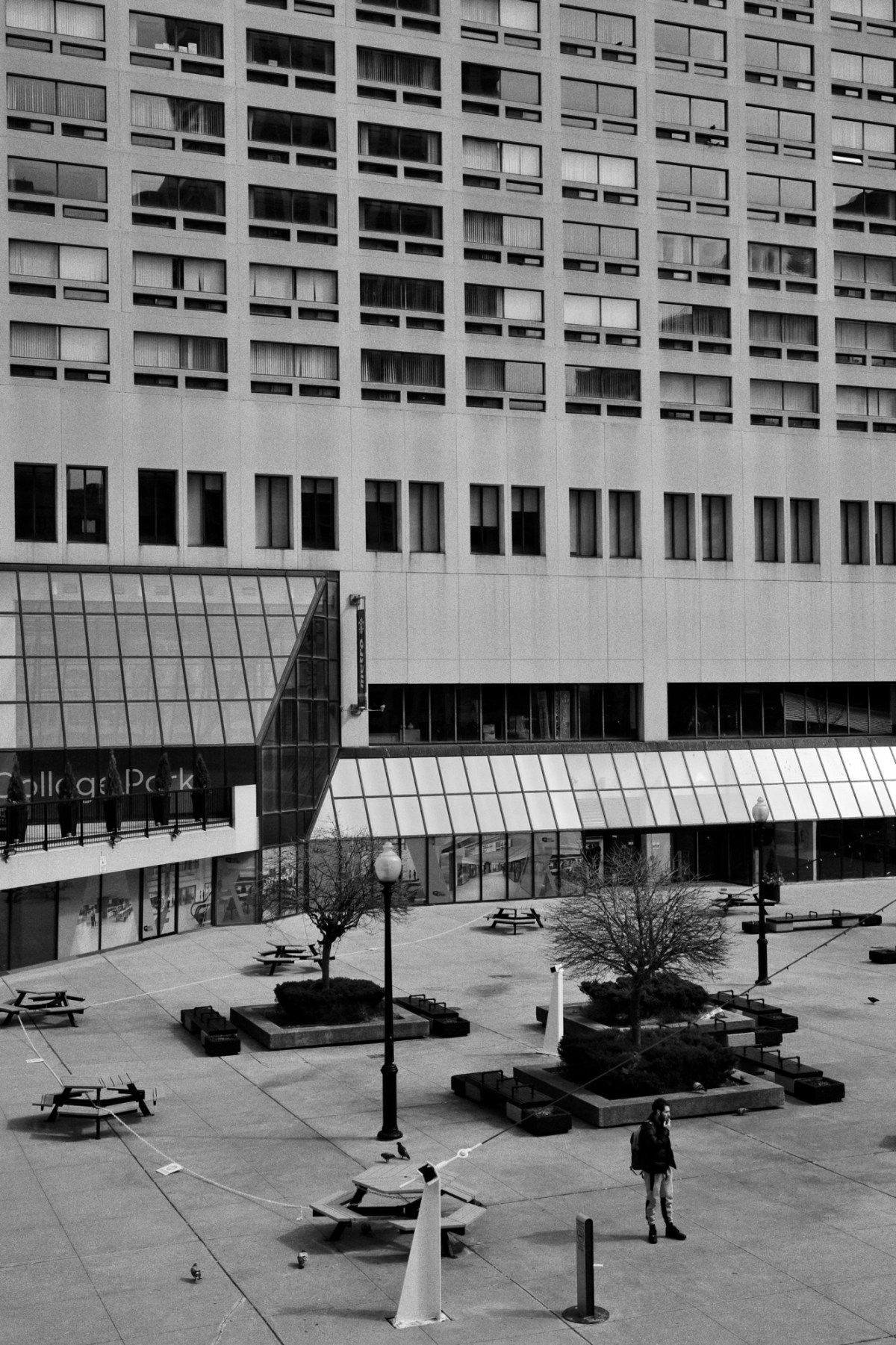
Each month Glass has a different featured photographic category. In March, a photograph I took of College Park was amongst the many excellent images that photographers published to the platform throughout the month in the ‘Urban’ category.
A feature of my street photography is to showcase lone humans in busy metropolitan areas. For context, College Park is surrounded by condos and rental apartments, and is located by a major subway stop; I suspect it’s amongst the denser parts of the city. Nevertheless I was able to catch this lone figure and the ever-present pigeons when I was running to a grocery store to get a few things.
I don’t know that I, personally, consider this to be the best image I made in March. But it definitely is very reflective of the types of images I’ve been making and so is representative of a particular body of work that I continue to develop.
For those interested, this was made using a Ricoh GR iiix. I use a custom monochrome jpeg simulation, applied minor edits in Apple Photos, and cropped the image slightly so it is 20 megapixels as displayed.
Toronto is a city of destruction and construction: destruction of the previous era’s architecture (and often industrial buildings) and the construction of housing or glass office towers in their stead. This image by Tecumseth & Niagara shows the destruction of an abattoir that was removed to make room for condos, and the buildings in the background are new rentals in Toronto’s Liberty Village. When I landed in Toronto, in Liberty Village over a decade ago, the land those rentals are on were home to a few artist spaces where the big Toronto samba schools practiced and massive parade puppets were made. Nothing has replaced those artist spaces, to the detriment of artists across the city.
Weirdly I have very intimate memories of the abattoir. Toronto hosts an annual sunset-to-sunrise art festival, Nuit Blanche, and a couple interesting art exhibits were hosted at the abattoir over the years, and I have photos of them that I regularly return to re-experience. After the buildings were designated for destruction a number of community vegetable gardens were maintained on the outside lots. It was always a striking place to come and make images, and was a reminder of the Toronto-that-once-was and was yet-to-become.
For many street photographers, we take images and it is decades later that ‘difference’ is registered because many cities take a long time for major changes to become visible. It’s part of why the habits of the population —what people are wearing, holding, or driving — resonate so strongly with viewers; people and culture change while the built environment persists.
Toronto, by way of contrast, is in a moment of hyper-growth and so an attentive and active street photographer can document things today that may literally be different tomorrow. It turns the street photographer, almost by default, into an urban documentarian. And, also, is one of the many reasons why I think that Toronto offers a subset of street photographers a real opportunity to do novel and rapidly impactful work, as compared to those working in cities that aren’t undergoing the same tempo of destruction and re-construction.
In the late fall of 2022 I decided that I’d turn one of my street photographs into a postcard for each month of 2023. I just received my proofs for 2023 this week and I’m happy with them; the full order will be made in the next week or two.
I also, however, will be posting the preceding year’s images to Excited Pixels. So, this January I’m posting the January 2023 photograph, in February I’ll post the February photograph from February 2023, and so on.
In addition to the street photograph that was made into a postcard I’ll also be publishing my favourite landscape/streetscape from that month. Despite making a reasonable number of landscapes/streetscapes, this will be the first time that I regularly publish some of them.
January 2023: Streetscape
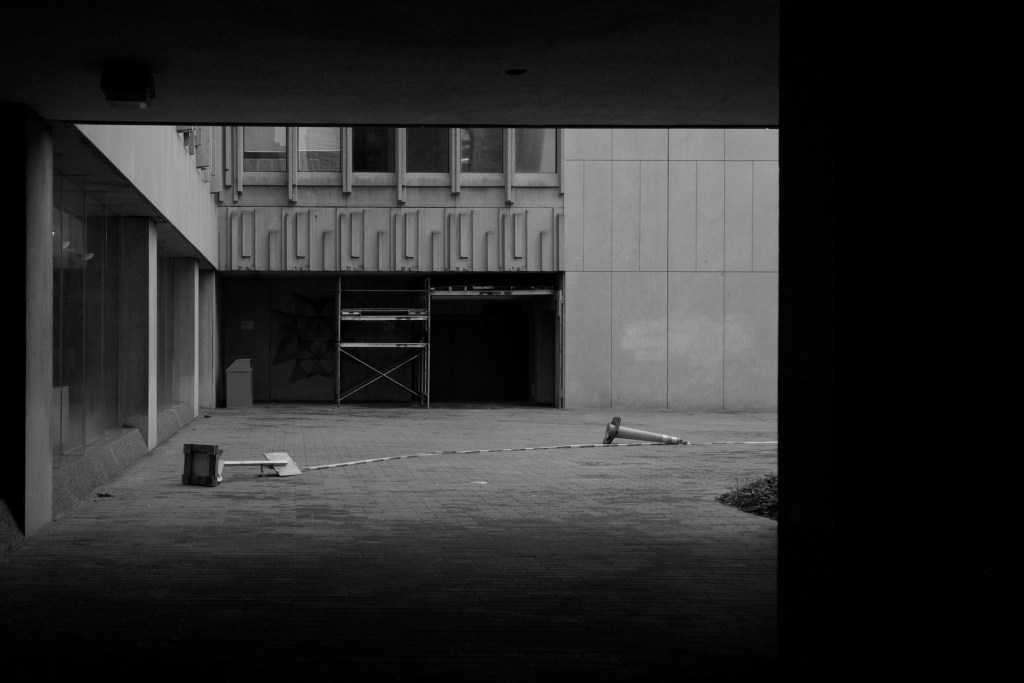
University of Toronto , Toronto, 2023
I made this image of an under-construction part of the University of Toronto in my last few weeks employed with the institution. It is, in many ways, a deeply personal photo that reflected my passage to a new space. The tape and barriers being knocked over was figurative, in the sense that what once was a warning to keep me away was now a path to follow out of frame, and into new experiences and adventures after working with the same employer for almost a decade.
January 2023: Street Photograph
Richmond & Bay, Toronto, 2023
This photo was made January 1, 2023 and it remains one of my favourites. The emotion in the subjects’ face draws me in and the steam and garbage lends this part of the city (home to the country’s largest banks, stock exchange, and other financial and legal institutions) a kind of grittiness that belies its proximity to wealth and power. The photograph, also, speaks of how you can build a story in a frame that might look one way, but which doubles in meaning and context once grounded in the space and time wherein it was made.
I kept coming back to Bay and Richmond throughout the year and was regularly rewarded with rich images. The fluidity of the location, with updates to the built infrastructure in the form of temporary construction scaffolding, and the steam emerging from vents in this party of the city, just made it fun to keep coming back to.
The Globe and Mail has a terrific photographic series entitled "A century caught on camera." As a Toronto resident I was struck by just how many traditions, rituals, and grievances have stuck with the city–or in the city–for over a century.
Further, the way in which the images have been captured has changed substantially over time as a result of the technical capacity of camera equipment, along with the interests or preferences of the photographers at different times. Images in the past decade or two, as an example, clearly draw more commonly from celebrity or artistic portraiture than 50 years ago. Moreover, it’s pretty impressive just how much photographers have done with their equipment over the past century and this, generally, speaks to how easy street and documentary photographers have it today as compared to when our compatriots were using slow lenses and film.
It may take you quite a while to get through all the images but I found the process to be exceedingly worthwhile. Though I admit that the first decade during which the Globe used colour images probably ranks as my least favourite period in the galleries that the paper has published.
I’ve had the good fortune to get out and take photos pretty well every week of the summer. On the whole I’ve enjoyed decent light, good and interesting weather, and lots of events that opened up opportunities to capture the city in interesting ways.
This was taken at one of the first festivals of the summer. I just walked back and forth through it over a couple of days and left with a number of images I liked, with this probably my favourite. Why?
First, I love the woman’s expression in her relationship to the officer, as well as with the pineapples: what exactly is the problem? Why is she so shocked? What has the officer said, if anything?
Second, I liked the background — it showcases this part of Toronto. It’s not filled with the new shiny glass buildings and condos, and still has some of the older shops and signs. This location gives a sense of ‘where’ this image was taken.
Third, I just like having images with pineapples in them. I don’t know why but I can tell it’s a motif in studying the images that I’ve taken over the years.
Queens Quay & Spadina, Toronto, 2023
This image was taken on Toronto’s waterfront. It just captures all the things that summer can be in Toronto: ferries coming from the Toronto islands, some people relaxing along the water, seagulls (which are everywhere along the waterfront in the summer), travellers landing at the island airport, and just a sense of activity and calm.
York & Wellington, Toronto, 2023
Taken from the financial district of downtown Toronto, I really liked how the light was falling on the scene and the way that the male subject is relaxing against the bulls. It almost feels pastoral to me, which isn’t the typical experience I get when walking around (or living in) the downtown core.
Queen & Bay, Toronto, 2023
I’m a sucker for taking photos of ice cream trucks and I really liked how this guy was looking out of the truck while a pigeon was just wandering by in the lower left of the frame. Is this the most complex image I took in the summer? Nope. But I still liked the environmental portrait that was captured.
Spadina & St Andrew, Toronto, 2023
Taken along one of my regular patrol routes, there’s a lot that I like throughout this frame.
It has a lot of construction elements — something I’ve been deliberately including in my street photos as part of a long-term project — and there’s some sub-framing that comes out because of how the shadows lay against the wall. The subjects to the far right of the frame are somewhat interesting — what are they pointing at? And does it intersect with the ‘caution’ warning? — but their shadows are where they shine. The shadows seem like they’re up to…something…while at the same time there is a subject that is reminiscent of the Invisible Man wandering along the left side of the frame. In aggregate, this scene has a degree of dimensionality that I really liked, some subjects of interest, and fit within an ongoing project.
Queens Quay & Bay, Toronto, 2023
I’m always a sucker for isolated subjects in the city who are in interesting situations, or have interesting expressions or body language. This photograph captures this for me.
I like that the main subject seems somewhat desolate, and yet is sitting alongside a series of summer treats and toys. And the fact that this is a vendor who only takes cash? I wonder when such signs are going to be real indicators of a distant past. The other piece that I like is how the top, right, and left of the frame are all food-related: the subject is selling popcorn and candies, hotdogs are being sold along the left of the frame, and the top of the frame can refer to top-end gourmet restaurants. So there’s multiples ‘frames’ to the subject which, again, adds a degree of structure or complexity into the composition.
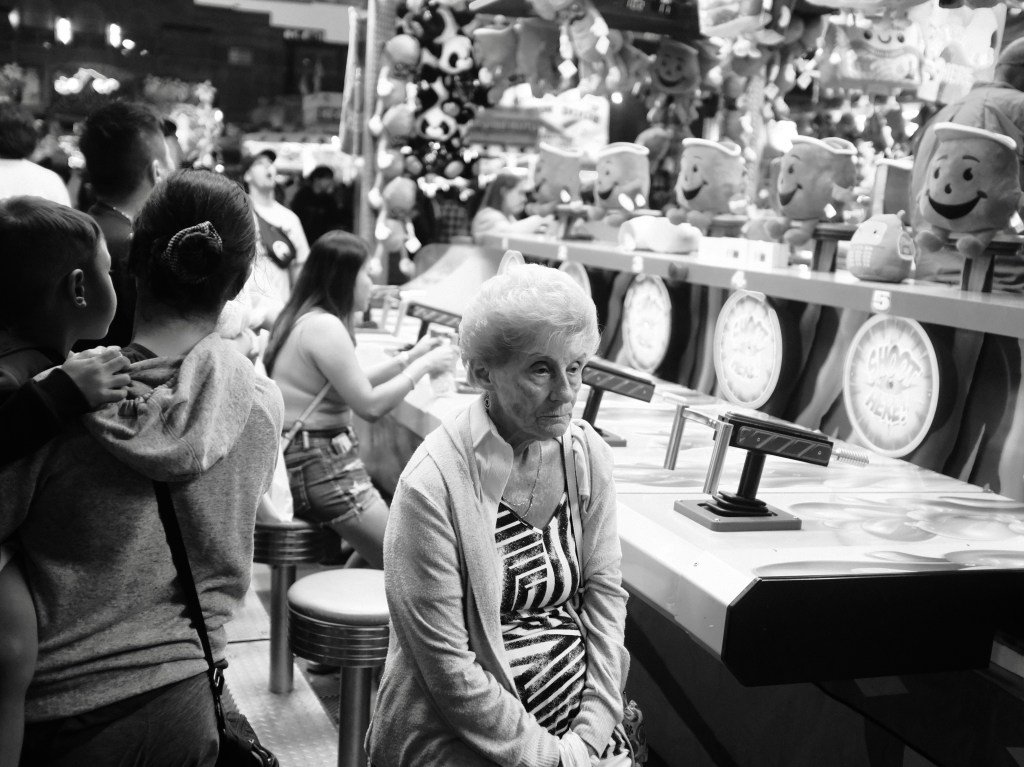
Canadian National Exhibition, Toronto, 2023
This was taken during the waning days of the CNE, which is a massive festival that takes place annually in Toronto. People are typically excited and happy, but our older subject, here, seems sad, quiet, or in deep contemplation.
Having her placed against games and the Kool-Aid Man on one side, and the child and mother on the other, really underscores her emotional state in what is typically a festive situation. I also like the depth of the photo that indicates where the women is in Toronto. This leaves the viewer with a deeper sense of context, which helps to amplify the woman’s facial expression and body language.
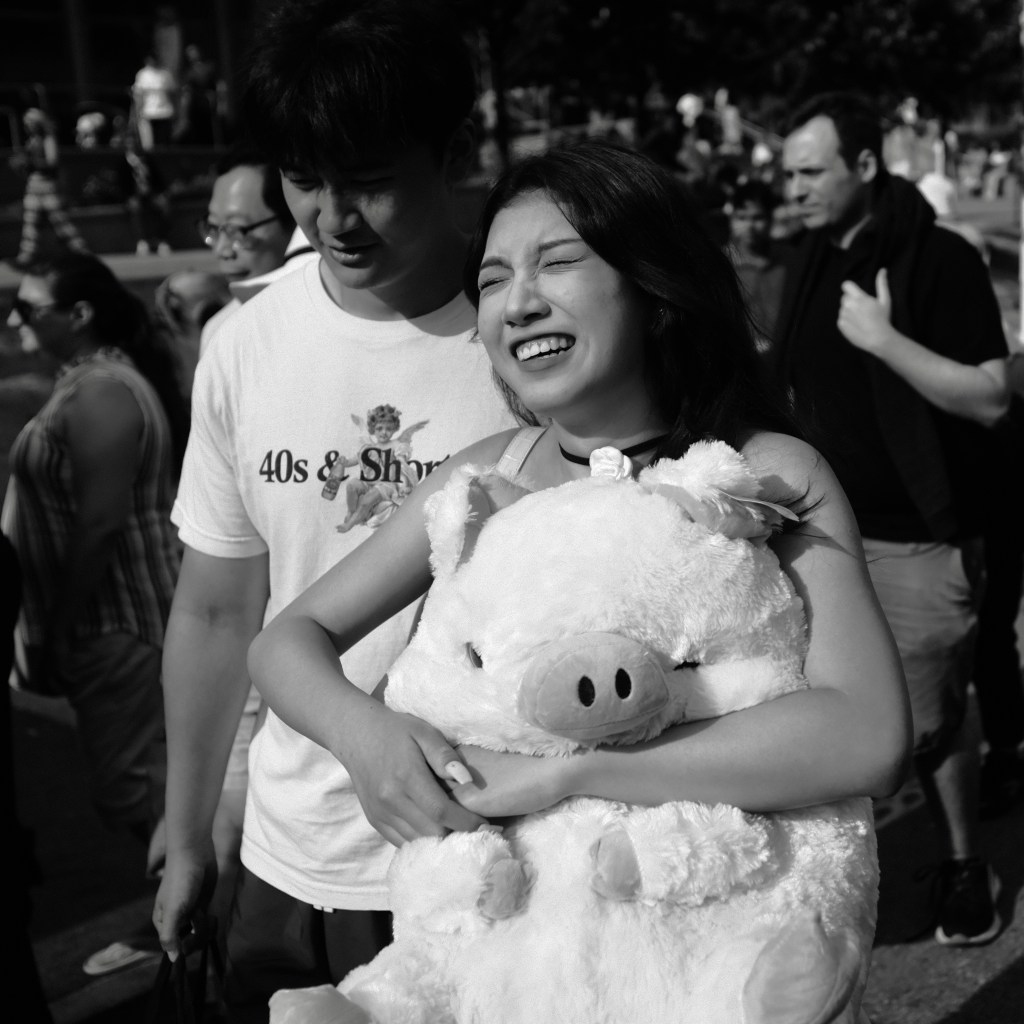
Canadian National Exhibition, Toronto, 2023
The final photo of the summer is another from the CNE. The subjects in this one exemplify what is ‘normal’ in the summer — happiness, togetherness, and fun. The subjects’ expressions and open and apparent and I love how large the stuffed pig is in context to the woman — what will she do with it once she gets it home?
While it’s not the most complicated of photos I took over the summer it expresses a sense of unadulterated happiness or joy that regularly brings a smile to my face.
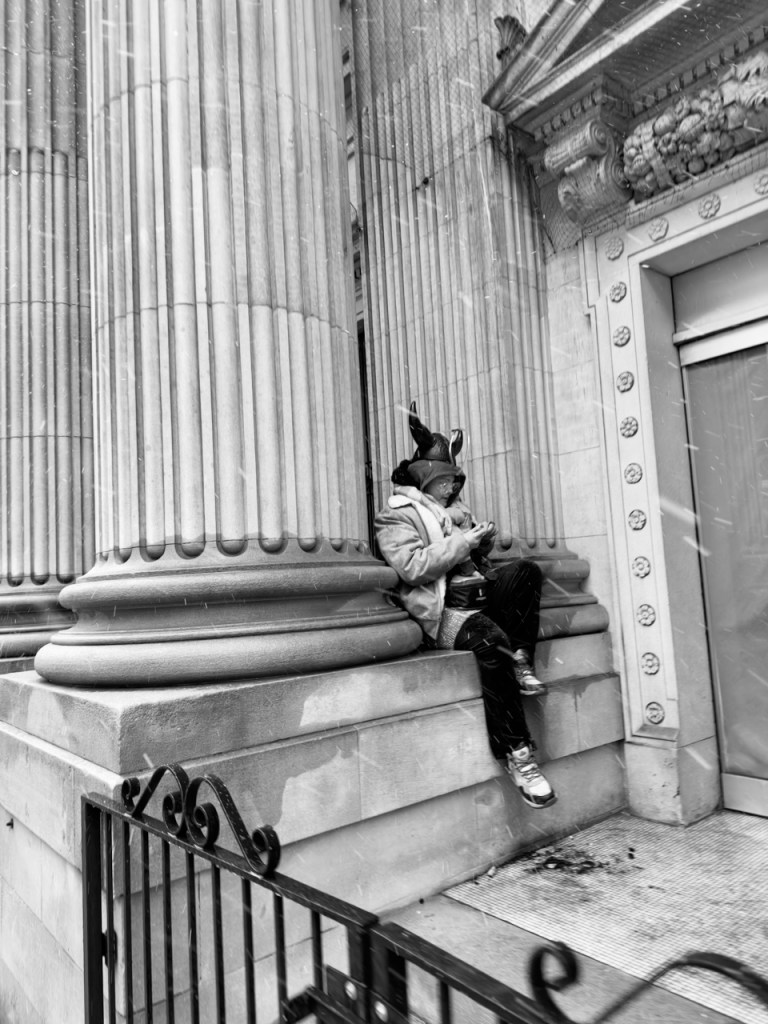
Toronto ended up getting a proper snowstorm late January. While it wasn’t the first snow of the year it was the first proper storm that saw 15cm of snow (or more) coming down over the course of many hours. In fact, the snow was coming down heavily enough that I didn’t want to risk my non-weather sealed cameras: I’m happy to get them damp by snow but in this weather they were certain to get soaked.
So what was I to do? Despite not being in love with the iPhone 14 Pro it’s a weather sealed camera and capable of making some decent images. So I grabbed it, donned my winter weather gear and some smartphone-compatible gloves, and headed out for a few hours of capturing the city.
When I went out I decided to increase the exposure a bit–set to 0.7–to keep the snow from coming out grey, but I found that exposure kept resetting. I half suspect that this was due to a combination of the somewhat bulky gloves I was using and the water on the screen resetting or modifying the exposure slider. Still, given that I was shooting in ProRAW I could generally modify exposures to my taste when I got home and did some light post-processing.
Speaking of the ProRAWs…I accidentally left the 24mm (equiv.) sensor set to 48MP images from the last time I was shooting with it! Which in hindsight explains why it often took so long to go from pressing the shutter button to capturing an image; I’d thought the delay was because of an issue with the conductive gloves or the cold or the water on the screen but, in fact, was was due to the file size. As always, I should have fully checked my equipment (and its software) before heading out. I’m just glad that I have a 512GB iPhone so at least I didn’t need to worry about running out of space on the device!
I did end up coming home with some smaller files using the main sensor from when I was shooting in burst mode. In burst you will default down to taking 12MP images on the 24mm (equivalent) lens and I used it when shooting faster-action scenes earlier in my walk.
In some notes to myself about the iPhone 14 Pro, I previously wrote:
The 48 megapixel main camera (24mm equivalent) when shot at its full resolution, in ProRAW, doesn’t work well for street photography. I tend to shoot bursts to get people stepping just so in a shot, but there’s an approximately 1 second or so delay in capturing one image and being able to capture another. That’s a shame as this is supposed to be a highlight feature and the A16 processor and specialized ISP just cannot process things fast enough for how I shoot street.
At the time, I didn’t realise the camera app would shift from taking 48MP to 12MP images under burst mode. It’s, also, not something that is apparent in the user interface. Just like, when in the camera app, there’s no indication or warning that you’re shooting at 48MP! All of which is to say that the stock Camera app on iPhone is getting very long in the tooth and is in desperate need of an overhaul.
Lest it sound that I only have negative things to say I should be very clear: I managed to go out and make images for several hours and came back with some that I liked. I couldn’t have gone out with my other camera gear. Since I thought I was shooting with the 12MP 24mm (equiv.) main lens quite often I tried to be fastidious in how I framed shots because I wasn’t going to be able to crop much. By happy accident, this ultimately meant that the images shot on that lens ended up being much higher quality than anticipated due to capturing 48MP images in all of their glory.
I also took the time to use the ultra-wide as well as telephoto lenses. I admit that I just don’t have a huge amount of experience shooting ultra-wide and so this was a fun experience in seeing what I could capture in the scene. Other images that didn’t quite make the cut saw me experiment with cutting the frame in two, with a divider in the centre of the frame and building scenes to the left and right of it. While I didn’t get any publishable-quality photos it was a good experiment and reminded me of just how challenging it is to replicate photographic masters who use this technique, like Sean Penn. The images I made with the 78mm lens, however, often ended up being too soft and ultimately I’ve opted to publish only one of them (above, woman walking away from sign with an arrow on it while looking at her phone).
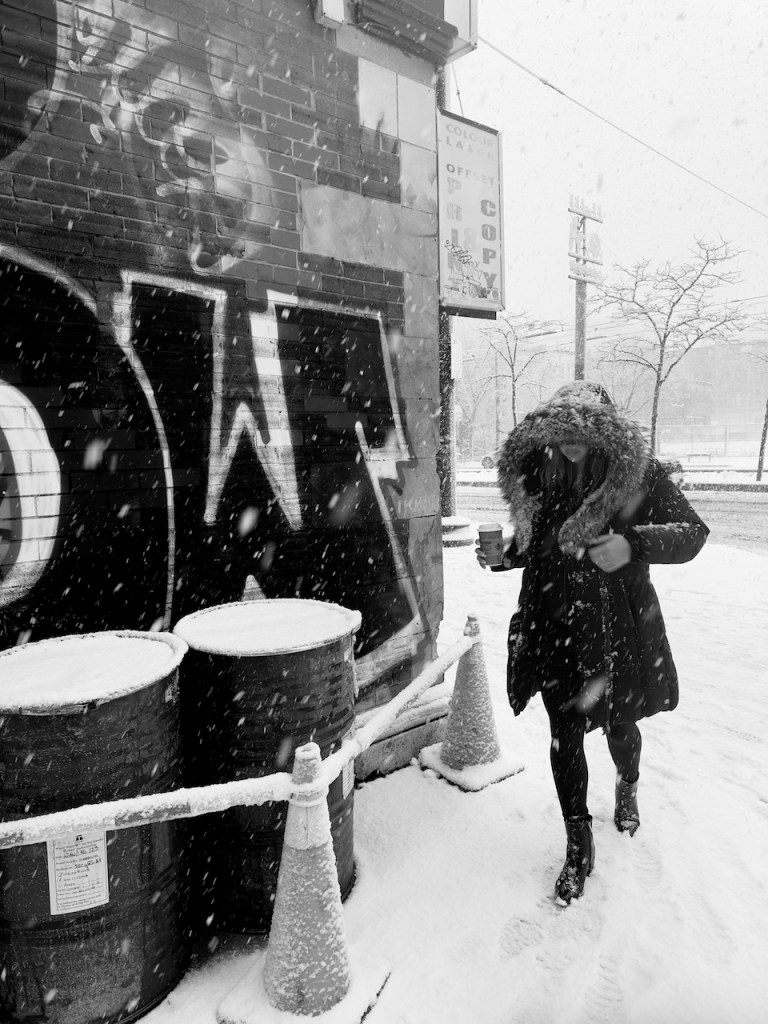
When I went out I had hoped that I’d be able to capture the sense of how much the snow was beating down on everyone in the city. I think this came true as the iPhone didn’t shoot above 1/120 of a second the whole day, and at times was as low as 1/23. The result is that the snow is apparent and the subjects–unless they were relatively unmoving–have a bit of blur to them as they raced from place to place.
At the same time, because of the snow most people couldn’t move as quickly as they would on clear sidewalks and roads. It was an interesting personal lesson, insofar as I realised that in this weather I can probably easily get away with 1/80 to 1/200 and get sufficiently sharp images that still communicate the fury of the weather.
As I kept walking, however, a number of annoyances returned. I absolutely hate how holding your finger on the shutter button in the stock iPhone Camera app records a video instead of firing of a burst shot. This was a problem because when I was trying to take a single image sometimes I’d get a very short video, instead, meaning that I was without a photograph! I get that this is how most people probably want to use the app but it’d be nice to be able to customise the app’s functionality some. Especially if these are supposed to be ‘professional’ devices. Also, for reasons I couldn’t figure out, the Podcasts app also sometimes sped up the episodes I was listening to, or even skipped to the next podcast. Frustrating!
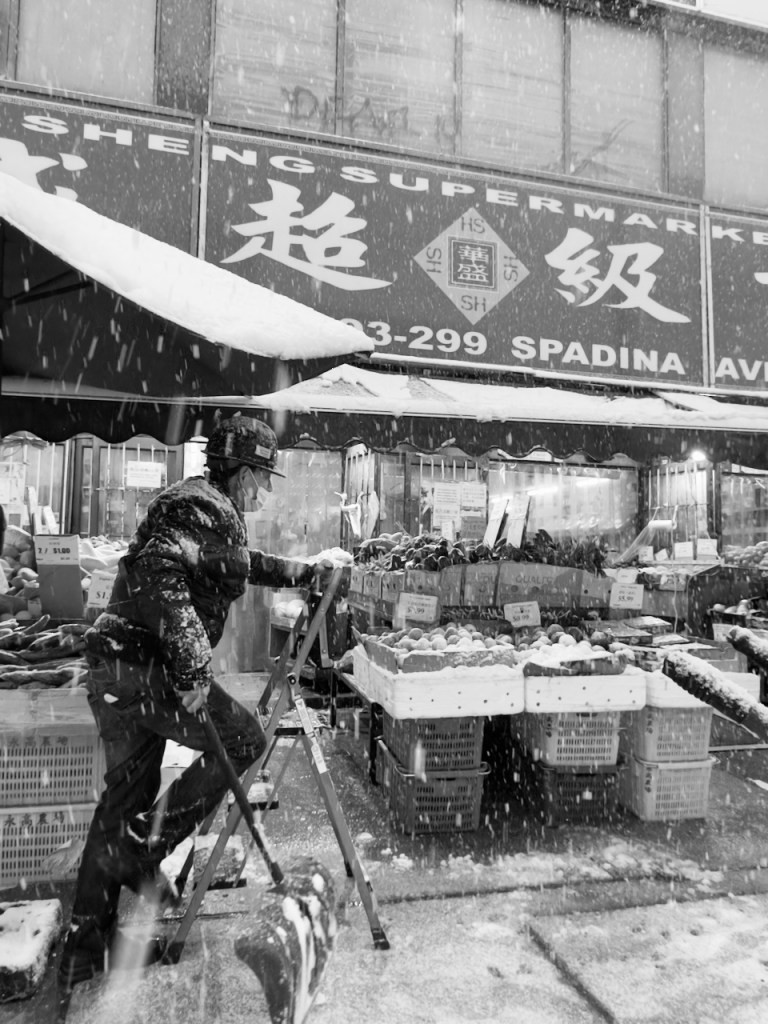
It had been quite some time since I’d walked through Chinatown during a real dropping of snow and it was great to see very familiar scenes in slightly different situations. Catching someone shovelling while, at the same time, a customer was taking refuge in a doorway was a real catch for me. I’m sure I’ve captured images from this location (as in the very spot I was standing in to make the image) dozens of times; this is a very different feel and texture than those I tend to make at this location. Win!
I ended up walking through Kensington Market last year during a slightly-less intense snowstorm and was rewarded with an image that was amongst my favourites of the year. I don’t think that I caught images that will necessarily fall into the same bucket this year, in part because several times I wasn’t able to activate the iPhone camera quickly enough. Still, I liked capturing how desolate the Market was, which was largely reflective of how quiet it was.
I did like how, towards the end of the shoot and into the evening, the snow started to come down even heavier which had the effect of leaving little droplets of water on the lens. While these blotches do upset the ‘perfection’ of the image I think they, also, have the effect of making it that much clearer what the weather was like and ideally put the viewer more firmly into the cold and wet scene.
It was on my return trip home that the worst of the weather was apparent for those who had to brave the wet snow that had piled up over the past many hours. There were relatively few pedestrians out, even at the major intersections, as compared to better-weather times. Hoods were up and high, foot slips were common, and cars were throwing up huge volumes of grey and brown slush onto anyone who happened to get too close to the curb.
Amongst the bravest of the brave were the few cyclists who continued to try and share the road with Toronto drivers. Between the streets that hadn’t been cleared and the erratic behaviour of vehicles whose owners hadn’t driven in the snow in over a year, it seemed risky and not that much faster than just walking. Still, they made for interesting subjects when they were waiting for a chance to get onto the road and make their way to their destination, and especially with the streetcar lines overhead layered with snow.
While cyclists arguably had a hard time of things, even harder times were surely experienced by the parents I saw who were trying to push strollers around. The snow routinely got into the wheels with the effect that parents were just pushing the strollers without the help of the wheels. Still, almost every stroller had a plastic barrier separating the child from the storm which at least meant that the little one’s weren’t getting soaked on their ways home.
Ultimately the images that I came back with after several hours of shooting are qualitatively different from anything I’d have made with my Fuji X100F or Ricoh GR or GRiiix. At least to my eye, they have a feel of an older camera and, due to the slow shutter speeds, many of the images remind me of film photographs I’ve seen of past Toronto winter storms from the 1970s and 1980s. Many also have an almost more intimate quality, to my eye, due to the technical imperfections that resulted from lighting conditions and occasional focus challenges. Still, I feel like they present the experience of the storm that lasted throughout the day and night, and which left the city blanketed in white by the following morning.
This long form photoessay showcases the absences that have been wrought by the pandemic in my city of Toronto, Ontario. The essay provides a meditation on a world of social isolation and distancing, and how the spaces that have historically united and bound Toronto’s residents have been left empty or made safe in response to being associated with risk and disease. Throughout, people are represented as separate from one another in their efforts to socially and physically distance, with individuals, pairs, or very small groups standing in juxtaposition to the much larger built world they inhabit.
All of the images were created using a combination of a Fuji X100f, Sony rx100ii, iPhone 11 Pro, and iPhone 12 Pro. Images were edited to taste using Apple Photos (for cropping) and Darkroom; two images had some healing applied using Snapseed.










 Excited Pixels