Categories
Links

Here’s Proof Canada Is Snooping on People’s Twitter Accounts

Here’s Proof Canada Is Snooping on People’s Twitter Accounts:

I’m am increasingly impressed with the length, clarity, and directness of Vice’s tech reporting in Canada. It’s quickly becoming one of the best sources in Canada for this kind of news.

Categories
Links Quotations

Privacy watchdog calls for reforms but ministers stay silent

Privacy watchdog calls for reforms but ministers stay silent:

The federal privacy watchdog’s concerns appear to be falling on deaf ears in the government, with three cabinet ministers yet to respond to her calls for reform.

(…)

While Clement has agreed to work with the commissioner, it’s not clear if her other recommendations will be entertained by the government. Chris Parsons, a privacy scholar with the Munk School of Global Affairs in Toronto, said the government has little incentive to change the current system or increase oversight.

“As revelations come out, that could be hurtful to government,” Parsons said. “There’s an understandable political value in not (enhancing) these audit powers. You can just imagine the first audit is performed and it reveals very high amounts of personal information being collected from various sources … . It could be politically unhelpful.”

My money is on the government quietly hoping the public and media just forget about this issues through the summer, given that they’ll be breaking from Parliament soon for BBQ season.

Categories
Links

Is social media info reliable?

Is social media info reliable?:

I much preferred this interview over the one with CBC; in particular, the final discussion is helpful: Canadians want a responsible and transparent government, not one that is opaque and operates counter to Canadian values.

Categories
Links Quotations

Government snooping on social media may breach Privacy Act

Government snooping on social media may breach Privacy Act:

Those are questions the government hasn’t answered, said Christopher Parsons, a post-doctoral fellow at the University of Torontos Citizen Lab, which focuses on human rights, IT and global security research.

“This is information that’s been collected without Canadians knowing, and as the privacy commissioner noted, without clear reason,” said Parsons, an expert on state surveillance tools.

“This government is saying they should be able to access public information just like anybody else, but that confuses how Canadian law works.”

Parsons said, once information is made public, Canadians maintain a “privacy interest” in the material.

Without a doubt, this is the most comprehensive piece to date on the federal government snooping on Canadians’ social media accounts.

Categories
Links Quotations

The Canadian Government Is Creeping on Your Facebook

The Canadian Government Is Creeping on Your Facebook:

Categories
Aside Humour

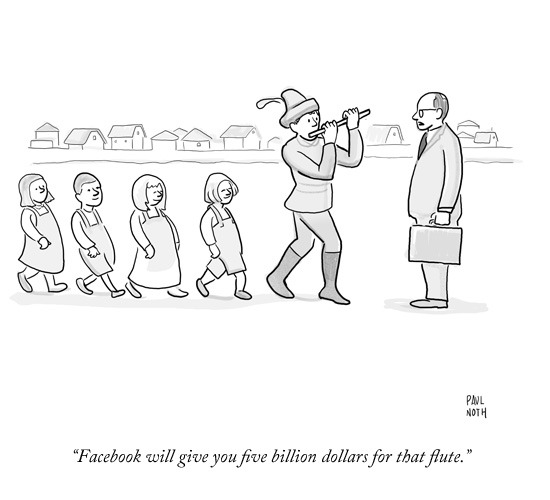
Facebook’s Next Acquisition

emptyage:

Facebook will give you five billion dollars for that flute

(via Daily Cartoon: Tuesday, November 19th : The New Yorker)

A nice comment on the business of purchasing services to acquire younger and younger users.

Categories
Aside Links Quotations

How to Publish A  Story That Explains How to Use Social Media to Juice Your Story’s Popularity

emptyage:

I paid to have my latest Wired story promoted on social networks, like Twitter and Facebook, to try to show that a lot of the metrics* we use to measure a story’s success are bullshit. It worked. When the story went live today, the page appeared with more than 15,500 links on Twitter, and 6,500 likes on Facebook. The story is a part of Wired’s Cheats package for the latest issue of the magazine. It needed to go live online at the same time readers encountered it in print, and it needed to have all those social shares set up in advance. 

The entire package was going live at once. I could publish my story a little bit early, but the timing needed to be very close. I wanted all the public-facing stats (like the 15 thousand links and Twitter and 6,000 Facebook shares) to be live by the time the text appeared. Certainly, if someone found it in print or on the tablet, it needed those metrics to already be there. To make that happen, we cheated. 

This morning (or last night) at a little after 1 am, I added the story text, set it to the current time, and hit update. Now it showed up in RSS readers and I could openly tweet it form my main account. (I had originally used a secondary Twitter account I have for testing 3rd party stuff to link to it and score retweets.)

So now, the story goes “live” and as if by magic it has tens of thousands of social shares listed on it the instant real people start to encounter it. It worked. 

*As is site traffic, to a very large extent. My original idea was to use a botnet to throw traffic at it, but Wired’s lawyers said “no, no. Don’t do that.“ 

And, of course, people tend to associate lots of shares with an article’s significance or influence. Consequently, by ‘cheating’ ahead of time a content owner can add a false gravitas to the content in question. I’m curious to know how search companies that, in part, use social signals to surface content deal with this kind of ‘hacking the social.’
Categories
Quotations

2013.7.8

Like a giant python that has consumed a rat, Facebook captures, swallows, and slowly digests its users.

Ron Deibert, Black Code: Inside the Battle for Cyberspace
Categories
Links

This is not surveillance as we know it: the anatomy of Facebook messages

There are a lot of issues related to ‘wiretapping the Internet.’ A post from Privacy International, from 2012, nicely details the amount of metadata and data fields linked with just a Facebook message and the challenges in ‘just’ picking out certain fields from large lists.

As the organization notes:

Fundamentally, the whole of the request to the Facebook page must be read, at which point the type of message is known, and only then can the technology pretend it didn’t see the earlier parts. Whether this information is kept is often dismissed as “technical detail”, but in fact it is the fundamental point.

We should be vary of government harvesting large amounts of data and then promising to dispose of it; while such actions could be performed, initially, once the data is potentially accessible the laws to legitimize its capture, retention, storage, and processing will almost certainly follow.

Categories
Videos

“Your entire life is online. Be vigilant.”