I really liked Robin Wong’s reflection on why he keeps returning to the same streets to make his images.
the beauty of doing the same routines, walking the same paths is the familiarity of the location, and you know every turn and corner, you know the details inside out, so you can be prepared for the unexpected. That is also the exciting part of shooting on the streets, you will find something unusual, something you will not know will happen beforehand, and the surprise is worth the redundant process of walking the same streets all over again. […] It isn’t about finding something completely new or extra-ordinary to shoot but finding beauty in the most ordinary settings and make it worth clicking your shutter button for.[^ Emphasis added.]
Like Wong, I’ve found that familiarity can sharpen my eye. Because I walk the same places regularly, I’m able to find the images I do. Having seen the same scene hundreds of times, I can tell when something has changed or that there’s some novelty in the scene that’s before me.
To some extent I think of regularly seeing the same scenes a little like drinking whiskey. At first, whiskey just tastes hot and spicy; any differences seem more theoretical than real. But over time you notice subtle nuances and also detect rarified variances between what you’re enjoying. And you can get excited over little things that really aren’t apparent or distinguishable to someone that hasn’t built up the same kind of palate.
When you walk the same streets over and over, you develop your own sense of what should and shouldn’t be there. You can detect what’s normal or novel. By training your eye on these common spaces, you develop your style. If you need to find something novel in the same place over and over, you’ll develop a unique way of seeing the world, whereas if you’re always seeing a new place you don’t need to stretch in quite the same way — you don’t need to push yourself to develop your sense of what is visually interesting to you.
All of which is to say: from afar, street photography can look pretty dull or boring because there’s a lot of repetition. It’s exactly this repetition, however, that helps you discover the kind of photographer you are.
I’m an amateur Toronto-based documentary and street photographer, and have been making images on the street for over a decade. In the fall of 2023 I purchased a used Leica Q2. I’d wanted the camera for a while, but it wasn’t until late 2023 that I began running into situations where I’d benefit from a full-frame sensor. Since then I’ve been going out and making images with it at least once a week for hours at a time and have made tens of thousands of frames in all kinds of weather.
In this post I discuss my experiences using the Leica Q2 in a variety of weather conditions to make monochromatic JPG images. I tend to exclusively use either single-point autofocus or zone focusing, and either multi-field or highlight-weighted exposure modes, generally while using aperture priority at 1/500s to freeze action on the street. My edits to images have, previously, used Apple Photos and now rely on the Darkroom app on my iPad Pro. You can see the kinds of images that I’ve been making on my Glass profile.
Each month or so, the Photowalk podcast has been choosing a single term to inspire photographers to consider when making images. The March term was “humanity”, and my submission follows.
Yonge & Gloucester, Toronto, 2025
Text for entry:
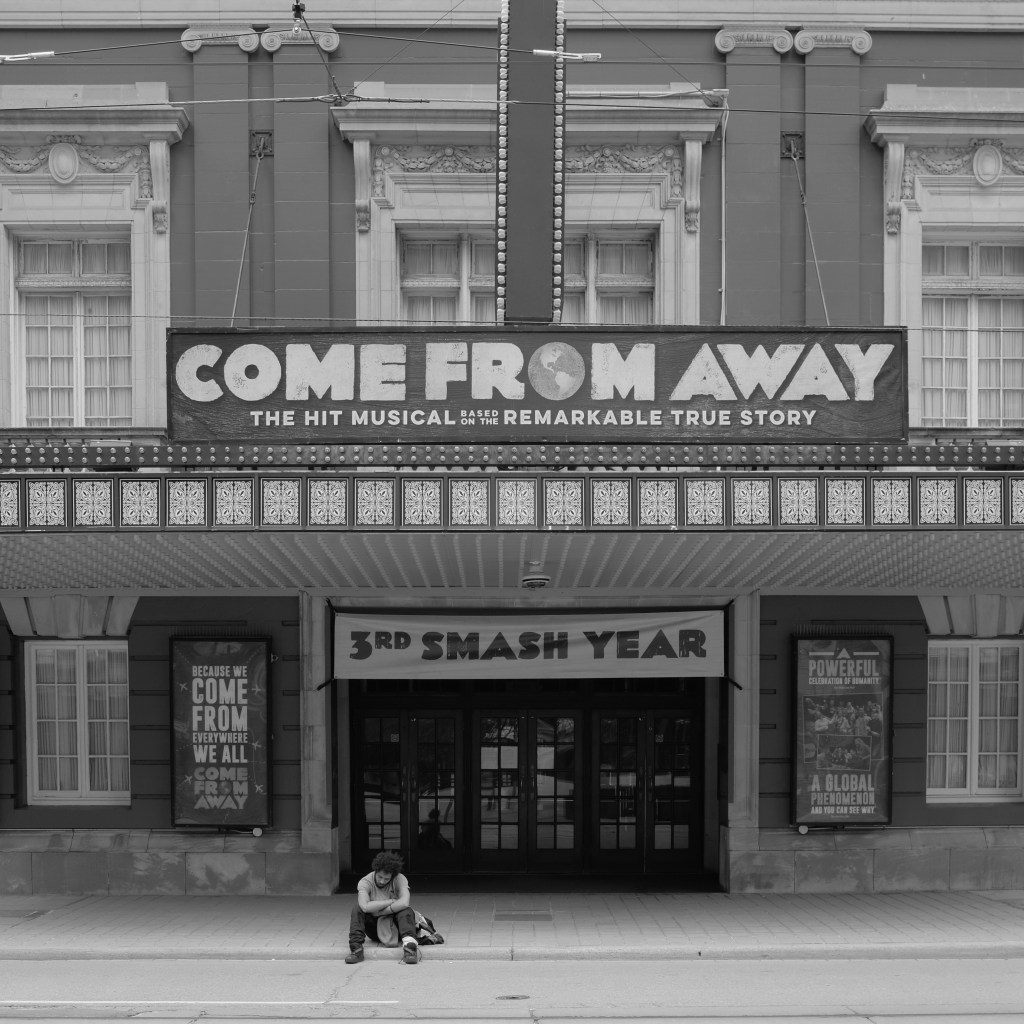
The image can be read as speaking to the stature of man, and the forces that rise above him spiritually and physically, while living a life of being downtrodden and isolated. In a well-populated urban capital our subject is left alone with himself, save for weather damaged urban art that gestures to imagined better times and the eyes of his transitory documentarian in front of him.
I’ve enjoyed a particularly productive photographic year during which I’ve (mostly) acclimated to the Leica Q2 and used it to shoot almost exclusively in black and white, and usually in the city of Toronto.
Narrowing everything down to 10 images was challenging given that I have gone out weekly throughout 2024 to make images and kept thousands of them. The images in this series hold up on their own while, also, developing a narrative when read beside one another.
Gerrard & Galt, Toronto, 2024
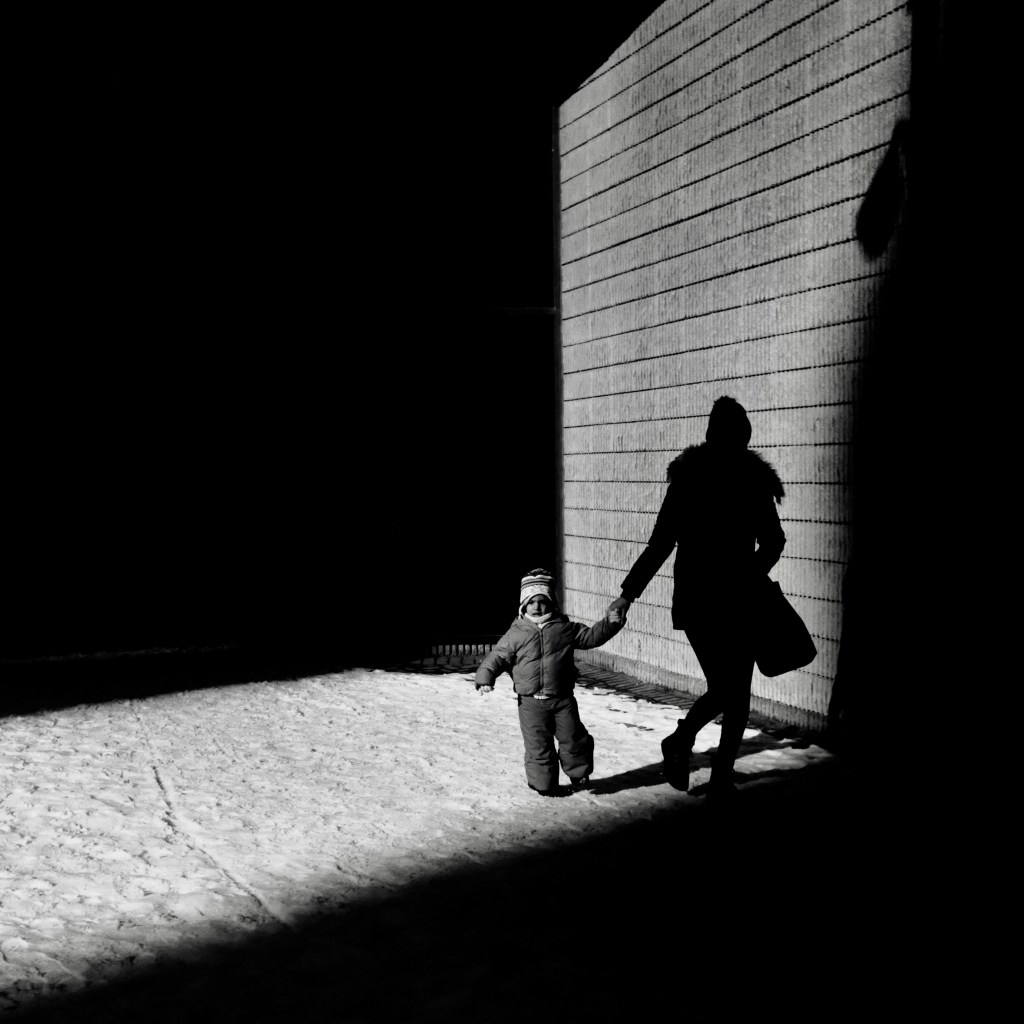
When was this photograph taken? 2024 or 1964?
The use of black and white has the effect of confusing the viewer of the image’s temporality. This is accentuated by the sign in the photograph being from another generation. Adding power to the image are the two figures who are wandering through the early January snow, with the young woman looking down and over to the city’s garbage, and the little boy looking up past the trash to the graffiti on the wall. This speaks to the hopes and ambitions of youth and the practicality of maturity, while they are both literally passing by the abandoned garbage of the day.
This was one of the first images that I made of 2024 and it remained amongst my favourites throughout the year.
Shuter & Yonge, Toronto, 2024
What is this woman so focused upon? How much has she seen during her lifetime and how shadowy are those memories?
Throughout the year I’ve spent time seeking out images that rely on reflections to strengthen the environment around the main subject(s) of photographs. The woman’s white hat and mask made her stand out through the windows, and then play nicely with the shadowy figures reflected in the glass. It’s this juxtaposition that brings the image to life in my eyes.
Crescent & Cluny, Toronto, 2024
What does it mean to be an inhabitant of a major city?
This photograph shows the city from a different perspective than is typical of Toronto street photographers who are making images in the core. Still, the image captures ever present aspects of city life: mass transit, rapid development, and the isolation and anonymity of the residents as they move through their day.
I’ve been coming to this particular subway stop to make this image for 5 years. After years of visiting the same location I finally got the light, subject, and subway where I wanted them at the same time.
Centre & Edward, Toronto, 2024
What did Toronto look like during its process of being built up in the contemporary era?
We are in a time of building but there are relatively few organic photographs that are deliberately capturing this development. Like images of old this photograph speaks to the relationship of people and the city that is growing (or metastasizing) around them.
Toronto is rapidly building density in its core. I’ve worked throughout the year to incorporate construction into my street images while, also, seeking elevated heights to capture the city’s transformation. The lines across the image draw the eye upwards and the construction worker on the railing serves to underscore the size of the development.
Yonge & Dundas, Toronto, 2024
Well hello, madame – what gave you your sense of style?
The Saint Patrick’s Day parade is a major event in Toronto. I’ve been photographing it for years and regularly march in it to make images of the crowds. I like how the woman in this photograph is almost posing in her winter jacket — it gives her a sense of elegance and self-importance — while, above her, the sign suggests that she is happy and ranked #1. But it’s the man who is looking on at the right-hand side of the frame adds a degree of electricity to the image with his dourness in contrast to the woman’s more positive energy.
College & Clinton, Toronto, 2024
Someday in the future will we be amazed at the low cost of a veal sandwich or beverage?
This is one of those images that works, in part, because the ordering of the image isn’t quite right: the subject is looking away from the rest of the signs, which encourages the reader of the image to go from left to right which isn’t typical in Western culture. I also like his expression and how the contrast in the image draws the eye through the items for sale at the festival.
Dundas & Dufferin, Toronto, 2024
What’s happening here? What do you feel when you’re so close to this slightly obscured woman and her side-eye staring companion?
Like many street photographers, I try to make use of graffiti and other temporary art in the city when making images. I like how this image somewhat conceals the look that the older woman is giving the viewer, at the same time as she is getting a side eye from her companion. The contrast through the image also serves to create an effect foreground, middle, and background.
Great Lakes Waterfront Trail, Toronto, 2024
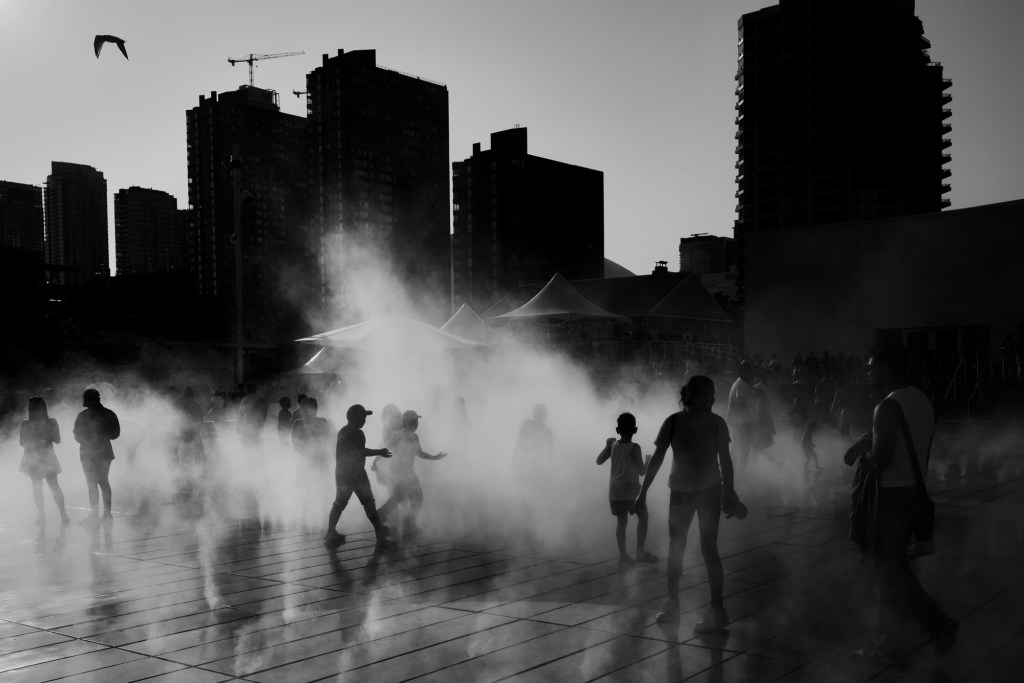
So this is summer! Children playing in the mist while the city towers above them, and a bird flees the city towards some less inhabited region.
This image captures the idealized life of being in the city, where people come out from their ever-growing towers to relax and play together. It is also one that hides the actual subjects, themselves, and in so doing conceals the participants in this space. Is this a playground of the elite’s children or a communal space used by all inhabitants of the city? For those who live here the answer is apparent but otherwise a degree of mystery may remain concerning the socio-economics of the subjects.
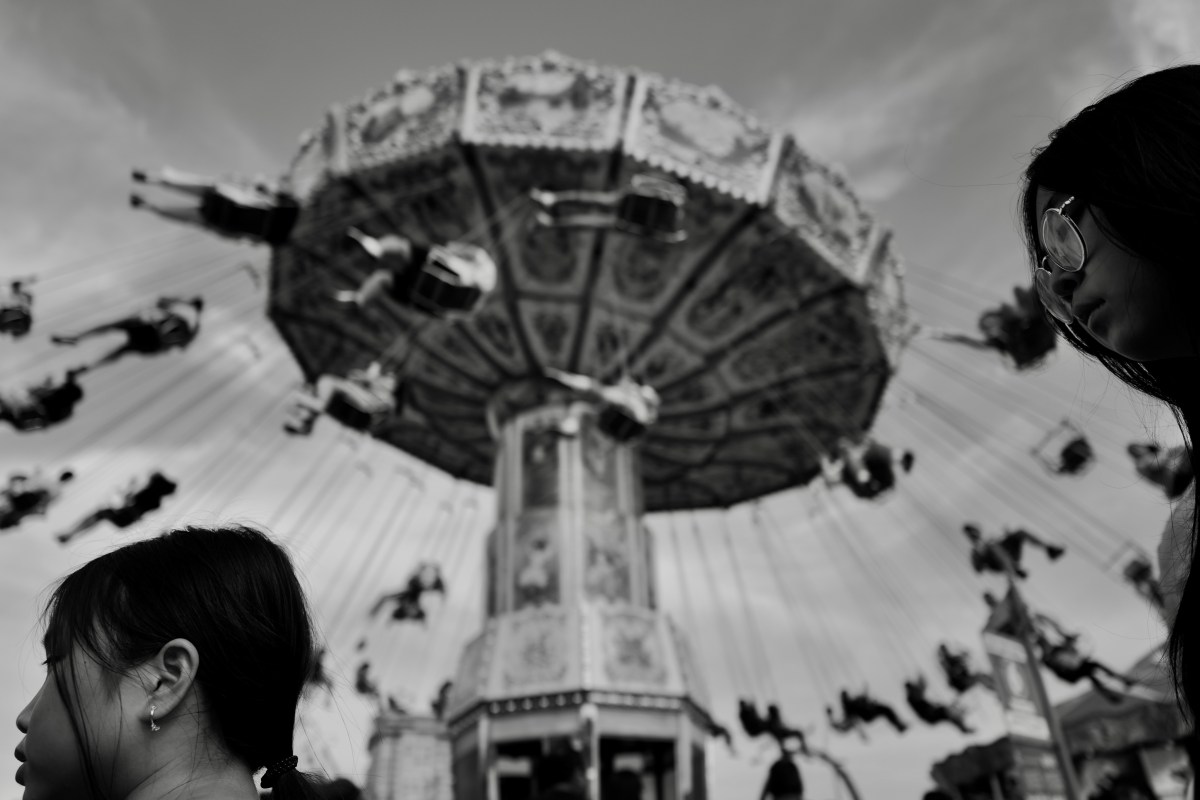
Ontario & Princess, Toronto, 2024
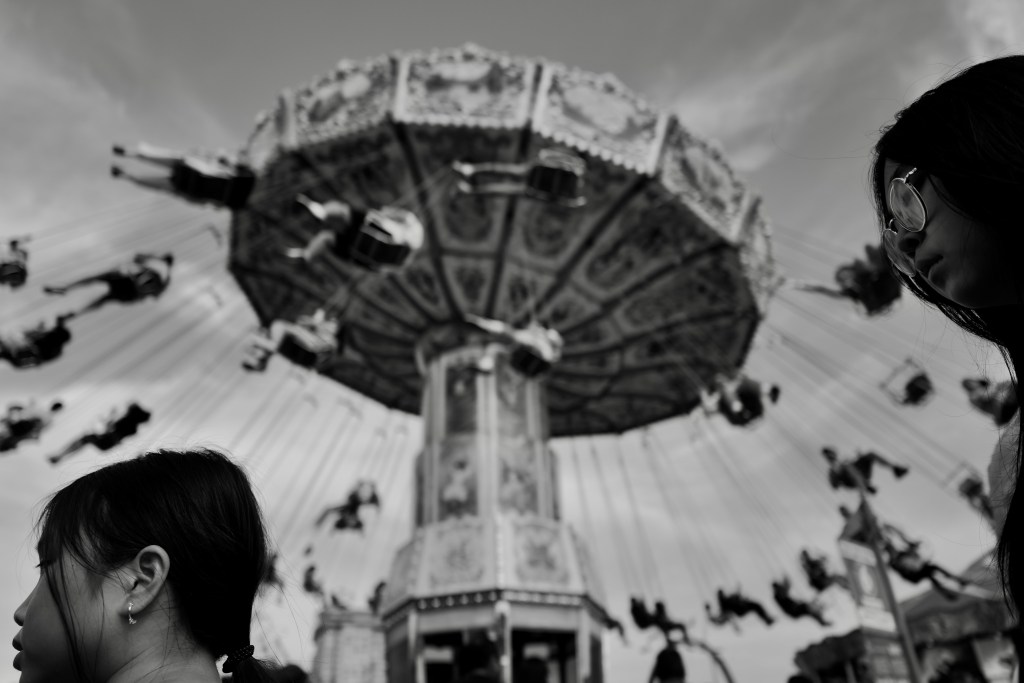
Swings let us throw our hair back and play with our suspended bodies while soaring above the ground; we enjoy a kind of freedom that is in opposition to our normal land based experiences.
Every year I go to the CNE’s Exhibition and get a little more comfortable looking for scenes to make images. This year I spent a bunch of time at this ride, and I think that this image captures the carefree playfulness that’s associated with the summer fair.
Baldwin & Augusta, Toronto, 2024
What is it like to be alone in the city and reflect on what once was, and what could become?
Like the first image in the set, this photograph conveys a sense of solitude in Canada’s largest city while also hearkening to a time past. Because this image is monochromatic it establishes a degree of ambiguity as to when the image was made and thus provides a sense of balance to the collection of images.
All of my images are located by city cross-streets and are are lightly processed using Apple Photos. I post new images daily to Glass.
Artist’s Statement
Christopher Parsons an amateur Toronto-based documentary and street photographer, and has been making images for over a decade. His monochromatic photographs focus on little moments that happen on the streets and which record the ebb and flow of urban life over the course of years and decades.
His work often deliberately plays with the temporality of built environments and photographs themselves, and regularly uses temporal ambiguity to entice viewers into questioning what happened prior to, and following, the pressing of the shutter button.
Since 2006 Toronto has hosted Nuit Blanche, where selected artists are invited to set up art installations from sundown at 7pm until sunrise at 7am the following day. For the past decade or so I’ve tried to get out and enjoy the exhibits. I usually try to walking from 1am until 7am when the installations are taken down.
This year many of the installations took place around Toronto’s downtown waterfront. This had the effect of clustering people in a common part of the city and enhancing the sense of togetherness associated with the art exhibits; in past years I often felt like I alone was still out at 7am but not this year!
Bay & Queens Quay, Toronto, 2024
Each year there are food stall and trucks, and this year was no exception. Even at 1 in the morning there were crowds who were looking to have a quick bite to carry them through the evening. I’d just arrived and had yet to feel the bite of hunger or thirst.
Lower Sherbourne & Queens Quay, Toronto, 2024
One of the exhibits this year included a series of skeletal shacks. They stood above us and we looked at what may happen when civilization degrades and this is what we remain left with.
Great Lakes Waterfront & Queen Quay, Toronto, 2024
Of course walking around this late at night meant there were often strong contrasts between shadow and light. I’ve visited this area of Toronto regularly over the past decade and captured people huddled in the same spot, but never with such dynamic contrast between the lit structure and the rest of the environment. I liked how the subjects were huddled away from the darkness that was just beyond the lit structure. Isn’t this the nature of humans: huddling in the light while the darkness is kept at bay?.
Dockside & Knapp, Toronto, 2024
Each year there are some exhibits that are at least slightly interactive. Every person who attended a particular film screening was first asked to pick up a custom hanger and think about it during the performance. It wasn’t self-apparent how this hanger necessarily mapped to film.
Queens Quay & Freeland, Toronto, 2024
This was the only colour image I made through the night. The exhibit projected videos of people’s homes on a condo wall and, beside it, the artist had set up a tent to represent how many of Toronto’s least fortunate must live their nights. This was one of the more poignant exhibits I saw through the evening.
Queens Quay & York, Toronto, 2024
A set of screens were set up in Love Park and rotated the images in them through the night. The eyes that regularly cropped up were eerie at that time of the early morning.
Great Lakes Waterfront & Harbour, Toronto, 2024
Continuing the theme of eyes, this separate video display regularly had an image of an eyeball looking into the audience. When it isolated the older woman I knew I had to hold onto the moment.
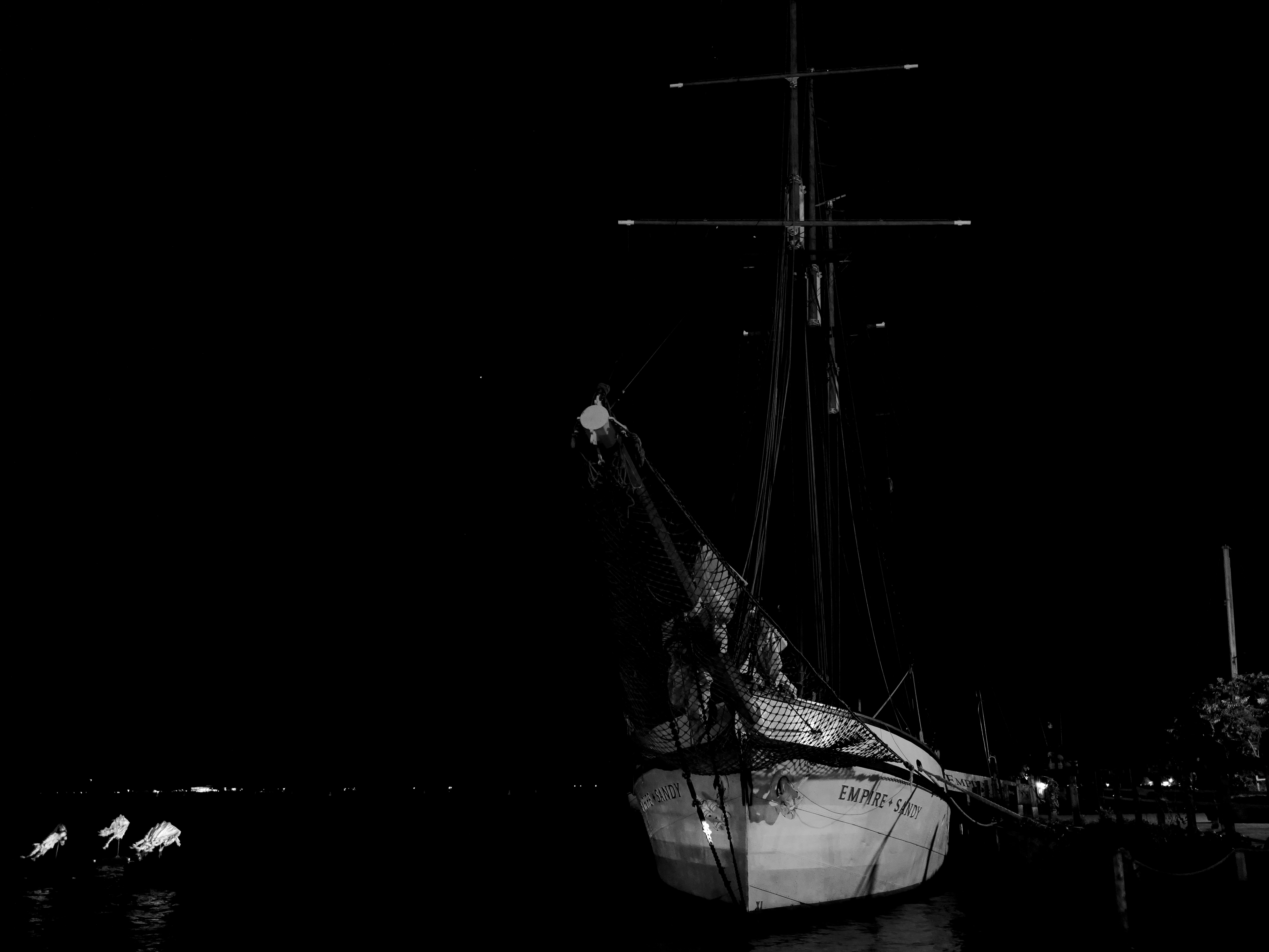
Spadina & Queens Quay, Toronto, 2024
One of the marque exhibits of the year were glowing fish that were placed in the harbour. Here, I’ve captured their luminescent being alongside one of the tall ships that is always docked; the effect is spectral, to my eye, with the fish racing towards the ghost-boat.
Bathurst & Queens Quay, Toronto, 2024
Hosting a project that raised the issue of disability inside a basketball court forced audiences to confront the ableism that permeates our lives, and especially contemporary sport. The exhibit forced audiences to acknowledge that disabled athletes have led the way in more accessible design that is now the norm for all athletes, disabled or not. By this time it was about 5am and the crowds were dying down, though spectators and attendees to the festival were still around in smaller numbers.
Richmond & Spadina, Toronto, 2024
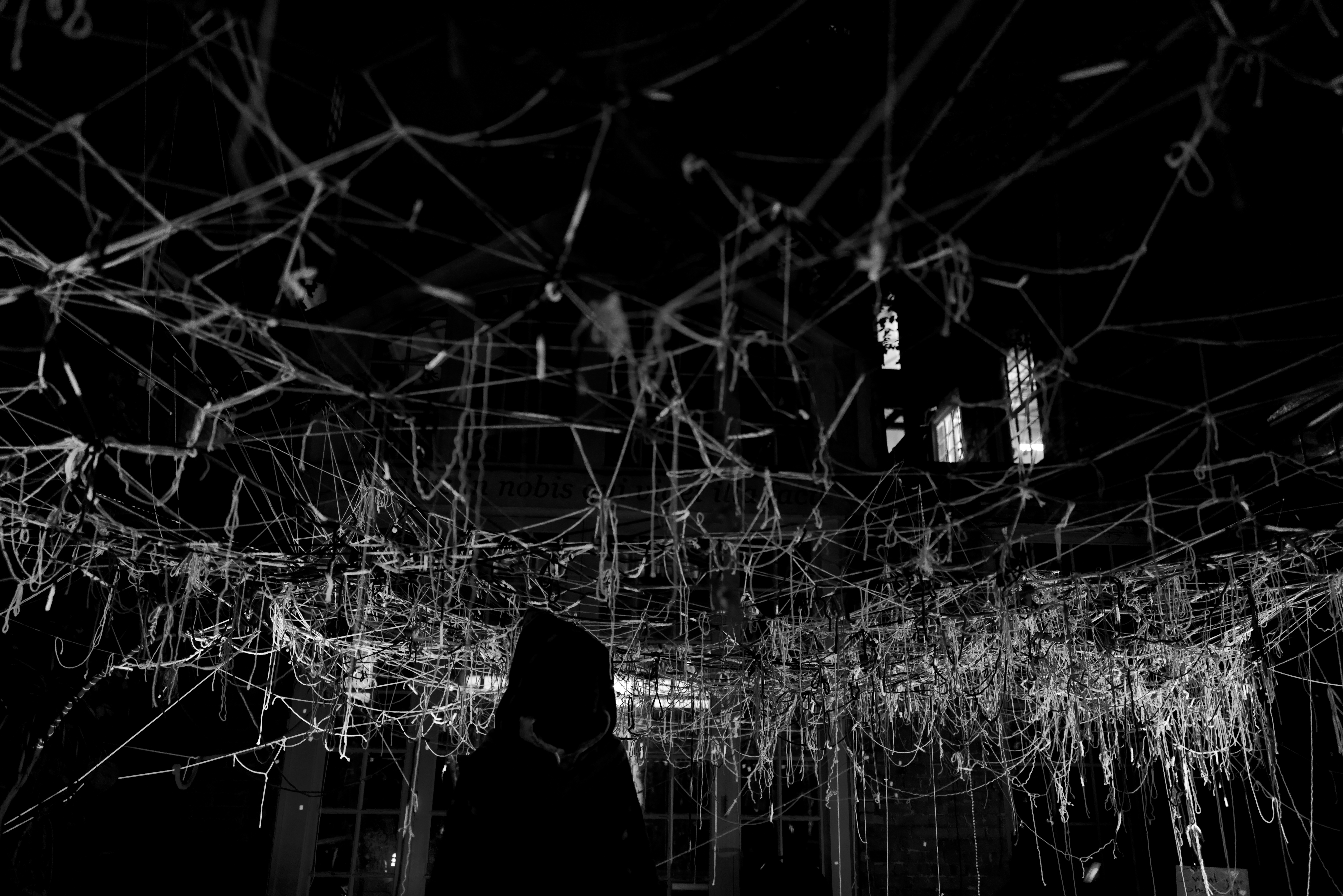
This was the last exhibit that I documented and left with an image I was satisfied with. The artists were lowering a multi-coloured spider web that had been elevated above the attendees, when a sole last participant walked through the exhibit despite the efforts to tear it down by sundown. The subject is reaper-like in their image and spoke to the end of the exhibit, and the end of Nuit Blanche for 2024.
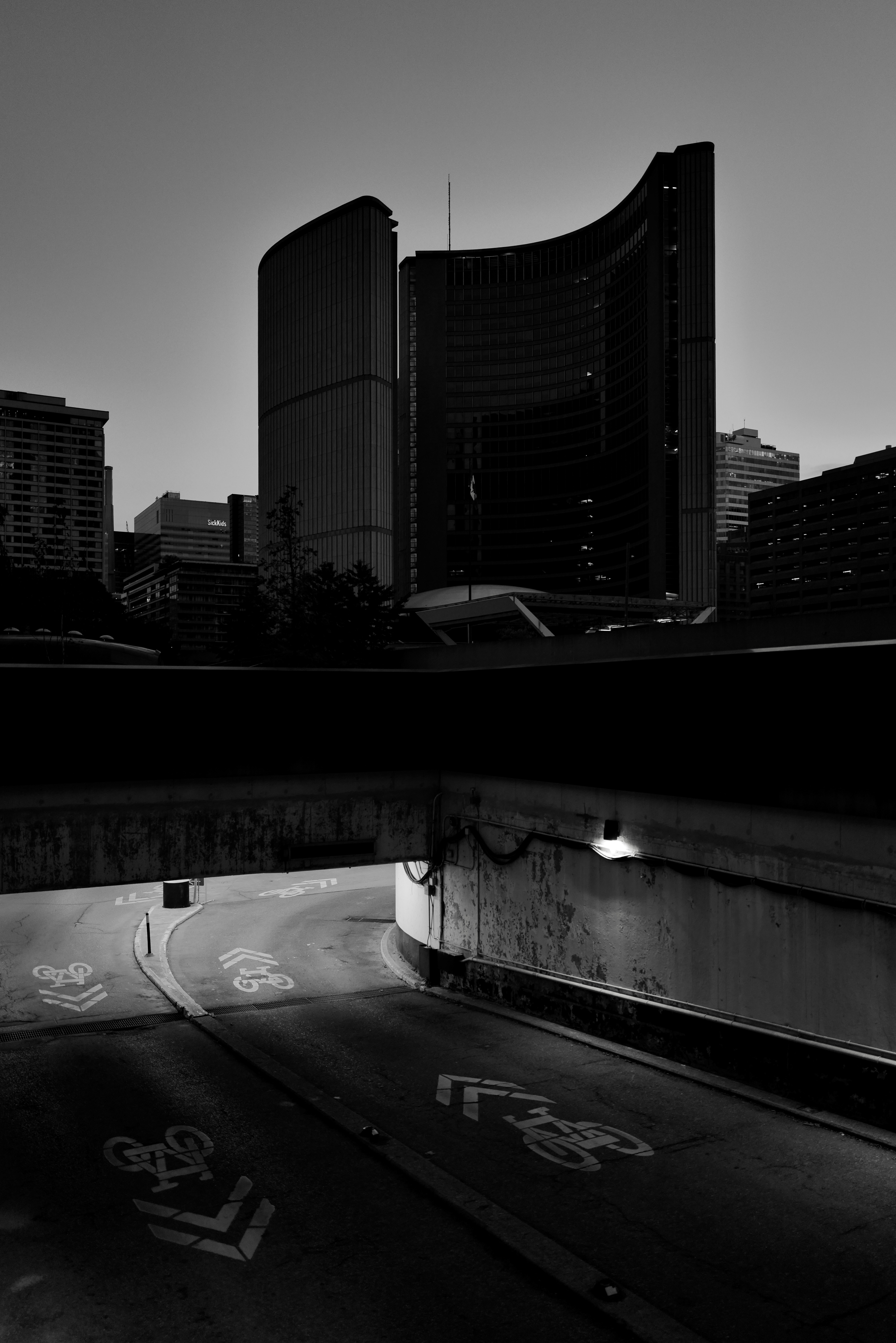
Queen & Chestnut, Toronto, 2024
On my way to breakfast I captured this image of Toronto’s City Hall as the sun was just starting to rise. All was quiet, including the parking garages, though the city had begun coming back to life once I got home an hour or so later to crawl into bed before a short nap ahead of afternoon activities.
As part of my ongoing efforts to get more comfortable sharing my photographs with a wider audience I started to participate in photographic competitions last year. While I didn’t receive any awards the very act of submitting my work was the personal award that I took away.
This year, for the first time, I’m submitted to a contest with a small fee. I appreciate that many photographers take issue with the “pay to compete” models but this is normal, and I enjoy a level of disposable income that means I can afford to submit to a few contests a year. This post includes the images that I submitted to the Eyeshot 2024 competition, the descriptions I included with the images, and an artist’s statement.
Submitted Images
All of my images are part of a broader documentary project that traces how built environments that I inhabit develop and transform through the seasons, and across the years that I have been photographing my surroundings. As befits this objective, all of my images are titled by their rough location (based on major street intersections), geographic region or city, and the year made.
Great Lakes Waterfront Trail, Toronto, 2024
Toronto is home to a vast waterfront trail which was renovated in 2024 to include a large splash and mist park. On a swelteringly hot day I passed by after it had recently been re-opened and was delighted to see the silhouettes of people — mostly children — playing in the mist, while the looming under-construction condo towers of downtown Toronto provided a sense of youthfulness and activity to the cityscape itself. This photograph captures the youthful energy of Toronto as manifest in its residents and built infrastructures while simultaneously possessing a kind of timelessness as a result of capturing the moment in black and white.
Cumberland & Bellair, Toronto, 2024
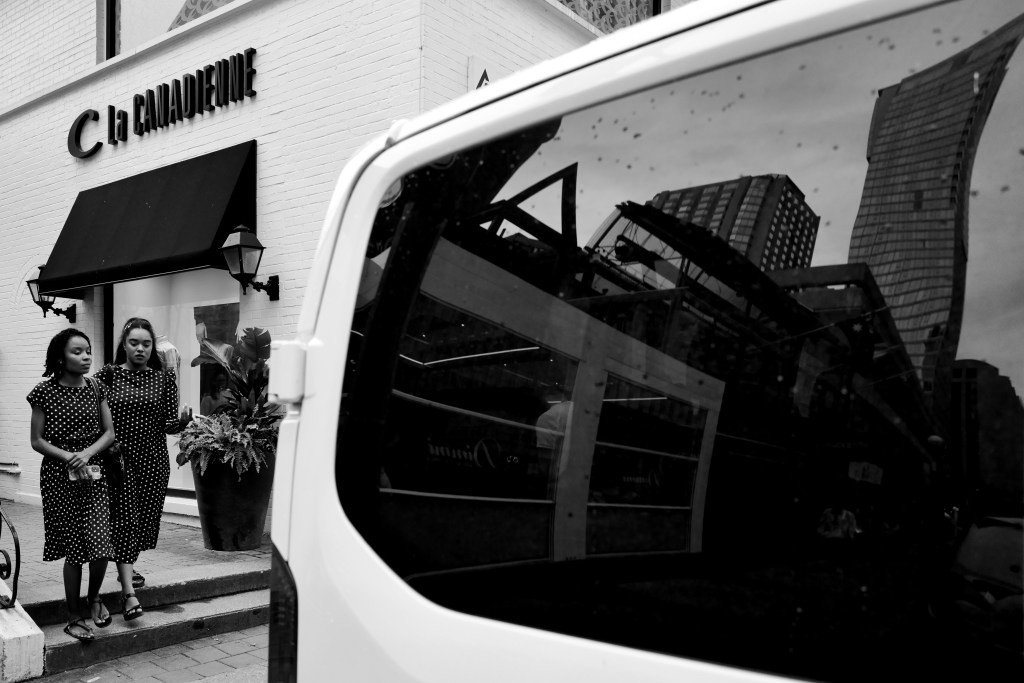
One of Toronto’s most posh shopping areas is Yorkville, where the affluent come out to spend and be seen. I like how this monochromatic photograph results in the two women looking like they could have come from 40 or 60 years ago, while the reflection in the window reveals some of the built infrastructure surrounding them. It speaks to a timelessness that is specifically located to being within a large urban environment.
Yonge & Dundas, Toronto, 2024
The Saint Patrick’s Day parade is a major event in Toronto. I’ve been photographing it for years and always march in it to make images of the crowds. I like how the woman in this photograph is almost posing in her winter jacket — it gives her a sense of elegance and self-importance — while, above her, the sign suggests that she is happy we’ve ranked her #1. But in addition to her, the man who is looking on in the right-hand side of the frame adds a degree of electricity to the image with his dourness contrasting with the woman’s own more-positive energy.
Gerrard & Galt, Toronto, 2024
When was this photograph taken? 2024 or 1964? The use of black and white has the effect of confusing the viewer as to when the photograph was made. This is accentuated by the sign in the photograph being from another generation. Adding power to the image are the two figures who are wandering through the early January snow, with the young woman looking down and over to the city’s garbage, and the little boy looking up past the trash to the graffiti on the wall. This speaks to the hopes and ambitions of youth and the practicality of maturity, while they are both literally passing by the abandoned garbage of the day.
Queen & Peter, Toronto, 2023
This photograph is only made possible because of the advertising-heavy urban landscapes in which we live. Taken in downtown Toronto, this photograph juxtaposes a question about one’s life with an idealised (and unrealistic) advertised imagination of excitement, along with a man contemplating his possible future. Him exiting the frame leaves us to wonder whether he will do something to change his life or if, instead, he will continue to live the same life that he always has. We are already left with some sense of his trajectory, however: his walking out to the left of the frame imposes on us a question of whether his movements will take him back to something he once enjoyed in life, or if his retreat through that side of the frame instead symbolises a staidness. Regardless, he will not be moving forward into the future — into the right of the frame — to see some change to his life.
Nathan Phillips Square, Toronto, 2023
Yonge and Dundas Square is Toronto’s imagined equivalent to Times Square. In this photograph we see it at peak energy: the two women hiding under a transparent umbrella are huddling together with somewhat shocked looks on their faces, while behind them a woman is running from something out of scene and a giant in white strolls behind them. Photographs like this capture the dynamism of our urban landscapes while, simultaneously, not explaining what is specifically occurring. Instead the viewer is merely left with an ever-growing cascade of questions: Why are the women drinking out of a pineapple in the rain? Why are they shocked? Who is chasing the woman in the background? Why is there a tall white giant wandering around? What is going on with the squatting man in the advertisement? These questions draw the viewer in and invite them to create their own stories of what was before, and followed, the 1/320s that this frame holds together.
Artist’s Statement
I’m an amateur Toronto-based documentary and street photographer, and have been making images for over a decade. I make monochromatic photographs that focus on little moments that happen on the streets and which document the ebb and flow of the city over the course of years and decades. My work often deliberately plays with the temporality of photographs and calls into question when images were made, and invites the viewer to ask what specifically happened immediately prior to and following the pressing of the shutter button.
The democratization of photography means that there are a lot of people who are interested in making images on the streets. However, many are scared of the possible confrontations they may have after taking other people’s images without first getting their permission. There are innumerable videos and essays that offer a lot of tips, but many of the common “tips” just wouldn’t work for me when I was starting out.
By way of background, I’ve been making images in Toronto since 2014 and have used a range of cameras, focal lengths, and so forth. I started out being very hesitant to take people’s images whereas, today, I am pretty comfortable and they are in the majority of the images that I take each week. You can see my most recent images on my Glass profile.
So here are 10 tips that can help you get used to making images on the street based on my own trepidations when I started out.
1. Just Walk Around With Your Camera
When I first purchased my Olympus EM10-II I was really nervous to actually use it in downtown Toronto. What if someone got mad that I was taking their photo?
2015
So my solution at the outset was just to always be carrying my camera to and from work. I had about a 2-3 km walk each way through urban areas and ensured that I had my camera in my hand the whole time.
For me, just always holding the camera in public normalized how it felt to me. It also helped me better appreciate the weight and how it moved in my hand.
2. Don’t Focus on Being “Stealthy”
So many street photography tips focus on being “stealthy”. That can mean using a long lens so that people don’t know you’re taking their photo, to shooting exclusively from waist height, never raising your camera to your eye, and so forth. But when you’re shooting in a stealthy way and someone approaches you, then you’re put in a position of potentially lying to them if you say you weren’t making images.
2016
By being “stealthy” — especially if you’re nervous about confrontation — and getting caught the potential confrontation may be a lot more emotionally charged. By way of contrast, if you’re not sneaking about and you’re being confronted then the emotions are going to be lower at the outset than if you were caught sneaking a shot of someone.
3. Don’t Focus on the People
If you’re anything like me when I started making images in my downtown core, taking images of people was something I aspired to but wasn’t comfortable with. But I lived in a big urban city and there was always lots to see and make images of…and so I made images of graffiti, of buildings, or of art exhibitions, and so forth. And in all cases the images that I captured were in public with other people around.
2017
Again, the focus (no pun intended) was just to get comfortable using my camera in public. I liked capturing ambient images of the city and its life, but really this was me practicing and just getting used to holding and using my camera in public, with the ultimate ambition of including people in my images.
Bonus Sub-Tip: As part of not focusing on people you can also consider looking for scenes and then waiting for people to just wander through the scene. I often will do this, myself: I’ll find a location, raise my camera to my eye, hold it for a minute or two, and only then start making images. Anyone who comes through the scene knows that I was there first — I wasn’t chasing them to make their image — and if someone asks what I’m doing, I can talk about the scene and what drew me to it. This helps to orient any conversations around specific individuals in your photographs being incidental to the image being taken, as opposed to the individuals being the primary focus of the image itself.
4. Practice With a 50mm or Wider Lens
It’s pretty routine advice to get a prime lens and learn with it, especially when taking images of metropolitan areas. To my mind there are a few good reasons for this approach to learning.
2018
First, just in terms of training, a prime prevents you from certain kinds of indecisiveness. When you’re operating a zoom lens you have to wonder which of the focal lengths are “best” and you don’t necessarily learn to “see” in any particular focal lengths. If you only have a 50mm focal length, by way of comparison, then you quickly learn to “see” in that length. And you can still zoom — it just requires using your feet!
Second, a prime lens helps you determine what kinds of images you are, or are not, looking to make. If you’re using a 50mm lens then very wide street images that you can capture with a 28mm are just not going to be made. And that’s fine — you learn to look for images that align with that particular focal length. By imposing a series of restrictions on how you can make an image you can expand your creativity by just focusing on what that focal length can produce.
2019
Third, using a single prime lens will mean that you’re carrying less weight and you won’t end up carrying a whole pile of kit with you. Which brings us to the next tip…
5. Don’t Trudge Around with More Than 1-2 Lenses
If you’re going to wander around the streets then you will benefit from not carrying too many lenses. I’d recommend only stepping out the door with your one prime lens. Not only does having a few lenses lead to creative ambiguity — is lens 1 or 2 or 3 “right” for this scene? — but it means you have to carry more stuff on your person.
Down But Not Out, 2020
Less weight and fewer focal lengths options means that you may be out making images longer and with more creative discipline. And by really leaning into 1 or 2 fixed focal lengths you’ll learn a lot about whether you like those focal lengths and, as importantly, how you can use them when making images.1
6. Go to Events Where Taking Photographs is Normalized
If there’s a parade, or public art show, or whatever then try to get there and practice taking images of people in those venues. Because it’s a big public event people will tend to be pretty OK with their images being taken. And it will also expose you, a budding photographer, to the challenge of sometimes grabbing a shot in changing light, moving crowds, and so forth.
Joy In Dark Times, 2021
If you’re feeling particularly daring then you might consider walking alongside a parade or protest, and make images of those who are viewing the event. It’s the “one step up” from making images of the participants of parades and events but still pretty comfortable. Most people in crowds are going to be OK with their images being captured and you’ll have walked past anyone who happened to be annoyed at your photographing them before they emerge from the crowds.
7. Go Out a Lot
I try to get onto the streets for a couple hours every weekend. I have a busy full-time job and photography is my hobby, so I don’t worry about not being able to devote a hour or more every day into making images. I’d love to be able to do so but it’s just not my reality.
Fix, Found, 2022
This having been said I am always out each weekend. Every year I make thousand of frames and often keep returning to the same spots year over year over year in the hopes of some scenes finally producing an image that I like. And by going out you both get a sense for how light falls in your environments, how people move in them, as well as how the urban environment changes through the year. The more you can predict about the environment and its inhabitants the more likely it is that you’ll collect images that speak to you.
8. Review Your Work
Figure out a review tempo for your work and then keep to it. There are at least two parts to this.
First, you need to review the images that you’re making on the streets. I tend to do quick reviews when I come back but other folks do so days or weeks later. Whatever your tempo is it’ll be important to look to see what you’re capturing. It’s the only way to really understand how your creative vision is being interpreted using the camera and lens that you’re carrying.
Toronto, 2023
Second, I’d encourage you to do either monthly, quarterly, bi-annual, or annual assessments of the images that you’re taking. Go through and pick out your top 10-20 images and really think about why they’re your favourites. And, also, how would you want them to be improved? What more might you have done?
As you go through more of these reviews also do comparisons to past favourite images — it’s by undertaking this kind of self-assessment or critique that you’ll be able to see whether you are growing or stretching as a photographer, as well as detect themes or commonalities in what you are being attracted towards.
9. Post Some of Your Work Online
Lots of photographers use some kind of online service to post their images. What you use doesn’t really matter. But having a published set of images means that if someone does ask you what you’re doing on the streets, you can quickly direct them to your online work so they can see you’re doing something artistic and genuine.
Cumberland & Bellair, Toronto, 2024
If someone does ask about you about what you’re doing just be honest: you’re starting out as a photographer and like capturing urban environments. Maybe the person in question looked interesting. And you can show them a selection of your work which will reveal you are treating photography at least somewhat seriously as opposed to just taking creepy shots of people on the street.2
10. Have Fun and Ignore Equipment
Street photography is a fun hobby whether you’re out with a smartphone camera, using a film camera or DSLR, or playing with a mirrorless camera. Don’t worry about having “the right” camera or one that is sufficiently new. Any camera that has been made in the past 10 years is going to be more than enough when you’re in the streets for the first time. Don’t focus on the equipment and, instead, just enjoy the fun that comes from focusing intently on the built environment, light, and the people who pass through the streets.
Princess & Nunavut (CNE), Toronto, 2024
Those are my own 10 tips — what tips would you give a younger version of yourself, today, based on your experiences to date?
If you just want to use the kit lens that came with your camera — likely a zoom lens — then just set it to a single fixed focal lens and restrict in in place with some electrical tape. ↩︎
Of course, if you are just taking creepy shots of people — such as some street photographers who use massive zoom lenses to exclusively take long distance photographs of attractive people — then this will just “out” you and what you’re up to. Don’t be one of those people! ↩︎
I recently purchased Conversations with Contemporary Photographers, following my recent reading of On Street Photography and the Poetic Image. As a bit of a surprise, I discovered that my recently purchased book included a strip of exposed Kodak 100TX film. I don’t think I’ve actually seen or held a strip of physical film before and I certainly haven’t ever tried to digitize it before today.
Given that this was a bit of a lark I ended up using Filmbox to create quick digital scans. This is a an iOS application where you hold the film a few inches away from a white screen and, then, use the application to capture any given frame.
I can’t claim that the process is perfect nor that the results are spectacular. But they do have the effect of letting me see more clearly what the different frames on this thing strip of film more clearly look like.
None of these photos were made by me. I have no idea where they were made. But I suspect the film is from within the past 20 years or so, based on the clothing when when the book was published. All of them are reproduced, below, with the only ‘edit’ being to fully convert them to black and white.
Like many other photographers I regularly share my images through a social media platform. I also sometimes post them on this website. And that’s fine and good. And because it’s so normalized it feels very safe; while I might get positive comments from other users it’s the not the same as sharing my work where it might be assessed or publicly reviewed by people who are far more experienced by me, and where those considerations might she shared with a very large set of viewers.
Over the past year I’ve tried to push myself out of my comfort zone. I’ve been more active in thinking about street photography and sharing it with a part of the photographic community — the Photowalk Show — and then sometimes having those thoughts shared with Neale James’ other listeners. I submitted a few photos to a competition for the first time. I described for the first time the motivations and philosophy that underlie my street photography to a (friendly) group of strangers while also sharing an associated sequence of my photographs. I’ve had one of my photos highlighted in a roundup by Glass. And so on.
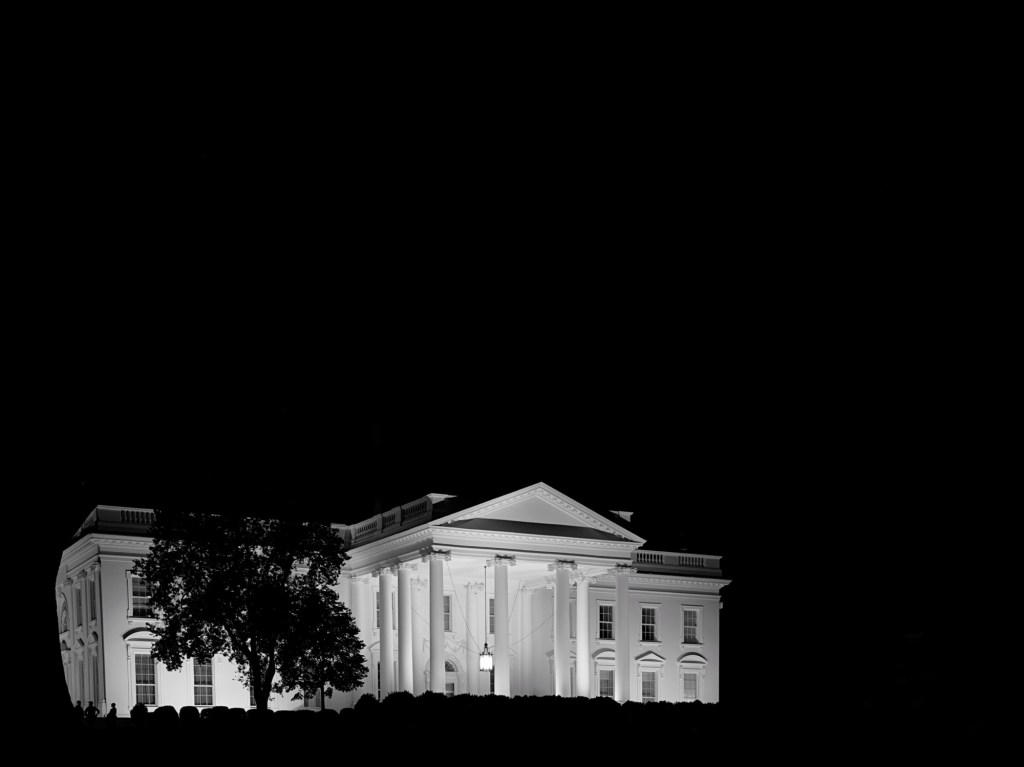
The White House, Washington, DC, 2023
But the scariest thing has been associated with my postcards project. To be clear, actually printing those postcards wasn’t scary at all! But actually sending them to people — with the prospect they would look at a cohesive bit of my work and then offer commentary to potentially hundreds or thousands of people — has been intimidating because it constitutes an exposure of my amateur photography to an otherwise unknown set of publics.
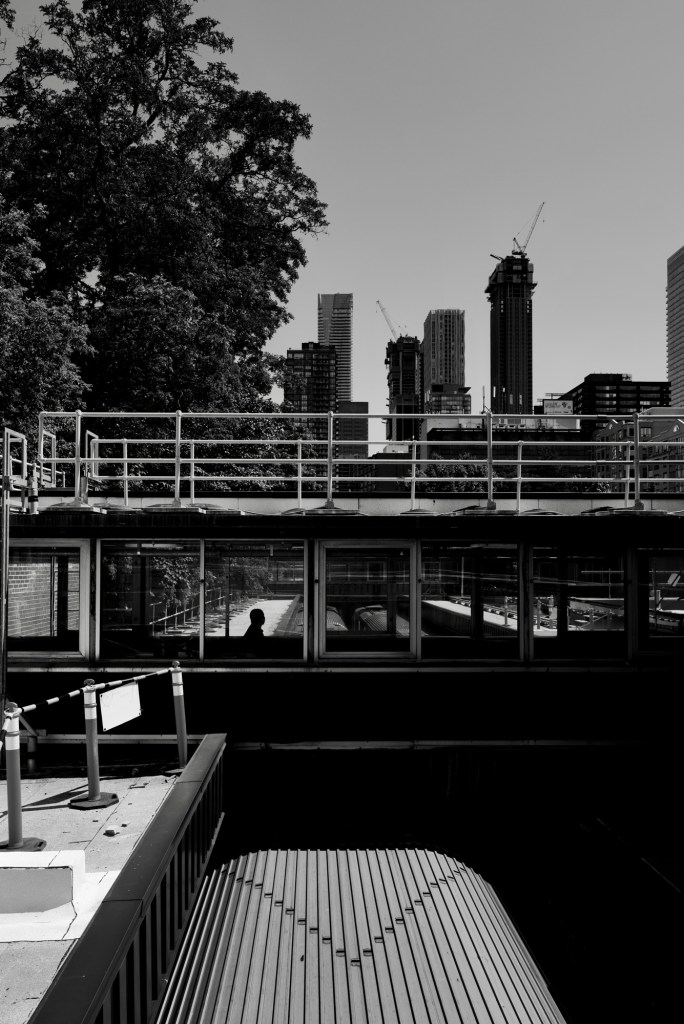
Crescent & Cluny, Toronto, 2024
I’m not afraid of publicity or engaging with publics. I’ve been very involved in public life for the past 15 years, and am as comfortable speaking with leaders of government or other senior leaders as I am appearing on television and speaking to tens or hundreds of thousands of people. But the sharing of my photographic hobby is different because it isn’t a domain where I’m a well-credentialed expert: I’m very much a learning amateur when it comes to photography. While I take my hobby very seriously I don’t have the skills or experience that parallel those of a more seasoned or professional photographer.
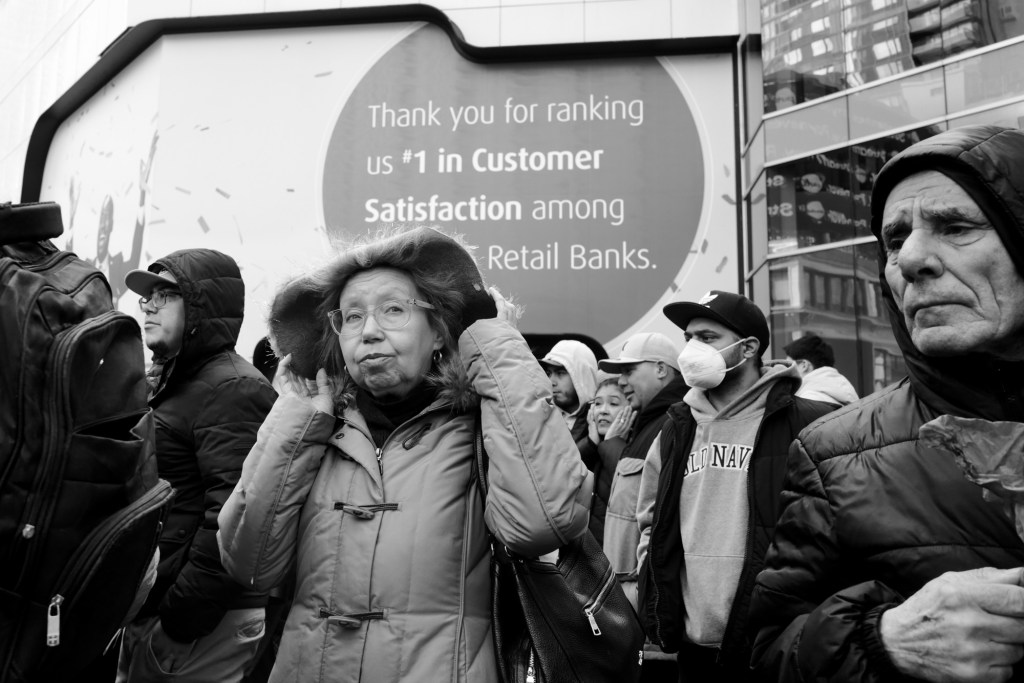
Yonge & Dundas, Toronto, 2024
I recognize that sharing my work, be it with NealeJamesandhisPhotowalkPodcast, or with Ted Forbes and his Art of Photography YouTube channel, has been a real step for me. It represents my ever deepening appreciation for the art form and my starting to explore ways of more broadly sharing my work, as well as developing increasing confidence in what I’m making. I’ve got an long way to go in deepening my expertise in making the kinds of photos I want to make but I feel more confident in what I’m doing, today, than I did even a year ago.
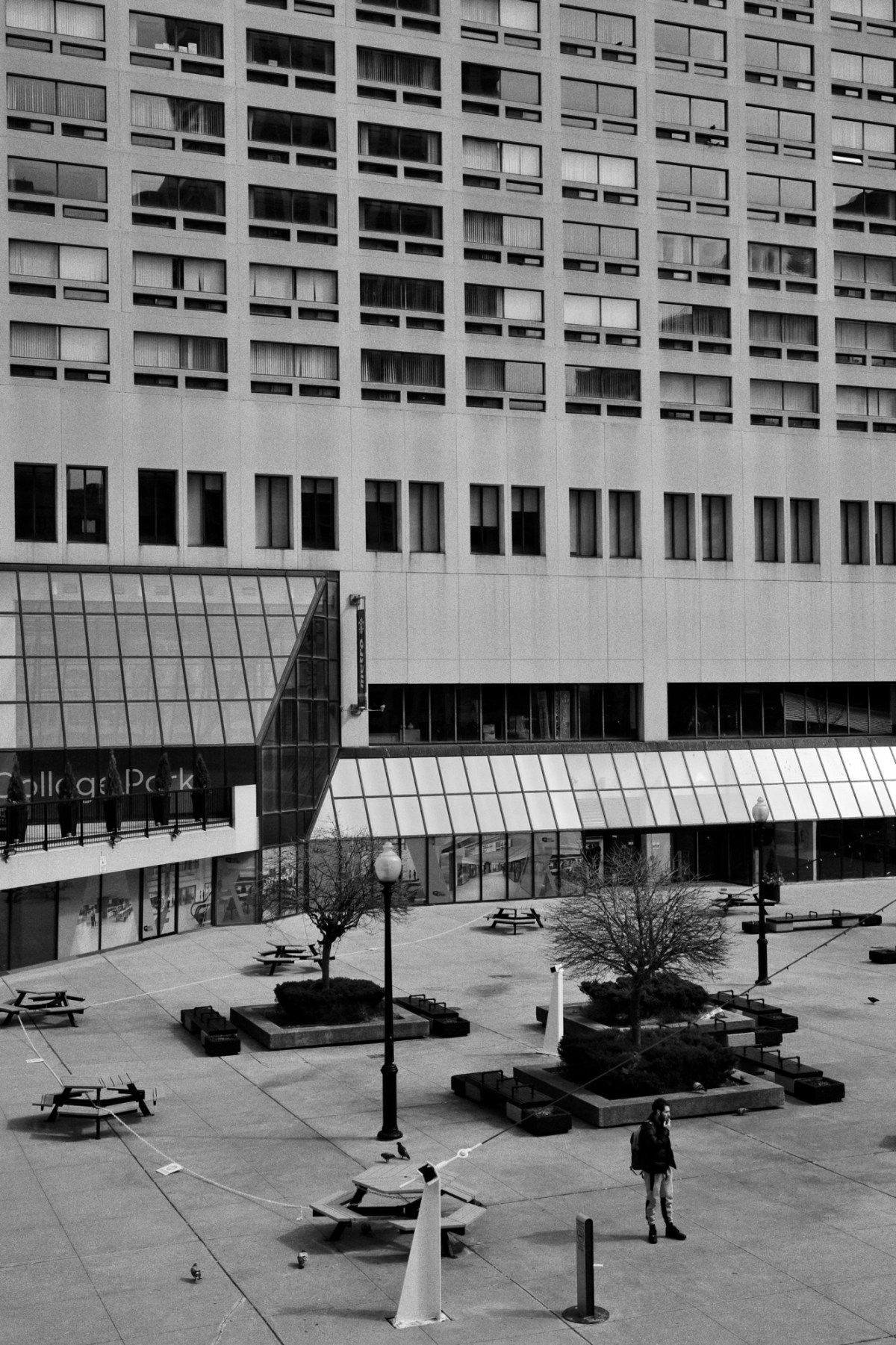
Each month Glass has a different featured photographic category. In March, a photograph I took of College Park was amongst the many excellent images that photographers published to the platform throughout the month in the ‘Urban’ category.
A feature of my street photography is to showcase lone humans in busy metropolitan areas. For context, College Park is surrounded by condos and rental apartments, and is located by a major subway stop; I suspect it’s amongst the denser parts of the city. Nevertheless I was able to catch this lone figure and the ever-present pigeons when I was running to a grocery store to get a few things.
I don’t know that I, personally, consider this to be the best image I made in March. But it definitely is very reflective of the types of images I’ve been making and so is representative of a particular body of work that I continue to develop.
For those interested, this was made using a Ricoh GR iiix. I use a custom monochrome jpeg simulation, applied minor edits in Apple Photos, and cropped the image slightly so it is 20 megapixels as displayed.











 Excited Pixels