For the first time I’ve submitted a trio of photos to a (free) competition being run by Ricoh.
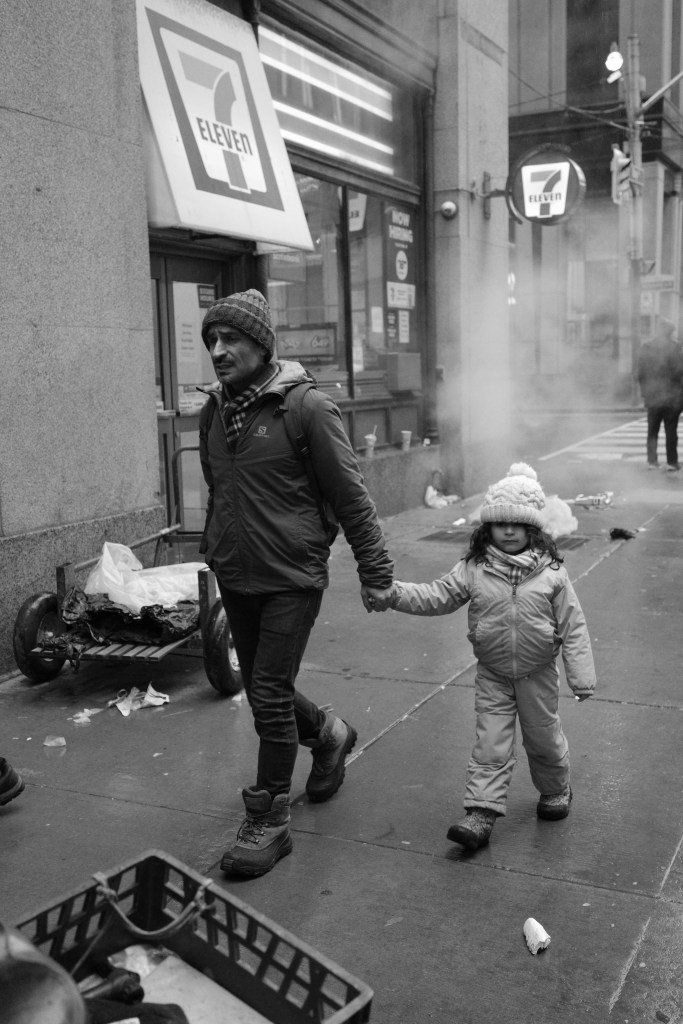
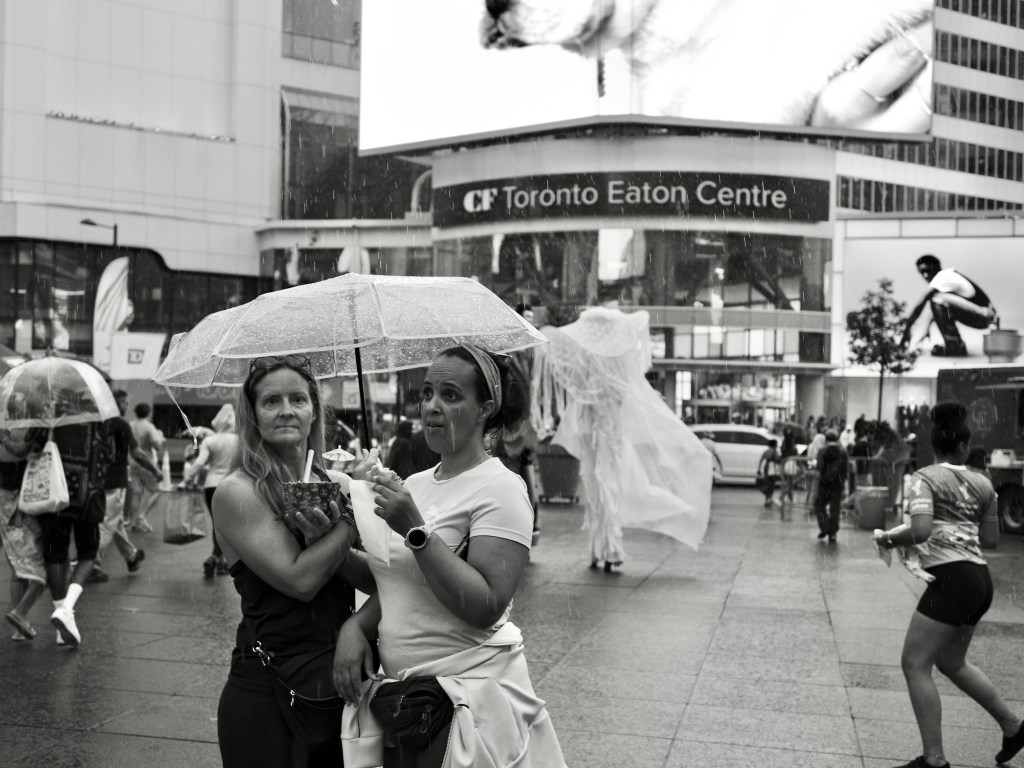
While I can’t picture winning it seems like a real step in my own confidence in the photos that I’m capturing.

For the first time I’ve submitted a trio of photos to a (free) competition being run by Ricoh.
While I can’t picture winning it seems like a real step in my own confidence in the photos that I’m capturing.

I’ve had the good fortune to get out and take photos pretty well every week of the summer. On the whole I’ve enjoyed decent light, good and interesting weather, and lots of events that opened up opportunities to capture the city in interesting ways.
Paulie B. has a recent video where he asked street photographers about their top photo or two of the summer. Inspired by his video, I thought that I’d post a few of my photos and explain why I liked them. All of these photos were first shared on Glass, and Fuji images relied on my “Classic Monochrome” recipe.

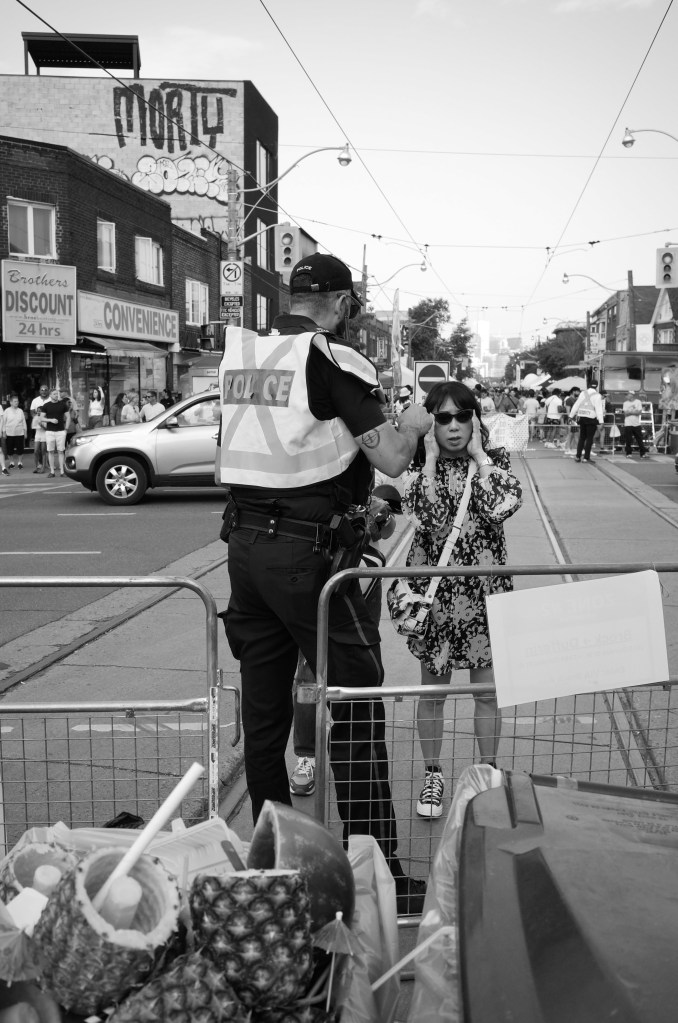
This was taken at one of the first festivals of the summer. I just walked back and forth through it over a couple of days and left with a number of images I liked, with this probably my favourite. Why?
First, I love the woman’s expression in her relationship to the officer, as well as with the pineapples: what exactly is the problem? Why is she so shocked? What has the officer said, if anything?
Second, I liked the background — it showcases this part of Toronto. It’s not filled with the new shiny glass buildings and condos, and still has some of the older shops and signs. This location gives a sense of ‘where’ this image was taken.
Third, I just like having images with pineapples in them. I don’t know why but I can tell it’s a motif in studying the images that I’ve taken over the years.

This image was taken on Toronto’s waterfront. It just captures all the things that summer can be in Toronto: ferries coming from the Toronto islands, some people relaxing along the water, seagulls (which are everywhere along the waterfront in the summer), travellers landing at the island airport, and just a sense of activity and calm.

Taken from the financial district of downtown Toronto, I really liked how the light was falling on the scene and the way that the male subject is relaxing against the bulls. It almost feels pastoral to me, which isn’t the typical experience I get when walking around (or living in) the downtown core.

I’m a sucker for taking photos of ice cream trucks and I really liked how this guy was looking out of the truck while a pigeon was just wandering by in the lower left of the frame. Is this the most complex image I took in the summer? Nope. But I still liked the environmental portrait that was captured.

Taken along one of my regular patrol routes, there’s a lot that I like throughout this frame.
It has a lot of construction elements — something I’ve been deliberately including in my street photos as part of a long-term project — and there’s some sub-framing that comes out because of how the shadows lay against the wall. The subjects to the far right of the frame are somewhat interesting — what are they pointing at? And does it intersect with the ‘caution’ warning? — but their shadows are where they shine. The shadows seem like they’re up to…something…while at the same time there is a subject that is reminiscent of the Invisible Man wandering along the left side of the frame. In aggregate, this scene has a degree of dimensionality that I really liked, some subjects of interest, and fit within an ongoing project.

I’m always a sucker for isolated subjects in the city who are in interesting situations, or have interesting expressions or body language. This photograph captures this for me.
I like that the main subject seems somewhat desolate, and yet is sitting alongside a series of summer treats and toys. And the fact that this is a vendor who only takes cash? I wonder when such signs are going to be real indicators of a distant past. The other piece that I like is how the top, right, and left of the frame are all food-related: the subject is selling popcorn and candies, hotdogs are being sold along the left of the frame, and the top of the frame can refer to top-end gourmet restaurants. So there’s multiples ‘frames’ to the subject which, again, adds a degree of structure or complexity into the composition.
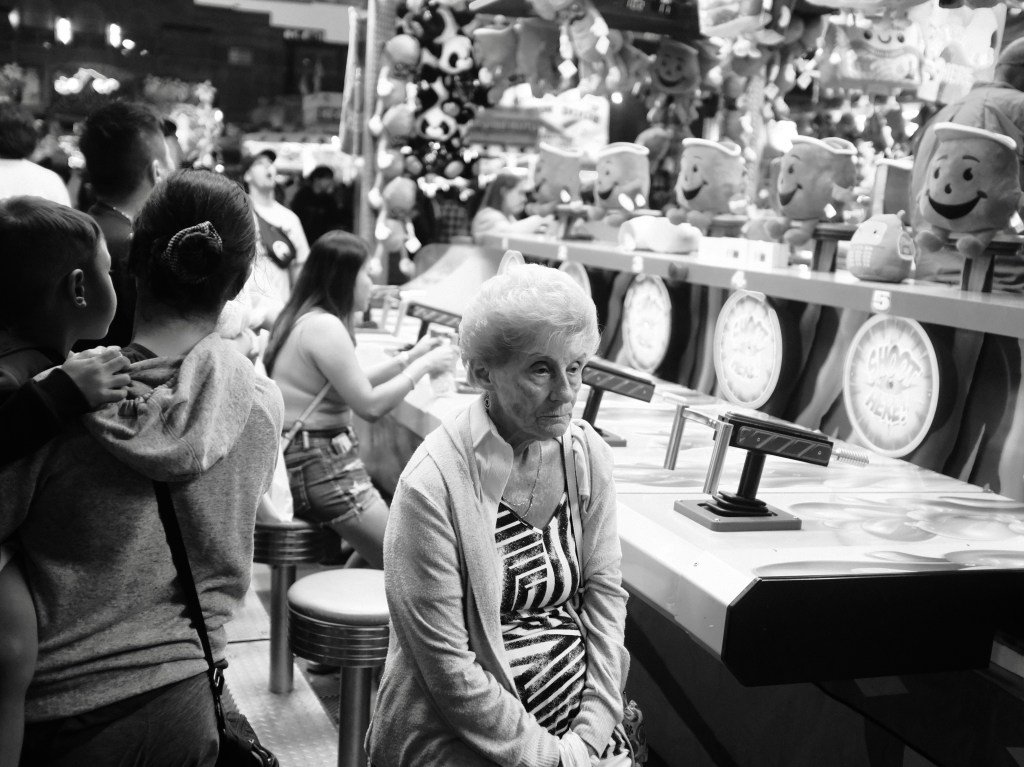
This was taken during the waning days of the CNE, which is a massive festival that takes place annually in Toronto. People are typically excited and happy, but our older subject, here, seems sad, quiet, or in deep contemplation.
Having her placed against games and the Kool-Aid Man on one side, and the child and mother on the other, really underscores her emotional state in what is typically a festive situation. I also like the depth of the photo that indicates where the women is in Toronto. This leaves the viewer with a deeper sense of context, which helps to amplify the woman’s facial expression and body language.
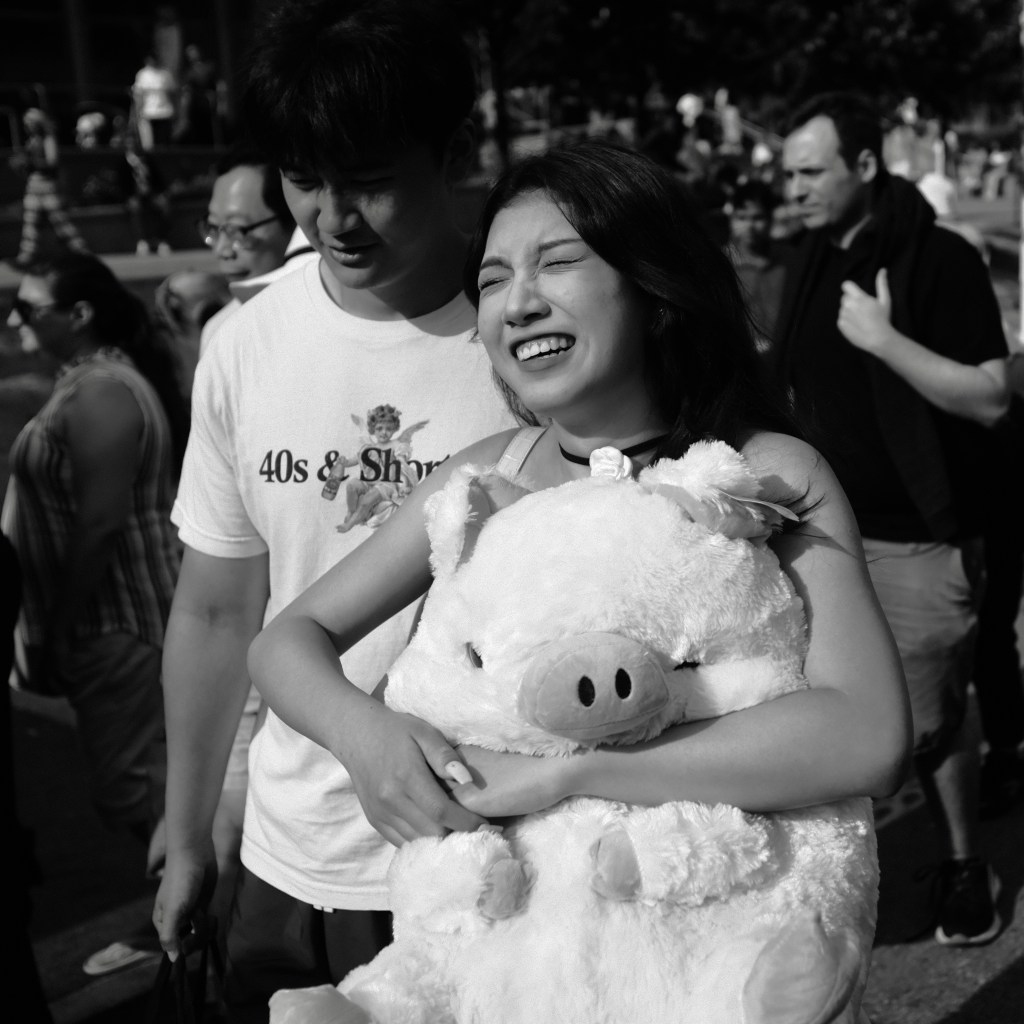
The final photo of the summer is another from the CNE. The subjects in this one exemplify what is ‘normal’ in the summer — happiness, togetherness, and fun. The subjects’ expressions and open and apparent and I love how large the stuffed pig is in context to the woman — what will she do with it once she gets it home?
While it’s not the most complicated of photos I took over the summer it expresses a sense of unadulterated happiness or joy that regularly brings a smile to my face.
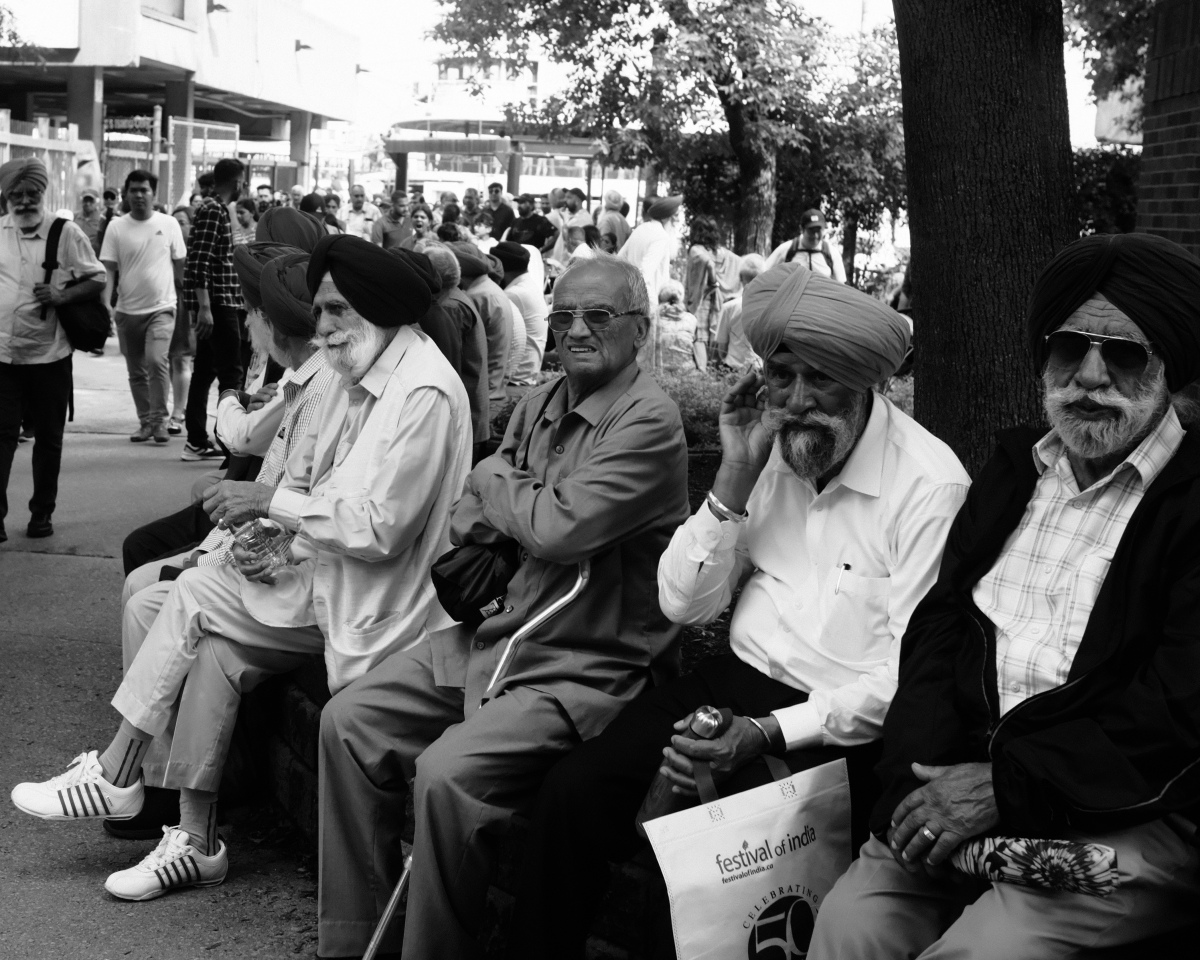

For the past several months Neale James has talked about how new laws which prevent taking pictures of people on the street will inhibit the documenting of history in certain jurisdictions. I’ve been mulling this over while trying to determine what I really think about this line of assessment and photographic concern. As a street photographer it seems like an issue where I’ve got some skin in the game!
In short, while I’m sympathetic with this line of argumentation I’m not certain that I agree. So I wrote a longish email to Neale—which was included in this week’s Photowalk podcast—and I’ve largely reproduced the email below as a blog post.
I should probably start by stating my priors:
Anyhow, with that out of the way:
If you think of street photography in the broader history of photography, it started with a lot of images with hazy or ghostly individuals (e.g. ‘Panorama of Saint Lucia, Naples’ by Jones or ’Physic Street, Canton’ by Thomson or ‘Rue de Hautefeuille’ by Marville). Even some of the great work—such as by Cartier-Bresson, Levitt, Bucquet, van Schaick, Atget, Friedlander, Robert French, etc—include photographs where the subjects are not clearly identified. Now, of course, some of their photographs include obvious subjects, but I think that it’s worth recognizing that many of the historical ‘greats’ include images where you can’t really identify the subject. And… that was just fine. Then, it was mostly a limitation of the kit whereas now, in some places, we’re dealing with the limitations of the law.
Indeed, I wonder if we can’t consider the legal requirement that individuals’ identifiable images not be captured as potentially a real forcing point for creativity that might inspire additional geographically distinctive street photography traditions: think about whether, in some jurisdictions, instead of aperture priority being a preferred setting, that shutter priority is a default, with speeds of 5-15 second shutters to get ghostly images.2
Now, if such a geographical tradition arises, will that mean we get all the details of the clothing and such that people are wearing, today? Well…no. Unless, of course, street photographers embrace creativity and develop photo essays that incorporate this in interesting or novel ways. But street photography can include a lot more than just the people, and the history of street photography and the photos we often praise as masterpieces showcase that blurred subjects can generate interesting and exciting and historically-significant images.
One thing that might be worth thinking about is what this will mean for how geographical spaces are created by generative AI in the future. Specifically:
As a final point, while I identify as a street photographer and avoid taking images of people in distress, the nature of AI regulation and law means that there are indeed some good reasons for people to be concerned about the taking of street photos. The laws frustrating some street photographers are born from arguably real concerns or issues.
For example, companies such as Cleaview AI (in Canada) engaged in the collection of images and, subsequently, generated biometric profiles of people based on scraping publicly available images.
Most people don’t really know how to prevent such companies from being developed or selling their products but do know that if they stop the creation of training data—photographs—then they’re at least less likely to be captured in a compromising or unfortunate situation.
It’s not the photographers, then, that are necessarily ‘bad’ but the companies who illegally exploit our work to our detriment, as well as to the detriment of the public writ large.
All to say: as street photographers, and photographers more generally, we should think broader than our own interests to appreciate why individuals may not want their images taken in light of technical developments that are all around us. And importantly, the difference is that as photographers we do often share our work whereas CCTV cameras and such do not, with the effect that the images we take can end up in generative AI, and non-generative AI training data systems, whereas the cameras that are monitoring all of us always are (currently…) less likely to be feeding the biometric surveillance training data beast.

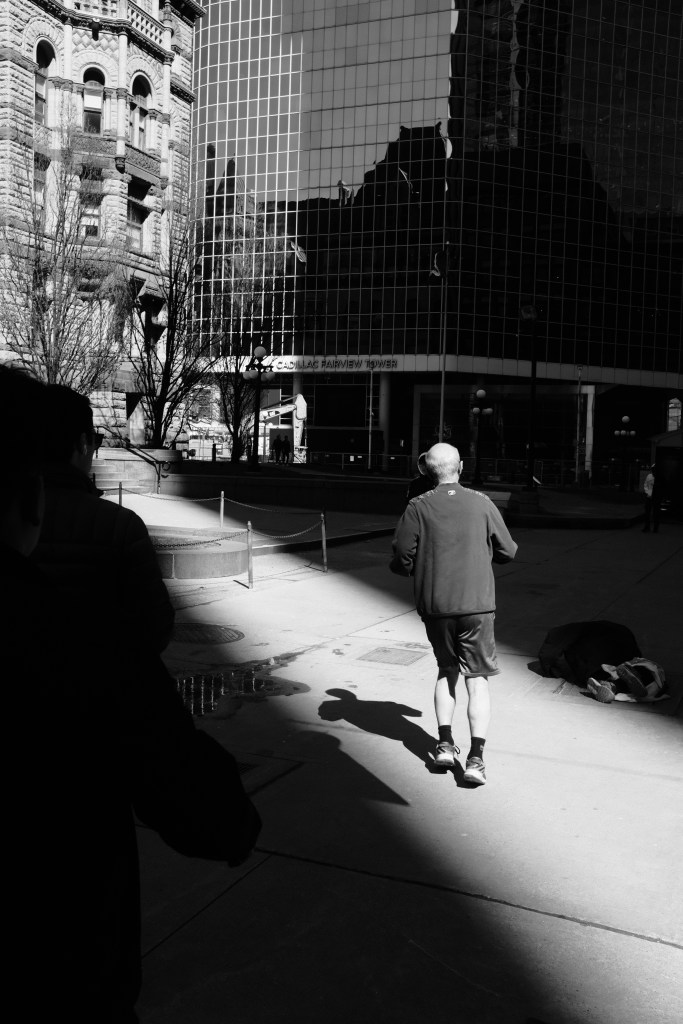
I made this image while out on my weekend photowalk. I’ve passed this same location hundreds of time since I’ve lived in Toronto. In what might become a semi-regular type of post, I wanted to write a bit about the backstory of the image. It was originally posted to Glass.
I was drawn to this scene, first, just because of how the light managed to slice through the shadows which were cast by the surrounding skyscrapers. After dialling the exposure to -1.3 I waited for some interesting characters to pass through the light.
It was only after taking a couple images that I really noticed how the unhoused person’s feet and legs were apparent. They were on grates that pass steam in the colder times of the year. Some of the unhoused use these grates to stay warm during the winter.
I deliberately avoid taking many head-on or identifiable photos of people who are in distress. I’m generally not a fan of that kind of street photography, unless the photographer chooses to really engage with the subjects in meaningful ways.
Still, the city—and especially the city core—does have a serious and growing housing issue. And so I ultimately decided to compose the scene with the hopes that it would show people noticing, but passing by, the individual on the street, as a kind of broader commentary of the social housing issues that exist in Toronto.
Compositionally the image is simple: a pair of men looking in the direction of the source of the light, and not towards the half shrouded person on the sidewalk, and moving towards the light. Behind them the aperture of the light beam starts to close, but the reader of the photograph can see the sparkle of youth (the new, glass, building) as juxtaposed agains the old (Toronto’s historical city hall). The young reflects the old, reminding us that youth is impermanent. As I said: it’s not a deep photograph nor are any particularly special tricks used to make it.
I often linger when I find light that I like for at least a couple minutes, to see if more interesting (or any interesting!) subjects come to fill the scene. Other times I’ll recompose and work the scene a little bit. But I have to admit that staying put is something that I need to get better with: it’s not enough to just linger for 5-10 minutes!



The above set of images aren’t touched up and are a few of the ‘raw’ versions of images I took and normally wouldn’t post (I took a total of about 20 frames before I settled on the one at the top of the post). I, personally, learn a lot from the older Magnum photos that include contact sheets.
While my rougher images aren’t the same, nor as descriptive, as contact sheets maybe they’ll be helpful to someone else when they are thinking of weighing a scene. Or maybe just to make clear that the admittedly very amateur images I make involve a lot more than just one lucky capture (with a handful of exceptions of course).
Black Tap Magazine has a helpful article that distinguishes between photojournalism, documentary photography, and street photography. I found it particularly helpful to see the author grapple with the differences (and commonalities) between documentary and street photography, with the former focusing more on projects and potentially posed/non-urban photography, and the latter being cast as more spontaneous and less project-driven. While I think good street photography should be emotive and tell a story over time, I appreciate that the core assertion is that documentary photography must tell (or try to tell) some story, often as a photo set, whereas street photography is not similarly bound by these conditions.


We got our first snow of the year on Sunday. I kept waiting for it to come and as soon as the snow started to fall I grabbed my Fuji X100F with a Cinebloom 10% attached and headed out to make some images.

I live in a densely populated section of Toronto. Notwithstanding the snow there were many people out and about when I first hit the streets. But it was as I moved to side streets, or into parts of the city that tend to be populated by tourists, that it was apparent that huge chunks of the city were largely depopulated as people decided to stay inside where it was warm and dry.

There were, of course, some people out even in the less populated parts of the city. They, however, tended to be trying to get out of the snow—which functionally turned into snow that was almost indistinguishable from rain towards the early evening—and generally wanted to just avoid getting wet or cold.


Somewhat surprisingly I saw almost no other photographers out and about. I’m sure they were there, somewhere. But, at the same time, I wonder how much the weather dissuaded them from getting out and shooting the streets or urban landscapes.
I will never be accused of babying my cameras. My Fuji X100F lacks the weatherproofing of the newest version and, so, when I’m out in the snow I tend to protectively place one hand over it’s screen and eyepiece, and keep the lens pointed downwards and slightly in towards my body. It doesn’t prevent all the precipitation from getting onto the camera but, along with brushing off water when it starts to gather on dials and such, has always seemed good enough to keep the equipment safe.


The mix of heavy coats and umbrellas is something that I’m always curious about, if only because I can’t recall ever seeing something similar while I was growing up or when I visit parts of the country (or world) that receive large volumes of snow. I don’t dispute the potential utility of an umbrella—it will, obviously, help to keep your head wet and my uncovered head certainly got soaked after 3-4 hours outside—but it always seems like an instrument that is out of place. Though they look very distinct in the snow and so I definitely took the chance to make images of people who were carrying them!


Though there were people out and about, and evidence in other cases of someone having been present recently, much of the city felt oddly solitary. When I make my photos I’m often trying to communicate a sense of, on the one hand, the press of other people around and upon us and, on the other, the loneliness or isolation experienced while being in these massive urban environments. Dismal weather almost always draws me to the latter and wanting to express how large our environments are and what they look like with few figures or, alternately, in the absence of humans entirely. What will the city look like when the humans are gone?
When I watched one of James Popsys’ videos recently he mentioned that, when taking his landscapes, he likes putting either a human or a human-made thing in his images. Doing so has the effect of communicating human presence and, often, what the natural environment looks in our absence. Human-made things, also, have the effect of drawing us into an image on the basis that we ‘see’ something of ourselves in the otherwise natural environment.
In an almost modernist way of thinking those solitary human-things have the effect of both showing the attempt to overcome, or start overcoming, nature while often simultaneously showcasing the majesty and longevity of nature against the transitory existence of human-made things. Or at least that’s how I see and study such images.

I don’t know how well I really captured ‘nature’ in my walk—save towards the very end of my walk—but Popsys’ words have resonated in my head for some time. For years when I’ve made images of the city it’s often been with a view that the humans are transitory; they move though the frame, they enter and exit the city, they live and die. The built infrastructure and the protected landscapes interspersed throughout the city, however, will (should?) persist for a far longer period of time. Yes, Toronto is a city undergoing profound construction but looking through historical photos of the city reveal that key things have remained for a century or more in spite of the changes.
Of course that isn’t to say that the old has stayed perfectly the same; the bridge I took the below image from is literally a bridge to nowhere that was disconnected from the surrounding roads in 1964. While there were plans to remove it, apparently it’s more affordable to do minimal maintenance on it than tear it down; it’s only a matter of time, though, until this economic calculus changes. The city keeps putting up fences and warnings to keep people off the bridge but there’s only been once in the past decade where the fences were intact and I was prevented from getting onto the bridge. In the summer you can regularly discover some pretty cool graffiti along its struts.
The bridge sits over the Don River and, looking south, you have a view of a highway that our municipal and provincial governments continue to pour money into, as well as industrial lands which have been in declining operation for a long time. While the specific buildings will almost certainly change—most likely to be replaced by condos—the character of the landscape should remain the same for decades insofar as the highway and walking path should persist. Though it may be that a similar image will only be accessible to those flying small drones when the economic calculus for maintaining the bridge changes.

The answer, in almost all cases, is a resounding “yes.” David Fraser, a privacy and technology lawyer from Halifax, does an exceptional job in running curious (Canadian) street photographers through what the law allows and the rare exceptions when making street photos could have legal consequences.

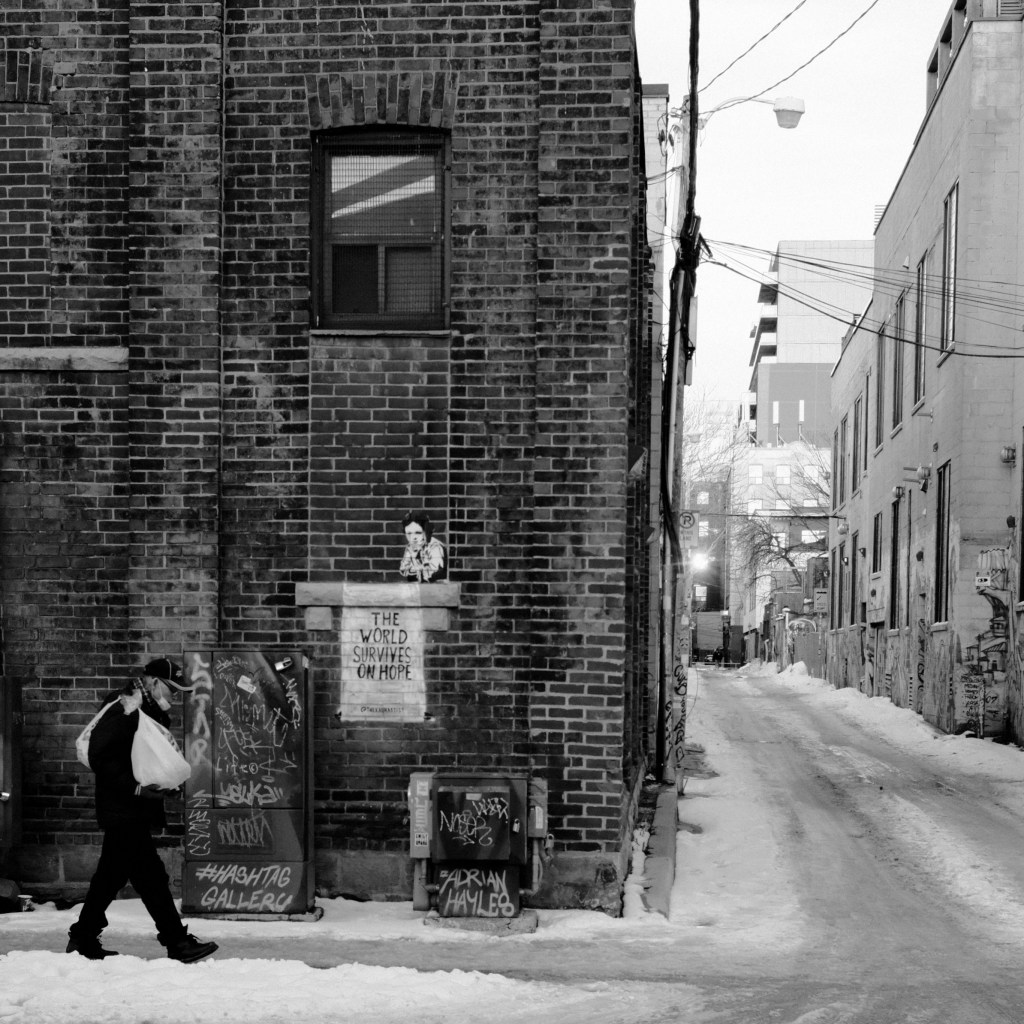
For the past several years I’ve created a ‘best of’ album that summarizes the year’s best photos that I made. I use the yearly album to assess how my photography has changed and what, if any, changes are common across those images. The process of making these albums and then printing them forces me to look at my images, how they work against one another, and better understand what I learned over the course of taking photos for a year.
I have lots of favourite photographs but what I’ve learned the most, at least over the past few years, is to ignore a lot of the information and ‘tips’ that are often shared about street photography. Note that the reason to avoid ignore them is not because they are wrong per se, or that photographers shouldn’t adopt them, but because they don’t work for how I prefer to engage in street photography.
Probably the key tip that I generally set to the side is that you should be stealthy, sneaky, or otherwise hidden from the subjects in the photos that I capture. It’s pretty common for me to see a scene and wait with my camera to my eye until the right subjects enter the scene and are positioned where I want them in my frame. Sometimes that means that people will avoid me and the scene and other times they’ll clearly indicate that they don’t want to have their photo taken. In these cases the subject is communicating their preferences quite clearly and I won’t take their photograph. It’s just an ethical line I don’t want to cross.

In yet other instances, my subjects will be looking right at me as they pass through the scene. They’re often somewhat curious. And in many situations they stop and ask me what I’m taking photos of, and then a short conversation follows. In an odd handful of situations they’ve asked me to send along an image I captured of them or a link to my photos; to date, I’ve had pretty few ‘bad’ encounters while shooting on the streets.
I’ve spent a lot of time learning about classic photographers over the past couple years. I’ve been particularly drawn to black and white street photography, in part because I think it often has a timeless character and because it forces me to more carefully think about positioning a subject so they stand out.
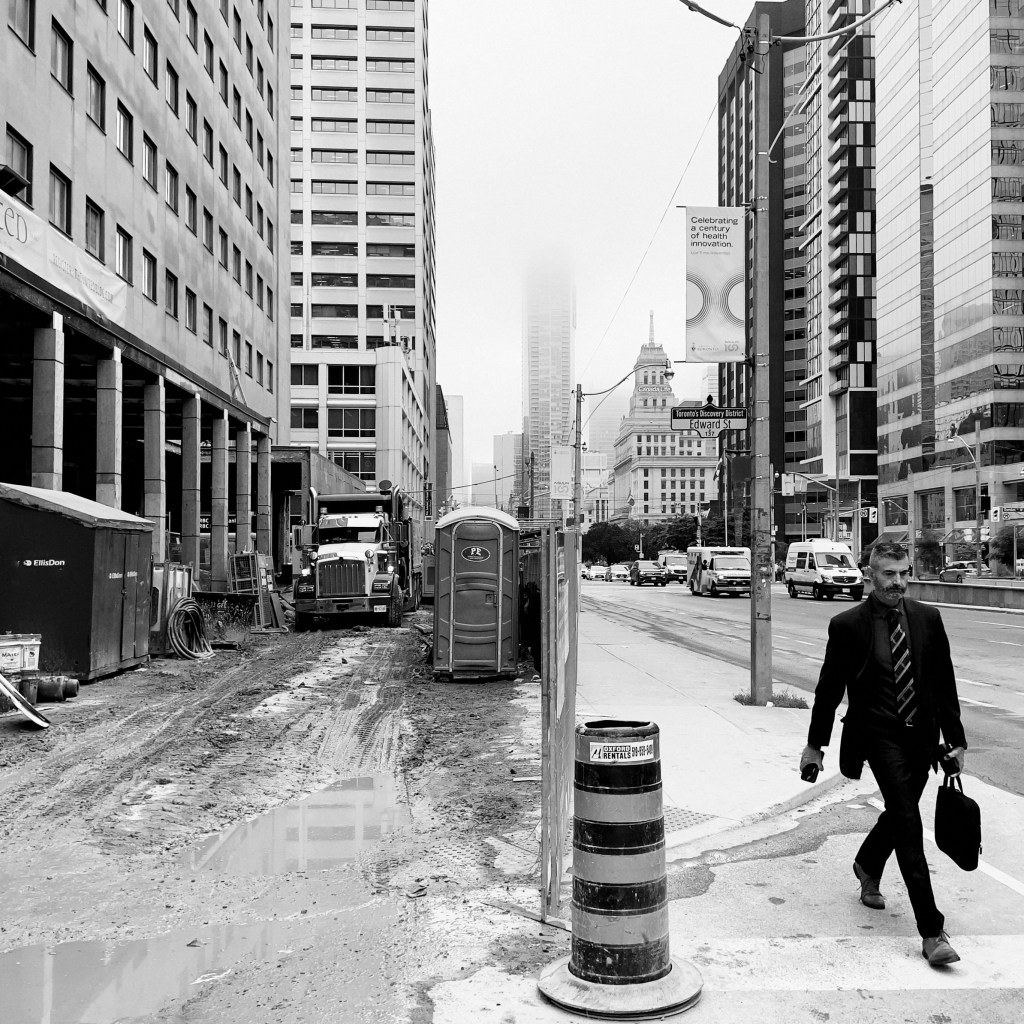
This being said, I don’t think that I’m directly imitating anyone else. I shoot with a set of focal ranges and periodically mix up the device I’m capturing images on; last year, a bulk of my favourite photos came from an intensive two week photography vacation where I forced myself to walk extensively and just use an iPhone 12 Pro. Photos that I’m taking, this year, have largely been with a Fuji X100F and some custom jpg recipes that generally produce results that I appreciate.
Don’t get me wrong: in seeing some of the photos of the greats (and less greats and less well-knows) I draw inspiration from the kinds of images they make, but I don’t think I’ve ever gone out to try and make images like theirs. This differs from when I started taking shots in my city, and when I wanted to make images that looked similar to the ‘popular’ shots I was seeing. I still appreciate those images but they’re not what I want to make these days.
While I don’t think that I’m alone in this, the images that I make are principally for myself. I share some of those images but, really, I just want to get out and walk through my environment. I find the process of slowing down to look for instances of interest and beauty help ground me.
Because I tend to walk within the same 10-15km radius of my home, I have a pretty good sense of how neighbourhoods are changing. I can see my city changing on a week to week basis, and feel more in tune with what’s really happening based on my observations. My photography makes me very present in my surroundings.

I also tend to use my walks to both cover new ground and, also, go into back alleys, behind sheds, and generally in the corners of the city that are less apparent unless you’re looking for them. Much of the time there’s nothing particularly interesting to photograph in those spaces. But, sometimes, something novel or unique emerges.
For the past year or so, a large volume (95% or more) of my images have been black and white. That hasn’t always been the case! But I decided I wanted to lean into this mode of capturing images to develop a particular set of skills and get used to seeing—and visualizing—scenes and subjects monochromatically.
But my focus on black and white images, as well as images that predominantly include human subjects, is relatively new: if I look at my images from just a few years ago there was a lot of colour and stark, or empty, cityscapes. I don’t dislike those images and, in fact, several remain amongst my favourite images I’ve made to date. But I also don’t want to be constrained by one way of looking at the world. The world is too multifaceted, and there’s too many ways of imagining it, to be stuck permanently in one way of capturing it.
This said, over time, I’d like to imagine I might develop a way of seeing the world and capturing images that provides a common visual language across my images. Though if that never happens I’m ok with that, so long as the very practice of photography continues to provide the dividends of better understanding my surroundings and feeling in tune with wherever I’m living at the time.


I’ve spent a lot of personal time behind my cameras throughout 2021 and have taken a bunch of shots that I really like. At the same time, I’ve invested a lot of personal time learning more about the history of photography and how to accomplish things with my cameras. Below, in no particular order, is a list of the ways I worked to improve my photography in 2021.
I started looking at different ‘recipes’ that I could use for my Fuji x100f, starting with those at Fuji X Weekly and some YouTube channels. I’ve since started playing around with my own black and white recipes to get a better sense of what works for making my own images. The goal in all of this is to create jpgs that are ‘done’ in body and require an absolute minimum amount of adjustment. It’s very much a work in progress, but I’ve gotten to the point that most of my photos only receive minor crops, as opposed to extensive edits in Darkroom.
The first real memory I have of ‘doing’ street photography was being confronted by a bus driver after I took his photo. I was scared off of taking pictures of other people for years as a result.
Over the past year, however, I’ve gotten more comfortable by watching a lot of POV-style YouTube videos of how other street photographers go about making their images. I don’t have anyone else to go an shoot with, and learn from, so these videos have been essential to my learning process. In particular, I’ve learned a lot from watching and listening to Faizal Westcott, the folks over at Framelines, Joe Allan, Mattias Burling, and Samuel Lintaro Hopf.
Moreover, just seeing the photos that other photographers are making and how they move in the street has helped to validate that what I’m doing, when I go out, definitely fits within the broader genre of street photography.
In the latter three months of 2021 I spent an enormous amount of time watching videos from the Art of Photography, Tatiana Hopper, and a bit from Sean Tucker. The result is that I’m developing a better sense of what you can do with a camera as well as why certain images are iconic or meaningful.
I really love my Fuji X100F and always have my iPhone 12 Pro in my pocket. Both are terrific cameras. However, I wanted something that was smaller than the Fuji and more tactile than the iPhone, and which I could always have in a jacket pocket.
To that end, in late 2021 I purchase a very lightly used Ricoh GR. While I haven’t used it enough to offer a full review of it I have taken a lot of photos with it that I really, really like. More than anything else I’m taking more photos since buying it because I always have a good, very tactile, camera with me wherever I go.
I’m not a particularly big fan of Instagram these days given Facebook’s unwillingness or inability to moderate its platform, as well as Instagram’s constant addition of advertisements and short video clips. So since October 2021 I’ve been posting my photos almost exclusively to Glass and (admittedly to a lesser extent) to this website.
Not only is the interface for posting to Glass a lot better than the one for Instagram (and Flickr, as well), the comments I get on my photos on Glass are better than anywhere else I’ve ever posted my images. Admittedly Glass still has some growing pains but I’m excited to see how it develops in the coming year.

This long form photoessay showcases the absences that have been wrought by the pandemic in my city of Toronto, Ontario. The essay provides a meditation on a world of social isolation and distancing, and how the spaces that have historically united and bound Toronto’s residents have been left empty or made safe in response to being associated with risk and disease. Throughout, people are represented as separate from one another in their efforts to socially and physically distance, with individuals, pairs, or very small groups standing in juxtaposition to the much larger built world they inhabit.
All of the images were created using a combination of a Fuji X100f, Sony rx100ii, iPhone 11 Pro, and iPhone 12 Pro. Images were edited to taste using Apple Photos (for cropping) and Darkroom; two images had some healing applied using Snapseed.


Have a WordPress.com account? Log in now.

