Categories
Links Writing

I Like The Apps, But Not The Design

A new version of the iPad is coming. The latest ‘craze’ around this version is whether or not it will come with a home button. To date, there’s been one particularly strong ‘In Defence of the Home Button’ post by Dave Caolo, which is effectively a listing of all the functions that Apple has tied to the singular button at the bottom of each iDevice.

This button isn’t going anywhere. And that’s really unfortunate, because better – or at least equivalent – options are out there.

The PlayBook is seriously lacking on apps. SERIOUSLY LACKING. But the hardware design of the device is stunning. I don’t need to pay attention to what is up, down, left, or right because of how RIM has integrated the bezel functionality. For a quick overview of the bezel options, check out the video below:

This isn’t to say that the Playbook is a winner hands down. Apple’s home button is linked to variety of accessibility options which are lacking on the Playbook. Also, Apple has a series of gestures that enable similar features as the Playbook, though I’m far less impressed at how they’re integrated. Because of how awkward these gestures tend to be, I tend to just use the home button, which can be incredibly inconvenient depending on the iPad’s orientation at the time.

My dream would be Apple getting creative and bringing the hardware design leadership of the Playbook to the app-rich iDevice environment. I’m not holding my breath through.

Categories
Links

Why TV is Broken

Minimal Mac has an interesting piece on the UX of television. In short, a young girl who isn’t exposed to TV suddenly is, and is confused and upset by the service provided. She doesn’t understand commercials, doesn’t understand the changes in volume, and becomes resigned to cable TV’s deficiencies.

A cautionary note to advertisers and television moguls alike: if your next-generation audience is ‘resigned’ to your service, and has alternates to your content delivery options, you need to adapt or watch your audience base slowly erode.

Go read the piece. It’s well written and eye-opening.

Categories
Aside

Useful Warnings

circa476: Poor Apple….

THIS is the kind of actionable, helpful, warning information that should be presented to end-users. It gives them the relevant information they need to choose ‘Cancel’ or ‘Add Anyway’ without scaring them one way or the other. If the jailbreak community can do this, then why the hell can’t the big players like Apple, RIM, Google, Microsoft and the rest?

Categories
Links

Management and RIM

This is an incredibly mixed article on RIM, but one section in particular stood out to me as either bad reporting, incompetent journalism, or Apple fanboyism.

Success also bred hubris about RIM’s position in the market. By late 2009, it was clear that the iPhone and Android had redefined the smartphone, and that RIM needed to adapt. The company had to target consumers more aggressively, not just business customers. It also had to drastically improve the BlackBerry’s user interface and web-browsing capabilities, not to mention attract developers to write more applications for the BlackBerry platform. Smartphones became less about communication—RIM’s biggest strength—and more about consuming media.

What’s more, the company itself was becoming increasingly complex. RIM produces multiple handsets, each with different screen sizes and internal hardware. RIM will even customize the same device to suit the needs of different carriers. Apple, in contrast, produces just one iPhone model per year. The product complexity at RIM takes a firm hand to manage, and that becomes more difficult when the entire organization is undergoing a seismic shift.

I agree: adaptation was signalled (though not necessarily entirely evident) in 2009. I agree: the company had to update it’s UI and OS to match that of their competitors.

Factually incorrect: Apple produces a single version of their iPhone (they have CDMA and GSM versions, as well as multiple ‘lines’ of their product by year, as well as some version that have or don’t have cameras according to businesses’ needs).

It strikes me that, while RIM certainly has challenges, focusing on the number of devices is of variable importance. If a company has a routine or standardized production and policy cycle that accommodates different radio technologies, then the radio technologies themselves are of minimal importance for overall production of new and updated devices. What the author actually means to say is that there was an emphasis on radios rather that UI innovation. This is arguably accurate – I have a Bold 9900 at the moment, and the UI is dated – but the hardware is incredible.

RIM is, and has been, a hardware company for quite some time. Other than Nokia there is no company that even comes close to competing (and I say this as an ex-iPhone owner, and the current owner of a Samsung Windows Phone device). The real test is watching to see if RIM becomes a Nokia, or transcends the problems that beset Nokia.

At best, BB 10 will enable transcendence. At worst, it will herald RIM turning into the world’s (arguably) best mobile hardware vendor in the world.

Categories
Writing

More Playbook UI Fail

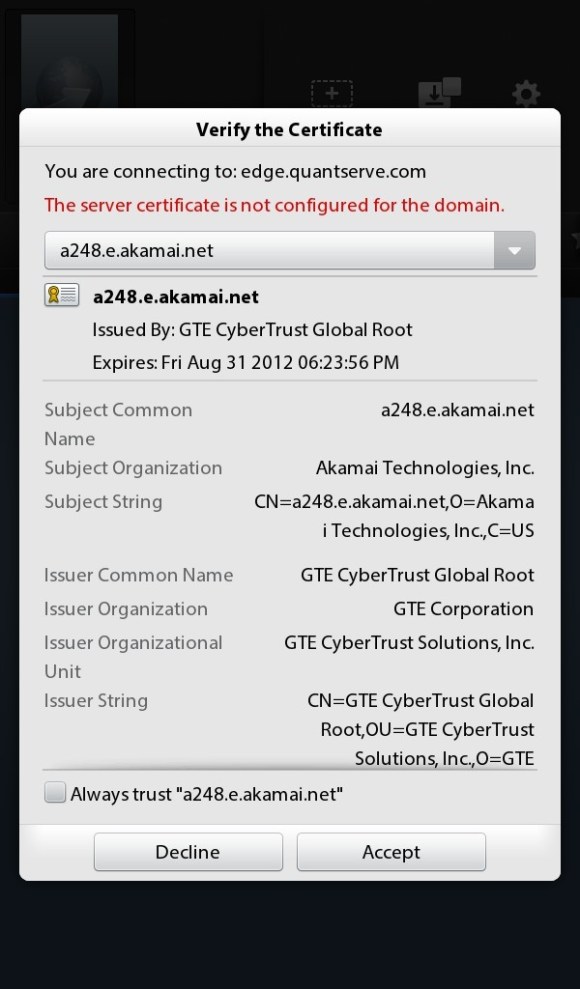
This is (another) security freak-out from the PlayBook. Is it really the case that Quantcast isn’t properly registering their certificates? What does it mean for the end-user to deny verifying the certificate?

The information contained in this screenshot lacks actual actionable information for most end-users, and they’re instead given a choice between X and Y without having any clear understanding of what either X (Decline) or Y (Accept) entrails.

Categories
Links

Ubuntu and TV

This is smart TV software done beautifully. It (seemingly) has more functionality than Apple TV and (looks to be) better integrated with movie purchasing services than Dlink’s Boxee Box. The problem with all smart TV devices remains their stability: I’m a geek, so I don’t mind occasionally reseting my Boxee Box or media centre and I accept that periodic crashes in the middle of a show or movie are the cost of early adoption.

Most people aren’t geeks. Most people won’t settle for sometimes crashing TVs. If Ubuntu doesn’t get that element right then everything else they do won’t matter one bit to the mainstream. Though us geeks will likely love it.

Categories
Humour

This is possibly the most insane remote I’ve ever seen. God help the traditional television makers if Apple ever produces a real TV.

Categories
Writing

PlayBook Browser UI Blunders

On the whole, I really like my PlayBook. That said, there are certain UI decisions that make absolutely no sense and are in desperate need of being cleaned up. One example: the URL bar in the default browser.

Landscape Mode

The UI makes loads of sense here. No major issues, though the decision to have the history icon (counter-clockwise circle) dead beside the refresh icon (at the end of the URL bar) is a boneheaded given the imprecision of the touch interface.

Portrait Mode

Note that to get the full browser options in the second portrait screenshot, you need to slide your finger along the favourite icon to reveal the other options. This is not an intuitive decision. Note that, with the poor precision of the touch controls, having the history button beside the refresh button is an even worse decision in portrait mode than when in landscape.

Truly WTF Decision

Note that in all the above screenshots there is a medal-like icon to the left of the URL. Tapping it brings up the below screen.
99.99999% of the world will have no clue what this means. For those of us that do it’s confusing: I’ve had the browser tell me on multiple occasions that the certificate is invalid when I know that not to be the case. I get that certificate awareness is a security plus but it’s done so poorly here that it’s (at best) effectively meaningless.
Now, are these huge issues? No, of course not. Are they signs of an unpolished OS release? Most definitely. Hopefully they’ll be improved upon in the 2.0 release of the PlayBook OS.