In 2010 and 2011, many discounted and differentiated Julian Assange from mainstream journalists by comparing him to a spy or foreign agent, despite the fact that he was just doing what every major US journalism organization does: publishing leaked classified information in the public interest.
Well, the government alleges in Rosen’s case that he acted “much like an intelligence officer would run a clandestine intelligence source” and communicated his “clandestine communications plan.” This is reminiscent of a disturbing House Judiciary hearing last year where the committee’s lead witness compared the New York Times’ David Sanger to a spy, saying he “systematically penetrating the Obama White House as effectively as any foreign agent.”
By that language, the government is arguing journalism is now akin to spying, no matter if its WikiLeaks or the mainstream press.
Trevor Timm, “Virtually Everything the Government Did to WikiLeaks is Now Being Done to Mainstream US Reporters”
Tag: United States
Raymond Michael Rodden was bored this week, so he drove to downtown Phoenix and began walking around, snapping photos of the federal courthouse and the state capitol with his iPhone.
The 33-year-old man ended up jailed, unemployed and homeless; his iPhone, iPad and Macintosh laptop confiscated as “evidence.”
All because they found it odd he was taking photos at 3 a.m.
“They told me they’re going to keep my computer because they want to see my search history,” he said Saturday evening in a telephone interview with Photography is Not a Crime.
“They wanted to know if I belonged to any extremist groups like the national socialist movement or sovereign citizens. They wanted to know what kind of books I checked out of the library.”
However, the only charges pending against him, if you even want to call them charges, are citations that he walked into an alley – a bogus charge that applies only to motorized vehicles – and that he neglected to change the address on his driver license after moving to Phoenix from Tucson last August.
They couldn’t even keep him jailed on the initial charge of an outdated warrant out of California because the San Obispo County Sheriff’s Office did not want to bother extraditing him from Phoenix.
“The warrant was not even valid in Arizona,” adding that it was over a probation violation for unlawful use of a vehicle, stemming from a 2001 incident in which he took his roommate’s car without permission after a heated argument.
That old roommate is still one of his best friends, allowing him to stay in his Tucson home after he was kicked out of the Phoenix home that was part of his employment.
“I was living in my boss’s house taking care of his son,” he said. “Now he thinks I’m some crazy person.”
The fact that the Phoenix police bomb squad tore his boss’s car apart searching for explosives before impounding it most likely convinced him that Rodden was not the most suitable person to care for his six-year-old son as he worked as a long-distance truck driver.
“The most radical thing I do is read Photography is Not a Crime and Cop Block,” he said.
So like most people who read those sites, he knows his rights when it comes to dealing with police.
And that is exactly why he is going through this ordeal.
It started Thursday at 3 a.m. when he was sitting at home, unable to sleep. He decided to drive to downtown in his boss’s car, which he had permission to do.
He parked the car in front of the Phoenix Police Department and began walking around downtown, which is a ghost town at that time.
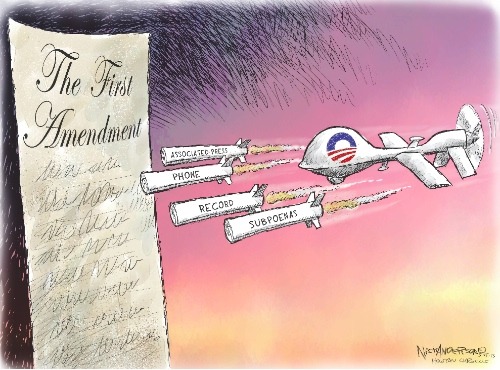
This is particularly insane.
Via Ars Technica:
Rushed production, faulty code doomed a Cold War game changer 26 years ago today.
A super interesting story about the politics and the (minor, but very significant) technical failure that doomed the Soviet Union’s attempt to put anti-Satellite lasers in space.
![]()
Clay Bennett/Chattanooga Times Free Press (04/25/2013)
A particularly good – if depressing – political cartoon.
2013.4.5
Much of the information collected by CIFA [Counterintelligence Field Activity] was amassed in a database called Talon, which stands for Threat and Local Observation Notice. Under a classified order data July 20, 2005, and reported in the Washington Post by military affairs blogger William Arkin, CIFA was allowed to collect information about U.S. citizens in Talon if there was reason to believe those citizens were connected to international terrorist activities, narcotics traffic, and foreign intelligence organizations and were a “threat” to DoD installations and personnel (“In other words,” Arkin commented, “some military gumshoe or over-zealous commander just has to decide [that] someone is a ‘threat to’ the military”). CIFA also obtained information about U.S. persons from the NSA and the DIA. As it turned out, however, many of these threatening people were antiwar activists, and the information about them came from monitoring meetings held in churches, libraries, college campuses, and other locations.
Tim Shorrock, Spies for Hire: The Secret World of Intelligence Outsourcing. Pp. 178.
2013.3.30
The determination by Congress and President Barack Obama’s administration to protect networks of critical U.S. industries from hackers and cyberspies is creating an explosive growth opportunity – for lobbyists.
There were 513 filings by consultants and companies to press Congress on cybersecurity by the end of 2012, up 85 percent from 2011 and almost three times as many as in 2010, according to U.S. Senate filings. Twelve firms have submitted new registrations this year on behalf of companies including Google Inc. (GOOG)’s Motorola Mobility unit, Symantec Corp. (SYMC), United Parcel Service Inc. (UPS) and Ericsson Inc., the U.S. subsidiary of Stockholm-based Telefonaktiebolaget LM Ericsson.
Eric Engleman & Jonathan D. Salant, “Cybersecurity Lobby Surges as Congress Considers New Laws”
I’m sure the lobbyists are only there as good patriotic Americans, aiming to best ensure that Americans are kept safe and Congresspeople and Senators (and their associated staff) just get the best information possible. No way that, in the wake of US scaremongering, lobbyists are looking to massively expand ‘security’ projects to the detriment of Americans’ privacy and (almost comically) security interest. Right?
Dr. Pentland, an academic adviser to the World Economic Forum’s initiatives on Big Data and personal data, agrees that limitations on data collection still make sense, as long as they are flexible and not a “sledgehammer that risks damaging the public good.”
He is leading a group at the M.I.T. Media Lab that is at the forefront of a number of personal data and privacy programs and real-world experiments. He espouses what he calls “a new deal on data” with three basic tenets: you have the right to possess your data, to control how it is used, and to destroy or distribute it as you see fit.
Personal data, Dr. Pentland says, is like modern money — digital packets that move around the planet, traveling rapidly but needing to be controlled. “You give it to a bank, but there’s only so many things the bank can do with it,” he says.
His M.I.T. group is developing tools for controlling, storing and auditing flows of personal data. Its data store is an open-source version, called openPDS. In theory, this kind of technology would undermine the role of data brokers and, perhaps, mitigate privacy risks. In the search for a deep fat fryer, for example, an audit trail should detect unauthorized use.
Steve Lohr, “Big Data Is Opening Doors, but Maybe Too Many”
So, I don’t really get how Pentland’s system is going to work any better than the Platform for Privacy Preferences (P3P) work that was done a decade ago. Spoiler alert: P3P failed. Hard. And it was intended to simultaneously enhance users’ privacy online (by letting them establish controls on how their personal information was accessed and used) whilst simultaneously giving industry something to point to, in order to avoid federal regulation.
There is a prevalent strain of liberalism that assumes that individuals, when empowered, are best suited to control the dissemination of their personal information. However, it assumes that knowledge, time, and resourcing are equal amongst all parties. This clearly isn’t the case, nor is it the case that individuals are going to be able to learn when advertisers and data miners don’t respect privacy settings. In effect: control does not necessarily equal knowledge, nor does it necessarily equal capacity to act given individuals’ often limited fiscal, educational, temporal, or other resources.
2013.3.24
With drones, the question is how long before the dozens of states with the aircraft can arm and then operate a weaponized version. “Pretty much every nation has gone down the pathway of, ‘This is science fiction; we don’t want this stuff,’ to, ‘OK, we want them, but we’ll just use them for surveillance,’ to, ‘Hmm, they’re really useful when you see the bad guy and can do something about it, so we’ll arm them,’ ” Singer said. He listed the countries that have gone that route: the United States, Britain, Italy, Germany, China. “Consistently, nations have gone down the pathway of first only surveillance and then arming.”
When the Whole World Has Drones – NationalJournal.com (via thisistheverge)
It’s the creeping use, combined with perceptions of citizens’ inability to affect government behavior that, combined, arguably are provoking resistance to drones in Canada and the US.
FBI: Smart Meter Hacks Likely to Spread
Though a little over a year old, this post concerning the security of smartmeters is particularly valuable considering the rapid adoption of the technologies throughout Canada. Particularly pertinent:
Citing confidential sources, the FBI said it believes former employees of the meter manufacturer and employees of the utility were altering the meters in exchange for cash and training others to do so. “These individuals are charging $300 to $1,000 to reprogram residential meters, and about $3,000 to reprogram commercial meters,” the alert states.
The FBI believes that miscreants hacked into the smart meters using an optical converter device — such as an infrared light — connected to a laptop that allows the smart meter to communicate with the computer. After making that connection, the thieves changed the settings for recording power consumption using software that can be downloaded from the Internet.
“The optical converter used in this scheme can be obtained on the Internet for about $400,” the alert reads. “The optical port on each meter is intended to allow technicians to diagnose problems in the field. This method does not require removal, alteration, or disassembly of the meter, and leaves the meter physically intact.”
The bureau also said another method of attacking the meters involves placing a strong magnet on the devices, which causes it to stop measuring usage, while still providing electricity to the customer.
So, this suggests that insider threats and poor shielding enable significant fraud. Can’t say it’s surprising given how often these meters have been compromised when deployed in other jurisdictions.