Categories
Photography

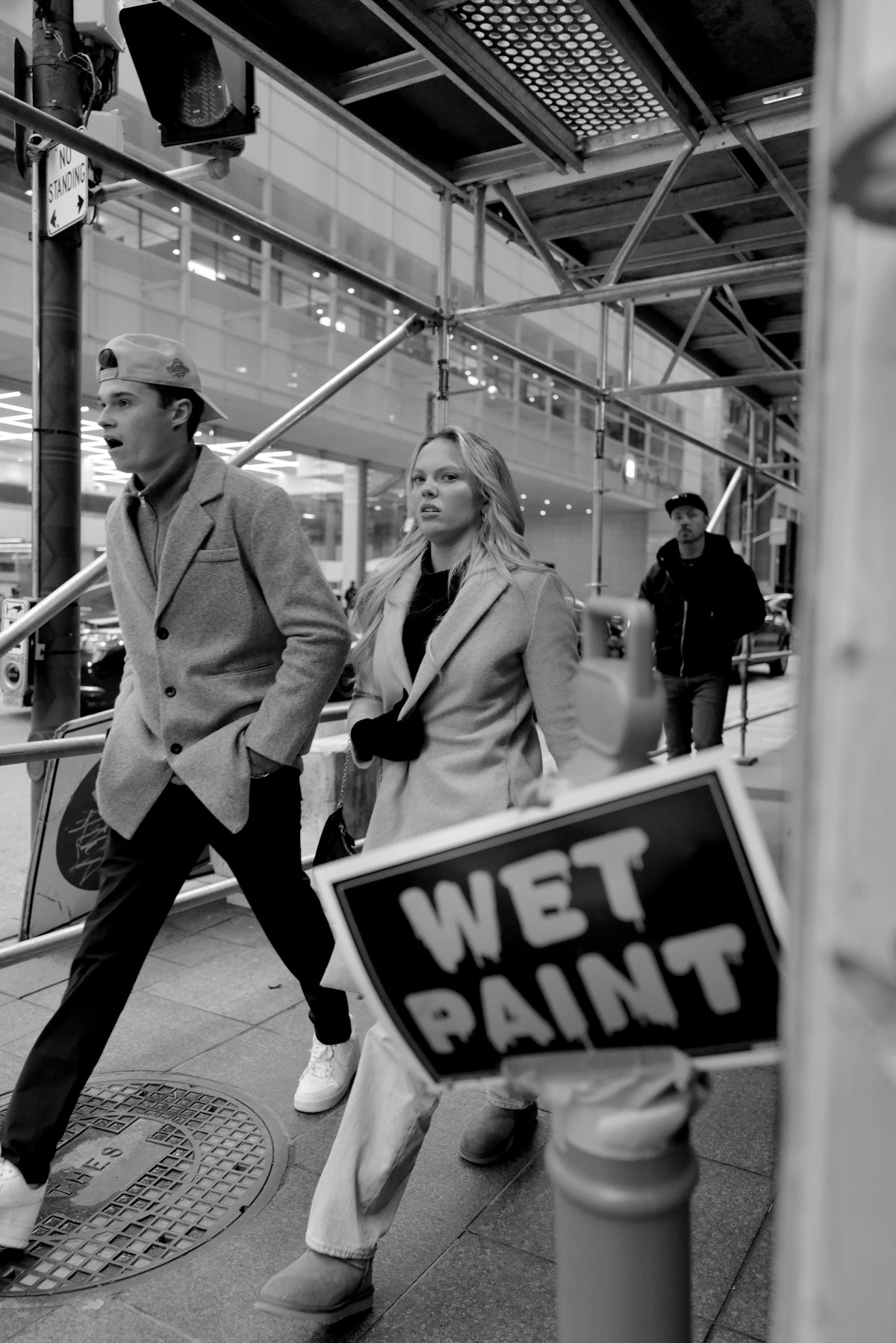
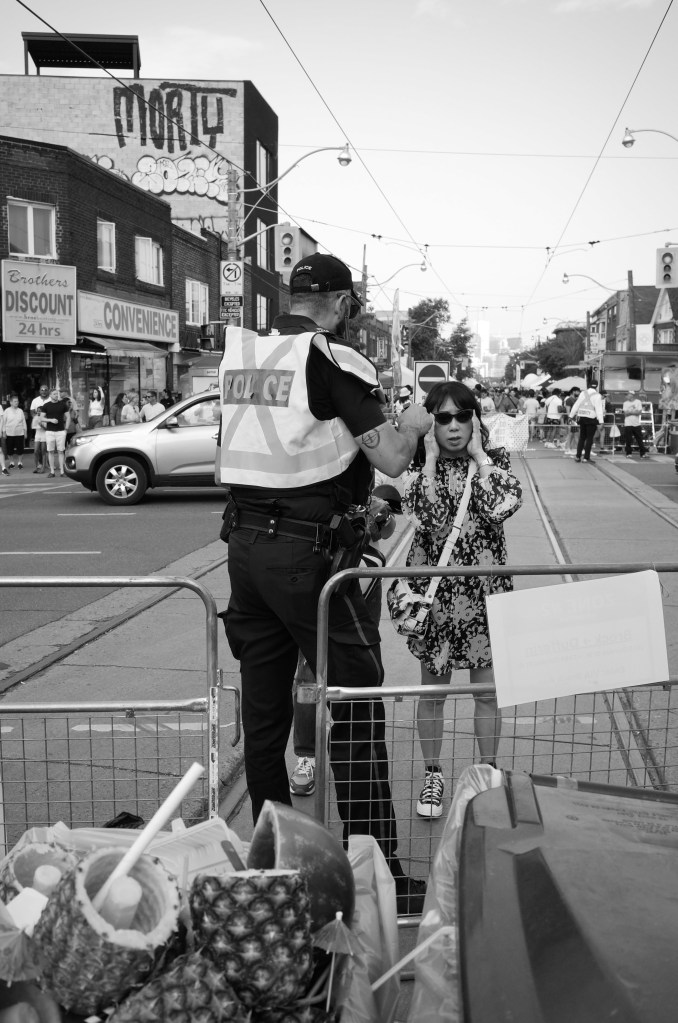
Postcards Project: January 2023

In the late fall of 2022 I decided that I’d turn one of my street photographs into a postcard for each month of 2023. I just received my proofs for 2023 this week and I’m happy with them; the full order will be made in the next week or two.

I also, however, will be posting the preceding year’s images to Excited Pixels. So, this January I’m posting the January 2023 photograph, in February I’ll post the February photograph from February 2023, and so on.

In addition to the street photograph that was made into a postcard I’ll also be publishing my favourite landscape/streetscape from that month. Despite making a reasonable number of landscapes/streetscapes, this will be the first time that I regularly publish some of them.

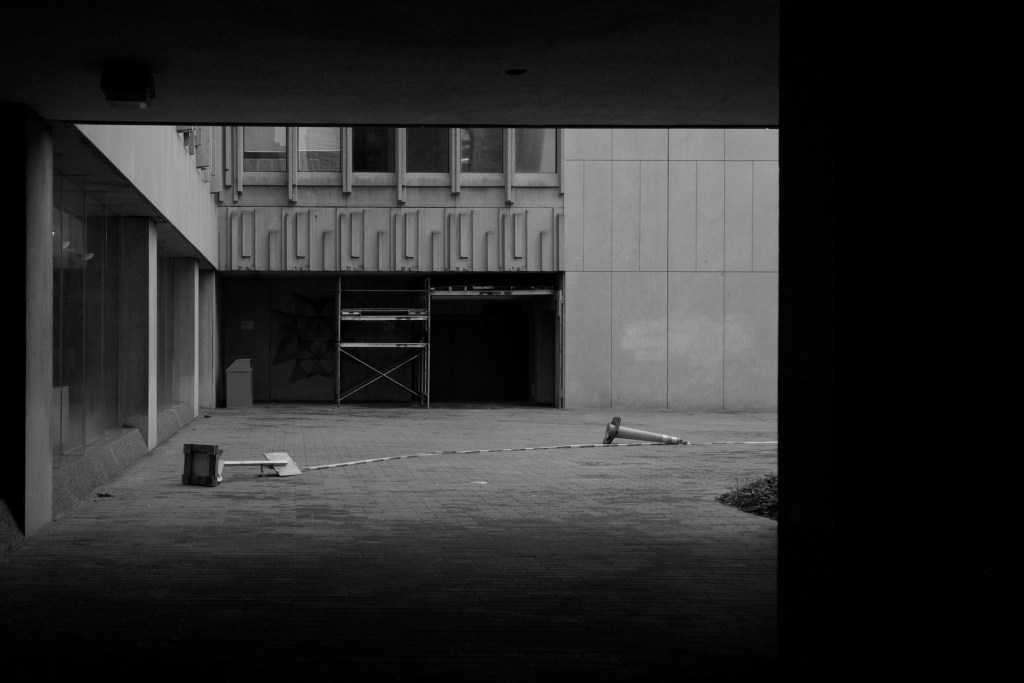
January 2023: Streetscape

University of Toronto , Toronto, 2023

I made this image of an under-construction part of the University of Toronto in my last few weeks employed with the institution. It is, in many ways, a deeply personal photo that reflected my passage to a new space. The tape and barriers being knocked over was figurative, in the sense that what once was a warning to keep me away was now a path to follow out of frame, and into new experiences and adventures after working with the same employer for almost a decade.

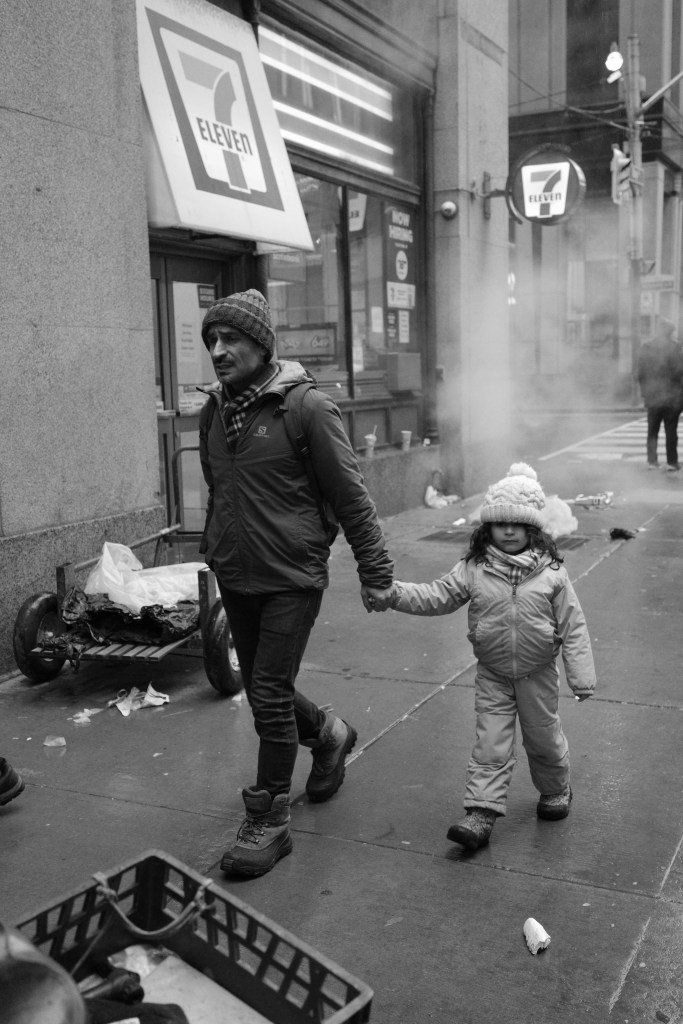
January 2023: Street Photograph

Richmond & Bay, Toronto, 2023

This photo was made January 1, 2023 and it remains one of my favourites. The emotion in the subjects’ face draws me in and the steam and garbage lends this part of the city (home to the country’s largest banks, stock exchange, and other financial and legal institutions) a kind of grittiness that belies its proximity to wealth and power. The photograph, also, speaks of how you can build a story in a frame that might look one way, but which doubles in meaning and context once grounded in the space and time wherein it was made.

I kept coming back to Bay and Richmond throughout the year and was regularly rewarded with rich images. The fluidity of the location, with updates to the built infrastructure in the form of temporary construction scaffolding, and the steam emerging from vents in this party of the city, just made it fun to keep coming back to.

Categories
Aside Photography

2024.1.20

Throughout 2023 I sorted the photographs I made with the intention of choosing one, from each month, to use in a limited run of postcards. All are street photos from around Toronto. I just ordered some proofs and I can’t wait to see them in the next few weeks ahead of doing a full print run!

Categories
Photography Writing

Best Photography-Related Stuff of 2023

There are lots of ‘best of’ lists that are going around. Instead of outlining the best things that I’ve purchased or used over the year I wanted to add a thematic: what was the best ‘photography stuff’ that I used, read, watched, or subscribed to over the course of 2023?

Photography Stuff I Used

Best Technology of 2023

90-95% of the photographs that I made over the year were with the Fuji X100F. It’s a spectacular camera system; I really like how small, light, and versatile it is. I created a set of recipes early summer and really think that I dialled in how to use them and, also, how to apply my very minimal editing process to the images. I’m at the point with this camera that I can use it without looking at a single dial, and I know the location of every setting in the camera that I regularly use.

I do most of my writing on my well-used iPad Pro 11” (2018). It’s a great device that is enough for 99% of my needs.1 However, I have to admit that I’ve long missed owning an iPad Mini because they’re so small and light and portable. I do pretty well all of my reading on the iPad Mini these days. My partner purchased me one this year and I’ve fallen in love with it again. I’m using it everyday for an hour or more, and ultimately I now pull out the iPad Pro 11” just when I need to do longer-form writing.

Finally, though I haven’t had it all that long, I really do enjoy the Leica Q2. I’m still getting used to the 28mm focal length but deeply appreciate how I can now shoot in bad weather and low light.2 The in-camera stabilization is also letting me experiment with novel slow shutter speeds. I remain excited, however, for what it’ll be like to use the camera when I haven’t been in persistent cloud cover!

Best Services I Paid For

I have kept using Glass each and every day. Does it (still) have problems with its AI search? Yes. Does it have the best photographic community I’ve come across? Also yes. You should subscribe if you really love photography and want to contribute to a positive circle of practice. And if you’re watching a lot of photography-related materials on YouTube I cannot recommend a Premium subscription highly enough!

I also am deeply invested in Apple’s services and pay for Apple One. This gives me access to some things that I care about, including a large amount of cloud storage, News, customized email, Apple Music, and Apple TV. I find the current costs to be more than a little offensive–Apple’s decision to raise costs without increasing the benefits of the service was particularly shitty–but I’m deeply invested in Apple’s ecosystem–especially for storing my photographs!–and so will continue to pay Apple’s service tax.

Best Apps

I use lots of apps but the best ones I rely on for photography include:

  • Podcasts App to listen to the different podcasts to which I’ve subscribed.
  • Reeder for staying on top of the different blogs/websites I’m interested in reading.
  • Glass to look at, comment on, and reflect on photographers’ images.
  • Geotags Photos Pro and Geotags Photo Tagger. I’ve set the former app to record my geolocation every 5 minutes when I’m out making images and the latter to then apply geotags to the photographs I keep from an outing.3

Stuff I Read

Best Photography Books

Most of the non-fiction books that I read throughout the year were focused around photography. The two best books which continue to stand out are:

  • Bystander: A History of Street Photography. This book does an amazing job explaining how (and why) street photography has developed over the past 150 years. I cannot express what a terrific resource this is for someone who wants to understand what street photography can be and has been.
  • Daido Moriyama: A Retrospective. This book is important for all photographers who are interested in monochromatic images because it really explains why, and how, Moriyama made his classic images. It reveals why he made his gritty black and white images and, also, why some of the equivalent ‘recipes’ the mimic this kind of image-making may run counter to his whole philosophy of image making.

Stuff I Watched

Best Movies

The best photography-related movies that I watched were all classics. They included Bill Cunningham: New York; Gary Winogrand: All Things Are Photographable; The Jazz Loft According to W. Eugene Smith; and Ordinary Miracles: The Photo League’s New York. Combined with written history and photo books they helped to (further) reinforce my understanding of how and why street photographers have made images.

Best YouTube Channels

I watch a lot of photography YouTube. The channels I learn the most from include those run by James Popsys, Tatiana Hopper, EYExplore, Alan Schaller, Pauline B, aows, Aperture, and Framelines. My preference is for channels that either provide POV or discuss the rationales for why and how different images are being (or have been) made.4

Stuff I Subscribed To

Best Podcasts

I tend to listen to photography podcasts on the weekend when I go out for my weekly photowalks. The two that I listen to each and every week are The Photowalk and The Extra Mile. It’s gotten to the point that it almost feels like Neale James (the host of the podcasts) is walking along with me while I’m rambling around taking photos.

Aside from those, I’ll often listen to A Small Voice or The Candid Frame. These are interviews with photographers and I regularly learn something new or novel from each of the interviews.

Best Blogs/RSS Feeds

For the past year I’ve trimmed and managed the number of my RSS feeds. I keep loving the work by Craig Mod, Little Big Traveling Camera,5 and Adrianna Tan’. They all do just amazing photoessays and I learn a tremendous amount from each of them in their posts.

Biggest Disappointments

I somehow managed to break the hood that I’d had attached to my Fuji X100F in the fall and decided to get what seemed like a cool square hood to replace it. It was a really, really bad idea: the hood was a pain to screw on so that it wasn’t misaligned and, once it was aligned, was on so tight that it was very hard to remove. I would avoid this particular hood like the plague.

I also bought a Ricoh GR IIIx and while it’s a fantastic camera I just haven’t used it that much. I didn’t take as many images with it as I’d hoped when I was walking to or from work, and really ended up just using it when I needed to go out and take photos in the rain (I kept it safely hidden under my umbrella). Also, the camera periodically just fails to start up and requires me to pull the battery to reset it. Is it a bad camera? Nope, not at all, and I did manage to capture some images I was happy with enough to submit to Ricoh’s photography contest. But it’s not a camera that I’ve really fallen in love with.

Finally, while I use my AirPods Pro all the time I really don’t like them because I cannot get them to stay in my ears unless I purchase third-party foam tips. And I need to keep purchasing new sets of tips because they wear out after a couple of months. Are they good headphones once they stay in my ears? Yes. But the only way to accomplish that is becoming increasingly costly and that’s frustrating.

Conclusion

Anyhow, that’s my list of the ‘best photography-related stuff’ I’ve used in the course of 2023. What was your top stuff of the year?


  1. I really do want to get a new iPad 11” and will do so once they update the screen. I edit pretty well all of my photos on the iPad Pro and an updated screen (and battery…) would be lovely. ↩︎
  2. There is a caveat that I’ve found: the electronic shutter is absolute garbage for shooting at dusk/in the dark with LED lights. And I think the single-use exposure dial on the Fuji X100F is preferable to the configurable dial on the Q2. ↩︎
  3. You can set the app to record your location more regularly but I’ve found this to be a good balance between getting geolocation information and preserving my phone’s battery life. ↩︎
  4. If you watch a lot of YouTube then I recommend that you pay for a YouTube Premium subscription. You’ll cut out the frustrating advertising that otherwise intrudes into the videos. ↩︎
  5. I think that this is perhaps the single best photography blog that I’ve found. I aspire to this level of excellence and regularity of updates! ↩︎
Categories
Writing

Quick Thoughts on Academics and Policy Impact

I regularly speak with scholars who complain policy makers don’t read their work. 95% of the time that work is either published in books costing hundreds of dollars (in excess of department budgets) or behind a journal paywall that departments lack access to.1

Bluntly, it’s hard to have impact if your work is behind paywalls.

Moreover, in an era of ‘evidence-based policymaking’ dedicated public servants will regularly want to assess some of the references or underlying data in the work in question. They perform due diligence when they read facts, arguments, or policy recommendations.

However, the very work that a scholar is using to develop their arguments or recommendations may, also, lay behind paywalls. Purchasing access to the underlying books and papers that go into writing a paper could run a public servant, or their department, even more hundreds or thousands of dollars. Frankly they’re not likely to spend that amount of money and it’d often be irresponsible for them to do so.

So what are the effect of all these paywalls? Even if the government policymaker can get access to the scholar’s paper they cannot fact-check or assess how it was built. It is thus hard for them to validate conclusions and policy recommendations. This, in turn, means that committed public servants may put important scholarly research into an ‘interesting but not sufficiently evidence-based’ bucket.

Does this mean that academics shouldn’t publish in paywalled journals or books? No, because they have lots of audiences, and publications are the coin of the academic realm. But it does mean that academics who want to have near- or middle-term impacts need to do the work and make their findings, conclusions, and recommendations publicly available.

What to do, then?

Broadly, it is helpful to prepare and publish summaries of research to open-source and public-available outlets. The targets for this are, often, think tanks or venues that let academics write long-form pieces (think maximum of 1,200-1,500 words). Alternately, scholars can just start and maintain a blog and host summaries of their ideas, there, along with an offer to share papers that folks in government might be interested in but to which they lack access.

I can say with some degree of authority from my time in academia that publishing publicly-available reports, or summarising paywalled work, can do a great deal to move the needle in how government policies are developed. But, at the same time, moving that needle requires spending the time and effort. You should not just expect busy government employees to randomly come across your paywalled article, buy it, read it, and take your policy recommendations seriously.


  1. Few government departments have extensive access to academic journals. Indeed, even working at one of the top universities at the world and having access to a wealth of journals, I regularly came across articles that I couldn’t access! ↩︎
Categories
Aside Photography

2023.12.29

I’ve owned a Leica Q2 for a little over a month so far. I haven’t really used it enough to say what I truly like (or dislike) about it, aside from moving from an APC-C sensor to a full frame sensor has been a fantastic upgrade in the lighting conditions in which I’ve been shooting.

The last day I had actual, honest to god, direct sunlight was on November 19, 2023. Every other day I’ve been out has been cloudy, rainy, or just grey. The larger sensor has meant that I’m reliably able to shoot at 1/500 and at an ISO under 3200. That would have been entirely impossible where I shoot with either my Fuji X100F or the Ricoh GR IIIx.

You can see what I’ve been shooting over at my Glass profile.

Categories
Aside Photography

2023.12.9

For the first time I’ve submitted a trio of photos to a (free) competition being run by Ricoh.

While I can’t picture winning it seems like a real step in my own confidence in the photos that I’m capturing.

Categories
Links

Pulling Back the Curtain on the Appin Cyber Mercenary Organization

Curious about what “cyber mercenaries” do? How they operate and facilitate targeting?

This excellent long-form piece from Reuters exquisitely details the history of Appin, an Indian cyber mercenary outfit, and confirms and publicly reveals many of the operations that it has undertaken.

As an aside, the sourcing in this article is particularly impressive, which is to expected from Satter et al. They keep showing they’re amongst the best in the business!

Moreover, the sidenote concerning the NSA’s awareness of the company, and why, is notable in its own right. The authors write,

The National Security Agency (NSA), which spies on foreigners for the U.S. government, began surveilling the company after watching it hack “high value” Pakistani officials around 2009, one of the sources said. An NSA spokesperson declined to comment.

This showcases that Appin may either have been seen as a source of fourth-party collection (i.e. where an intelligence service takes the collection material, as another service is themselves collecting it from a target) or have endangered the NSA’s own collection or targeting activities, on the basis that Appin could provoke targets to assume heightened cybersecurity practices or otherwise cause them to behave in ways that interfered with the NSA’s own operations.

Categories
Links Photography

A Century Caught on Camera

The Globe and Mail has a terrific photographic series entitled "A century caught on camera." As a Toronto resident I was struck by just how many traditions, rituals, and grievances have stuck with the city–or in the city–for over a century.

Further, the way in which the images have been captured has changed substantially over time as a result of the technical capacity of camera equipment, along with the interests or preferences of the photographers at different times. Images in the past decade or two, as an example, clearly draw more commonly from celebrity or artistic portraiture than 50 years ago. Moreover, it’s pretty impressive just how much photographers have done with their equipment over the past century and this, generally, speaks to how easy street and documentary photographers have it today as compared to when our compatriots were using slow lenses and film.

It may take you quite a while to get through all the images but I found the process to be exceedingly worthwhile. Though I admit that the first decade during which the Globe used colour images probably ranks as my least favourite period in the galleries that the paper has published.

Categories
Aside

2023.11.6

I was summoned for jury duty this week but we were all let out after just a few hours. While I admit I didn’t want to be stuck in a trial for up to a few weeks, I had hoped for a little more time to get through a massive backlog of reading that’s built up over the past 3-4 months. Still, I managed to read, annotate, and close over 100 Safari tabs so I’ll call it a win!

Categories
Aside Photography

Incoming Leica Q2

For the past several years I’ve kept looking at the Leica Q2 as the next step in the camera I want to use. To be clear, I think I’m pretty proficient with the Fuji X100F but I’ve also been in situations where it hasn’t been able to perform, either due to weather or extreme low light. And as much as I like it there are things I find less than ideal about the Fuji, including the zone focusing system.

When I was in Quebec, recently, I held the Q2 for the first time, and got to play with it bit, and it convinced me that this was the next device I wanted to use to make photos. I don’t know that I’ll actually use it to make 28mm images and suspect I’ll crop to 35mm (equiv), but regardless I’m looking forward to using it when it arrives in the next week or so!