Categories
Links Writing

DHS, Drones, and Domestic Surveillance

In the name of efficiency and good long-term planning, DHS is ensuring that its Predator Drones over the USA are able to distinguish persons from animals, evaluate whether such persons are armed, and are also integrating signals intelligence systems into the vehicles. From the article:

Homeland Security’s specifications for its drones, built by San Diego-based General Atomics Aeronautical Systems, say they “shall be capable of identifying a standing human being at night as likely armed or not,” meaning carrying a shotgun or rifle. They also specify “signals interception” technology that can capture communications in the frequency ranges used by mobile phones, and “direction finding” technology that can identify the locations of mobile devices or two-way radios.

The analysis and interdiction capabilities being integrated into drones may – prospectively – be considered legal. If they are legal then it should be clear that ethical and normative (to say nothing of constitutional) claims should be brought to bear on the basis that such expansions of government surveillance are almost certain to be used inappropriately and to the disadvantage of American citizens and residents alike.
Categories
Links Writing

Your TV as a Beachhead

The Internet of Things is moving apace and consumers are increasingly purchasing Internet-connected devices for their homes. In the case of SmartTVs it appears that manufacturers’ poor security design(s) could pose a direct threat to the network the TV is integrated with:

Since the well-known Javascript object XmlHttpRequest is available within the DAE, not only the TV is the target of possible attacks but also other networked devices in the user’s home network.

Using a timing-based approach, attackers are able to scan the user’s home network from the TV for other devices that are behind the user’s firewall and would not directly be visible from the internet. This could be used for user profiling and for finding further attack targets.

The next step for the attackers could be the reconfiguration of components in the local area network in order to facilitate further attacks via different vectors. For example the home router – which in many cases has no password protection when accessed from the LAN – could be reconfigured by the attacker to have no protection against attacks from the internet.

In order to gain personal information, attackers could access well-known services like UPnP or http in the user’s network via the connected TV. For example IP cameras or printers could be compromised using this technique.

Also using the XmlHttpRequest object, attackers can transfer all of the gained information to arbitrary Internet drop-zones, which would also expose the victim’s IP address.

As a lot of these attacks have been publicized in the context of browser hacking, there is a lot of available code on the Internet that might be used for also compromising Smart TVs.

While the researcher who’s done this work is presently posing SmartTVs as potential – rather than necessary, or actual – threats, now that the cat’s out of the bag it’s almost guaranteed that more people will be working on weaponizing your TV. Isn’t the pervasive connection of equipment to the Internet just great?

Categories
Quotations

2013.7.5

Privacy’s moral weight, its importance as a value, does not shrink or swell in direct proportion to the numbers of people who want or like it, or how much they want to like it. Rather, privacy is worth taking seriously because it is among the rights, duties, or values of any morally legitimate social and political system.

Helen Nissembaum, Privacy in Context: Technology, Policy, and the Integrity of Social Life
Categories
Links

Lockdown: RSS and Webstandards

An excellent piece that address how the Web is increasingly shifting from a domain of open standards that facilitated the free exchange of data and flight of users to proprietary standards designed to limits subscriber flight.

Categories
Links

Prism threatens ‘sovereignty’ of all EU data

Caspar Bowden has been aggressively lobbying the EU Parliament over the implications of the FISA Amendments Act for some time. In short, the Act authorizes capturing data from ‘Electronic Communications Service Providers’ when the data possesses foreign intelligence value. The result is that business and personal information, in addition to information directly concerning ‘national security’, can be legitimately collected by the Agency. (For more, see pages 33-35 of this report.)

Caspar’s most recent article outlines the unwillingness of key members of the EU Parliament to take seriously the implications of American surveillance … until it ceases to be an issue for policy wonks, and one of politics. Still, the Parliament has yet to retract recent amendments that would detrimentally affect the privacy rights of European citizens: it will be interesting to see whether the politics of the issue reverse the parliamentarians’ decisions or if lobbying by corporate interests win the day.

Categories
Links

James Clapper, EU play-acting, and political priorities

Greenwald has an excellent piece pointing out just some of the hypocrisy surrounding the Snowden revelations. A taste:

The first NSA story to be reported was our June 6 articlewhich exposed the bulk, indiscriminate collection by the US Government of the telephone records of tens of millions of Americans. Ever since then, it has been undeniably clear that James Clapper, the Director of National Intelligence, outright lied to the US Senate– specifically to the Intelligence Committee, the body charged with oversight over surveillance programs – when he said “no, sir” in response to this question from Democratic Sen. Ron Wyden: “Does the NSA collectany type of data at all on millions or hundreds of millions of Americans?”

That Clapper fundamentally misled Congress is beyond dispute. The DNI himself has now been forced by our storiesto admit that his statement was, in his words, “clearly erroneous” and to apologize. But he did this only once our front-page revelations forced him to do so: in other words, what he’s sorry about is that he got caught lying to the Senate. And as Salon’s David Sirota adeptly documented on Friday, Clapper is still spouting falsehoods as he apologizes and attempts to explain why he did it.

There has been a considerable amount of ‘flak’ – efforts to discredit organizations or individuals who disagree with or cast doubt on the prevailing assumptions that are favourable to established power – exhibited throughout the Snowden affair. It demonstrates quite powerfully that the Propaganda Model, written about in the 1988 book Manufacturing Consent remains a powerful tool of media analysis.

Categories
Aside Humour

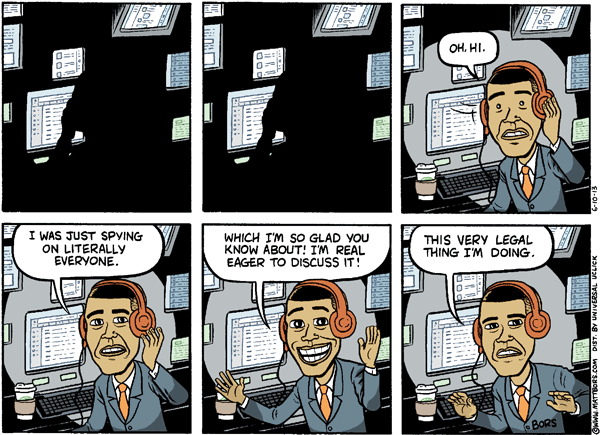
It’s A-OK, Right?

azspot:

Matt Bors

If he’s smiling, it must be OK. Right? Right?

Categories
Links Quotations

For $1,650 a month, subscribers will soon be able to fly as much as they want between four California cities, NPR’s Wendy Kaufman reports. Members (not “customers”) will be able to board as many times as they want to travel between San Francisco, Monterey, Santa Barbara, and Los Angeles

Interesting. I can I only imagine how popular such an approach would be on some routes in Canada.

Categories
Humour Videos

Mercer: Question Period Live

Categories
Aside Quotations

2013.6.7

Privacy advocates have long warned that allowing the government to collect and store unlimited “metadata” is a highly invasive form of surveillance of citizens’ communications activities. Those records enable the government to know the identity of every person with whom an individual communicates electronically, how long they spoke, and their location at the time of the communication. Such metadata is what the US government has long attempted to obtain in order to discover an individual’s network of associations and communication patterns. The request for the bulk collection of all Verizon domestic telephone records indicates that the agency is continuing some version of the data-mining program begun by the Bush administration in the immediate aftermath of the 9/11 attack.

Glenn Greenwald (via azspot)

Anyone trying to convince people “it’s only metadata” should be discounted as a fool or a government shill. Or perhaps as being both.