Categories
Writing

Publicly Normalizing Significant Espionage Operations is a Good Thing

The USA government recently took a bad beat when it came to light that alleged Chinese threat actors undertook a pretty sophisticated espionage operation that got them access to sensitive email communications of members of the US government. As the details come out it seems as though the Secretary of State and his inner circle weren’t breached but that other senior officials managing the USA-China relationship were.

Still, the actual language the US government is using to describe the espionage operation is really good to read. As an example, the cybersecurity director of the NSA, Rob Joyce, has stated that:

“It is China doing espionage […] That is what nation-states do. We need to defend against it, we need to push back on it, but that is something that happens.”

Why is this good? Because the USA was successfully targeted by an advanced espionage operation that has likely serious effects but this is normal, and Joyce is saying so publicly. Adopting the right language in this space is all too rare when espionage or other activities are often cast as serious ‘attacks’ or described using other inappropriate or bombastic language.

The US government’s language helps to clarify what are, and are not, norms-violating actions. Major and successful espionage operations don’t violate acceptable international norms. Moreover, not only does this make clear what is a fair operation to take against the USA; it, also, makes clear what the USA/FVEY think are appropriate actions to take towards other international actors. The language must be read as also justifying the allies’ own actions and effectively preempts any arguments from China or other nations that successful USA or FVEY espionage operations are anything other than another day on the international stage.

Clearly this is not new language. Former DNI Clapper, when describing the Office of Personnel Management hack in 2015, said,

You have to kind of salute the Chinese for what they did. If we had the opportunity to do that, I don’t think we’d hesitate for a minute.

But it bears regularly repeating to establish what remain ‘appropriate’ in terms of signalling ongoing international norms. This signalling is not just to adversary nations or friendly allies however, but also to more regular laypersons, national security practitioners, or other operators who might someday work on the national or international stage. Signalling has a broader educational value for them (and for new reporters who end up picking up the national security beat someday in the future).

At an operational level, it’s also worth noting that this is intelligence gathering that can potentially lower temperatures. Knowing what the other side is thinking or how they’re interpreting things is super handy if you want to defrost some of your diplomatic relations. Though it can obviously hurt by losing advantages in your diplomatic positions, too, of course! And especially if it lets the other side outflank you.

Still, I have faith in the EquationGroup’s ongoing collection against even hard targets in China and elsewhere to help balance the information asymmetry equation. While the US suffered a now-publicly reported loss of information security, the NSA is actively working to achieve similar (if less public) successes of its own on a daily basis. And I’m sure they’re racking up wins of their own!
Categories
Photography Writing

Street Photography in a More Private World

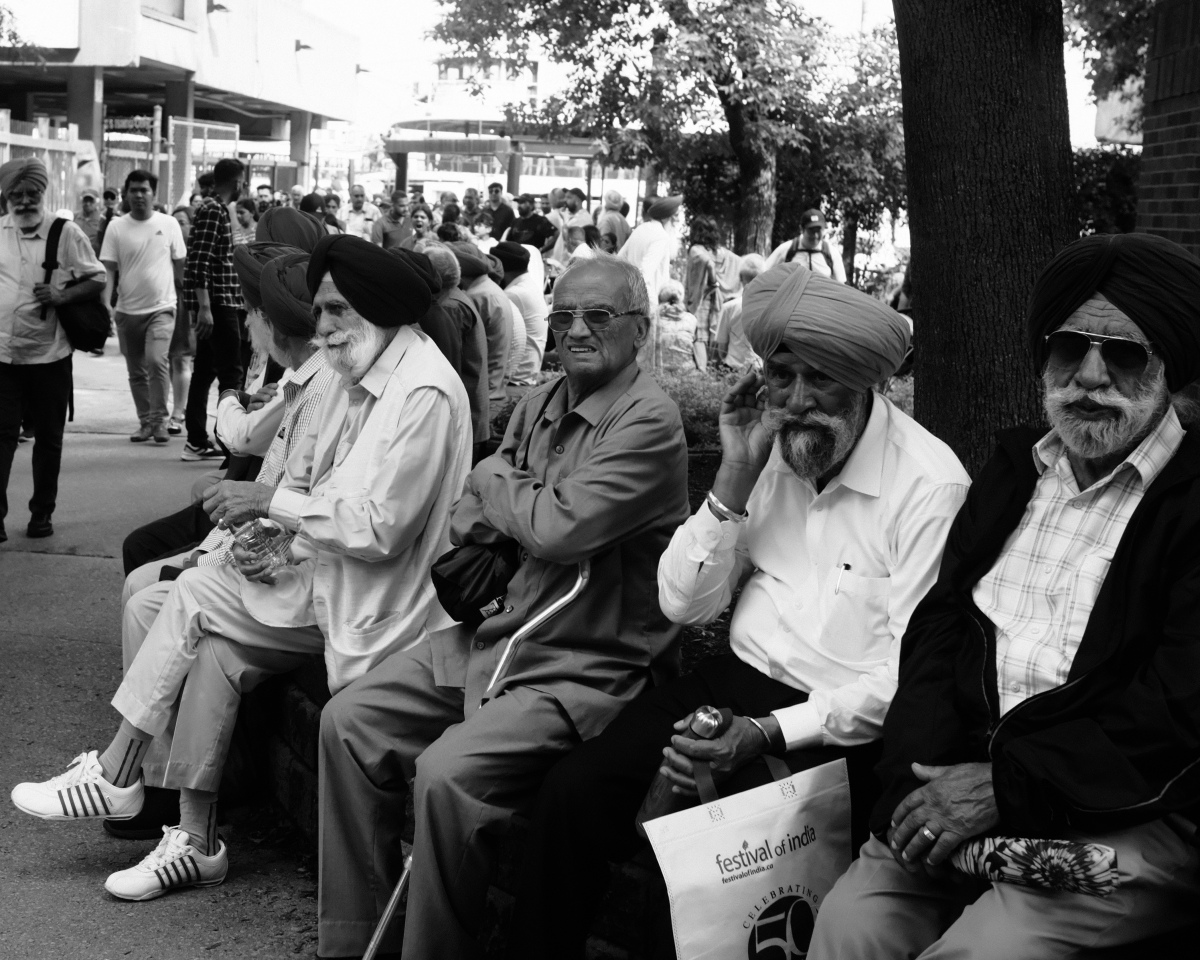
Jack Layton Ferry Terminal, Toronto, 2023

For the past several months Neale James has talked about how new laws which prevent taking pictures of people on the street will inhibit the documenting of history in certain jurisdictions. I’ve been mulling this over while trying to determine what I really think about this line of assessment and photographic concern. As a street photographer it seems like an issue where I’ve got some skin in the game!

In short, while I’m sympathetic with this line of argumentation I’m not certain that I agree. So I wrote a longish email to Neale—which was included in this week’s Photowalk podcast—and I’ve largely reproduced the email below as a blog post.

I should probably start by stating my priors:

  1. As a street photographer I pretty well always try to include people in my images, and typically aim to get at least some nose and chin. No shade to people who take images of peoples’ backs (and I selectively do this too) but I think that capturing some of the face’s profile can really bring many street photos to life.1
  2. I, also, am usually pretty obvious when I’m taking photos. I find a scene and often will ‘set up’ and wait for folks to move through it. And when people tell me they aren’t pleased or want a photo deleted (not common but it happens sometimes) I’m usually happy to do so. I shoot between 28-50mm (equiv.) focal lengths and so it’s always pretty obvious when I’m taking photos, which isn’t the case with some street photographers who are shooting at 100mm . To each their own but I think if I’m taking a photo the subjects should be able to identify that’s happening and take issue with it, directly, if they so choose to.

Anyhow, with that out of the way:

If you think of street photography in the broader history of photography, it started with a lot of images with hazy or ghostly individuals (e.g. ‘Panorama of Saint Lucia, Naples’ by Jones or ’Physic Street, Canton’ by Thomson or ‘Rue de Hautefeuille’ by Marville). Even some of the great work—such as by Cartier-Bresson, Levitt, Bucquet, van Schaick, Atget, Friedlander, Robert French, etc—include photographs where the subjects are not clearly identified. Now, of course, some of their photographs include obvious subjects, but I think that it’s worth recognizing that many of the historical ‘greats’ include images where you can’t really identify the subject. And… that was just fine. Then, it was mostly a limitation of the kit whereas now, in some places, we’re dealing with the limitations of the law.

Indeed, I wonder if we can’t consider the legal requirement that individuals’ identifiable images not be captured as potentially a real forcing point for creativity that might inspire additional geographically distinctive street photography traditions: think about whether, in some jurisdictions, instead of aperture priority being a preferred setting, that shutter priority is a default, with speeds of 5-15 second shutters to get ghostly images.2

Now, if such a geographical tradition arises, will that mean we get all the details of the clothing and such that people are wearing, today? Well…no. Unless, of course, street photographers embrace creativity and develop photo essays that incorporate this in interesting or novel ways. But street photography can include a lot more than just the people, and the history of street photography and the photos we often praise as masterpieces showcase that blurred subjects can generate interesting and exciting and historically-significant images.

One thing that might be worth thinking about is what this will mean for how geographical spaces are created by generative AI in the future. Specifically:

  1. These AI systems will often default to norms based on the weighting of what has been collected in training data. Will they ‘learn’ that some parts of the world are more or less devoid of people based on street photos and so, when generating images of certain jurisdictions, create imagery that is similarly devoid of people? Or, instead, will we see generative imagery that includes people whereas real photos will have to blur or obfuscate them?
  2. Will we see some photographers, at least, take up a blending of the real and the generative, where they capture streets but then use programs to add people into those streetscapes based on other information they collect (e.g., local fashions etc)? Basically, will we see some street photographers adopt a hybrid real/generative image-making process in an effort to comply with law while still adhering to some of the Western norms around street photography?

As a final point, while I identify as a street photographer and avoid taking images of people in distress, the nature of AI regulation and law means that there are indeed some good reasons for people to be concerned about the taking of street photos. The laws frustrating some street photographers are born from arguably real concerns or issues.

For example, companies such as Cleaview AI (in Canada) engaged in the collection of images and, subsequently, generated biometric profiles of people based on scraping publicly available images.

Most people don’t really know how to prevent such companies from being developed or selling their products but do know that if they stop the creation of training data—photographs—then they’re at least less likely to be captured in a compromising or unfortunate situation.

It’s not the photographers, then, that are necessarily ‘bad’ but the companies who illegally exploit our work to our detriment, as well as to the detriment of the public writ large.

All to say: as street photographers, and photographers more generally, we should think broader than our own interests to appreciate why individuals may not want their images taken in light of technical developments that are all around us. And importantly, the difference is that as photographers we do often share our work whereas CCTV cameras and such do not, with the effect that the images we take can end up in generative AI, and non-generative AI training data systems, whereas the cameras that are monitoring all of us always are (currently…) less likely to be feeding the biometric surveillance training data beast.


  1. While, at the same time, recognizing that sometimes a photo is preferred because people are walking away from the camera/towards something else in the scene. ↩︎
  2. The ND filter manufacturers will go wild! ↩︎
Categories
Links

New Details About Russia’s Surveillance Infrastructure

Writing for the New York Times, Krolik, Mozur, and Satariano have published new details about the state of Russia’s telecommunications surveillance capacity. They include documentary evidence in some cases of what these technologies can do, including the ability to:

  • identify if mobile phones are proximate to one another to detect meetups
  • identify whether a person’s phone is proximate to a burner phone, to de-anonymize the latter
  • use deep packet inspection systems to target particular kinds of communications metadata associated with secure communications applications

These types of systems are appearing in various repressive states and are being used by their governments.

Similar systems have long been developed in advanced Western democratic countries which leads me to wonder whether what we’re seeing from authoritarian countries will ultimately usher in the use of similar technologies in higher rule-of-law states or if, instead, Western companies will merely export the tools without them being adopted in the countries developing them.

In effect, will the long-term result of revealing authoritarian capabilities lead to the gradual legitimization of their use in democratic countries so long as using them is tied to judicial oversight?

Categories
Links

Critically Assessing AI Technologies’ Economic Potentials

This article by Ramani and Wang, entitled “Why transformative AI is really, really hard to achieve,” is probably the best critical economic analysis of the current AI debates I’ve come across. It assesses what would be required for AI technologies to live up to the current hype cycles about how these technologies will massively benefit economic productivity. Based on the nature of AI technologies being developed, combined with the history of economic productivity enhancements over time, the authors conclude that the present day hype is unlikely to be met.

Key to the arguments is that AI technologies do not, as of yet, sufficiently automate a vast set of tasks which are comparatively easy for humans to accomplish, nor are they able to benefit from the latent knowledge and intelligence that guides humans in their daily lives. The authors argue that AI technologies must broadly automate tasks, instead of discretely automating them, in order to achieve cross-industry improvements to productivity. Doing otherwise will merely accelerate aspects of processes which will remain gridlocked in the aggregate by more traditional or less automated processes.

The authors are not dismissing the potential utility of AI technologies, however, but instead just arguing that they are not as likely to achieve the transformative economic miracles that many are suggesting are just around the corner. However, even if AI systems are ‘only’ as significant for productivity as the combustion engine (which discretely as opposed to comprehensively enhanced productivity) this would be a significant accomplishment.

Categories
Reviews

Three Month Review- Bellroy Transit Workpack (20L)

I’ve been using the Bellroy Transit Workpack daily for about 3 weeks now to carry my stuff to and from work. It’s a 20L backpack that can hold up to a 16″ laptop. For the weekdays, I use the bag to carry devices to/from work, and to bring my lunch, coffee thermos, and other miscellaneous things on a daily basis. On the weekend, I use it to carry some camera gear, light jacket or vest, and to pick up small things when I’m out.

The Good

I’ve found that it fits well once the excess shoulder straps are tightened, and appreciate how the included clips hold down excessive straps on the shoulders. Once tightened the bag is nicely snug to my back. My normal weekday carry is a 13” laptop, iPad, lunch, water bottle, keys, miscellaneous small electronics, books or shoes, and sometimes a spare jacket. All of this fits easily and comfortably in the bag without it appearing stretched or overloaded.

On the weekend, I regularly use the bag to carry a compressible jacket or vest, various camera batteries, and to pick up small things to bring home.

A couple fun facts:

  • You can easily fit two very large fresh-baked loaves of bread in the main compartment with no problems and they’ll come back in great condition with some room on the top of the main compartment for other baked goods, and
  • The ‘tech sleeve’ in the laptop compartment can easily (and safely) hold a Fuji X100F and even when it has a hood attached to the lens.

During my time with the bag I’ve worn it through rain and heavy snow. While the zippers require a bit more force to pull than those on other backpacks, the same zippers (and material used in the backpack) means that water just flows off the bag. All of which is to say that my electronics and other valuables haven’t ever gotten wet. This includes in situations where I’ve accidentally set the bag down on very wet floors: not once has a drop of moisture gotten past the bag’s exterior.

The bag also stands on its own pretty well, so long as it’s not overly weighted in one direction or another and has at least a little bit of stuff in the main compartment. The pen loops in the front compartment are helpful and not something I realised were included in the bag when I bought it.

Finally, the backpack it light. I’ve been using a much heavier backpack every now and then for the past few years (my daily carry has been a messenger bag for several years) and I really can’t believe just how light and robust the Bellroy Transit Workpack is compared to either my backpack or messenger!

The Bad

There are a few relatively minor downsides to the bag. First, the front pouch: it’s not the most convenient for storing things, though I do appreciate the small ‘lip’ that’s used to keep some items from moving around.

Second, the key elastic being in one of the water bottle pouches makes it pretty impractical for how I use the bag. Also, getting a water bottle into the hidden side-holders can sometimes be a bit of a pain (bad) but once in the holder the liquid is kept away from stuff on the bag’s internal compartment (good!) and preserves the look of the bag (also good!).

Third, the Transit Workpack lacks a luggage pass through so if you wanted to put this on your luggage while moving through an airport you’re going to be out of luck.

Fourth, it has taken me a few months to figure out how to use the webbing straps that come with the bag. Until I have, the straps kept coming loose and I’d have to reset them every few days. This is really, really annoying and if there’s a flaw with the backpack it’s the idiotic strapping system the Bellroy has gone with.

Finally, if you weigh the bag down and are carrying it for a long period of time (defined as 3 hours) you really need to ensure the straps are at the right length and tightness to best allocate the weight. Doing otherwise will leave you with some very sore shoulders!

Purchasing

I bought my Transit Workpack from a local Toronto company, Te Koop. The shipping was prompt and engagement from staff has been excellent, with staff having reached out several times to confirm that I’m happy with the backpack as well as to inform me about any return policies should I need it retained. I’m very happy to have purchased my bag from them.

Concluding Thoughts

If you’re an office worker, or someone looking for a sleek and easy-to-pack backpack, then I’d recommend this for you.

Categories
Links

Deskilling and Human-in-the-Loop

I found boyd’s “Deskilling on the Job” to be a useful framing for how to be broadly concerned, or at least thoughtful, about using emerging A.I. technologies in professional as well as training environments.

Most technologies serve to augment human activity. In sensitive situations we often already require a human-in-the-loop to respond to dangerous errors (see: dam operators, nuclear power staff, etc). However, should emerging A.I. systems’ risks be mitigated by also placing humans-in-the-loop then it behooves policymakers to ask: how well does this actually work when we thrust humans into correcting often highly complicated issues moments before a disaster?

Not to spoil things, but it often goes poorly, and we then blame the humans in the loop instead of the technical design of the system.1

AI technologies offer an amazing bevy of possibilities. But thinking more carefully on how to integrate them into society while, also, digging into history and scholarly writing in automation will almost certainly help us avoid obvious, if recurring, errors in how policy makers think about adding guardrails around AI systems.


  1. If this idea of humans-in-the-loop and the regularity of errors in automated systems interests you, I’d highly encourage you to get a copy of ‘Normal Accidents’ by Perrow. ↩︎
Categories
Links

Russian Cyber Doctrine and Its Implementation

While the following might be a bit bellicose it, at the same time, has a ring of truth to it.

Using a foreign country’s military doctrine to reframe fuck-ups as successes — here, that the Russians’ real operations have had the intended effects — boils down to doing a GRU colonel’s work for him; placating Gerasimov about whether or not the O6’s department has contributed to winning the war, among other things.

The Russian government and its various agencies have been incredibly active in attempting to influence or affect the ability of the Ukrainian government to resist the illegal Russian invasion of its territory. But at the same time there has been a back and forth about the successes or failures of Russia in largely academic or public policy circles. In at least some cases, these arguments seem to argue for the successes of the Russian doctrine without sufficient evidence to maintain the position.

Notwithstanding the value of some of those debates it’s nice to see a line of critique that is more attentive to the structure of institutions and what often drives them, with the affect of broadening the rationales and explanations for the (un)successful efforts in the cyber domain by Russian forces.

Categories
Photography

My Summer 2023 Fuji X100F Recipes

I’ve been shooting with a Fuji X100F for three years now, having gotten a used one for $800 CAD just prior to the start of the COVID-19 pandemic. Since purchasing it I’ve shot well north of 100,000 photos, and retained approximately 12,000 after culling.

In mid-October 2021 I built or adapted a recipe for monochrome images. In mid-2022 I found a ‘Leica-like’ colour recipe which I’ve kept in camera, though not used all that often. During my ownership of the camera I’ve made a lot of other recipes and just not really used them.

I’m back in isolation for the second time in 6-7 months and so took the time this weekend to update my Custom profiles. I know that others find these kinds of profiles/recipes helpful and so I thought I’d post them for others who are interested. In the case of Custom One and Custom Four I include a small selection of images that were made with the respective recipes.

Global Note

Ages ago I set my White Balance to Auto (R 2, B -2). My preference would be to have the white balance associated with each Custom mode but that’s only possible with the X100V, so I just have set this and left it.

Generally, I wanted to make sure that Custom One was the most commonly used recipe that I used. Previously, this was set to Customer Five which was fine (I had muscle memory on flipping back to it in the menu) but added more work than should have existed. I then tried to batch the ‘key’ monochrome and colour profiles together; Custom Seven is a default Acros but I don’t really expect to dig that deep into my Custom Recipes to get to it all that often.

Also, for the past year or so I’ve kept a Moment Cinebloom 10% on the lens, which gives images a slightly softer image and blooms light.

Custom One—“My Classic Monochrome”

I have shot a lot of images with this recipe, probably to the tune of retaining about 8,000 frames over a year and a half. Generally, I find that in hard lighting (with strong shadows and bright highlights) that it benefits from dialling the exposure down by -⅔ to -1.0. In brighter light, however, I find that it works best to dial up exposure by at least ⅓ and often ⅔.

  • DR: 200
  • Film Simulation: Black and White
  • Grain Effect: Weak
  • While Balance: Auto
  • Highlight Tone: 2
  • Shadow Tone: 2
  • Colour: 0
  • Sharpness: -1
  • Noise Reduction: 0

I do find that with this profile I sometimes use the Brush in Snapseed to either Dodge & Burn or increase exposure on faces when they’re hidden in shadows.

Custom Two—“Ilford HP5 Plus”

This is the recipe from Fuji X Weekly. I haven’t shot with it as of yet, but am curious to see how it looks as compared to my ‘normal’ (Custom One) monochrome recipe. Based on the settings it should naturally have a stronger contrast than comes normally with Custom One.

  • DR: 200
  • Film Simulation: Acros
  • Grain Effect: Strong
  • While Balance: Auto
  • Highlight Tone: 4
  • Shadow Tone: 2
  • Colour: 0
  • Sharpness: 0
  • Noise Reduction: -3
  • Exposure Compensation: 0 (Normally)

Custom Three—“Astia Kodak Ektar 100”

Another recipe from Fuji X Weekly! I like this as it’s punchy but somewhat soft in its nature. I’m going to be a bit curious to see how this looks with my Moment Cinebloom 10% Filter.

  • DR: DR-Auto
  • Film: Astia
  • Grain: None
  • White Balance: Auto
  • Highlight Tone: 1
  • Shadow Tone: 3
  • Colour: 4
  • Sharpness: 1
  • Noise Reduction: -3
  • Exposure Compensation: 0 to ⅓ (typically)

Note: while the recipe calls for 3 Red and -2 Blue, my white balance is set to 2 Red and -2 Blue.

Custom Four—“Leica Colour”

I have no idea where precisely this came from but it’s been the only colour profile I’ve used for the past year or so. I really like how saturated and bright it is, but really have no idea how much what comes through is really ‘Leica-like’. This was just the description provided by wherever I copied the recipe.

  • DR: 200
  • Film: Standard
  • Grain: None
  • White Balance: Auto
  • Highlight Tone: 1
  • Shadow Tone: 1
  • Colour: 3
  • Sharpness: 1
  • Noise Reduction: 0

Custom Five—“Punchy Classic Chrome”

I have a love of Classic Chrome, and added this to make it a little more saturated than typical. I also wanted to see about adding more dramatic contrast between highlights and shadows, which is something I often tried to do in post when I first shot Classic Chrome a few years ago.

  • DR: 200
  • Film: Classic Chrome
  • Grain: None
  • White Balance: Auto
  • Highlight tone: 2
  • Shadow Tone: 2
  • Colour: 1
  • Sharpness: 1
  • Noise Reduction: 0

Custom Six—“Punchy Pro High-Neg”

I…haven’t really ever taken a photo with Pro High-Neg before. So I don’t quite know how this recipe will play out or even how much I might use it.

  • DR: Auto
  • Film: Pro High-Neg
  • Grain: Weak
  • WB: Auto
  • Highlight: 1
  • Shadow: 1
  • Colour: 1
  • Sharpness: -1
  • Noise Reduction: 0

Custom Seven—“Acros Bland”

This is a pure Acros recipe with no changes. I just want it present to be able to quickly flip to it and try it out at some point.

  • DR: 200
  • Film: Acros
  • Grain: Off (Acros increases grain normally as you exceed 800 ISO)
  • WB: Auto
  • Highlight: 0
  • Shadow: 0
  • Colour: NA
  • Sharpness: 0
  • Noise Reduction: 0
Categories
Photography

The Backstory: Bay & Queen, Toronto, 2023

Bay & Queen, Toronto, 2023

I made this image while out on my weekend photowalk. I’ve passed this same location hundreds of time since I’ve lived in Toronto. In what might become a semi-regular type of post, I wanted to write a bit about the backstory of the image. It was originally posted to Glass.

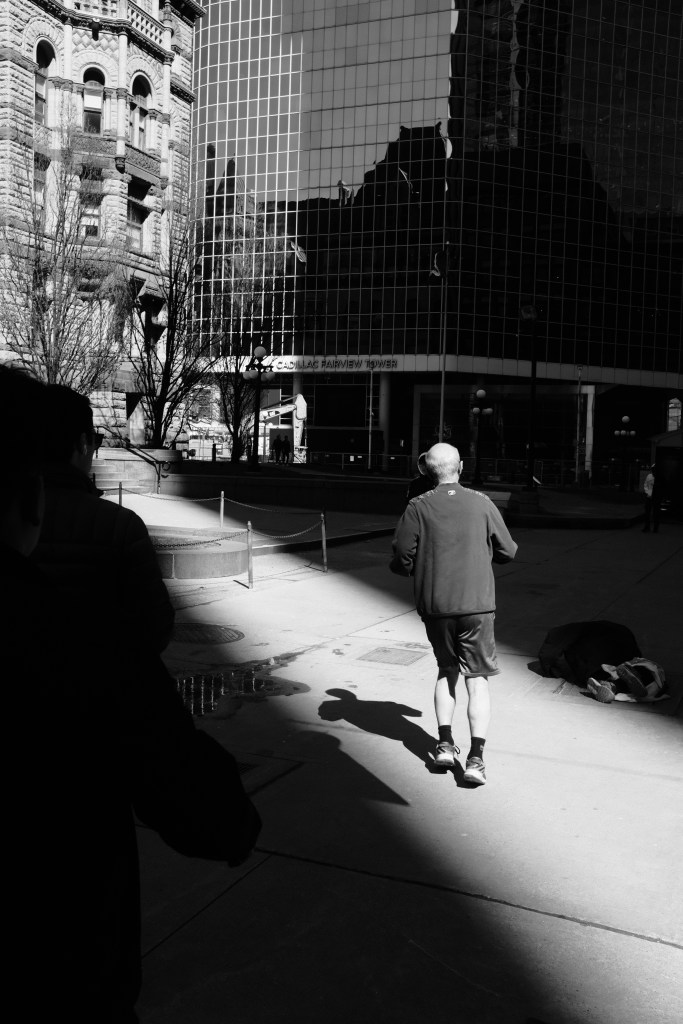
I was drawn to this scene, first, just because of how the light managed to slice through the shadows which were cast by the surrounding skyscrapers. After dialling the exposure to -1.3 I waited for some interesting characters to pass through the light.

It was only after taking a couple images that I really noticed how the unhoused person’s feet and legs were apparent. They were on grates that pass steam in the colder times of the year. Some of the unhoused use these grates to stay warm during the winter.

I deliberately avoid taking many head-on or identifiable photos of people who are in distress. I’m generally not a fan of that kind of street photography, unless the photographer chooses to really engage with the subjects in meaningful ways.

Still, the city—and especially the city core—does have a serious and growing housing issue. And so I ultimately decided to compose the scene with the hopes that it would show people noticing, but passing by, the individual on the street, as a kind of broader commentary of the social housing issues that exist in Toronto.

Compositionally the image is simple: a pair of men looking in the direction of the source of the light, and not towards the half shrouded person on the sidewalk, and moving towards the light. Behind them the aperture of the light beam starts to close, but the reader of the photograph can see the sparkle of youth (the new, glass, building) as juxtaposed agains the old (Toronto’s historical city hall). The young reflects the old, reminding us that youth is impermanent. As I said: it’s not a deep photograph nor are any particularly special tricks used to make it.

I often linger when I find light that I like for at least a couple minutes, to see if more interesting (or any interesting!) subjects come to fill the scene. Other times I’ll recompose and work the scene a little bit. But I have to admit that staying put is something that I need to get better with: it’s not enough to just linger for 5-10 minutes!

The above set of images aren’t touched up and are a few of the ‘raw’ versions of images I took and normally wouldn’t post (I took a total of about 20 frames before I settled on the one at the top of the post). I, personally, learn a lot from the older Magnum photos that include contact sheets.

While my rougher images aren’t the same, nor as descriptive, as contact sheets maybe they’ll be helpful to someone else when they are thinking of weighing a scene. Or maybe just to make clear that the admittedly very amateur images I make involve a lot more than just one lucky capture (with a handful of exceptions of course).

Categories
Aside

Warning Shots From The FTC On AI

The FTC has a very direct and to the point post about things that businesses should consider ahead of integrating generative A.I. into business offerings:

  1. Should you even be making or selling it?
  2. Are you effectively mitigating the risks?
  3. Are you over-relying on post-release detection?
  4. Are you misleading people about what they’re seeing, hearing, or reading?

The FTC is not, of course, saying that they oppose the integration of A.I. into products. But they are being very clear that companies should do their due diligence ahead of such integrations or else run the risk of government investigations driven to protect consumers’ interests.