Categories
Quotations

2013.3.19

So even in the worst cases, free products don’t usually end too badly. Well, unless you’re a user, or one of the alternatives that gets crushed along the way. But everyone who funds and builds a free product usually comes out of it pretty well, especially if they don’t care what happens to their users.

Free is so prevalent in our industry not because everyone’s irresponsible, but because it works.

In other industries, this is called predatory pricing, and many forms of it are illegal because they’re so destructive to healthy businesses and the welfare of an economy. But the tech industry is far less regulated, younger, and faster-moving than most industries. We celebrate our ability to do things that are illegal or economically infeasible in other markets with productive-sounding words like “disruption”.

Marco Arment, “Free Works
Categories
Links

Internet Census 2012

yostivanich:

While playing around with the Nmap Scripting Engine (NSE) we discovered an amazing number of open embedded devices on the Internet. Many of them are based on Linux and allow login to standard BusyBox with empty or default credentials. We used these devices to build a distributed port scanner to scan all IPv4 addresses. These scans include service probes for the most common ports, ICMP ping, reverse DNS and SYN scans. We analyzed some of the data to get an estimation of the IP address usage.

Super interesting research, though incredibly illegal and borderline ethical (at absolute best, and most charitable).

Categories
Links Writing

The Internet as a Surveillance State

The Internet is a surveillance state. Whether we admit it to ourselves or not, and whether we like it or not, we’re being tracked all the time. Google tracks us, both on its pages and on other pages it has access to. Facebook does the same; it even tracks non-Facebook users. Apple tracks us on our iPhones and iPads. One reporter used a tool called Collusion to track who was tracking him; 105 companies tracked his Internet use during one 36-hour period.

This is ubiquitous surveillance: All of us being watched, all the time, and that data being stored forever. This is what a surveillance state looks like, and it’s efficient beyond the wildest dreams of George Orwell.

Opinion: The Internet is a surveillance state – CNN.com (via new-aesthetic)

There are a few important things to recognize about Schneier’s argument (which, I don’t think, detract from his overall points):

  1. Surveillance isn’t inherently bad. It speaks to a distribution of power where another party enjoys heightened capabilities resulting from their perception of the surveilled. Surveillance becomes ‘bad’ when the power disequilibrium has harmful moral or empirical consequences.
  2. Again, it isn’t entirely surveillance that’s the ‘problem’ with the Internet; it’s the persistent recollection of information by third-parties, often without the data subject knowing that (a) the data was collected; (b) it was subsequently recalled in an unrelated context; © it was then used to influence interactions with the data subject. These problems have always existed, in some fashion, but we are living in an era where what used to historically have been lost to the ethers of time is being retained in massive databases. The nature of perpetual computational memory – often made worse when errors in retained data spawn in perpetuity across interlinked systems – challenges how humans understand time, history, and subjectivity in very powerful ways.
  3. With regards to (2), this is why Europeans are interested in their so-called ‘Right to Be Forgotten’. And, before thinking that forgetting some data collected vis-a-vis the Internet would lead to the end of the (digital) world, consider that Canadians largely already ‘enjoy’ this right under the consent doctrines of federal privacy law: the ‘net isn’t broken here, at least not yet!

(Note: for more on the consent doctrine as it relates to social media, see our paper on SSRN entitled, “Forgetting, Non-Forgetting and Quasi-Forgetting in Social Networking: Canadian Policy and Corporate Practice”)

Categories
Humour Videos

Hitler Finds Out Google Reader Is Shutting Down

Categories
Aside Links

Notes EM: Disorder as resistance

evgenymorozov:

I found this in the Letters section of the latest issue of The Times Literary Supplement (dated March 15, 2013). It doesn’t seem to be online:

Binder families

Sir, – In David Winters’s review of The Demon of Writing by Ben Kafka he mentions a clerk who saved the actors of the Comédie-Française during the Terror, by soaking their death warrants in a tub and throwing the balls of pulp out of the window (February 15). In the 1960s I worked as a welfare case worker, along with several hundred others, in a vast office in downtown Chicago. Each of the families of my 300 clients existed, bureaucratically speaking, as a large binder filled with forms and written notes. When the families had been on welfare for several generations, the binders were equivalent to two or three large telephone books.

Overwhelmed with an avalanche of forms, telephone calls, clients waiting for hours downstairs to see me, home visits to the high-rise housing projects in which they lived, I was taught by the veteran case workers to simply go into the huge library where the binders were stored, alphabetically on endless shelves, and “accidentally” file binders out of place. Then I could innocently plead that I was unable to take any action on the case because I could not find the binder. Without the binder nothing in the status of the clients could change, their cheques would continue to arrive, and I could “miraculously” locate their binder if I needed to. Sadly, we were on the verge of the computer age, the information was beginning to appear on IBM punch cards, and the binders were soon to become obsolete, signalling the beginning of a far more ruthless era in which no clerk could make inconvenient facts disappear.

MICHAEL LIPSEY 75 San Marino Drive, San Rafael, California 94901.

This speaks volumes to the humanity that “inefficient” bureaucratic organization can enable. Further, it foregrounds how contemporary drives towards efficiency and order can obviate some historical means of bureaucratic resistance, resistance that was significant for maintaining and improving people’s daily lives.

Categories
Quotations

2013.3.16

This is the problem. Against a sufficiently skilled, funded, and motivated adversary, no network is secure. Period. Attack is much easier than defense, and the reason we’ve been doing so well for so long is that most attackers are content to attack the most insecure networks and leave the rest alone.

Bruce Schneier, “Phishing Has Gotten Very Good
Categories
Links Writing

Did Google just shut down the wrong product?

parislemon:

John Herrman of BuzzFeed:

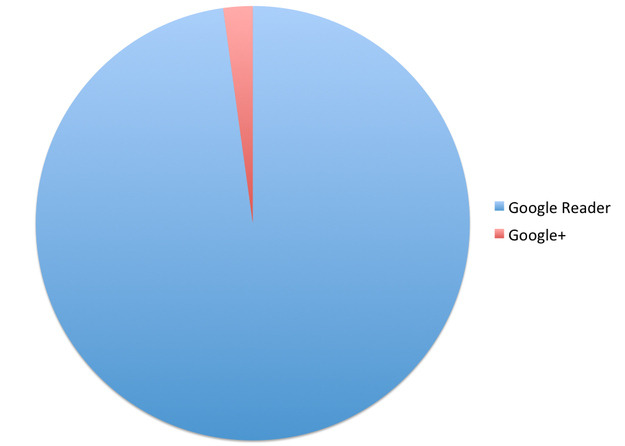
According to data from the BuzzFeed Network, a set of tracked partner sites that collectively have over 300 million users, Google Reader is still a significant source of traffic for news — and a much larger one than Google+. The above chart, created by BuzzFeed’s data team, represents data collected from August 2012 to today.

Yikes. Did Google just shut down the wrong product?

I’m less clear that the ‘wrong’ thing happened.* Google is getting slammed in Europe for grabbing headlines for Google News: why not shut down Reader (which pulls information from those agencies, to readers on a Google platform) and (if the same companies want all that traffic) force them onto Google+ so that the publishers are directly providing information to Google. With Google’s current policies could they then repurpose Google+ information that the companies provided and use that to feed Google News, thus undercutting publishers’ arguments?

In essence: could this be a play to push publishers onto Google+ and, by extension, then attract people who want publishers’ content, while at the same time trying to undermine some of the arguments in the EU about Google ‘stealing’ content?

*Don’t get me wrong. I depend on Google Reader and think they screwed up. But from Google’s perspective they might not have…

Categories
Links

Data Protection Law and Consent

Data protection law has not fallen from the sky. Let me give you an example of this – the overblown discussion on consent.

The current Directive states since 1995 that consent has to be ‘unambiguous’. The Commission thinks it should be ‘explicit’. 27 national Data Protection Authorities agree. This has become a major talking point. What will this mean in practice? That explicit consent will be needed in all circumstances? Hundreds of pop-ups on your screens? Smartphones thrown on the floor in frustration? No. It means none of these things. This is only the scaremongering of certain lobbyists.

Citizens don’t understand the notion of implicit consent. Staying silent is not the same as saying yes.

  • Viviane Reding, Vice-President of the European Commission

The EU’s Data Protection reform: Decision-Time is Now

http://europa.eu/rapid/press-release_SPEECH-13-197_en.htm

(via omalleyprivacy)

Important things to consider when reading about how consent will – somehow – break the Internet. It will force American (and some Canadian!) companies to obey the law or face fines. So be it.

Categories
Quotations

2013.3.15

Cheney’s office, according to Leonard, took secrecy to excessive lengths – attempting to classify as much as possible, and often bypassing the system altogether by inventing classification markings. Even documents as ordinary as Cheney’s talking points were marked Treated as Top Secret/SCI or Treated as Top Secret/Codeword.

“That’s not a recognized marking,” said Leonard. “I have no idea if it was the intent, but I can guarantee you what the consequences of those markings are. When any of this material eventually does end up at a presidential library and access demands are being made, or it’s being processed for release, when some poor archivist sees material marked Handle as SCI, it’s going into the bottom of the pile, and it is going to get much more conservative review. Whether it was the intent to retard the eventual release of the information, I know that’s going to be a consequence of it.”

D.B. Grady, “Why We’ll Never Get a Full Account of the War in Iraq
Categories
Aside Links

Firm That Tests ISP Meters: ISP Meters Aren’t Accurate

I have this dream of Measurement Canada being forced to regulate ISPs’ mirrors.