Categories
Links Writing

Doing A Policy-Oriented PhD

Steve Saideman has a good, short, thought on why doing a PhD is rarely a good idea for Canadians who want to get into policy work. Specifically, he writes:

In Canada, alas, there is not that much of a market for policy-oriented PhDs. We don’t have much in the way of think tanks, there are only a few govt jobs that either require PhDs or where the PhD gives one an advantage over an MA, and, the govt does not pay someone more if they have a PhD.

I concur that there are few places, including think tanks or civil society organizations, where you’re likely to find a job if you have a policy-related PhD. Moreover, when you do find one it can be challenging, if not impossible, to find promotion opportunities because the organizations tend to be so small.

That said, I do in fact think that doing a policy-related PhD can sometimes be helpful if you stay pretty applied in your outputs while pursuing your degree. In my case, I spent a lot of time during my PhD on many of the same topics that I still focus on, today, and can command a premium in consulting rates and seniority for other positions because I’ve been doing applied policy work for about 15 years now, inclusive of my time in my PhD. I, also, developed a lot of skills in my PhD—and in particular the ability to ask and assess good questions, know how questions or policy issues had been previously answered and to what effect, and a reflexive or historical thinking capacity I lacked previously—that are all helpful soft skills in actually doing policy work. Moreover, being able to study policy and politics, and basically act as an independent agent for the time of my PhD, meant I had a much better sense of what I thought about issues, why, and how to see them put into practice than I would have gained with just a master’s degree.

Does that mean I’d recommend doing a PhD? Well…no. There are huge opportunity costs you incur in doing them and, also, you can narrow you job market searches by appearing both over-educated and under-qualified. The benefits of holding a PhD tend to become more apparent after a few years in a job as opposed to being helpful in netting that first one out of school.

I don’t regret doing a PhD but, if someone is particularly committed to doing one, I think that they should hurl themselves into it with absolute abandon and treat it as a super-intensive 40-65 hour/week job, and be damn sure that you have a lot of non-academic outputs to prove to a future employer that you understand the world and not just academic journals. It’s hard work, which is sometimes rewarding, and there are arguably different (and less unpleasant) ways of getting to a relatively similar end point. But if someone is so motivated by a hard question that they’d be doing the research and thinking about it, regardless of whether they were in a PhD program? Then they might as well go and get the piece of paper while figuring out the answer.

Categories
Aside Links

What is Documentary Photography?

Black Tap Magazine has a helpful article that distinguishes between photojournalism, documentary photography, and street photography. I found it particularly helpful to see the author grapple with the differences (and commonalities) between documentary and street photography, with the former focusing more on projects and potentially posed/non-urban photography, and the latter being cast as more spontaneous and less project-driven. While I think good street photography should be emotive and tell a story over time, I appreciate that the core assertion is that documentary photography must tell (or try to tell) some story, often as a photo set, whereas street photography is not similarly bound by these conditions.

Categories
Photo Essay Photography Writing

First Snow of 2023 Photowalk

We got our first snow of the year on Sunday. I kept waiting for it to come and as soon as the snow started to fall I grabbed my Fuji X100F with a Cinebloom 10% attached and headed out to make some images.

I live in a densely populated section of Toronto. Notwithstanding the snow there were many people out and about when I first hit the streets. But it was as I moved to side streets, or into parts of the city that tend to be populated by tourists, that it was apparent that huge chunks of the city were largely depopulated as people decided to stay inside where it was warm and dry.

There were, of course, some people out even in the less populated parts of the city. They, however, tended to be trying to get out of the snow—which functionally turned into snow that was almost indistinguishable from rain towards the early evening—and generally wanted to just avoid getting wet or cold.

Somewhat surprisingly I saw almost no other photographers out and about. I’m sure they were there, somewhere. But, at the same time, I wonder how much the weather dissuaded them from getting out and shooting the streets or urban landscapes.

I will never be accused of babying my cameras. My Fuji X100F lacks the weatherproofing of the newest version and, so, when I’m out in the snow I tend to protectively place one hand over it’s screen and eyepiece, and keep the lens pointed downwards and slightly in towards my body. It doesn’t prevent all the precipitation from getting onto the camera but, along with brushing off water when it starts to gather on dials and such, has always seemed good enough to keep the equipment safe.

The mix of heavy coats and umbrellas is something that I’m always curious about, if only because I can’t recall ever seeing something similar while I was growing up or when I visit parts of the country (or world) that receive large volumes of snow. I don’t dispute the potential utility of an umbrella—it will, obviously, help to keep your head wet and my uncovered head certainly got soaked after 3-4 hours outside—but it always seems like an instrument that is out of place. Though they look very distinct in the snow and so I definitely took the chance to make images of people who were carrying them!

Though there were people out and about, and evidence in other cases of someone having been present recently, much of the city felt oddly solitary. When I make my photos I’m often trying to communicate a sense of, on the one hand, the press of other people around and upon us and, on the other, the loneliness or isolation experienced while being in these massive urban environments. Dismal weather almost always draws me to the latter and wanting to express how large our environments are and what they look like with few figures or, alternately, in the absence of humans entirely. What will the city look like when the humans are gone?

When I watched one of James Popsys’ videos recently he mentioned that, when taking his landscapes, he likes putting either a human or a human-made thing in his images. Doing so has the effect of communicating human presence and, often, what the natural environment looks in our absence. Human-made things, also, have the effect of drawing us into an image on the basis that we ‘see’ something of ourselves in the otherwise natural environment.

In an almost modernist way of thinking those solitary human-things have the effect of both showing the attempt to overcome, or start overcoming, nature while often simultaneously showcasing the majesty and longevity of nature against the transitory existence of human-made things. Or at least that’s how I see and study such images.

I don’t know how well I really captured ‘nature’ in my walk—save towards the very end of my walk—but Popsys’ words have resonated in my head for some time. For years when I’ve made images of the city it’s often been with a view that the humans are transitory; they move though the frame, they enter and exit the city, they live and die. The built infrastructure and the protected landscapes interspersed throughout the city, however, will (should?) persist for a far longer period of time. Yes, Toronto is a city undergoing profound construction but looking through historical photos of the city reveal that key things have remained for a century or more in spite of the changes.

Of course that isn’t to say that the old has stayed perfectly the same; the bridge I took the below image from is literally a bridge to nowhere that was disconnected from the surrounding roads in 1964. While there were plans to remove it, apparently it’s more affordable to do minimal maintenance on it than tear it down; it’s only a matter of time, though, until this economic calculus changes. The city keeps putting up fences and warnings to keep people off the bridge but there’s only been once in the past decade where the fences were intact and I was prevented from getting onto the bridge. In the summer you can regularly discover some pretty cool graffiti along its struts.

The bridge sits over the Don River and, looking south, you have a view of a highway that our municipal and provincial governments continue to pour money into, as well as industrial lands which have been in declining operation for a long time. While the specific buildings will almost certainly change—most likely to be replaced by condos—the character of the landscape should remain the same for decades insofar as the highway and walking path should persist. Though it may be that a similar image will only be accessible to those flying small drones when the economic calculus for maintaining the bridge changes.

Categories
Links Writing

Economic Fundamentals Are Just That: Fundamental

In an opinion piece for the New York Time, Mihir A. Desai writes:

Embracing novelty and ambition in the face of huge problems is to be lauded, but the unhinged variety of these admirable traits that we have seen so much of in recent years is counterproductive. The fundamentals of business have not changed merely because of new technologies or low interest rates. The way to prosper is still by solving problems in new ways that sustainably deliver value to employees, capital providers and customers. Over-promising the scope of change created by technology and the possibilities of business and finance to a new generation will lead only to disaffection as these promises falter.1

A whole generation has seen exploding home prices, outrageous explosions in the costs of education, deeply challenging labour markets, and is facing down ecological catastrophe. These changes have taken place during a time of unprecedented financial gain for an older segment of the economy while the younger generations is, also, being routinely told that it is the first that will generally live a worse life than their parents.

So, in the face of ‘fundamentals’ falling apart a whole range of people—often though not always younger—have sought to find new ways of generating wealth in the face of the exploding challenges to living in Western society. Shockingly, the new companies that depend on exploiting regulatory blind spots to ‘find value’ (or, instead, just act illegally and dare governments to take the time and effort to rule that their operations are illegal) or that offer new lottery-like “currencies” have become popular as ways that may enable younger people to generate wealth and enjoy the (perceived) good life of their parents.

The fundamentals of businesses, and currencies and interest, however are just that: fundamental. The effect, however, is that while the promised wealth-generation opportunities may in fact be dead in the water, the explosion of costs and challenges to younger generations are not. Under-regulated capitalism has, also, become a fundamental of business with the effect that unless new regulations are developed and deployed we can expect further, and ongoing, attempts to evade the fundamentals of business if only so as to overcome the fundamental unfairness of capitalism and its logics of accumulation.

All of which is to say: sure, business fundamentals are just that. But an increasingly desperate and younger population will keep throwing fundamentals to the wind in the face of a business systems that is fundamentally and structurally designed to inhibit that same population from enjoying the Western ideal of the good life.


  1. 1: Emphasis not in original. ↩︎
Categories
Links Writing

Social Networks, Social Media, and Design Affordances

Ian Bogost has a good piece in The Atlantic that recalls the trajectory of social networking services and their transformation into social media services. He distinguishes between the two thusly:

The terms social network and social media are used interchangeably now, but they shouldn’t be. A social network is an idle, inactive system—a Rolodex of contacts, a notebook of sales targets, a yearbook of possible soul mates. But social media is active—hyperactive, really—spewing material across those networks instead of leaving them alone until needed.

I’m someone who obtains a vast amount of very valuable information from my social networks. People are always softly pushing information that is relevant to my specific interests, such as by RSS or through private email groups, with just enough extra stuff that I can learn about novel topics or issues. In all of these cases however I make the choice to interact with the content and in a pretty focused way. This approach is perhaps a bit more active than how Bogost frames social networks but is much closer to the earliest days of Web 2.0, prior to the advent of microblogging and image sharing becoming major things in my neck the Internet. Much of this information comes from people I have either strong or intermediate connections with.

Professionally, I have historically found Twitter to be a useful social media platform. I and other experts have used it to surface media and/or opinions that were meant to be helpful in better understandings parts of the world I engage with. This, of course, has changed for the worse in the past 2 months. Broadly, I and other experts have benefitted from the design affordances of the ‘megascale’ of Twitter.

Most social media, however, holds little or no value to me.1 And perhaps most dangerously even Twitter has the effect of sharpening language (gotta keep within those character or thread limits!) while also making it much harder, if not impossible, to find useful contributions at a later date in time. As experts have moved to Twitter and away from long-term content storage repositories (e.g., blogs, opinion articles, etc) their expertise has the effect of appearing briefly and then being lost to themselves as well as future audiences. Broadly, then, one question is what is the role of social media for professionals and experts who have a public communication role to their careers?

There is also some real value in social media platforms that move content quite quickly. I know for a fact that Twitter, as an example, is regularly useful for foreign policy observers who are trying to determine what is happening around the world. These observers are taking advantage of weak ties to obtain otherwise difficult to find information. Twitter is, also, helpful for crowdsourcing in the case of disasters. At the same time these networks can be, and have been, and are being used for harmful purposes. This includes targeted harassment, government abuse, and more. We often hear about these latter ills and, in response, some wish that very different or slower social media platforms existed on the presumption that they would reduce the harm while still enabling the good platforms. This is perhaps best captured by Bogost’s earlier article, “People Aren’t Meant to Talk This Much,” where he writes:

Imagine if access and reach were limited too: mechanically rather than juridically, by default? What if, for example, you could post to Facebook only once a day, or week, or month? Or only to a certain number of people? Or what if, after an hour or a day, the post expired, Snapchat style? Or, after a certain number of views, or when it reached a certain geographic distance from its origins, it self-destructed? That wouldn’t stop bad actors from being bad, but it would reduce their ability to exude that badness into the public sphere.

However, in assessing the properties of networks/media systems designers should consider the respective technologies’ affordances and what they, and their users, really want or need. I don’t subscribe to the position that Twitter is Evil™ or that a ‘new Twitter’ needs to do away with all the affordances of the current platform.

Real good has come from the ability of different parties to exploit or benefit from virality. But that virality is not something that all persons should have to deal with if they don’t want to, and users of viral-enabled platforms should be protected by rigorous trust and safety policies and teams. (Twitter is clearly moving away from their already-insufficient efforts to protect their users and, so, any replacement virality-platform should start with trust and safety as a top priority ahead of almost anything else.)

The ‘solution’ to the ills of social media shouldn’t be to wistfully look back to the earliest era of Web 2.0, or the last breaths of Web 1.0, and say that we should be restricted to tool and service equivalents of those times. Social technologies should not be permanently halted in the time and template of Livejournal, Orkut, Google+, or Blogger.

First, because we enjoy a lot of modern affordances in our technology and likely won’t want to abandon them!

Second, because such call-backs are often to times when the social networks were far less diverse than the social media platforms today. We should be wary of seeking the civility of the past on the basis that much of that same perceived civility was premised on the exclusive and privileged nature of the social networks.

Third, it’s important for any and all who look for different social networks or social media platforms to recognize that the affordances they are seeking may not be the affordances that everyone is seeking. To use Twitter as just one example we regularly hear about how the platform is used by its Western users but comparatively little about how it’s used by Japanese users, who have prolifically adopted the platform. We should not over generalise our own experiences (or issues with) platforms and should instead adopt a more inclusive approach to understanding the benefits and drawbacks of a given platform’s affordances and capabilities.

I think that when imagining the ‘next’ iteration of social networks and social media it’s helpful to recognize that different kinds of networks will serve different functions. Not everything needs to operate at megascale. Also, though, we should learn lessons from the current social media platforms and design affordances that provide individuals and groups with the ability to express control over how their networks and media can be used. Tim Bray offers some of those suggestions in his proposals for updating Mastodon. Key, to my eye, are that content-licensing should be a default thing that is considered with code (and, unstated, law) being used to reinforce how individuals and communities permit their information to be accessed, used, collected, or disclosed.

We’re in the middle of yet another reflection period about what role(s) should social networks and social media play in Western society, as well as more generally around the world. Regulatory efforts are moving along and laws are being passed to rein in perceived issues linked with the companies operating the various networks. But there’s also real appetite to assess what should, and shouldn’t, be possible writ large on the contemporary and future social networks and social media platforms. We should lean into this in inclusive ways to develop the best possible policy. Doing anything else means we’ll just keep having the same debate ad infinitum.


  1. There’s lots of broader value: it can be useful economically for some individuals, enable speech outlets that are otherwise denied to individuals who are historically discriminated against, and serve as a medium for creative expression. ↩︎
Categories
Photo Essay Photography Writing

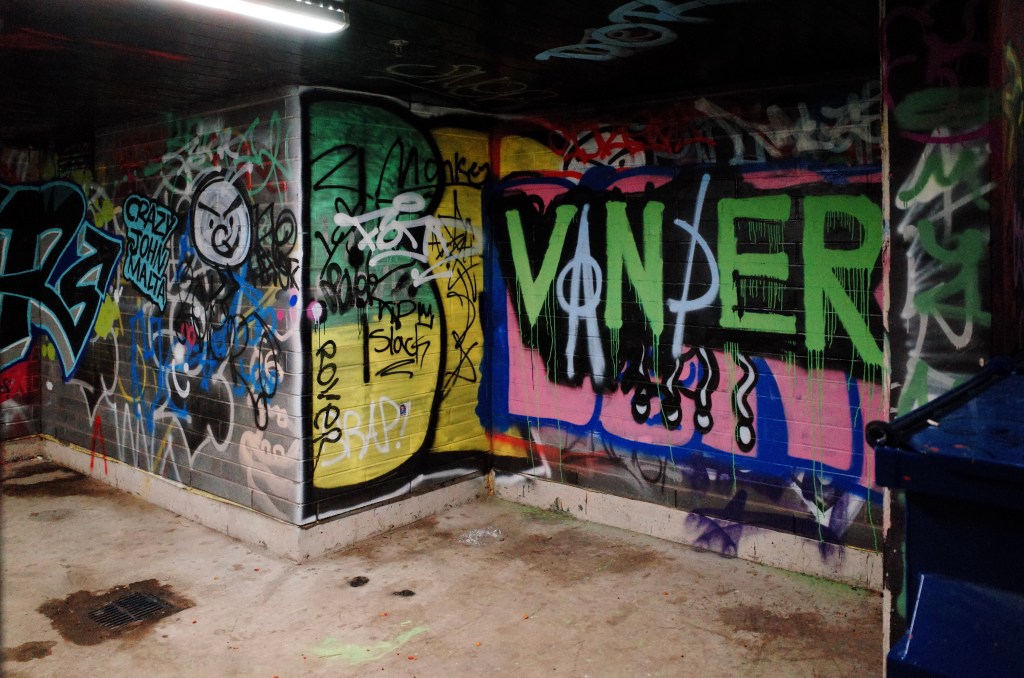
January 1st Graffiti Photowalk

I routinely try and take a bit of a longer photowalk at the start of each year. It’s an opportunity to stretch my legs some and a great way to start of the year while, also, getting a chance to document the city while it’s still recovering from New Years celebrations.

This year was no different, save that I ended up leaving for my walk later than intended and was drawn to a number of Toronto’s alleys throughout the evening.

While I did the majority of my shooting through the late afternoon and evening in monochrome, I couldn’t help by see how the positive film simulation in my Ricoh GRs would showcase the vibrant colours of graffiti under artificial lighting situations.

It was only once I’d brought the images home and looked at them that it became apparent that the majority of the photos were made from the same angle. I had no idea I was doing this at the time but, in hindsight, I definitely wish that I’d made images from wider variety of angles.

When I was wandering through some of the alleys I wished that there had been more people about to include in some of the images. Even a wisp of a figure would, I think, have added a bit of a haunting character to many of the photographs.

In their absence, however, I largely (though not completely) tried to channel Tatianna Hopper. She sometimes engages in a kind of street photography that simultaneously showcases the existence and absence of humans. Graffiti and human trash, or waste, expresses this concept to my mind.

In a number of alleys there were quasi-monstrous or demonic imagery. I see more and more of it around the city and have met the artists of some of it. The effort they’re putting in is amazing with really interesting effects; when shooting with humans in the frame and in monochrome, I find the graffiti adds an interesting graphic element and juxtaposition. Even on its own, however, the juxtaposition between colour and monochrome graffiti causes its own novel contrast.

Almost the entirety of 2022, and the tail end of 2021, saw me shoot 99% of my images in monochrome. I’m happy with the progress I’ve made on the street and can see the very real improvements in composition and ability to ‘see’ in monochrome. However I’m inspired by Alex Webb and Gustavo Minas’ ‘Maximum Shadow Minimal Light’. Both use shadow in colour photography and I’d like to develop similar skills . Maybe that means I’ll experiment some through the year in trying to translate what I’ve learned about light and shadows in monochrome images into colour photos!

Categories
Solved

Solved: Ricoh GR Not Using Auto-Hi ISO

I spent a few frustrating evenings shooting on aperture priority with the original Ricoh GR. It held my shutter speed at 1/40s and varied the ISO so that it was always at 1/40s.

I’ve finally sat down to figure out what the heck was going on as I’d never previously experienced this issue. For some reason each time I tried to set the ISO to Auto-High (with a 5000 ISO maximum and shutter minimum at 1/160s) it kept defaulting to Auto, instead.

The Problem

My Ricoh GR was stuck at 1/40s when shooting aperture priority (i.e., ‘Av’) with the ISO varying to ensure it could hit that shutter speed. My work-around solution was to take manual control of the ISO. When I manually raised the ISO I could get a much faster shutter speed.

The Solution

I had previously disabled ‘Continuous Mode’ when I had been experimenting with an external flash. In doing so I had, unknowingly, simultaneously disabled the camera’s ability to use ‘Auto-High.’1 Auto-High is used to set a maximum ISO and minimum shutter speed.2

To enable Auto-High on the Ricoh GR:

  1. Open the menu
  2. Enter the Shooting Menu (Camera symbol)
  3. Scroll down to ‘Continuous Mode’
  4. Press the right button on the control dial
  5. Scroll to ‘Continuous Mode’
  6. Press ‘OK’

You may, also, need to set the maximum ISO and minimum shutter speed for Auto-High. To set these values:

  1. Open the menu
  2. Enter the Setup Menu (Screwdriver and Wrench symbol)
  3. Scroll down to ‘ISO Auto-High Settings’
  4. Press the right button on the control dial
  5. Set the Maximum ISO and Change Shutter Speed to preferred values
  6. Press ‘OK’

At the conclusion of this you should hopefully have (re)enabled Auto-High ISO.

Note: My solution to this problem differs from some on the Internet. A post in the DP Review forums, as an example, suggests that you must disable ‘dynamic range compensation’ to solve the problem. This is not the case in my experience as I have dynamic range compensation set to ‘Medium’ on my Ricoh GR.


  1. This is not clearly explained in the Ricoh GR manual when when doing a search for ‘Auto-Hi’. ↩︎
  2. If shooting conditions are such that the camera cannot expose properly at a given aperture and maximum ISO setting, it may reduce the shutter speed below the minimum shutter speed set under Auto-High to get a correct exposure. ↩︎
Categories
Links

Cybersecurity and White Labelled Android Devices

Trend Micro has a nice short piece on the challenges of assessing the security properties of various components of Android devices. In short, white labelling incentivizes device manufacturers to invest the least amount possible in what they’re building for the brands that will sell devices to consumers. Trend Micro included this very nice little mention on the shenanigans that firmware developers can get up to:

Firmware developers supplying the OEM might agree to provide the software at a lower cost because they can compensate the lost profit through questionable means, for example by discreetly pre-installing apps from other app developers for a fee. There is a whole market built around this bundling service with prices ranging from 1 to 10 Chinese yuan (approximately US$0.14 to US$1.37 as of this writing) per application per device. This is where the risk is: As long as the firmware, packaged apps, and update mechanisms of the device are not owned, controlled, or audited by the smartphone brand itself, a rogue supplier can hide unauthorized code therein.1

While the authors suggest a range of policy options, from SBOMs to placing requirements on device transparency before administrators ‘trust’ devices, I’m not confident of these suggestions’ efficacy when taking a broader look at who principally uses white labelled devices. There are economics at play: should all devices have increased input costs associated with greater traceability and accountability then it will place financial pressures on the individuals in society who are most likely to be purchasing these devices. I doubt that upper-middle class individuals will be particularly affected by restricting the availability of many white labelled Android devices but such restrictions would almost certainly have disproportionate impacts on less affluent members of society or those who are, by necessity, price conscious. Should these individuals have to pay more for the computing power that they may depend on for a wide range of tasks—and in excess of how more affluent members of society use their devices?

Security has long been a property that individuals with more money can more easily ‘acquire’, and those who are less affluent have been less able to possess similar quantities or qualities of security in the services and products that they own. I understand and appreciate (and want to agree with) the Trend Micro analysts on how to alleviate some of the worse security properties associated with white labelled devices but it seems as though any such calculation needs to undertake a broader intersectional analysis. It’s possible that at the conclusion of such an analysis you still arrive at similar security-related concerns but would, also, include a number of structural social change policy prescriptions as preconditions that must be met before heightened security can be made more equitably available to more members of society.


  1. Emphasis added. ↩︎
Categories
Writing

Why Is(n’t) TikTok A National Security Risk?

Photo by Ron Lach on Pexels.com

There have been grumblings about TikTok being a national security risk for many years and they’re getting louder with each passing month. Indeed, in the United States a bill has been presented to ban TikTok (“The ANTI-SOCIAL CCP ACT“) and a separate bill (“No TikTok on Government Devices Act“) has passed the Senate and would bar the application from being used on government devices. In Canada, the Prime Minister noted that the country’s signals intelligence agency, the Communications Security Establishment, is “watching very carefully.”

I recently provided commentary where I outlined some of the potential risks associated with TikTok and where it likely should fit into Canada’s national security priorities (spoiler: probably pretty low). Here I just want to expand on my comments a bit to provide some deeper context and reflections.

As with all things security-related you need to think through what assets you are attempting to protect, the sensitivity of what you’re trying to protect, and what measures are more or less likely to protect those assets. Further, in developing a protection strategy you need to think through how many resources you’re willing to invest to achieve the sought-after protection. This applies as much to national security policy makers as it does to individuals trying to secure devices or networks.

What Is Being Protected

Most public figures who talk about TikTok and national security are presently focused on one or two assets.

First, they worry that a large volume of data may be collected and used by Chinese government agencies, after these agencies receive it either voluntarily from TikTok or after compelling its disclosure. Commentators argue that Chinese companies are bound to obey the national security laws of China and, as such, may be forced to disclose data without any notice to users or non-Chinese government agencies. This information could be used to obtain information about specific individuals or communities, inclusive of what people are searching on the platform (e.g., medical information, financial information, sexual preference information), what they are themselves posting and could be embarrassing, or metadata which could be used for subsequent targeting.

Second, commentators are adopting a somewhat odious language of ‘cognitive warfare’ in talking about TikTok.1 The argument is that the Chinese government might compel the company to modify its algorithms so as to influence what people are seeing on the platform. The intent of this modification would be to influence political preferences or social and cultural perceptions. Some worry this kind of influence could guide whom individuals are more likely to vote for (e.g., you see a number of videos that directly or indirectly encourage you to support particular political parties), cause generalised apathy (e.g., you see videos that suggest that all parties are bad and none worth voting for), or enhance societal tensions (e.g., work to inflame partisanship and impair the functioning of otherwise moderate democracies). Or, as likely, a combination of each of these kinds of influence operations. Moreover, the TikTok algorithm could be modified by government compulsion to prioritise videos that praise some countries or that suppress videos which negatively portray other countries.

What Is the Sensitivity of the Assets?

When we consider the sensitivity of the information and data which is collected by TikTok it can be potentially high but, in practice, possesses differing sensitivities based on the person(s) in question. Research conducted by the University of Toronto’s Citizen Lab found that while TikTok does collect a significant volume of information, that volume largely parallels what Facebook or other Western companies collect. To put this slightly differently, a lot of information is collected and the sensitivity is associated with whom it belongs to, who may have access to it, and what those parties do with it.

When we consider who is using TikTok and having their information uploaded to the company’s servers, then, the question becomes whether there is a particular national security risk linked with this activity. While some individuals may potentially be targets based on their political, business, or civil society bonafides this will not be the case with all (or most) users. However, in even assessing the national security risks linked to individuals (or associated groups) it’s helpful to do a little more thinking.

First, the amount of information that is collected by TikTok, when merged with other data which could theoretically be collected using other signals intelligence methods (e.g., extracting metadata and select content from middle-boxes, Internet platforms, open-source locations, etc) could be very revealing. Five Eyes countries (i.e., Australia, Canada, New Zealand, the United Kingdom, and the United States of America) collect large volumes of metadata on vast swathes of the world’s populations in order to develop patterns of life which, when added together, can be deeply revelatory. When and how those countries’ intelligence agencies actually use the collected information varies and is kept very secretive. Generally, however, only a small subset of individuals whose information is collected and retained for any period of time have actions taken towards them. Nonetheless, we know that there is a genuine concern about information from private companies being obtained by intelligence services in the Five Eyes and it’s reasonable to be concerned that similar activities might be undertaken by Chinese intelligence services.

Second, the kinds of content information which are retained by TikTok could be embarrassing at a future time, or used by state agencies in ways that users would not expect or prefer. Imagine a situation where a young person says or does something on TikTok which is deeply offensive. Fast forward 3-4 years and their parents are diplomats or significant members of the business community, and that offensive content is used by Chinese security services to embarrass or otherwise inconvenience the parents. Such influence operations might impede Canada’s ability to conduct its diplomacy abroad or undermine the a business’s ability to prosper.

Third, the TikTok algorithm is not well understood. There is a risk that the Chinese government might compel ByteDance, and through them the TikTok platform, to modify algorithms to amplify some content and not others. It is hard to assess how ‘sensitive’ a population’s general sense of the world is but, broadly, if a surreptitious foreign influence operation occurred it might potentially affect how a population behaves or sees the world. To be clear this kind of shift in behaviour would not follow from a single video but from a concerted effort over time that shifted social perceptions amongst at least some distinct social communities. The sensitivity of the information used to identify videos to play, then, could be quite high across a substantial swathe of the population using the platform.

It’s important to recognise that in the aforementioned examples there is no evidence that ByteDance, which owns TikTok, has been compelled by the Chinese government to perform these activities. But these are the kinds of sensitivities that are linked to using TikTok and are popularly discussed.

What Should Be Done To Protect Assets?

The threats which are posed by TikTok are, at the moment, specious: it could be used for any number of things. Why people are concerned are linked less to the algorithm or data that is collected but, instead, to ByteDance being a Chinese company that might be influenced by the Chinese government to share data or undertake activities which are deleterious to Western countries’ interests.

Bluntly: the issue raised by TikTok is not necessarily linked to the platform itself but to the geopolitical struggles between China and other advanced economies throughout the world. We don’t have a TikTok problem per se but, instead, have a Chinese national security and foreign policy problem. TikTok is just a very narrow lens through which concerns and fears are being channelled.

So in the absence of obvious and deliberate harmful activities being undertaken by ByteDance and TikTok at the behest of the Chinese government what should be done? At the outset it’s worth recognising that many of the concerns expressed by politicians–and especially those linked to surreptitious influence operations–would already run afoul of Canadian law. The CSIS Act bars clandestine foreign intelligence operations which are regarded as threatening the security of Canada. Specifically, threats to the security of Canada means:

(a) espionage or sabotage that is against Canada or is detrimental to the interests of Canada or activities directed toward or in support of such espionage or sabotage,

(b) foreign influenced activities within or relating to Canada that are detrimental to the interests of Canada and are clandestine or deceptive or involve a threat to any person,

(c) activities within or relating to Canada directed toward or in support of the threat or use of acts of serious violence against persons or property for the purpose of achieving a political, religious or ideological objective within Canada or a foreign state, and

(d) activities directed toward undermining by covert unlawful acts, or directed toward or intended ultimately to lead to the destruction or overthrow by violence of, the constitutionally established system of government in Canada,

CSIS is authorised to undertake measures which would reduce the threats to the security of Canada, perhaps in partnership with the Communications Security Establishment, should such a threat be identified and a warrant obtained from the federal court.

On the whole a general ban on TikTok is almost certainly disproportionate and unreasonable at this point in time. There is no evidence of harm. There is no evidence of influence by the Chinese government. Rather than banning the platform generally I think that more focused legislation or policy could make sense.

First, I think that legislation or (preferably) policies precluding at least some members of government and senior civil servants from using TikTok has some merit. In these cases a risk analysis should be conducted to determine if collected information would undermine the Government of Canada’s ability to secure confidential information or if the collected information could be used for intelligence operations against the government officials. Advice might, also, be issued by the Canadian Security Intelligence Service so that private organisations are aware of their risks. In exceptional situations some kind of security requirements might also be imposed on private organisations and individuals, such as those who are involved in especially sensitive roles managing critical infrastructure systems. Ultimately, I suspect the number of people who should fall under this ban would, and should, be pretty small.

Second, what makes sense is legislation that requires social media companies writ large–not just TikTok–to make their algorithms and data flows legible to regulators. Moreover, individual users should be able to learn, and understand, why certain content is being prioritised or shown to them. Should platforms decline to comply with such a the law then sanctions may be merited. Similarly, should algorithmic legibility showcase that platforms are being manipulated or developed in ways that deliberately undermine social cohesion then some sanctions might be merited, though with the caveat that “social cohesion” should be understood as referring to platforms being deliberately designed to incite rage or other strong emotions with the effect of continually, and artificially, weakening social cohesion and amplifying social cleavages. The term should not, however, be seen as a kind of code for creating exclusionary social environments where underprivileged groups continue to be treated in discriminatory ways.

So Is TikTok ‘Dangerous’ From A National Security Perspective?

Based on open source information2 there is no reason to think that TikTok is currently a national security threat. Are there any risks associated with the platform? Sure, but they need to be juxtaposed against equivalent or more serious threats and priorities. We only have so many resources to direct towards the growing legion of legitimate national security risks and issues; funnelling a limited set of resources towards TikTok may not be the best kind of prioritisation.

Consider that while the Chinese government could compel TikTok to disclose information about its users to intelligence and security services…the same government could also use business cutouts and purchase much of the same information from data brokers operating in the United States and other jurisdictions. There would be no need to secretly force a company to do something when, instead, it could just lawfully acquire equivalent (or more extensive!) information. This is a pressing and real national security (and privacy!) issue and is deserving of legislative scrutiny and attention.

Further, while there is a risk that TikTok could be used to manipulate social values…the same is true of other social networking services. Indeed, academic and journalistic research over the past 5-7 years has drawn attention to how popular social media services are designed to deliver dopamine hits and keep us on them. We know that various private companies and public organisations around the world work tirelessly to ‘hack’ those algorithms and manipulate social values. Of course this broader manipulation doesn’t mean that we shouldn’t care but, also, makes clear that TikTok isn’t the sole vector of these efforts. Moreover, there are real questions about the how well social influence campaigns work: do they influence behaviour–are they supplying change?–or is the efficaciousness of any campaign representative of an attentive and interested pre-existing audience–is demand for the content the problem?

The nice thing about banning, blocking, or censoring material, or undertaking some other kind of binary decision, is that you feel like you’ve done something. Bans, blocks, and censors are typically designed for a black and white world. We, however, live in a world that is actually shrouded in greys. We only have so much legislative time, so much policy capacity, so much enforcement ability: it should all be directed efficiently to understanding, appreciating, and addressing the fulness of the challenges facing states and society. This time and effort should not be spent on performative politics that is great for providing a dopamine hit but which fails to address the real underlying issues.


  1. I have previously talked about the broader risks of correlating national security and information security. ↩︎
  2. Open source information means information which you or I can find, and read, without requiring a security clearance. ↩︎
Categories
Videos

Is Street Photography Legal In Canada?

The answer, in almost all cases, is a resounding “yes.” David Fraser, a privacy and technology lawyer from Halifax, does an exceptional job in running curious (Canadian) street photographers through what the law allows and the rare exceptions when making street photos could have legal consequences.