Using a foreign country’s military doctrine to reframe fuck-ups as successes — here, that the Russians’ real operations have had the intended effects — boils down to doing a GRU colonel’s work for him; placating Gerasimov about whether or not the O6’s department has contributed to winning the war, among other things.
The Russian government and its various agencies have been incredibly active in attempting to influence or affect the ability of the Ukrainian government to resist the illegal Russian invasion of its territory. But at the same time there has been a back and forth about the successes or failures of Russia in largely academic or public policy circles. In at least some cases, these arguments seem to argue for the successes of the Russian doctrine without sufficient evidence to maintain the position.
Notwithstanding the value of some of those debates it’s nice to see a line of critique that is more attentive to the structure of institutions and what often drives them, with the affect of broadening the rationales and explanations for the (un)successful efforts in the cyber domain by Russian forces.
I’ve been shooting with a Fuji X100F for three years now, having gotten a used one for $800 CAD just prior to the start of the COVID-19 pandemic. Since purchasing it I’ve shot well north of 100,000 photos, and retained approximately 12,000 after culling.
In mid-October 2021 I built or adapted a recipe for monochrome images. In mid-2022 I found a ‘Leica-like’ colour recipe which I’ve kept in camera, though not used all that often. During my ownership of the camera I’ve made a lot of other recipes and just not really used them.
I’m back in isolation for the second time in 6-7 months and so took the time this weekend to update my Custom profiles. I know that others find these kinds of profiles/recipes helpful and so I thought I’d post them for others who are interested. In the case of Custom One and Custom Four I include a small selection of images that were made with the respective recipes.
Global Note
Ages ago I set my White Balance to Auto (R 2, B -2). My preference would be to have the white balance associated with each Custom mode but that’s only possible with the X100V, so I just have set this and left it.
Generally, I wanted to make sure that Custom One was the most commonly used recipe that I used. Previously, this was set to Customer Five which was fine (I had muscle memory on flipping back to it in the menu) but added more work than should have existed. I then tried to batch the ‘key’ monochrome and colour profiles together; Custom Seven is a default Acros but I don’t really expect to dig that deep into my Custom Recipes to get to it all that often.
Also, for the past year or so I’ve kept a Moment Cinebloom 10% on the lens, which gives images a slightly softer image and blooms light.
I have shot a lot of images with this recipe, probably to the tune of retaining about 8,000 frames over a year and a half. Generally, I find that in hard lighting (with strong shadows and bright highlights) that it benefits from dialling the exposure down by -⅔ to -1.0. In brighter light, however, I find that it works best to dial up exposure by at least ⅓ and often ⅔.
DR: 200
Film Simulation: Black and White
Grain Effect: Weak
While Balance: Auto
Highlight Tone: 2
Shadow Tone: 2
Colour: 0
Sharpness: -1
Noise Reduction: 0
Shocking LightWinter FlightToronto, 2023Toronto, 2023Toronto, 2023Queen & Bay, Toronto, 2023Toronto, 2023Royal York Hotel, Toronto, 2023
I do find that with this profile I sometimes use the Brush in Snapseed to either Dodge & Burn or increase exposure on faces when they’re hidden in shadows.
Custom Two—“Ilford HP5 Plus”
This is the recipe from Fuji X Weekly. I haven’t shot with it as of yet, but am curious to see how it looks as compared to my ‘normal’ (Custom One) monochrome recipe. Based on the settings it should naturally have a stronger contrast than comes normally with Custom One.
DR: 200
Film Simulation: Acros
Grain Effect: Strong
While Balance: Auto
Highlight Tone: 4
Shadow Tone: 2
Colour: 0
Sharpness: 0
Noise Reduction: -3
Exposure Compensation: 0 (Normally)
Custom Three—“Astia Kodak Ektar 100”
Another recipe from Fuji X Weekly! I like this as it’s punchy but somewhat soft in its nature. I’m going to be a bit curious to see how this looks with my Moment Cinebloom 10% Filter.
DR: DR-Auto
Film: Astia
Grain: None
White Balance: Auto
Highlight Tone: 1
Shadow Tone: 3
Colour: 4
Sharpness: 1
Noise Reduction: -3
Exposure Compensation: 0 to ⅓ (typically)
Note: while the recipe calls for 3 Red and -2 Blue, my white balance is set to 2 Red and -2 Blue.
Custom Four—“Leica Colour”
I have no idea where precisely this came from but it’s been the only colour profile I’ve used for the past year or so. I really like how saturated and bright it is, but really have no idea how much what comes through is really ‘Leica-like’. This was just the description provided by wherever I copied the recipe.
DR: 200
Film: Standard
Grain: None
White Balance: Auto
Highlight Tone: 1
Shadow Tone: 1
Colour: 3
Sharpness: 1
Noise Reduction: 0
Custom Five—“Punchy Classic Chrome”
I have a love of Classic Chrome, and added this to make it a little more saturated than typical. I also wanted to see about adding more dramatic contrast between highlights and shadows, which is something I often tried to do in post when I first shot Classic Chrome a few years ago.
DR: 200
Film: Classic Chrome
Grain: None
White Balance: Auto
Highlight tone: 2
Shadow Tone: 2
Colour: 1
Sharpness: 1
Noise Reduction: 0
Custom Six—“Punchy Pro High-Neg”
I…haven’t really ever taken a photo with Pro High-Neg before. So I don’t quite know how this recipe will play out or even how much I might use it.
DR: Auto
Film: Pro High-Neg
Grain: Weak
WB: Auto
Highlight: 1
Shadow: 1
Colour: 1
Sharpness: -1
Noise Reduction: 0
Custom Seven—“Acros Bland”
This is a pure Acros recipe with no changes. I just want it present to be able to quickly flip to it and try it out at some point.
DR: 200
Film: Acros
Grain: Off (Acros increases grain normally as you exceed 800 ISO)
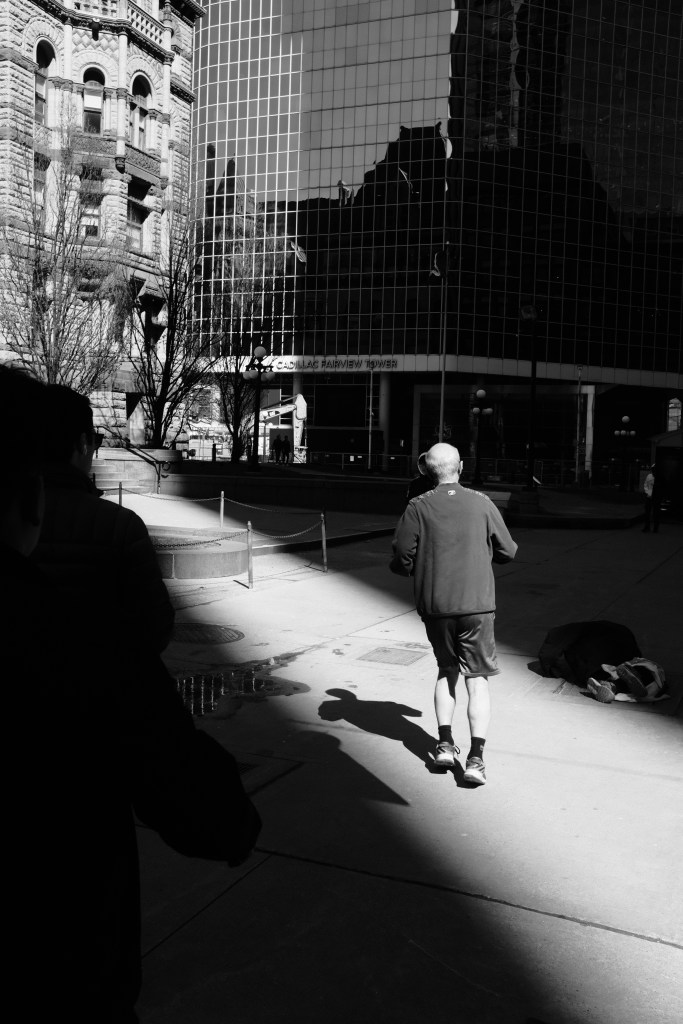
I made this image while out on my weekend photowalk. I’ve passed this same location hundreds of time since I’ve lived in Toronto. In what might become a semi-regular type of post, I wanted to write a bit about the backstory of the image. It was originally posted to Glass.
I was drawn to this scene, first, just because of how the light managed to slice through the shadows which were cast by the surrounding skyscrapers. After dialling the exposure to -1.3 I waited for some interesting characters to pass through the light.
It was only after taking a couple images that I really noticed how the unhoused person’s feet and legs were apparent. They were on grates that pass steam in the colder times of the year. Some of the unhoused use these grates to stay warm during the winter.
Still, the city—and especially the city core—does have a serious and growing housing issue. And so I ultimately decided to compose the scene with the hopes that it would show people noticing, but passing by, the individual on the street, as a kind of broader commentary of the social housing issues that exist in Toronto.
Compositionally the image is simple: a pair of men looking in the direction of the source of the light, and not towards the half shrouded person on the sidewalk, and moving towards the light. Behind them the aperture of the light beam starts to close, but the reader of the photograph can see the sparkle of youth (the new, glass, building) as juxtaposed agains the old (Toronto’s historical city hall). The young reflects the old, reminding us that youth is impermanent. As I said: it’s not a deep photograph nor are any particularly special tricks used to make it.
I often linger when I find light that I like for at least a couple minutes, to see if more interesting (or any interesting!) subjects come to fill the scene. Other times I’ll recompose and work the scene a little bit. But I have to admit that staying put is something that I need to get better with: it’s not enough to just linger for 5-10 minutes!
The above set of images aren’t touched up and are a few of the ‘raw’ versions of images I took and normally wouldn’t post (I took a total of about 20 frames before I settled on the one at the top of the post). I, personally, learn a lot from the older Magnum photos that include contact sheets.
While my rougher images aren’t the same, nor as descriptive, as contact sheets maybe they’ll be helpful to someone else when they are thinking of weighing a scene. Or maybe just to make clear that the admittedly very amateur images I make involve a lot more than just one lucky capture (with a handful of exceptions of course).
The FTC has a very direct and to the point post about things that businesses should consider ahead of integrating generative A.I. into business offerings:
Should you even be making or selling it?
Are you effectively mitigating the risks?
Are you over-relying on post-release detection?
Are you misleading people about what they’re seeing, hearing, or reading?
The FTC is not, of course, saying that they oppose the integration of A.I. into products. But they are being very clear that companies should do their due diligence ahead of such integrations or else run the risk of government investigations driven to protect consumers’ interests.
Look, if you think the fact that my Internet of Shit door-lock failed because the company that designed it made no plan to let me into my house if they went out of business would make me sympathetic to that company, you are out of your fucking mind.
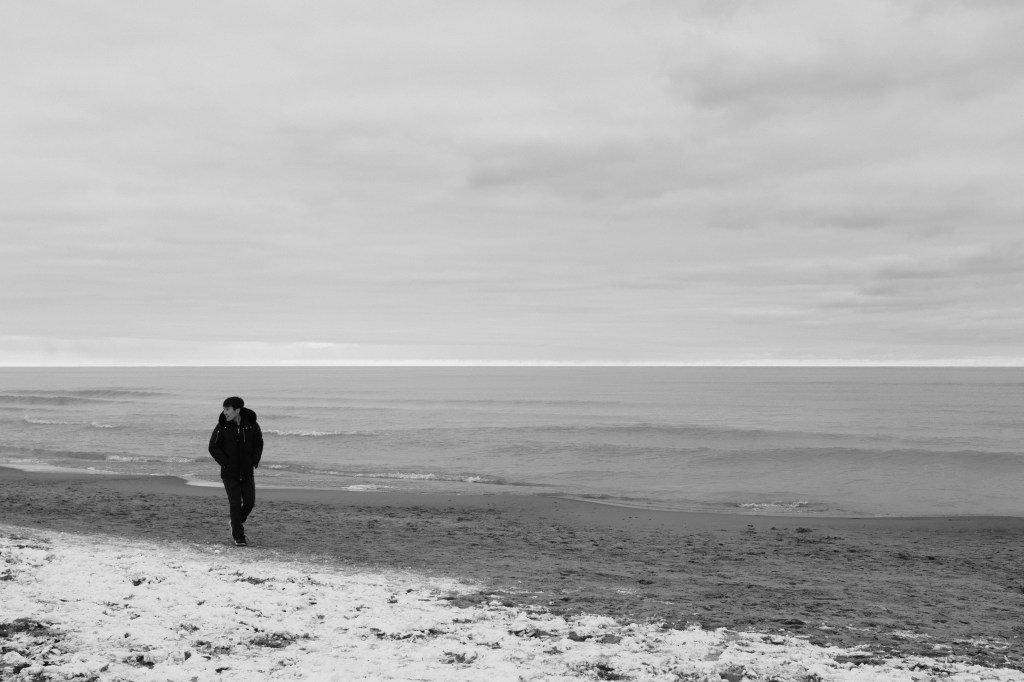
For the past five to six years or so I’ve been going to the Winter Stations outdoor art exhibit in the Beaches area of Toronto. Each year there is an international public competition between artists to put up architectural exhibits that include or encompass a lifeguard station that is set up along the Beach. Depending on the year there is, or isn’t, snow on the ground.
Families, children, and dogs all show up to enjoy (and try to understand!) the various exhibits that go up each year. At this point I see it as one of my ‘Toronto rituals’; the exhibition became important to me many years ago and I’ve refused to let that change. This part of the city, for as long as it lasts, is part of my experience of the city of Toronto itself and the ritual of seeing the exhibitions is part of what it is for me to be a Torontonian.
There’s a lot to enjoy about the experience, not the least being the presence of ‘typical’ beach stuff like the Muskoka chairs that people use along with the moderate starkness of the beach in a relatively inhospitable period of time. Some times that I’ve been to the exhibit has seen me shivering despite wearing multiple layers, along with an insulated vest and long wool coat with wool mittens and hat. Others have seen me just get wet with the rain as it pours onto the same kind of outfit. Fortunately it was a relatively balmy -2 degrees (Celsius) with no precipitation and I stayed warm the whole time, this year!
Each time I come to the art exhibit I not only feel a bit like I’m going through a Toronto-ritual I’ve developed but, also, it reminds me a bit of growing up along the Atlantic. The water isn’t salty and the life guard stations are a lot closer to the water, but it’s about the closest I’m likely to get to my historical home as is likely to occur.
One of the things that I always seem to look for when at this event is the kind of starkness or minimalism that is present in the exhibits. They need to stand up to the elements and, also, the destructive nature of children. And so many of the exhibitions are robust without much decoration. Years ago, there was an exhibit that encouraged children to (and I’m quoting) “interact” with the exhibit. It was ruined by the time that I appeared, though kids still liked jumping on all the damaged bits.
I had the pleasure this time of visiting the exhibit with my partner and a friend who generously put up with me making photos while they had conversations with one another. Despite being the person who was responsible for dragging people to the event—though it wasn’t this cold this time!—I was probably less present and/or took too much time doing my own thing than was likely appreciated. Both are long forgiving in their willingness to indulge me in my hobby.
Each time I return to this part of Toronto I’m reminded of my past: this was where I lived, many moons ago, and where some life changing stuff happened in my life. There’s always a sense of renewal—insofar as the art and people are different—along with a sense of the past that haunts me whenever I walked along this part of Lake Ontario.
At the same time, it’s always invigorating: it’s a place that reminds me of what once was and what is, now. And how great that now is!
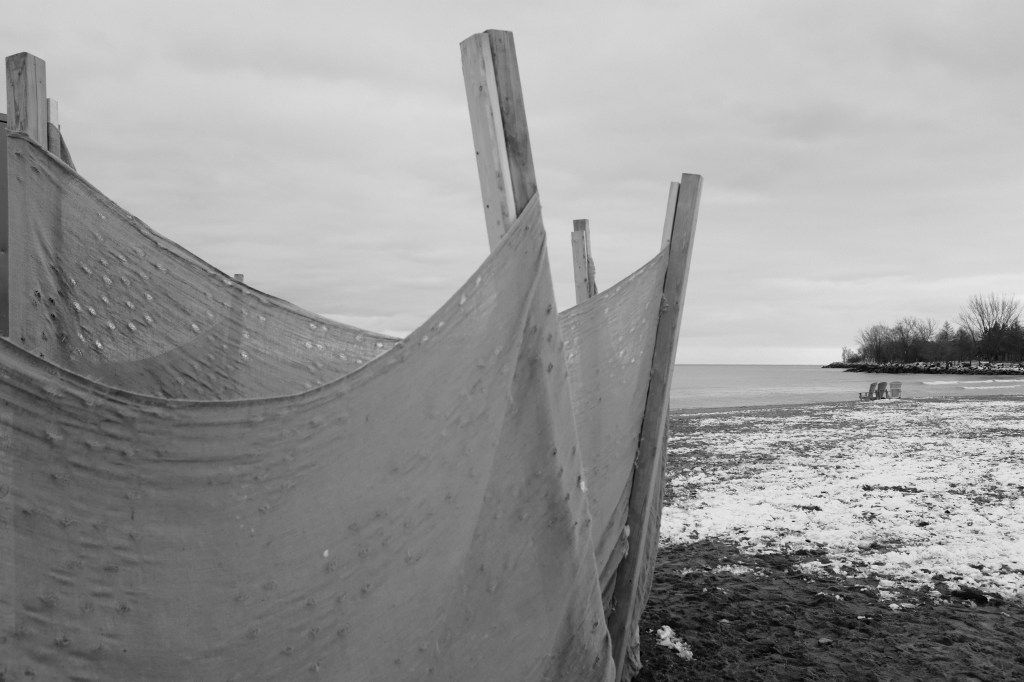
Some of the images I captured while at the exhibition this year, such as the above image of the empty chairs behind the fence, remind me that this space will be renewed soon with beach goers visiting and a liveliness that belies the current (general) absence of humans. Toronto ebbs and flows, and its residents will soon flow back to this part of the city once the weather improves some. I’ll look forward to returning to the Beaches—and capturing them in photographs—when the seasons have shifted!
Cory Doctorow has a great analysis of Netflix and it’s efforts to define (and delimit) what constitutes a family. The real kicker, though, is the final paragraph:
When [Netflix] used adversarial interoperability to build a multi-billion-dollar global company using the movie studios’ products in ways the studios hated, that was progress. When you define “family” in ways that makes Netflix less money, that’s felony contempt of business model.
Netflix: a company the whole family can appreciate. Just perhaps not together.
The Wall Street Journal is reporting that Baidu will soon integrate ChatGPT into the company’s chat/search offerings. The company plans, however, to:
limit its chatbot’s outputs in accordance with the state’s censorship rules, one of the people said. OpenAI also applies restrictions to ChatGPT’s outputs in an effort to avoid toxic hate speech and politically sensitive topics.
While I have no doubt that Baidu will impose censorship, I wonder whether researchers will be able to leverage the learning properties of ChatGPT to gain insight into what is censored by Baidu. Side-channel research has been used to reveal how censorship is undertaken by companies operating in China; I’d expect using these AI models will offer yet another way of interrogating their censorship engines.
All those people who had a certain amount of labour experience prior to or into the early 1990s and then carried on, they weren’t necessarily the ones who have seen that sort of precarity and job loss. Their experience carried them through.
People entering the workforce since then have had to contend with the continual erosion of labour standards, labour law, and collective bargaining, as well as all these different kinds of carveouts, especially around self-employment.
It creates what looks like an age divide, but it’s not really. It’s a deregulation divide.
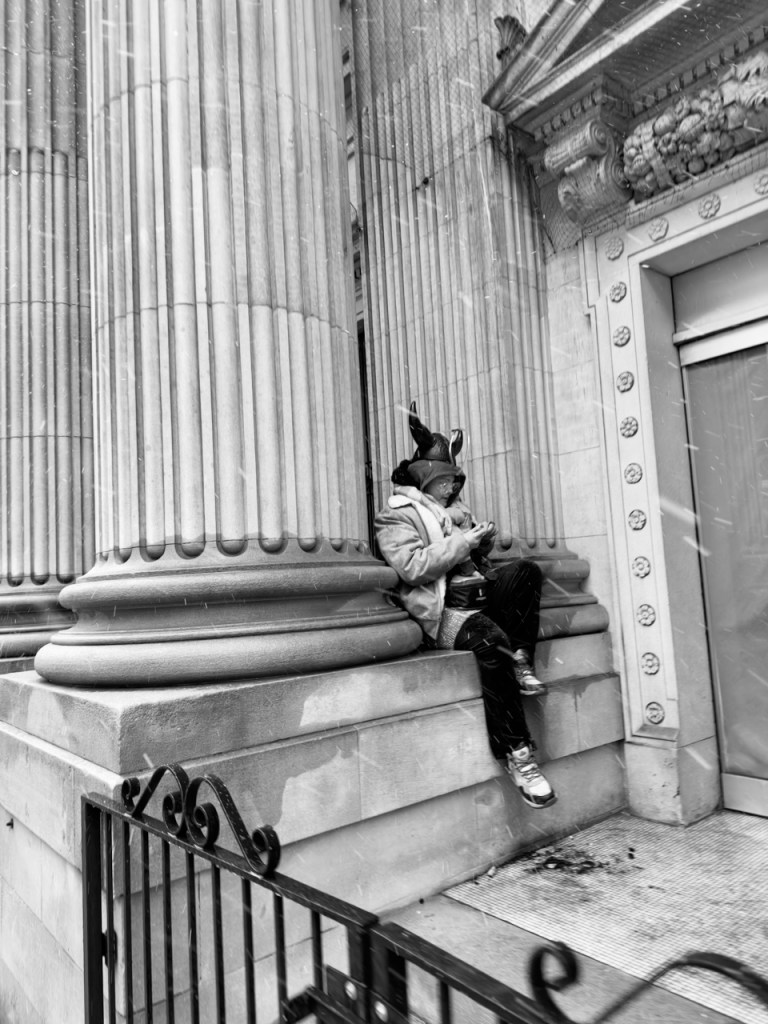
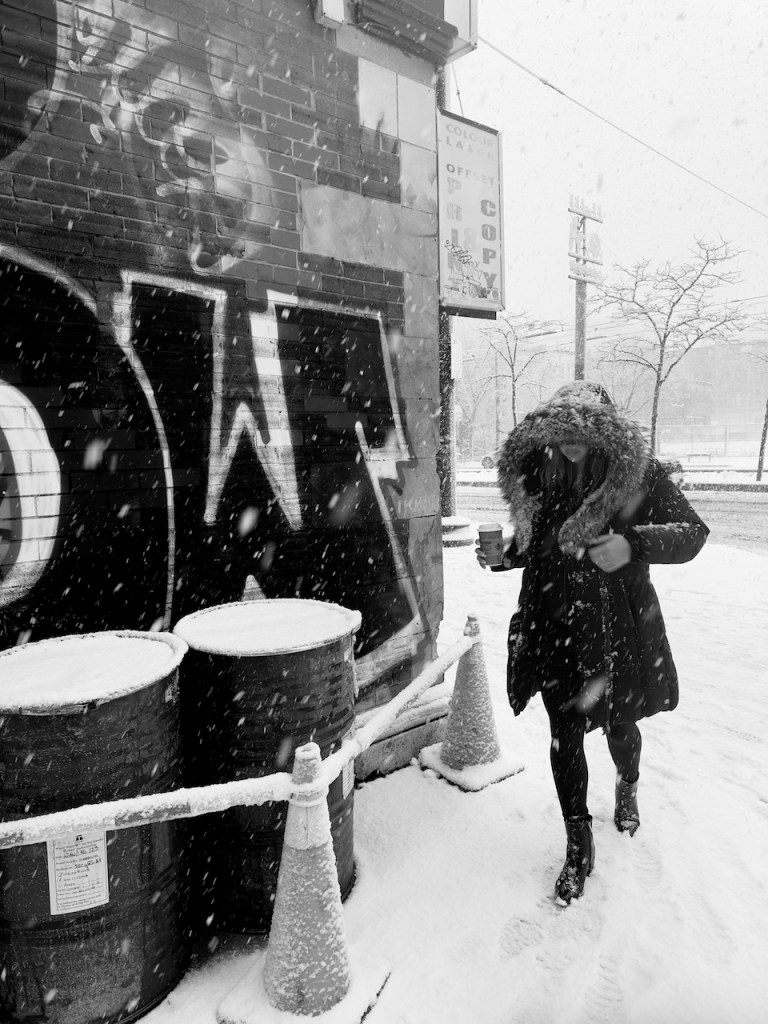
Toronto ended up getting a proper snowstorm late January. While it wasn’t the first snow of the year it was the first proper storm that saw 15cm of snow (or more) coming down over the course of many hours. In fact, the snow was coming down heavily enough that I didn’t want to risk my non-weather sealed cameras: I’m happy to get them damp by snow but in this weather they were certain to get soaked.
So what was I to do? Despite not being in love with the iPhone 14 Pro it’s a weather sealed camera and capable of making some decent images. So I grabbed it, donned my winter weather gear and some smartphone-compatible gloves, and headed out for a few hours of capturing the city.
When I went out I decided to increase the exposure a bit–set to 0.7–to keep the snow from coming out grey, but I found that exposure kept resetting. I half suspect that this was due to a combination of the somewhat bulky gloves I was using and the water on the screen resetting or modifying the exposure slider. Still, given that I was shooting in ProRAW I could generally modify exposures to my taste when I got home and did some light post-processing.
Speaking of the ProRAWs…I accidentally left the 24mm (equiv.) sensor set to 48MP images from the last time I was shooting with it! Which in hindsight explains why it often took so long to go from pressing the shutter button to capturing an image; I’d thought the delay was because of an issue with the conductive gloves or the cold or the water on the screen but, in fact, was was due to the file size. As always, I should have fully checked my equipment (and its software) before heading out. I’m just glad that I have a 512GB iPhone so at least I didn’t need to worry about running out of space on the device!
I did end up coming home with some smaller files using the main sensor from when I was shooting in burst mode. In burst you will default down to taking 12MP images on the 24mm (equivalent) lens and I used it when shooting faster-action scenes earlier in my walk.
In some notes to myself about the iPhone 14 Pro, I previously wrote:
The 48 megapixel main camera (24mm equivalent) when shot at its full resolution, in ProRAW, doesn’t work well for street photography. I tend to shoot bursts to get people stepping just so in a shot, but there’s an approximately 1 second or so delay in capturing one image and being able to capture another. That’s a shame as this is supposed to be a highlight feature and the A16 processor and specialized ISP just cannot process things fast enough for how I shoot street.
At the time, I didn’t realise the camera app would shift from taking 48MP to 12MP images under burst mode. It’s, also, not something that is apparent in the user interface. Just like, when in the camera app, there’s no indication or warning that you’re shooting at 48MP! All of which is to say that the stock Camera app on iPhone is getting very long in the tooth and is in desperate need of an overhaul.
Lest it sound that I only have negative things to say I should be very clear: I managed to go out and make images for several hours and came back with some that I liked. I couldn’t have gone out with my other camera gear. Since I thought I was shooting with the 12MP 24mm (equiv.) main lens quite often I tried to be fastidious in how I framed shots because I wasn’t going to be able to crop much. By happy accident, this ultimately meant that the images shot on that lens ended up being much higher quality than anticipated due to capturing 48MP images in all of their glory.
I also took the time to use the ultra-wide as well as telephoto lenses. I admit that I just don’t have a huge amount of experience shooting ultra-wide and so this was a fun experience in seeing what I could capture in the scene. Other images that didn’t quite make the cut saw me experiment with cutting the frame in two, with a divider in the centre of the frame and building scenes to the left and right of it. While I didn’t get any publishable-quality photos it was a good experiment and reminded me of just how challenging it is to replicate photographic masters who use this technique, like Sean Penn. The images I made with the 78mm lens, however, often ended up being too soft and ultimately I’ve opted to publish only one of them (above, woman walking away from sign with an arrow on it while looking at her phone).
When I went out I had hoped that I’d be able to capture the sense of how much the snow was beating down on everyone in the city. I think this came true as the iPhone didn’t shoot above 1/120 of a second the whole day, and at times was as low as 1/23. The result is that the snow is apparent and the subjects–unless they were relatively unmoving–have a bit of blur to them as they raced from place to place.
At the same time, because of the snow most people couldn’t move as quickly as they would on clear sidewalks and roads. It was an interesting personal lesson, insofar as I realised that in this weather I can probably easily get away with 1/80 to 1/200 and get sufficiently sharp images that still communicate the fury of the weather.
As I kept walking, however, a number of annoyances returned. I absolutely hate how holding your finger on the shutter button in the stock iPhone Camera app records a video instead of firing of a burst shot. This was a problem because when I was trying to take a single image sometimes I’d get a very short video, instead, meaning that I was without a photograph! I get that this is how most people probably want to use the app but it’d be nice to be able to customise the app’s functionality some. Especially if these are supposed to be ‘professional’ devices. Also, for reasons I couldn’t figure out, the Podcasts app also sometimes sped up the episodes I was listening to, or even skipped to the next podcast. Frustrating!
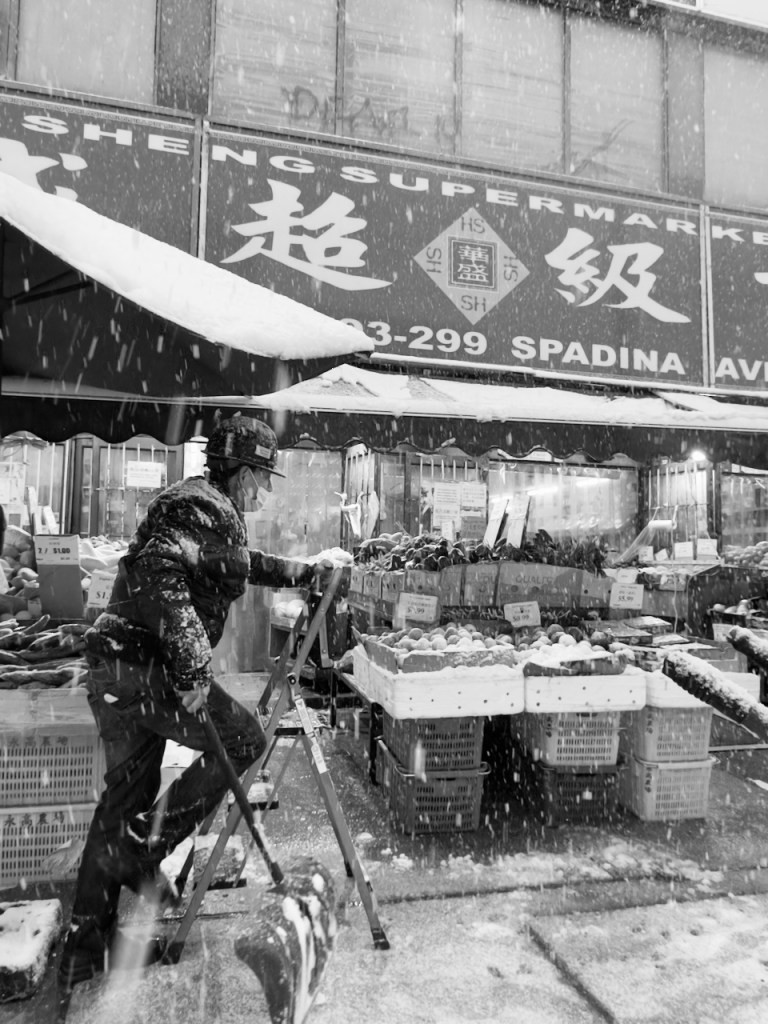
It had been quite some time since I’d walked through Chinatown during a real dropping of snow and it was great to see very familiar scenes in slightly different situations. Catching someone shovelling while, at the same time, a customer was taking refuge in a doorway was a real catch for me. I’m sure I’ve captured images from this location (as in the very spot I was standing in to make the image) dozens of times; this is a very different feel and texture than those I tend to make at this location. Win!
I ended up walking through Kensington Market last year during a slightly-less intense snowstorm and was rewarded with an image that was amongst my favourites of the year. I don’t think that I caught images that will necessarily fall into the same bucket this year, in part because several times I wasn’t able to activate the iPhone camera quickly enough. Still, I liked capturing how desolate the Market was, which was largely reflective of how quiet it was.
I did like how, towards the end of the shoot and into the evening, the snow started to come down even heavier which had the effect of leaving little droplets of water on the lens. While these blotches do upset the ‘perfection’ of the image I think they, also, have the effect of making it that much clearer what the weather was like and ideally put the viewer more firmly into the cold and wet scene.
It was on my return trip home that the worst of the weather was apparent for those who had to brave the wet snow that had piled up over the past many hours. There were relatively few pedestrians out, even at the major intersections, as compared to better-weather times. Hoods were up and high, foot slips were common, and cars were throwing up huge volumes of grey and brown slush onto anyone who happened to get too close to the curb.
Amongst the bravest of the brave were the few cyclists who continued to try and share the road with Toronto drivers. Between the streets that hadn’t been cleared and the erratic behaviour of vehicles whose owners hadn’t driven in the snow in over a year, it seemed risky and not that much faster than just walking. Still, they made for interesting subjects when they were waiting for a chance to get onto the road and make their way to their destination, and especially with the streetcar lines overhead layered with snow.
While cyclists arguably had a hard time of things, even harder times were surely experienced by the parents I saw who were trying to push strollers around. The snow routinely got into the wheels with the effect that parents were just pushing the strollers without the help of the wheels. Still, almost every stroller had a plastic barrier separating the child from the storm which at least meant that the little one’s weren’t getting soaked on their ways home.
Ultimately the images that I came back with after several hours of shooting are qualitatively different from anything I’d have made with my Fuji X100F or Ricoh GR or GRiiix. At least to my eye, they have a feel of an older camera and, due to the slow shutter speeds, many of the images remind me of film photographs I’ve seen of past Toronto winter storms from the 1970s and 1980s. Many also have an almost more intimate quality, to my eye, due to the technical imperfections that resulted from lighting conditions and occasional focus challenges. Still, I feel like they present the experience of the storm that lasted throughout the day and night, and which left the city blanketed in white by the following morning.