A really terrific paper on social media and ‘stranger danger’. You should read it.
Author: Christopher Parsons
Policy wonk. Torontonian. Photographer. Not necessarily in that order.
Hayles, Visualized
An image that immediately (for me) brings Hayles’ critiques of cybernetic visions of the human to mind.
I haven’t seen this argument before. It’s clever: stripping DRM (and/or transforming files to be cross-compatible with a variety of software readers) means that (in theory) those files will be accessible for longer periods of time, thus letting us preserve our (digital) history. From the article:
Piracy’s preserving effect, while little known, is actually nothing new. Through the centuries, the tablets, scrolls, and books that people copied most often and distributed most widely survived to the present. Libraries everywhere would be devoid of Homer, Beowulf, and even The Bible without unauthorized duplication.
The main difference between then and now is that software decays in a matter of years rather than a matter of centuries, turning preservation through duplication into an illegal act. And that’s a serious problem: thousands of pieces of culturally important digital works are vanishing into thin air as we speak.
At issue: I’m really not sure that a total archive of everything digital is actually something that we want, or necessarily need. A LOT of books, games, poems, and so forth were lost to the mists of time, and it’s not entirely clear to me that our world has fallen apart because of such losses.
History is a patchwork that is contingent on us perceiving certain items as more or less important from a partial and retrospective position. Moreover, it should be noted that truly significant texts/poems/artifacts have historically been replicated and distributed because of their value/importance at the time. Do we necessarily need a campaign of mass piracy – under the auspice of ‘preserving history’ – to ensure that similar efforts are made to secure the most critical elements of our past? I’m not so sure.
Raspberry Pi Powering XBMC and Airplay
It’s incredible that a cheap ($25-35) piece of hardware is capable of powering a full power media console as well as integrating with Apple’s Airplay technology. Videos of both below:
Flashy Failure
![]()
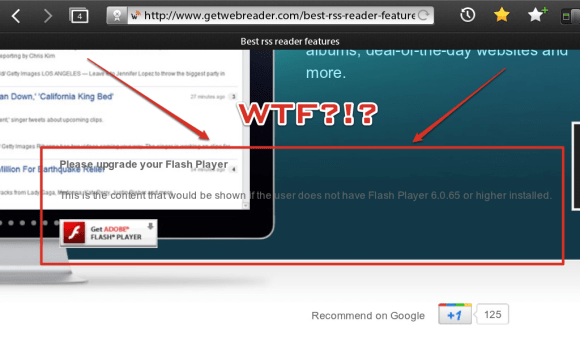
Flash is supposed to be a reason why consumers should buy a PlayBook, eh?
The NSA was quite aware that many new network systems were being built rapidly during the dotcom boom, and if cryptography wasn’t built in at the start, it should usually be too expensive to retrofit it later. So each year the NSA held the line on crypto controls meant dozens of systems open to surveillance for decades in the future. In these terms, the policy was successful: little of the world’s network traffic is encrypted, the main exceptions being DRM-protected content, Skype, the few web pages that are protected by TSL, opportunistic TLS encryption between mail servers, SSH traffic, corporate VPNs and online computer games. Everything else is pretty much open to interception – including masses of highly sensitive mail between companies.
~R. Anderson. (2008). Security Engineering: Second Edition. Indianapolis: Wiley Publishing Inc. Pp. 795.
There needs to be a term to describe the condition where you keep an email unread in your box because you’re not prepared to deal with it yet, but then you start to hate and resent the person who sent it because it is the only unread email in your box and it sits there silently accusing you with its boldedness. Or maybe I am the only sufferer of said disease.
I suffer from this condition. Some email causes me to bleed hate, but I can’t express such emotional positions that are directed as much at the mail as the person in polite (or impolite) company. So instead certain email festers like a gangrenous intellectual limbs, despoiling the entire body of my Inbox. Which generates more hate.
It’s a circle. Not necessarily virtuous, but a circle.
Management and RIM
This is an incredibly mixed article on RIM, but one section in particular stood out to me as either bad reporting, incompetent journalism, or Apple fanboyism.
Success also bred hubris about RIM’s position in the market. By late 2009, it was clear that the iPhone and Android had redefined the smartphone, and that RIM needed to adapt. The company had to target consumers more aggressively, not just business customers. It also had to drastically improve the BlackBerry’s user interface and web-browsing capabilities, not to mention attract developers to write more applications for the BlackBerry platform. Smartphones became less about communication—RIM’s biggest strength—and more about consuming media.
What’s more, the company itself was becoming increasingly complex. RIM produces multiple handsets, each with different screen sizes and internal hardware. RIM will even customize the same device to suit the needs of different carriers. Apple, in contrast, produces just one iPhone model per year. The product complexity at RIM takes a firm hand to manage, and that becomes more difficult when the entire organization is undergoing a seismic shift.
I agree: adaptation was signalled (though not necessarily entirely evident) in 2009. I agree: the company had to update it’s UI and OS to match that of their competitors.
Factually incorrect: Apple produces a single version of their iPhone (they have CDMA and GSM versions, as well as multiple ‘lines’ of their product by year, as well as some version that have or don’t have cameras according to businesses’ needs).
It strikes me that, while RIM certainly has challenges, focusing on the number of devices is of variable importance. If a company has a routine or standardized production and policy cycle that accommodates different radio technologies, then the radio technologies themselves are of minimal importance for overall production of new and updated devices. What the author actually means to say is that there was an emphasis on radios rather that UI innovation. This is arguably accurate – I have a Bold 9900 at the moment, and the UI is dated – but the hardware is incredible.
RIM is, and has been, a hardware company for quite some time. Other than Nokia there is no company that even comes close to competing (and I say this as an ex-iPhone owner, and the current owner of a Samsung Windows Phone device). The real test is watching to see if RIM becomes a Nokia, or transcends the problems that beset Nokia.
At best, BB 10 will enable transcendence. At worst, it will herald RIM turning into the world’s (arguably) best mobile hardware vendor in the world.
Rogers’ SpeedBoost system temporarily increases the rate that data is transmitted to their customers in the earliest moments of downloading an item. This system is meant to get ‘bursty’ traffic to end-users faster that would otherwise occur, as well as initially buffer streaming video so that customers don’t suffer delays. It was initially couched as a free ‘extra’ but it seems like Rogers customers now get to pay for these ‘enhancements’:
… a Rogers representative insists that users are lucky that the hikes weren’t worse, given Rogers had to “absorb much of these costs.” The company insists the improvements include some additional TV channels and SpeedBoost, a technology that delivers a little extra bandwidth at the beginning of a download (Comcast users in the States know it as PowerBoost):
$2/customer is a hefty increase when all customers are aggregated. While DSL Reports suggests that this move is driven by a lack of competition in Rogers’ primary markets I think that this is only one element of the story. A key problem facing Canadian ISPs is the high market saturation in wireline Internet services; quite simply, it can be challenging to attract new customers away from their current providers to raise quarterly revenues. One solution is to increase prices in minuscule ways, such that you deliver increased “value” to shareholders while targeting monthly cost increases just below consumers’ pain (and flight) points.
This doesn’t make Rogers’ practices any less horrible for their customers, but I really think that focusing exclusively on competition – and avoiding a reflection on market saturation – is missing a key part of the broader story.
Blackberry Playbook Sighs
![]()
This is the problem with having too many models, with too many disparate features and capabilities, on the market at the same time. The fact that the flagship of RIM’s smartphone empire – the Bold 9900 – can’t utilize ‘old’ apps is a sin. It should be there other way around, with old devices being unable to use applications!