![]()
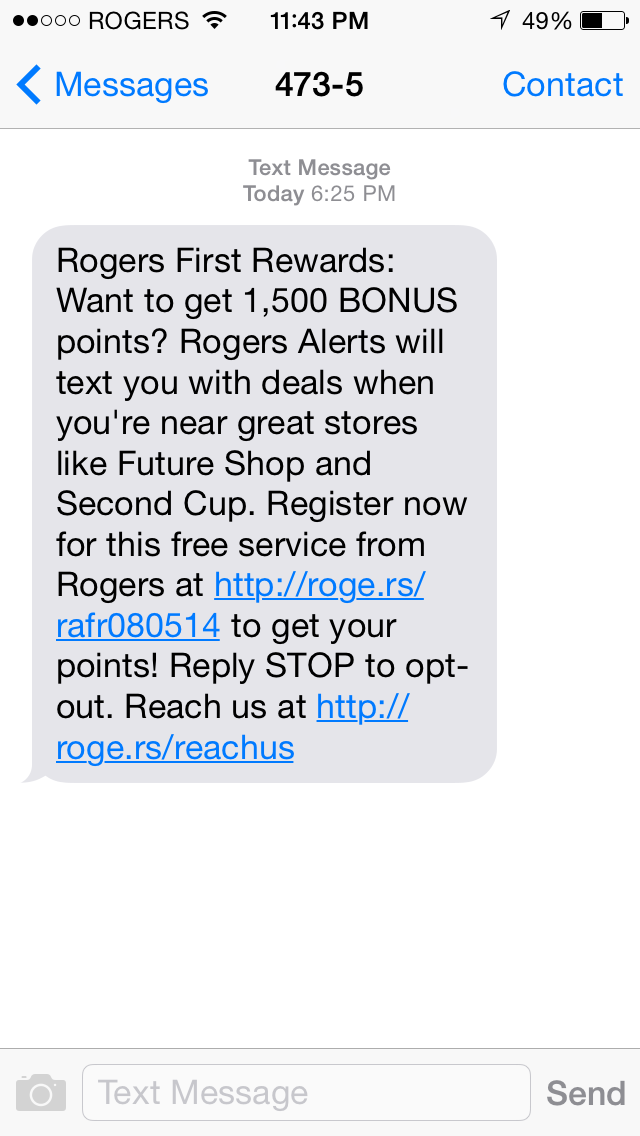
We received this from Rogers Communication recently, and were both left asking: Has Rogers opted us into the service, but we have the option to register, or have they not? And, if not, then what is the opt-out for?
Policy wonk. Torontonian. Photographer. Not necessarily in that order.
![]()
We received this from Rogers Communication recently, and were both left asking: Has Rogers opted us into the service, but we have the option to register, or have they not? And, if not, then what is the opt-out for?
Christopher Parsons, a postdoctoral fellow at the Munk School of Global Affairs’ Citizen Lab, said the fact that Facebook is asking for access to so much data is not surprising given the way the Android operating system works, but said users’ concerns over privacy are still legitimate.
“People enjoy the functionality of the app, but they’re sort of shocked when they ascertain or remember that ‘Oh yeah, this is what I actually have to give up in order to use contemporary, full-scale social media,’ ” he said.
Parsons, who is also managing director of Munk’s Telecom Transparency Project, said the odds of the data accessed by Facebook falling into the wrong hands are slim, describing its cyber-security staff as among the most aggressive and well-financed in the world.
Still, he said companies like Facebook could do a much better job at explaining to users why it needs their permission for so many different functions. It could, for example, offer a scaled-down version of its terms and conditions written in a language that anyone can understand, said Parsons.
He said even though more and more people have realized over the past week the extent of the Messenger requirements, it’s unlikely that Facebook will see a mass exodus of users.
“People may feel they don’t have any actual option, because if they don’t download the app, they can’t communicate with their social network,” said Parsons.
The Only Thing Worse Than Getting a Ph.D. in Today’s Academic Job Market:
Dissertations—some 250 pages of original research in the humanities, and topping 400 in the social sciences—are objectively, indisputably difficult. It sometimes takes years just to collect data or comb through the necessary archives, and then the damn thing must be written, often in total isolation. Dissertations are not impossible, but they are very hard, and most people in the world—including, perhaps, you, my friend—cannot complete one.
…
… there are the inner hindrances, the ones that cause procrastination, and then shame, and then paralysis. Here’s my favorite: believing, erroneously, that one must read and master every single word of existing scholarship before even beginning to write. Here’s my least favorite (which happens to my clients all the time): refusing to turn in any chapter that isn’t perfect, and thus not turning in anything at all—which results in the adviser getting irate, which puts even more pressure on the student to be even more perfect, ad infinitum. This is how dissertations are stalled, often forever.
So what can be done to fix this? The Izzy Mandelbaums of academia may argue the system is fine the way it is: In a field that requires extended independent work to succeed, the trial by fire of the dissertation is an apt initiation. (“All aboard the pain train!”) But does it have to be this way? I see no reason why, for example, more dissertation advisers couldn’t be enthusiastic about seeing early drafts, to provide guidance and support. Some already do this (mine did), but far too many of my clients say their advisers won’t even look at anything that isn’t “polished.” Every adviser who says this is part of the problem.
Another step in the right direction would be not just to hold dissertation workshops, but also to make them mandatory. A lot of grad students are simply too paralyzed (or ashamed to admit they don’t know what they’re doing) to attend one of their own volition. A mandatory workshop frees them to get the help they need, without having to admit they need help.
The belief that someone has ’failed if they do not complete their doctoral degree is absolutely frustrating and absurd; I’ve seen brilliant people leave not because they couldn’t write, not because they couldn’t publish, but because there were bureaucratic hoops they were emotionally ill-suited to handle. And instead of working with them – people who could have easily been the next leaders of their respective fields, and who were already emerging as such as doctoral students – they were instead cast aside. This is pre-defence of comprehensive exams, pre-defence of dissertation proposal, and thus way before the defence (or writing of) their dissertation itself.
For those ‘stuck’ at the dissertating point, I think that having regular (ideally weekly) meetups is incredibly helpful for successful completion, second in value only to regular (ideally bi-weekly) meetings with one’s supervisor. I was blessed to have an outstanding advisor who was willing to read early-draft work and provide valuable feedback, with most feedback returned in 2 weeks or so of me giving it to him. He shared with me thoughts and guidance, as well as tactics for moving forward. Sometimes I didn’t understand why he wanted what he wanted, to the point where it sometimes took years for me to implement the changes. Not because I didn’t want to, not because I wasn’t willing to (somewhat) blindly accept his proposed revisions, but because I wasn’t at a stage to understand what he was even proposing. Only by having regular, ongoing, contact with both dissertating peers and one’s supervisor does such nuance and advice become tangible and real in my experience.
The other helpful thing about regular peer-based meetings is you can set weekly goals, monthly goals, and semester-length goals. And you just chip away at them, every week. Ideally the group has at least one person who can drive a meeting so it’s quick and efficient and often asks pain-in-the-ass questions (e.g. It’s great that you’re working on that conference paper, but can you state how it fits with the dissertation, and what working on that paper will do over the next week/month/term in terms of advancing the dissertation)? In my experience, when I ran such meetings, they would take the following format:
Our meetings typically had been 4–7 people and, for those who attended and committed regularly, worked out well. We also had a deal where if you failed to accomplish any of your weekly goalsyou bought someone a coffee next week. It was a very small, but useful, measure to ensure that each person accomplished at least one of their goals set the prior week. And, if they failed, to have some ‘pain’ associated with that failure.
Inside Citizen Lab, the “Hacker Hothouse” protecting you from Big Brother:
Starting out in the basement of the Munk School of Global Affairs with a handful of students in the Spring of 2001, Deibert’s Citizen Lab now operates out of a third-story office on Bloor Street, on the northwest edge of the University of Toronto campus. But like the agencies its members often criticize, Citizen Lab has collaborators operating everywhere, supplying information about how state power is being exercised in cyberspace.
Deibert doesn’t mind the comparison. In fact, much of his inspiration for the Lab came from working inside the Canadian Department of Foreign Affairs in the mid-‘90s, where he studied the use of satellite reconnaissance for arms control verification. The working group he was part of conceptualized a kind of “earth monitoring system” to enforce bans on nuclear testing—a worldwide system of satellites, underwater fences, and seismic stations designed to hold entire nations to account.
…
Still, when it comes to what a “people’s intelligence agency” might look like, it’s hard to find a better template than the one created by Citizen Lab. And its hacker ethos is reflected in those it calls its allies.
One of the better descriptions of some of what we do, on a daily and ongoing basis, at the Citizen Lab.
No skin thick enough: The daily harassment of women in the game industry:
“Women are the niggers of gender,” the email said. “If you killed yourself, I wouldn’t even fuck the corpse.”
I blinked at my phone, fighting simultaneous urges to hurl my phone across the room in anger and cry. Later that day, someone texted me my address — telling me they’d “See me when I least expected it.”
I haven’t been out to my car at night by myself since January 2nd.
My name is Brianna Wu. I lead a development studio that makes games. Sometimes, I write about issues in the games industry that relate to the equality of women. My reward is that I regularly have men threatening to rape and commit acts of violence against me.
The aggression committed towards these women is truly abhorrent – it speaks poorly to the various efforts to effectively combat sexism and misogyny. No one should be on the receiving end of such comments, ever, and to normalize the sending and reception of them is just wrong. To be clear: this isn’t bullying, but the cases speak to acts of hate. And it’s an area where hate speech laws should be triggered to bring offenders to justice.
The Little-Known Loophole Obscuring Facebook and Google’s Transparency Reports:
The number of user data requests to Internet giants from foreign governments, are being lost in a legal loophole.
For some time I’ve been asking corporate executives how they do, or don’t, account for legal requests served by Canadian authorities on American social networking companies. And the obscurity has been noted in work I’ve previously published on this topic. In an admittedly selfish way, it’s terrific to see a Canadian reporter look into this issue further only to learn that the transparency numbers provided by Google et. al. do not fully account for non-US authorities’ requests for data.
Hopefully we’ll see other journalists, in countries the US has Mutual Legal Assistance Treaties (MLATs) with, file similar requests to better break down how many requests their domestic law enforcement agencies are issuing to the American companies responsible for storing and transiting so much of our personal data. While Google and other companies should be congratulated for their work it’s apparent that corporate transparency isn’t enough: we need better government accountability and corporate transparency to properly understand how, why, and how often authorities request (and receive) access to privately held telecommunications data.
![]()
How Apple and Google plan to reinvent healthcare:
For many years the digital health industry has been driven by wearable devices like the Fitbit, Nike’s Fuelband, and Jawbone’s Up. But if the titans of the smartphone industry succeed in creating a dominant platform for health and fitness data, this business could be in trouble. “A lot of the basic functions we have seen in fitness wearables — tracking your steps, taking your heart rate — those functions will become basic features on a smartphone or smartwatch,” says Wang.
As someone who’s worn one of these trackers for years now [1] and who is obsessive about carrying my smartphone, I cannot disagree more. My phone does rough calculation of how much I move every month and it’s routinely off by absolutely enormous magnitudes. [2] To some extent, that’s because the phone isn’t calibrated to precisely monitor how far I walk. To a greater extent, however, it’s because while I’m obsessive about keeping my phone around me it’s actually not on my person for about 30% of my movements each day. I don’t carry my phone at night when walking the dog, or necessarily when I’m wander around the building I work in.
For people who want just casual or ambient information about movement a smartphone might be fine. But anyone who is even moderately interested in tracking their activity for health reasons isn’t going to be willing to ‘guesstimate’ 1/3 of their day’s activity. The real power of smartphones is delivering information-rich notifications or aggregating data from a variety of sensors; it’s the software that they bring, first and foremost, that is their value add. And I think that for the fitness device companies to be successful they’ll need to develop powerful data mobilization schemes – you’ll need to be able to integrate data from the fitness hardware to any smartphone OS – to really capture significant portions of the market over the longer-term. I don’t buy the idea that people will keep buying sub-par products because the data is bound within a specific operating system or mobile phone ecosystem. Though, perhaps that’s just me as someone who hops between smartphone and smartphone OSes every 12–14 months.
Rogers sheds new light on what personal data spy agencies can get:
Comments yield insights into a largely hidden relationship between intelligence agencies and communications corporations Federal spy agencies are, like police, “obviously going to have to get a lot more production orders than they did in the past,” one of Canada’s Big Three communications companies says.
And while Ottawa’s agents had been getting warrantless access to some corporately held records, “we have not opened up our metadata to the government as apparently has happened in the U.S.”
Rogers Communications’ vice-president of regulatory affairs, Ken Engelhart, made these and other remarks about his company’s relationships with federal intelligence-agencies, as he spoke to The Globe’s Christine Dobby about corporate transparency in an interview this week.
Such remarks, not published until now, are important because they yield some insights into a largely hidden relationship between intelligence agencies and communications corporations.
But even as Rogers is now publicizing its bona fides as a telecom company that acts more openly than most, it is privately admitting to customers that it can face federal gag orders.
“We are unable to confirm with a customer when their information has been disclosed to a government institution… where that institution has refused to allow Rogers to disclose that information,” reads one such July 10 letter obtained by The Globe and Mail from privacy researcher Christopher Parsons, of University of Toronto’s Citizen Lab.
That Rogers is, in essence, playing a game of Catch-22 (if we told you we didn’t disclose your information, then others could see if they got a different response and learn we had disclosed their information, therefore we can’t tell anyone if we disclosed their information) is absurd. As is their refusal to provide basic records to their subscribers.
The argument for human rights is based upon protection for individuals against one-sided, deceitful, inefficient, oppressive, arbitrary, cowardly, and bullying government. They are the rights that are necessary for our individual integrity, for our acceptance by the state and civil society as full members of that community, of our right to belong … We are not treated as full members when government does not provide us with information about the effect of [its] decisions, the outcomes of such decisions, or the use of resources that made the exercise of power possible.
Patrick Birkinshaw, “Freedom of Information and Openness: Fundament Human Rights?” Administrative Law Review 58(1), 2006.