Categories
Solved

Solved: Apple Wallet Card Activation on a New iPhone

When I set up my new iPhone 17 Pro I ran into a frustrating problem: I couldn’t activate some of my credit and banking cards in Apple Wallet. Since this might happen to others, here’s how I diagnosed the issue and worked around it.

Setup Context

  • Transferred settings (including Apple Wallet) from my iPhone 14 Pro
  • Cards from CIBC and Wealthsimple
  • Used SMS (not voice) as the second factor for verification

The Problem

After transfer, my cards appeared in Apple Wallet but still needed to be re-verified. Each time I tried SMS verification, the text code arrived and auto-filled into the Wallet app — but the “Next” button was greyed out.

On some attempts, the button turned blue, but tapping it did nothing. Result: I couldn’t verify or use my cards.

The Workaround

The fix was surprisingly simple: don’t rely on auto-fill.

  1. Request the SMS code as usual.
  2. Open the Messages app, copy the code manually, and paste it into Wallet.
  3. This time the “Next” button turned blue and worked, letting me add the cards.

Likely Cause

Based on testing, there may be a bug in iOS 26.0 where auto-filled SMS codes don’t properly trigger the Apple Wallet verification step. Until Apple fixes it, copying the code manually may help you get around the issue.

Categories
Solved

Solved: HDCP Error After Updating Apple TV 4K to TVOS 18.4.1

I recently updated my Apple TV 4K to tvOS 18.4.1. After this, I received HDCP errors when trying to view content from steaming services (e.g., Disney , Amazon Prime, Crave).

These post outlines how I solved this problem.

Background and Context

I am using a TCL 55R635-CA, to which I have connected the Apple TV 4K and a Sonos Arc (with an attached Sonos Sub Mini).

When I updated my Apple TV 4K to tvOS 18.4.1, I received a prompt on my TCL 55R635-CA that I had to rename the Sonos Arc that is plugged into the TCL’s eARC HDMI port. I didn’t think anything of it and selected a new icon, but otherwise made no changes to the configuration of the TCL audio settings. I had never received this kind of prompt, before, when updated the Apple TV 4K.

YouTube content played without any errors. However, when I tried to steam content over Disney , Amazon Prime, or Crave I received HDCP errors. The error messages indicated that I might be trying to copy protected content (I was not doing this). Solutions proposed were to reseat HDMI cables to ensure a good connection, test different HDMI inputs to confirm they all worked, or replace the HDMI cable in case it had become damaged.

Failed Solutions

  1. I tried to reseat HDMI cables. This did not resolve the error messages I was receiving.
  2. I rebooted the Apple TV. This did not resolve the error messages I was receiving.
  3. I reset the Apple TV back to factory settings, and reinstalled streaming services. This did not resolve the error messages I was receiving.
  4. I pulled the plug — to fully depower — the Apple TV. This did not resolve the error messages I was receiving.
  5. I pressed the power button on the TCL remote, to turn off the television, and turned off the Apple TV. This did not resolve the error messages I was receiving.

Solution to Apple TV 4K HDCP Errors

My Apple TV 4K and Sonos Arc are plugged into a TCL 55R635-CA. When you turn off the television using the remote you do not actually turn off the television and, instead, just put the television into standby mode.

To resolve my HDCP errors when using my Apple TV 4K, I pulled the power plug for the television. I left the TCL 55R635-CA fully depowered for approximately 3 minutes. I then plugged the TV back in and turned it on.

Once the television turned back on, and switched over to the Apple TV 4K input, the errors had been resolved. The problem, the whole time, was with the TCL television and fully depowering the television resolve the HDCP errors.

Categories
Solved

Solved: Setting Up a Nanoleaf Essentials A19 Smart Bulb with a Dimmer Switch

When we first moved into our apartment several years ago I purchased a bunch of ‘smarthome’ equipment. One of those items was a Nanoleaf Essentials A19 Smart Bulb.

It never really worked. At the time it was because our kitchen light was on a dimmer switch and — as I learned — smart lights do not tend to work (well) on dimmers. The only solution was to replace the switch or, instead, not be able to have a smart light.

We couldn’t replace out the switch given that we live in an apartment. And so the Smart Bulb instead acted as a (not very good) dumb bulb for several years. Until now.

The Issue

When I installed the Nanoleaf Essentials A19 Smart Bulb into the kitchen light that was on a dimmer switch I was able to turn on the Smart Bulb. However, I could never get it to connect to my smart home environment. This is a documented issue on Nanoleaf’s support webpage.

I exclusively use Apple products and, in this case, was unable to get the smart bulb to connect to Apple Home or to the Nanoleaf app.

The Environment

The items that I was dealing with included:

The Solution

Fortunately this ended up being a surprisingly easy thing for which to solve.

  1. Remove your Nanoleaf Essentials A19 Smart Bulb and record the 8-digit code that is below the QR code on the bulb.
  2. Remove front plate over the Lutron AYCL-153P Dimmer switch.
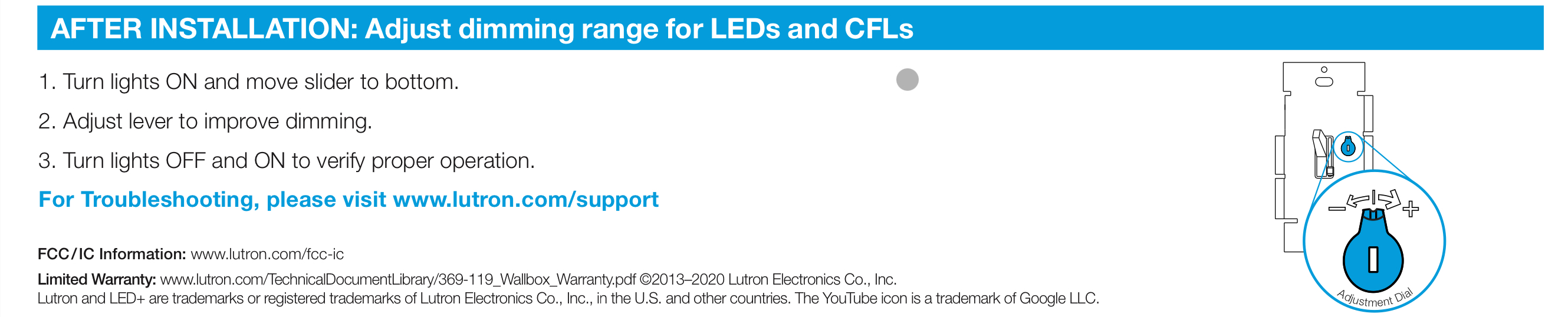
  3. There will be a small ‘dial’ that you can turn on the switch, to the right of the toggle switch. Turn it all the way to the right.1
  4. Factory reset your Nanoleaf Essentials A19 Smart Bulb2
  5. Disable the 5Ghz wifi radio temporarily on your Eero Pro 6. This involves: Open Eero App >> Settings >> Troubleshooting >> My Device Won’t Connect >> My Device is 2.4 GHz Only >> Click ‘Temporarily Pause 5GHz’. You must do this so that you can connect the Nanoleaf Essentials A19 Smart Bulb to your wireless network, because it only has a 2.4GHz radio.
  6. Add the device to Apple Home on an iOS device. This involves: Click the ‘ ’ icon in the upper right corner of the Apple Home app >> Add Accessory >> More options >> My Accessory Isn’t Shown Here >> Enter Code >> Continue >> Finalize adding the bulb to your Apple Home application.

You will now be able to access your Nanoleaf Essentials A19 Smart Bulb from Apple Home.


  1. IMG_0015
  2. From Nanoleaf: Turn off, wait for 3 seconds, turn back on for no more than 3 seconds. Repeat for a total of 5 power cycles. Bulb will flash red three times if successful. Note that it may take 2-3 second for this flashing to occur after the final power cycle. ↩︎
Categories
Solved

Solved: Ricoh GR Not Using Auto-Hi ISO

I spent a few frustrating evenings shooting on aperture priority with the original Ricoh GR. It held my shutter speed at 1/40s and varied the ISO so that it was always at 1/40s.

I’ve finally sat down to figure out what the heck was going on as I’d never previously experienced this issue. For some reason each time I tried to set the ISO to Auto-High (with a 5000 ISO maximum and shutter minimum at 1/160s) it kept defaulting to Auto, instead.

The Problem

My Ricoh GR was stuck at 1/40s when shooting aperture priority (i.e., ‘Av’) with the ISO varying to ensure it could hit that shutter speed. My work-around solution was to take manual control of the ISO. When I manually raised the ISO I could get a much faster shutter speed.

The Solution

I had previously disabled ‘Continuous Mode’ when I had been experimenting with an external flash. In doing so I had, unknowingly, simultaneously disabled the camera’s ability to use ‘Auto-High.’1 Auto-High is used to set a maximum ISO and minimum shutter speed.2

To enable Auto-High on the Ricoh GR:

  1. Open the menu
  2. Enter the Shooting Menu (Camera symbol)
  3. Scroll down to ‘Continuous Mode’
  4. Press the right button on the control dial
  5. Scroll to ‘Continuous Mode’
  6. Press ‘OK’

You may, also, need to set the maximum ISO and minimum shutter speed for Auto-High. To set these values:

  1. Open the menu
  2. Enter the Setup Menu (Screwdriver and Wrench symbol)
  3. Scroll down to ‘ISO Auto-High Settings’
  4. Press the right button on the control dial
  5. Set the Maximum ISO and Change Shutter Speed to preferred values
  6. Press ‘OK’

At the conclusion of this you should hopefully have (re)enabled Auto-High ISO.

Note: My solution to this problem differs from some on the Internet. A post in the DP Review forums, as an example, suggests that you must disable ‘dynamic range compensation’ to solve the problem. This is not the case in my experience as I have dynamic range compensation set to ‘Medium’ on my Ricoh GR.


  1. This is not clearly explained in the Ricoh GR manual when when doing a search for ‘Auto-Hi’. ↩︎
  2. If shooting conditions are such that the camera cannot expose properly at a given aperture and maximum ISO setting, it may reduce the shutter speed below the minimum shutter speed set under Auto-High to get a correct exposure. ↩︎
Categories
Solved

Solved: Changed Name Server and Apple Custom Email Domain Stopped Working

Photo by Miguel u00c1. Padriu00f1u00e1n on Pexels.com

I recently moved a self-hosted WordPress website from a shared hosting environment to WordPress.com. The migration was smooth: I had to export the XML for the self-hosted WordPress installation and import it to the WordPress.com CMS, and then fix a few images. The website is functioning well and the transition was smooth.

However, shortly after doing so I started having issues with receiving emails at my custom email which was set up with Apple’s iCloud Custom Email Domain. Not good!

The Problem

I changed the name servers with the domain registrar (e.g., Bluehost or Dreamhost) so that my custom domain (e.g., example.com) would point to the WordPress.com infrastructure. However, in doing so my custom email (user@example.com) that was using Apple’s iCloud Custom Email Domain stopped sending or receiving email.

This problem was surfaced because email could not be sent/received and, also, I could not verify its domain in Apple’s “Custom Email Domain”. Specifically, iCloud presented the dialogue message “Verifying your domain. This usually takes a few minutes but could take up to 24 hours. You’ll be able to continue when verification is complete.” The “Reverify” button, below the dialogue, was greyed out.

Background

When you have registered the domain with a registrar other than WordPress (e.g., Bluehost, Dreamhost, etc) and then host a website with WordPress.com you will have to update the name servers the domain uses. So, you will need to log into your registrar and point the name servers at the registrar to NS1.Wordpress.com, NS2.Wordpress.com, and NS3.Wordpress.com. In doing so, all the custom DNS information you have provided to your registrar, and which has been used to direct email to a third-party email provider such as Apple and iCloud, will cease to work.

The Solution

When transitioning to using WordPress’ nameservers you will need to re-enter custom domain information in WordPress’ domain management tabs. Specifically, you will need to add the relevant CNAME, TXT, and A records.1 This will entail the following:

  1. Log into your WordPress.com website, and navigate to: Upgrades >> Domains
  2. Select the domain for which you want to modify the DNS information
  3. Select “DNS Records” >> Manage
  4. Select “Add Record” (Upper right hand corner)
  5. Enter the information which is provided to you by your email provider

Apple iCloud Custom Domain and WordPress.com

When setting up your custom domain with Apple you will be provided with a set of TXT, MX, and CNAME records to add. Apple also provides the requisite field information in a help document.

While most of these records are self evident, when adding the DKIM (CNAME record-type) record in WordPress.com, the Host listed on Apple’s website is entered in the “Name” field on WordPress’ “Add a Record” page. The “Value” of the DKIM on Apple’s website is entered as the “value” on WordPress’ site.

TypeNameValue
CNAMEsig1._domainkeysig1.dkim.example.com.at.icloudmailadmin.com
Visualization of Adding iCloud CNAME Record for WordPress.com


Note: Apple will generate a new TXT record to verify you control the domain after pointing the name servers to WordPress.com. This record will look something like “apple-domain=[random set of upper/lower case letters and numbers]”. You cannot use the “apple-domain=“ field that was used in setting up your custom email information with your original registrar’s DNS records. You must use the new “apple-domain=“ field information when updating your WordPress.com DNS records.

Once you’ve made the needed changes with WordPress.com, and re-verified your domain with Apple’s iCloud Custom Domains, your email should continue working.

In the Future

It would be great if WordPress actively and clearly communicated to users who are pointing their name servers to WordPress.com that there is a need to immediately also update and add email-related DNS records. I appreciate that not all customers may require this information, but proactively and forcefully sharing this information would ensure that their customers are not trying to fix broken email while simultaneously struggling to identify what problem actuallyy needs to be resolved.


  1. WordPress does have a support page to help users solve this. ↩︎
Categories
Reviews Solved Writing

So You Can’t Verify Your Apple iCloud Custom Domain

Photo by Tim Gouw on Pexels.com

When you set up a custom iCloud email domain you have to modify the DNS records held by your domain’s registrar. On the whole, the information provided by Apple is simple and makes it easy to set up the custom domain.

However, if you change where your domain’s name servers point, such as when you modify the hosting for a website associated with the domain, you must update the DNS records with whomever you are pointing the name servers to. Put differently: if you have configured your Apple iCloud custom email by modifying the DNS information at host X, as soon as you shift to host Y by pointing your name servers at them you will also have to update DNS records with host Y.

Now, what if you don’t do this? Eventually as DNS information propagates over the subsequent 6-72 hours you’ll be in a situation where your custom iCloud domain email address will stop sending or receiving information because the routing information is no longer valid. This will cause Apple’s iCloud custom domain system to try and re-verify the domain; it will do this because the DNS information you initially supplied is no longer valid.

Should you run into this issue you might, naturally, first reach out to Apple support. You are, after all, running your email through their servers.

Positively: you will very quickly get a real-live human on the phone to help you. That’s great! Unfortunately, however, there is very little that Apple’s support staff can do to help you. There are very, very few internal help documents pertaining to custom domains. As was explained to me, the sensitivity and complexity of DNS (and the fact that information is non-standardized across registrars) means that the support staff really can’t help much: you’re mostly on your own. This is not communicated when setting up Apple custom email domains.

In a truly worst case scenario you might get a well meaning but ignorant support member who leads you deeply astray in attempting to help troubleshoot and fix the problem. This, unfortunately, was my experience: no matter what is suggested, the solution to this problem is not solved by deleting your custom email accounts hosted by Apple on iCloud. Don’t be convinced this is ever a solution.

Worse, after deleting the email accounts associated with your custom iCloud domain email you can get into a situation where you cannot click the re-verify button on the front end of iCloud’s custom email domain interface. The result is that while you see one thing on the graphical interface—a greyed out option to ‘re-verify’—folks at Apple/server-side do not see the same status. Level 1 and 2 support staff cannot help you at this stage.

As a result, you can (at this point) be in limbo insofar as email cannot be sent or received from your custom domain. Individuals who send you message will get errors that the email identify no longer exists. The only group at Apple who can help you, in this situation, are Apple’s engineering team.

That team apparently does not work weekends.

What does this mean for using custom email domains for iCloud? For many people not a lot: they aren’t moving their hosting around and so it’s very much a ‘set and forget’ situation. However, for anyone who does have an issue the Apple support staff lacks good documentation to determine where the problem lies and, as a result, can (frankly) waste an inordinate amount of time in trying to figure out what is wrong. I would hasten to note that the final Apple support member I worked with, Derek, was amazing in identifying what the issue was, communicating the challenges facing Apple internally, and taking ownership of the problem: Derek rocks. Apple support needs more people like him.

But, in the absence of being able to hire more Dereks, Apple needs better scripts to help their support staff assist users. And, moreover, the fact that Apple lacks a large enough engineering team to also have some people working weekends to solve issues is stunning: yes, hiring is challenging and expensive, but Apple is one of the most profitable companies in the world. Their lack of a true 24/7 support staff is absurd.

What’s the solution if you ever find yourself in this situation, then? Make sure that you’ve done what you can with your new domain settings and, then, just sit back and wait while Apple tries to figure stuff out. I don’t know how, exactly, Apple fixed this problem on their end, though when it is fixed you’ll get an immediate prompt on your iOS devices that you need to update your custom domain information. It’s quick to take the information provided (which will include a new DKIM record that is unique to your new domain) and then get Apple custom iCloud email working with whomever is managing your DNS records.

Ultimately, I’m glad this was fixed for me but, simultaneously, the ability of most of Apple’s support team to provide assistance was minimal. And it meant that for 3-4 days I was entirely without my primary email address, during a busy work period. I’m very, very disappointed in how this was handled irrespective of things ultimately working once again. At a minimum, Apple needs to update its internal scripts so that their frontline staff know the right questions to ask (e.g., did you change information about your website’s DNS information?) to get stuff moving in the right direction.
Categories
Solved

Solved: Mendeley-Related Error in Microsoft Word for MacOS

In the past I used Mendeley as a citation management system. I stopped using it, and uninstalled it from MacOS, when they deprecated the mobile application I relied upon. I had installed the Mendeley extension for Microsoft Word to facilitate easy citation insertion and updates. Ever since deleting Mendeley from MacOS I have received a popup window when opening Microsoft Word as well as a prompt to save changes to “Mendeley-word2016-1.19.4.dotm” when closing Word.

The Problem

I was receiving prompts when opening and closing Microsoft Word for MacOS after having uninstalled Mendeley. These were annoying and I wanted them to go away.

The Solution

In MacOS:

  1. Open Finder
  2. Search for “Mendeley”
  3. Delete “Mendeley Desktop.plist” and “Mendeley-word2016-1.19.4.dotm”

You should now be able to open Microsoft Word without being asked to point to where Mendeley is installed, and exit Word without being asked to save changes to Mendeley-word2016-1.19.4.dotm.

Categories
Solved

Solved: Set A Default Email Address in Apple Contacts

I figured out how to set a default email address for a contact in Apple Contacts, where the contact has multiple email addresses associated with them.

The Problem

Apple support claims that Siri is capable of learning which email address to use when someone you are contacting has multiple email addresses associated with them in your contact book. In my experience this is hit and miss. The result is that you need to check, each time, to ensure that an email is being sent to the correct email address.

The Solution

For the contact in question you must ensure that the email you want to most regularly contact them is the first email in the list of emails. Thus, if you had a set of emails ordered as such:

  • example1@email.me
  • example2@email.me
  • example3@email.me

and wanted ‘example 3@email.me’ to be the default email that you send message to, you would:

  1. Open Contacts and the individual’s card, and then click ‘Edit’
  2. Copy the email that you want to remove as the current default (e.g., example1@email.me)
  3. Create a new email record by clicking the field beside ‘Other’ at the bottom of the list and paste the email address you copied at 2
  4. In the top email field (i.e., example1@email.me) replace it with the preferred default email (e.g. example3@email.me)
  5. Delete the now-duplicated example3@email.me
  6. Click ‘done’

At the conclusion of this reordering, your email order list would appear as:

  • example3@email.me
  • example2@email.me
  • example1@email.me

The result of the reordering is that you should, by default, now send email to the contact’s example3@email.me. I hope this helps anyone else who’s running into this problem!

Categories
Solved

Solved: Connected Meross Smartplug to Eero 6 Pro

I helped set up some Meross smartplugs that were being used to automate home functions. What follows is how I was ultimately able to connect them to an Eero 6 Pro router.

The Problem

When opening the Home application on an iPhone or iPad, and scanning the QR code that was on the smartplug, I received errors that the process could not be completed. I tried resetting the phone, letting the Apple iOS devices linger for up to 5 minutes to complete the connection, and resetting the home hub to see if that would help. In no case were these measures successful.

The Solution

I connected the smartplugs to the Eero 6 Pro network (and Apple Home app) by modifying some of the router’s settings as well as not using the QR code to set up the device.

Specifically I:

  1. Opened the Eero app and temporarily disabled the 5Ghz radio and turned off the WPA3 experimental feature.
  2. Activated airplane mode on the iOS device I was using to connect the Meross plugs to the Home app.
  3. Performed a hard reset on the Meross plugs (this involved holding the power button for 15 seconds. I heard a ‘click’ sound when it reset). I checked to ensure that that the LEDs were blinking between amber and green colours.
  4. Reconnected the iOS device to the Eero 6 Pro router. This ensured that it would establish a 2.4Ghz connection.
  5. Opened the Home app on the iOS device. I then selected ‘Add Accessory’ and, then, the ‘More options…’ link.
  6. In the new options, I saw one that read as a smart plug, and another that had Meross in its name. I choose the one with Meross and then entered in the 8 digit code above the QR code on the smartplug when prompted. I did not connect using the QR code/camera.

The Meross smartplug subsequently connected to the network. As a note, I had to wait up to 30 seconds before it finished its setup.

Meross Smartplug Firmware Update

With the Meross smartplugs connected to the network I updated their firmware. To do so, I:

  1. Downloaded the Meross app and create an account.
  2. Linked the plugs to the account by tapping the ‘ ’ icon in the Home panel in the Meross app, granted the application permission to scan your local network, and then added the switches.
  3. Once they were added, I navigated to the ‘Account’ panel and selected ‘Firmware update’ under ‘System’. I then followed the on-screen instructions to update the plugs.

By the conclusion of this I managed to join the Meross smartplugs to the Eero 6 Pro network, as well as updated their firmware. Hope that this helps to solve any problems you’re encountering with them!

Categories
Solved

Solved: “A Server With This Hostname Cannot Be Found” In iOS

For the past few days whenever I’ve been using my iPhone on a cellular connection I’ve been unable to play podcasts or stream music, or do anything else that requires an Internet connection. The title of this post refers to the error I was receiving in Apple Music whenever I tried to play something.

After spending a bit of time diagnosing the issue it became apparent that the problem originated in the VPN service that I use to scan for, and block, trackers and malicious content. Specifically, the 1Blocker application currently has a problem when it uses DNS Proxy-based scanning for its firewall.

While one solution involves disabling 1Blocker’s VPN functionality entirely1 you can also switch to HTTP Proxy-based scanning in 1Blocker to resolve the issue. To do so:

  1. Open the 1Blocker application
  2. Open the Firewall tab
  3. Click the ‘…’ in the upper right corner
  4. Select ‘HTTP Proxy’

At the moment the company is asserting that the problem originates from “an ongoing connectivity issue that affects some mobile network operators.” No further information has been provided.

It’s possible that this will be resolved if carriers fix whatever is wrong on their end, though there isn’t a public ETA for this occurring at the moment.


  1. Settings > VPN > the (i) button beside 1Blocker > Turn off ‘Connect on Demand’ > return to VPN and set status to ‘Disconnected’ ↩︎