
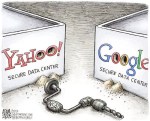
More surveilance whakery. Gotta thank the republicans and democrats for taking away our privacy.
The second image is terrific!
More surveilance whakery. Gotta thank the republicans and democrats for taking away our privacy.
The second image is terrific!
The border agency says that in 2012, only 25 of its 19,000 requests were refused by the telecoms, and only 13 customers were notified that the government had sought their records. Aspects of the handovers seem to happen automatically – with the telecoms typically charging only $1 to $3 for a “BSI” request and the answers usually coming back within three business days.
Every other federal investigative agency says it cannot or will not publicly provide such precise details of their relationships with the telecoms.
…
In this context, the CBSA disclosure is important and unprecedented, say digital privacy experts, who argue that the agency’s numbers suggest many more exchanges are occurring between the telecoms and other government agencies as well.
“It makes me wonder what other structures and costs are in place,” said Christopher Parsons, a researcher at the University of Toronto’s Citizen Lab. He pointed out that the Mounties and Canada’s intelligence agencies failed to release data.
Though CBSA is being pilloried at the moment for the number of times that it accessed telecommunications data (18,849 times in 2012), the agency should be congratulated as comprehensively responding to MP Borg’s questions. Only the Transportation Safety Board provided a comparable degree of accountability to the Parliamentarian. While I’d like CBSA to go further – we shouldn’t depend on a Parliamentarian’s curiosity to learn about state surveillance practices – the agency has, ultimately, created the model that other federal institutions ought to be forced to follow.
Source: Border agency asked for Canadians’ telecom info 18,849 times in one year
…Justice Canada says the proposed legal shield against liability offers nothing new. “This protection already existed under the jurisprudence,” said spokeswoman Carole Saindon in an e-mail responding to Globe questions. She added that the “language in the bill is not a substantive change.”
Privacy advocates are not reassured by any of this.
The “unaccountability is absolutely unacceptable,” blogged Chris Parsons, a researcher for the University of Toronto Citizen Lab on Thursday. “And it’s made worse by the fact that the currently proposed lawful-access legislation, C–13, would indemnify [Internet Service Providers] for sharing even more information with state authorities while not requiring these authorities to report on how often, and to what extent, they ‘request’ such information.”
Needless to say, I fundamentally disagree with Justice Canada’s position that they sufficiently account for federal agencies’ surveillance programs. And if the liability shield that is being introduced in C-13 isn’t needed and the language not a substantive change then the government should be happy to remove it when the lawful access bill goes to committee.
I’ve been busy parsing a nice hefty government document that documents a lot of federal agencies’ surveillance practices the past few days, and my post on “Accountability and Government Surveillance” is the result. It’s admittedly long but is fairly interesting. Go read!
There is a notable distinction between forms of privatization of military and bureaucratic state functions and examples of Internet governance privatization. Whereas the outsourcing of law enforcement functions or bureaucratic tasks normally involves financial compensation to the private entity delegated these functions, a unique feature in Internet governance is the expectation that some private entities, whether information intermediaries, or financial and transactional intermediaries, should be compelled to carry out law enforcement functions traditionally performed by the state without compensation and often with additional expense and possibly even liability exposure.
Laura DeNardis. The Global War for Internet Governance.
The tax refund has become a big part of the income stream for many low-income Canadians. Many tax credits are distributed through the tax system. And it’s the least well-off who are eligible for a lot of those credits.
Low-income Canadians can get their tax returns prepared for free at the many free income tax clinics set up across the country during tax season. But because the clinics can’t give instant refunds, it can be a tough sell to have people wait a couple of weeks to get all their money.
“We try to tell them that they don’t need to pay $40 or $50 to get their taxes prepared, they can get it done here for free,” says Viji Naguleswaran, a community financial worker at St. Christopher House, which caters to lower-income residents in Toronto.
Still, it often comes down to personal circumstances. Are these people willing to give up some of that precious refund to get their hands on money now?
“The issue is cash flow,” says Rick Eagan, community development co-ordinator at St. Christopher House. “When you’re desperate, 15 days can make a big difference.”
Tom McFeat, “Are instant tax refunds worth the cost?”
The report repeatedly emphasizes that the protests had been peaceful, but considers possible triggers for escalation. The sections of the documents that actually deal with what evidence the government had that the protests might have taken a violent turn, and what it would have done if that had happened, were not disclosed.
…
The report repeatedly emphasizes that the protests had been peaceful, but considers possible triggers for escalation. The sections of the documents that actually deal with what evidence the government had that the protests might have taken a violent turn, and what it would have done if that had happened, were not disclosed.
Given CSIS’s ongoing efforts to monitor for threats against national oil interests and other resource extraction companies and associated policies, it’s not necessarily a surprise that the security agency was focusing in on Idle No More. Native land is, after all, required to effectively mobilize resources across Canada.
This said, Canadians generally should be mindful that our security agency was “planning for every eventuality, concerned by the decentralized, leaderless nature of the protests and the multiple motivations and influences that drove them.“ Mindfulness is needed for two reasons: first, because CSIS’s concerns will likely lead to enhanced attempts to map communications patterns to divine ‘leaders’ and ‘centralization’ within activist groupings. Second, because CSIS’s activities are known to include stretching or breaking the law by lying to federal justices. CSIS’s targeting of Aboriginal groups shouldn’t be ignored by other Canadian citizens as not ultimately affecting them as well.
What might be most damaging about CSIS’s actions is how they will (continue to) damage relations between Canada and the Aboriginal people’s. Rather than trying to find a way of working with Canada’s native peoples the Canadian government has again classified them as prospective threats: that’s not how you develop a trusted negotiating relationship, let alone try to heal age-old wounds. And no matter how much surveillance CSIS engages in they can’t guard every mile of roads or pipelines that are used in extracting and transporting Canada’s natural resources.
So, I pointed to some of the issues with Steve Paikin’s comments a few days ago. Recap: he posted to his blog that he had significant problems getting women onto his program, and used some insensitive/poorly considered language in expressing why he thought TVO was facing challenges.
TVO’s put on a show that (more or less) takes Paikin to task. It’s worth a watch, and it reveals both how Paikin views the challenges of booking as well as a set of women who take him to task. More discussions like this need to happen, and at length, in more of our popular media venues.
Talking with Salmon, Goodman said she has an “enormous amount of evidence, including evidence which is not public,” persuading her Dorian Nakamoto is the right guy. “Goodman has not decided whether or how she might publish that evidence… What’s more, she has also made it clear that she was in possession of evidence which other journalists could not obtain,” Salmon wrote.
And that’s a problem, because many aspects of the story already look like a caricature of journalism gone awry. The man Goodman fingered as being worth $400 million or more is just as modest as his house suggests. He’s had a stroke and struggles with other health issues. Unemployed since 2001, he strives to take care of basic needs for himself and his 93-year-old mother, according to a reddit post by his brother Arthur Nakamoto (whom Goodman quoted as calling his brother an “asshole”).
If Goodman has mystery evidence supporting the Dorian Nakamoto theory, it should have been revealed days ago. Otherwise, Newsweek and Goodman are delaying an inevitable comeuppance and doubling down on past mistakes. Nakamoto’s multiple denials on the record have changed the dynamic of the story. Standing by the story, at this point, is an attack on him and his credibility.
Ars Technica has written one of the better critiques of the Newsweek story which (likely incorrectly) identified the man believed to have invented Bitcoin. It’s worth the read, if only to have the current state of debate over Newsweek’s story nicely summarized.
Source: The colossal arrogance of Newsweek’s Bitcoin “scoop”
It is disconcerting to realize that the reassessment of classification policy described by Mr. Litt was not prompted by the diligent exercise of congressional oversight or by judicial review or by ordinary advocacy. Rather it was explicitly inspired by the Snowden leaks, which Mr. Litt described as “criminal.” The upshot is that leaks emerge as a uniquely powerful tool for shaping intelligence classification policy, while conventional checks and balances appear all but irrelevant by comparison.
Moreover, the purpose of the newfound push for greater transparency seems to be instrumental, not principled. In other words, it is driven by tactical considerations, not by statutory requirements or any other objective norm.
“I strongly believe that the best way to prevent the damage that leakers can cause is by increased transparency on our part,” Mr. Litt said. “Transparency can both lessen the incentive for disaffected employees to disclose our activities improperly, and provide the public appropriate context to evaluate leaks when they occur.”
That implies that what is needed is only as much transparency as it takes to achieve these imprecise and transient goals. It is a unilateral move that can be unilaterally reversed.
Steve Aftergood, “ODNI Rethinks Secrecy and Openness in Intelligence”

 Excited Pixels