Categories
Links

Towards Transparency in Canadian Telecommunications – The Citizen Lab

A project that’s been in the works, now, for 1.5 years is finally really starting! Exciting times!

Source: Towards Transparency in Canadian Telecommunications – The Citizen Lab

Categories
Aside

CSE Redactions

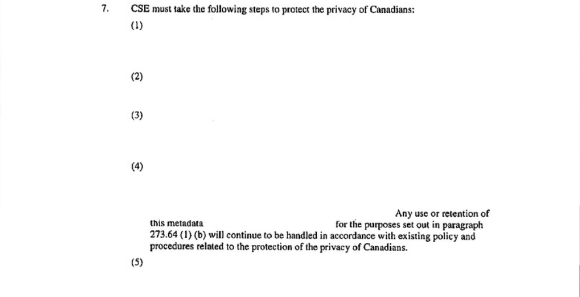
Clearly, Canadians can totally have confidence in CSEC’s steps to protect privacy. As in, there are 5 separate steps to protect Canadians, plus (possibly) other ‘incidental’ steps that are dealt with elsewhere. (Source: 2011 ATIP from CSEC)

Categories
Links Quotations

Supreme Court Hearings – Matthew David Spencer v. Her Majesty the Queen

Case # 34644 Matthew David Spencer v. Her Majesty the Queen (December 9, 2013) At issue is Whether section 8 of the Charter of Rights and Freedoms was violated. The appellant downloaded child pornography from the internet using a peer-to-peer file-sharing software program. The appellant stored child pornography in a shared folder and did not override the default settings that made the folder accessible to others. Since the files were accessible to other users they could therefore be downloaded. A police officer searched the shared folder and discovered the pornographic files. The officer couldn’t identify the owner of the folder but was able to determine that the IP address being used was assigned by Shaw Communications. The police wrote to Shaw and requested information identifying the assignee at the relevant time. Shaw Communications identified the user as the appellant’s sister. The police obtained a warrant and searched her residence, where they seized the appellant’s computer. The appellant was charged with possession of child pornography and making child pornography available.

An interesting case, especially when read against the scholarship that examines the Charter and PIPEDA implications of disclosing subscriber data absent a court order.

Categories
Quotations

2013.12.17

Some have suggested that the [Nova Scotia cyberbullying] law has to be so broad to capture all the harmful conduct and we should leave it to the courts and the cybercops to use their judgement in how it is applied. I’m sorry, but as soon as an employee of the government of Nova Scotia picks up the phone and tells a citizen to remove Charter protected speech from the internet, that crosses the line. That goes waaaaay over the line. Canadians have an absolute right to speak truth to power. Canadians have an obligation to call out politicians on hypocrisy and idiocy. An elected official like Lenore Zann, before publicly admonishing a minor, should educate herself about “copyrwite (sic) law”, fair dealing and the criminal code. (A bit of free advice: Bill C-12 isn’t the law yet and an image taken on a sound stage surrounded by a filming crew for the purpose of international broadcast on cable television likely does not qualify as an intimate image “in respect of which, at the time of the recording, there were circumstances that gave rise to a reasonable expectation of privacy”.)

David Fraser, “Nova Scotia politician alleges cyberbullying, calls the authorities on tweeting teen
Categories
Aside Links

The Oddities of CBC’s Snowden Redactions | Technology, Thoughts & Trinkets

The CBC redacted the Snowden documents concerning NSA surveillance during the G8/G20. While I can agree that some of the redactions were appropriate the majority that were made seem excessive.

Categories
Quotations

2013.11.26

It would appear as though the culture of deceit inside the Tory caucus extends far beyond who knew what and when about secret payments to Mike Duffy. The cyber-bullying bill is largely a cut-and-paste job from legislation that had been rejected by the Canadian public, and which the government had promised never to reintroduce. It limits our freedom and violates our right to privacy. Canadians should not stand for this.

Jesse Kline, “Jesse Kline: Tories bully Canadians into accepting Internet surveillance bill”
Categories
Aside Humour

Nothing to See Here!

David Parkins, The Globe and Mail

Categories
Writing

We Need Clarity on ‘National Security’ Rules for Telecommunications

The story of Blackberry has gripped many technology watchers, watchers who are bearing witness to the trials and tributations of the company as it struggles to compete in the increasingly populated smartphone market. To some, it seemed that one way ‘out’ for Blackberry was for the company to be purchased by another firm looking to aggressively enter this market. Based on recent reporting by the Globe and Mail, however, it looks like any hopes that Blackberry might be purchased could be scuttled for ‘national security’ reasons.

Specifically, Steven Chase and Boyd Erman write that,

Ottawa made it clear in high-level discussions with BlackBerry that it would not approve a Chinese company buying a company deeply tied into Canada’s telecom infrastructure, sources said. The government made its position known over the last one to two months. Because Ottawa made it clear such a transaction would not fly, it never formally received a proposal from BlackBerry that envisioned Lenovo acquiring a stake, sources said.

on Monday the Canadian official took pains to emphasize that concerns about BlackBerry are not part of a trend to shut out Chinese investment. “This is a company that has built its reputation and built its success on system security and its infrastructure. That’s one of the reasons businesses use BlackBerries. … The security is robust and we’d obviously have an interest in making sure we didn’t do anything or allow anything that would compromise Last fall, citing a rarely used national-security protocol, Ottawa has sent a signal to Chinese telecom equipment giant Huawei Technologies that it would block the firm from bidding to build the Canadian government’s latest telecommunications and e-mail network. Huawei, founded by a former People’s Liberation Army member, has on numerous occasions found itself having to reject claims its equipment could be used to enable spying.

In October. 2012, a senior spokesman for Prime Minister Stephen Harper publicly hinted Huawei would be left out the cold. “I’ll leave it to you if you think that Huawei should be a part of [the] Canadian government security system,” Mr. MacDougall said.

I’m particularly mindful of the possible security issues that may be linked to letting foreign-located businesses playing significant roles in Canadian telecommunications networks. But, at the same time, the present Canadian government seems to be applying ‘national security considerations’ in a manner that prevents market analysts and watchers from clearly assessing when such considerations might be applied.

Without clear criteria, what are the conditions under which a non-Canadian company could purchase Blackberry? Could a well-financed American company buy it, based on what we’ve learned about NSA surveillance? Could a company that was known to comply with foreign governments’ lawful interception requirements buy Blackberry, given that such requirements could have a global reach? Could Blackberry be purchased by companies that operate in countries that, if their governments had access to Blackberry communications, could gain an edge in international diplomatic engagements with Canada or its closest international partners?

I don’t dispute that national security may sometimes demand terminating business deals that would violate the national interest. However, given that incredibly large investments are being killed by the federal government of Canada it is imperative that the government make clear what ‘national security’ interests are at play, and the security models that motivate terminating such deals. To date, neither the interests nor models are particularly clear. As a result, analysts are forced to read the outcome of federal decisions without the benefit of understanding the full rationale of what went into them in the first place. The result has been to make it incredibly uncertain whether foreign businesses will be legally permitted to engage in market operations with Canadian companies.

Canadians are all to aware that the current federal government has failed on its promise to provide a digital strategy for the Canadian marketplace. In the absence of such a strategy, perhaps the federal government could at least provide its rules for determining when a business proposal runs counter to national security?

Categories
Links Quotations

Andrew Coyne: Conservatives’ effort to hide from public only gains them more enemies

“…the Conservative tragedy grinds on. When your only principle is paranoia — when your central organizing proposition is that “everyone is out to get us” — when every criticism is merely confirmation of the essential rightness of that proposition, and every deviation is evidence of disloyalty, then you are less a party than a cult.”

Strong words, this time from Andrew Coyne.
Categories
Links

Greater Oversight Required for Canada’s Spy Agencies

This is the kind of introspection and critique that all backbenchers should be able to present to the public. They shouldn’t be forced to leave their party caucus to do so.

Source: Greater Oversight Required for Canada’s Spy Agencies