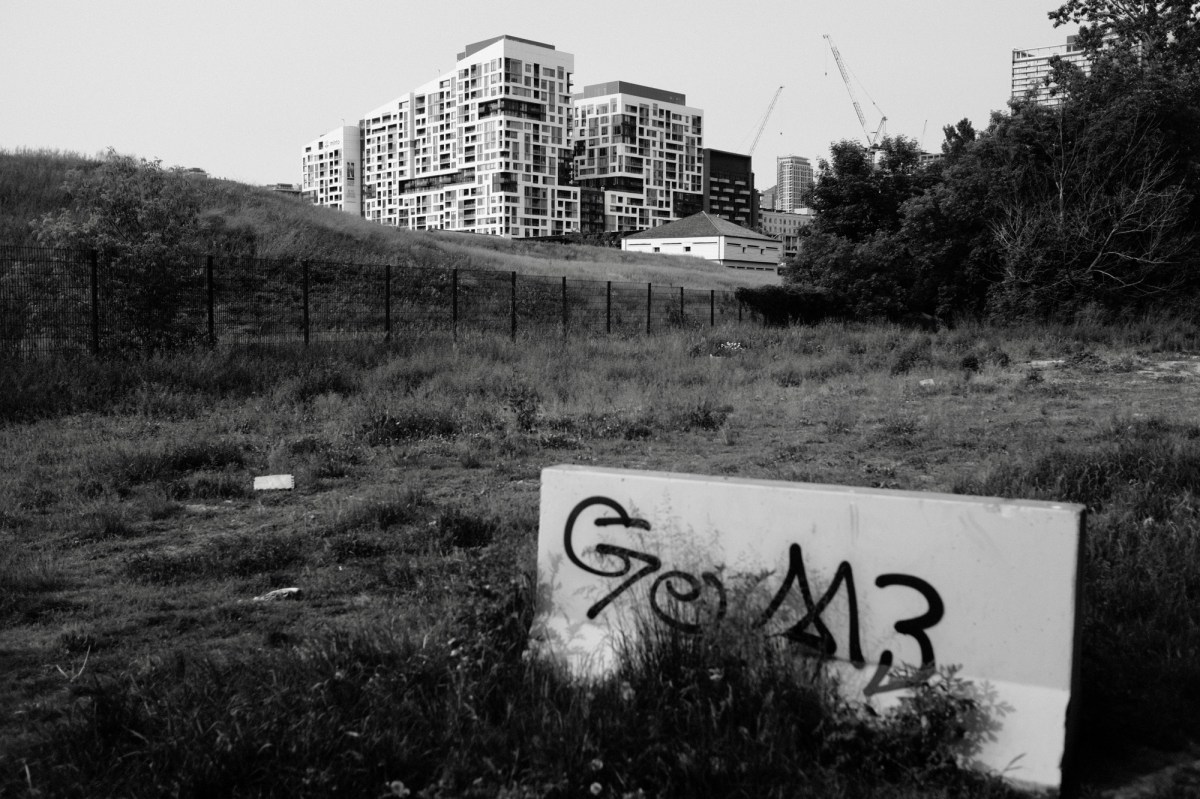
This is one of my 12 preferred landscape/cityscape images from 2023, which I created (but didn’t print) alongside my 2023 Postcard project.
The photograph has a few things happening to my eyes: there’s the wildness in the foreground and a bit of roughness with the graffiti, that then passes into the rustic fortress that defended Toronto over a century ago, and then the new/under construction parts of Toronto. While it formally lacks any humans in the scene it radiates humanity in each gradation of the image, while also communicating a kind of evolution of Toronto’s emergence over time.
I went away on vacation last year to Guelph. It’s an hour or so away from Toronto and also happens to be where I spent a lot of time growing up and where I did some of my university degrees. We tend to visit once or twice a year just to get away from the ‘big’ city and enjoy some of the restaurants, distilleries, breweries, and other features of Guelph. It also provides an opportunity to see friends and family.
I made this image while we went on a long walk out to Guelph Lake; it’s an entirely man-made lake, and there are nice trails that track along rivers that you can take from downtown to get to the lake.
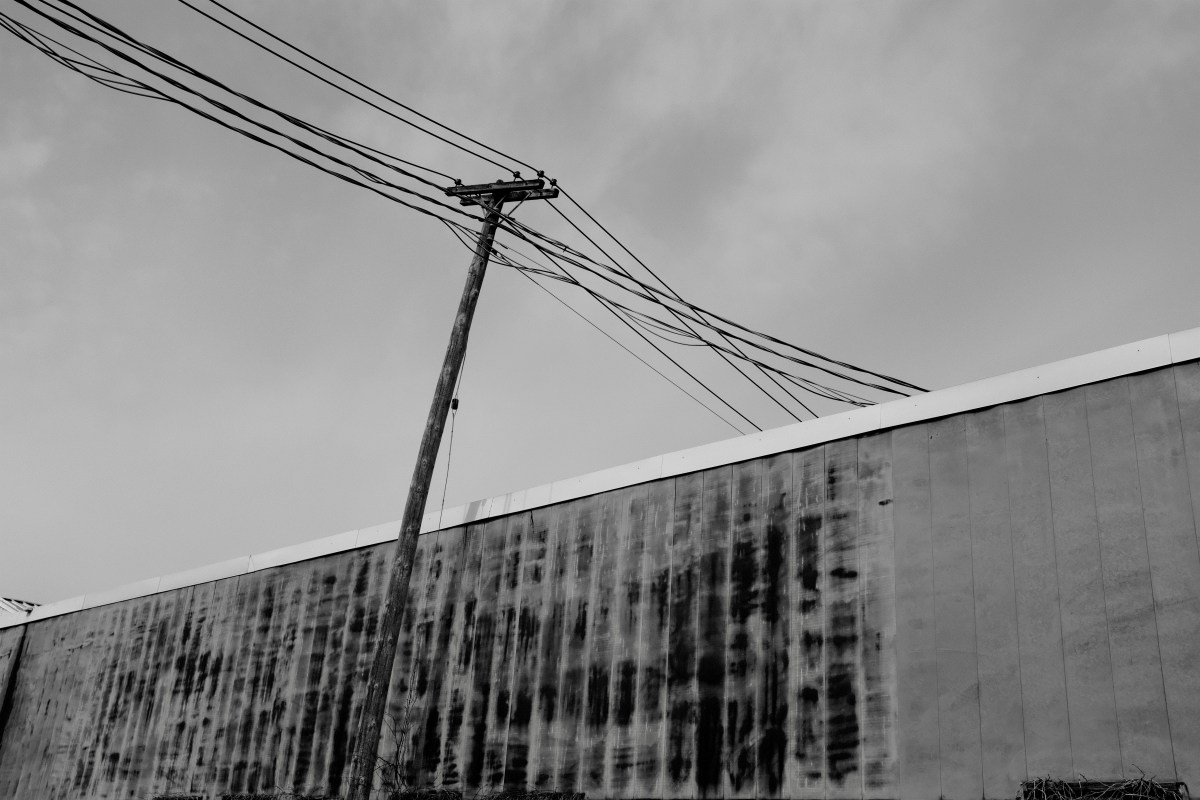
There isn’t anything particularly magical about this image: it doesn’t necessarily speak to a deep history of the city, or anything so substantive. But I liked the texture of the wall that the utility pole was pressed against, and the chaotic way that the utility wires were somewhat tangled together. And it’s for that reason that this was my favourite landscape-type photograph I made in April 2023.
There are lots of ‘best of’ lists that are going around. Instead of outlining the best things that I’ve purchased or used over the year I wanted to add a thematic: what was the best ‘photography stuff’ that I used, read, watched, or subscribed to over the course of 2023?
Photography Stuff I Used
Best Technology of 2023
90-95% of the photographs that I made over the year were with the Fuji X100F. It’s a spectacular camera system; I really like how small, light, and versatile it is. I created a set of recipes early summer and really think that I dialled in how to use them and, also, how to apply my very minimal editing process to the images. I’m at the point with this camera that I can use it without looking at a single dial, and I know the location of every setting in the camera that I regularly use.
I do most of my writing on my well-used iPad Pro 11” (2018). It’s a great device that is enough for 99% of my needs.1However, I have to admit that I’ve long missed owning an iPad Mini because they’re so small and light and portable. I do pretty well all of my reading on the iPad Mini these days. My partner purchased me one this year and I’ve fallen in love with it again. I’m using it everyday for an hour or more, and ultimately I now pull out the iPad Pro 11” just when I need to do longer-form writing.
Finally, though I haven’t had it all that long, I really do enjoy the Leica Q2. I’m still getting used to the 28mm focal length but deeply appreciate how I can now shoot in bad weather and low light.2 The in-camera stabilization is also letting me experiment with novel slow shutter speeds. I remain excited, however, for what it’ll be like to use the camera when I haven’t been in persistent cloud cover!
Best Services I Paid For
I have kept using Glass each and every day. Does it (still) have problems with its AI search? Yes. Does it have the best photographic community I’ve come across? Also yes. You should subscribe if you really love photography and want to contribute to a positive circle of practice. And if you’re watching a lot of photography-related materials on YouTube I cannot recommend a Premium subscription highly enough!
I also am deeply invested in Apple’s services and pay for Apple One. This gives me access to some things that I care about, including a large amount of cloud storage, News, customized email, Apple Music, and Apple TV. I find the current costs to be more than a little offensive–Apple’s decision to raise costs without increasing the benefits of the service was particularly shitty–but I’m deeply invested in Apple’s ecosystem–especially for storing my photographs!–and so will continue to pay Apple’s service tax.
Best Apps
I use lots of apps but the best ones I rely on for photography include:
Podcasts App to listen to the different podcasts to which I’ve subscribed.
Reeder for staying on top of the different blogs/websites I’m interested in reading.
Glass to look at, comment on, and reflect on photographers’ images.
Geotags Photos Pro and Geotags Photo Tagger. I’ve set the former app to record my geolocation every 5 minutes when I’m out making images and the latter to then apply geotags to the photographs I keep from an outing.3
Stuff I Read
Best Photography Books
Most of the non-fiction books that I read throughout the year were focused around photography. The two best books which continue to stand out are:
Bystander: A History of Street Photography. This book does an amazing job explaining how (and why) street photography has developed over the past 150 years. I cannot express what a terrific resource this is for someone who wants to understand what street photography can be and has been.
Daido Moriyama: A Retrospective. This book is important for all photographers who are interested in monochromatic images because it really explains why, and how, Moriyama made his classic images. It reveals why he made his gritty black and white images and, also, why some of the equivalent ‘recipes’ the mimic this kind of image-making may run counter to his whole philosophy of image making.
I watch a lot of photography YouTube. The channels I learn the most from include those run by James Popsys, Tatiana Hopper, EYExplore, Alan Schaller, Pauline B, aows, Aperture, and Framelines. My preference is for channels that either provide POV or discuss the rationales for why and how different images are being (or have been) made.4
Stuff I Subscribed To
Best Podcasts
I tend to listen to photography podcasts on the weekend when I go out for my weekly photowalks. The two that I listen to each and every week are The Photowalk and The Extra Mile. It’s gotten to the point that it almost feels like Neale James (the host of the podcasts) is walking along with me while I’m rambling around taking photos.
Aside from those, I’ll often listen to A Small Voice or The Candid Frame. These are interviews with photographers and I regularly learn something new or novel from each of the interviews.
Best Blogs/RSS Feeds
For the past year I’ve trimmed and managed the number of my RSS feeds. I keep loving the work by Craig Mod, Little Big Traveling Camera,5 and Adrianna Tan’. They all do just amazing photoessays and I learn a tremendous amount from each of them in their posts.
Biggest Disappointments
I somehow managed to break the hood that I’d had attached to my Fuji X100F in the fall and decided to get what seemed like a cool square hood to replace it. It was a really, really bad idea: the hood was a pain to screw on so that it wasn’t misaligned and, once it was aligned, was on so tight that it was very hard to remove. I would avoid this particular hood like the plague.
I also bought a Ricoh GR IIIx and while it’s a fantastic camera I just haven’t used it that much. I didn’t take as many images with it as I’d hoped when I was walking to or from work, and really ended up just using it when I needed to go out and take photos in the rain (I kept it safely hidden under my umbrella). Also, the camera periodically just fails to start up and requires me to pull the battery to reset it. Is it a bad camera? Nope, not at all, and I did manage to capture some images I was happy with enough to submit to Ricoh’s photography contest. But it’s not a camera that I’ve really fallen in love with.
Finally, while I use my AirPods Pro all the time I really don’t like them because I cannot get them to stay in my ears unless I purchase third-party foam tips. And I need to keep purchasing new sets of tips because they wear out after a couple of months. Are they good headphones once they stay in my ears? Yes. But the only way to accomplish that is becoming increasingly costly and that’s frustrating.
Conclusion
Anyhow, that’s my list of the ‘best photography-related stuff’ I’ve used in the course of 2023. What was your top stuff of the year?
I really do want to get a new iPad 11” and will do so once they update the screen. I edit pretty well all of my photos on the iPad Pro and an updated screen (and battery…) would be lovely. ↩︎
There is a caveat that I’ve found: the electronic shutter is absolute garbage for shooting at dusk/in the dark with LED lights. And I think the single-use exposure dial on the Fuji X100F is preferable to the configurable dial on the Q2. ↩︎
You can set the app to record your location more regularly but I’ve found this to be a good balance between getting geolocation information and preserving my phone’s battery life. ↩︎
If you watch a lot of YouTube then I recommend that you pay for a YouTube Premium subscription. You’ll cut out the frustrating advertising that otherwise intrudes into the videos. ↩︎
I think that this is perhaps the single best photography blog that I’ve found. I aspire to this level of excellence and regularity of updates! ↩︎
I’ve owned a Leica Q2 for a little over a month so far. I haven’t really used it enough to say what I truly like (or dislike) about it, aside from moving from an APC-C sensor to a full frame sensor has been a fantastic upgrade in the lighting conditions in which I’ve been shooting.
The last day I had actual, honest to god, direct sunlight was on November 19, 2023. Every other day I’ve been out has been cloudy, rainy, or just grey. The larger sensor has meant that I’m reliably able to shoot at 1/500 and at an ISO under 3200. That would have been entirely impossible where I shoot with either my Fuji X100F or the Ricoh GR IIIx.
I’ve been shooting with a Fuji X100F for three years now, having gotten a used one for $800 CAD just prior to the start of the COVID-19 pandemic. Since purchasing it I’ve shot well north of 100,000 photos, and retained approximately 12,000 after culling.
In mid-October 2021 I built or adapted a recipe for monochrome images. In mid-2022 I found a ‘Leica-like’ colour recipe which I’ve kept in camera, though not used all that often. During my ownership of the camera I’ve made a lot of other recipes and just not really used them.
I’m back in isolation for the second time in 6-7 months and so took the time this weekend to update my Custom profiles. I know that others find these kinds of profiles/recipes helpful and so I thought I’d post them for others who are interested. In the case of Custom One and Custom Four I include a small selection of images that were made with the respective recipes.
Global Note
Ages ago I set my White Balance to Auto (R 2, B -2). My preference would be to have the white balance associated with each Custom mode but that’s only possible with the X100V, so I just have set this and left it.
Generally, I wanted to make sure that Custom One was the most commonly used recipe that I used. Previously, this was set to Customer Five which was fine (I had muscle memory on flipping back to it in the menu) but added more work than should have existed. I then tried to batch the ‘key’ monochrome and colour profiles together; Custom Seven is a default Acros but I don’t really expect to dig that deep into my Custom Recipes to get to it all that often.
Also, for the past year or so I’ve kept a Moment Cinebloom 10% on the lens, which gives images a slightly softer image and blooms light.
I have shot a lot of images with this recipe, probably to the tune of retaining about 8,000 frames over a year and a half. Generally, I find that in hard lighting (with strong shadows and bright highlights) that it benefits from dialling the exposure down by -⅔ to -1.0. In brighter light, however, I find that it works best to dial up exposure by at least ⅓ and often ⅔.
DR: 200
Film Simulation: Black and White
Grain Effect: Weak
While Balance: Auto
Highlight Tone: 2
Shadow Tone: 2
Colour: 0
Sharpness: -1
Noise Reduction: 0
Shocking LightWinter FlightToronto, 2023Toronto, 2023Toronto, 2023Queen & Bay, Toronto, 2023Toronto, 2023Royal York Hotel, Toronto, 2023
I do find that with this profile I sometimes use the Brush in Snapseed to either Dodge & Burn or increase exposure on faces when they’re hidden in shadows.
Custom Two—“Ilford HP5 Plus”
This is the recipe from Fuji X Weekly. I haven’t shot with it as of yet, but am curious to see how it looks as compared to my ‘normal’ (Custom One) monochrome recipe. Based on the settings it should naturally have a stronger contrast than comes normally with Custom One.
DR: 200
Film Simulation: Acros
Grain Effect: Strong
While Balance: Auto
Highlight Tone: 4
Shadow Tone: 2
Colour: 0
Sharpness: 0
Noise Reduction: -3
Exposure Compensation: 0 (Normally)
Custom Three—“Astia Kodak Ektar 100”
Another recipe from Fuji X Weekly! I like this as it’s punchy but somewhat soft in its nature. I’m going to be a bit curious to see how this looks with my Moment Cinebloom 10% Filter.
DR: DR-Auto
Film: Astia
Grain: None
White Balance: Auto
Highlight Tone: 1
Shadow Tone: 3
Colour: 4
Sharpness: 1
Noise Reduction: -3
Exposure Compensation: 0 to ⅓ (typically)
Note: while the recipe calls for 3 Red and -2 Blue, my white balance is set to 2 Red and -2 Blue.
Custom Four—“Leica Colour”
I have no idea where precisely this came from but it’s been the only colour profile I’ve used for the past year or so. I really like how saturated and bright it is, but really have no idea how much what comes through is really ‘Leica-like’. This was just the description provided by wherever I copied the recipe.
DR: 200
Film: Standard
Grain: None
White Balance: Auto
Highlight Tone: 1
Shadow Tone: 1
Colour: 3
Sharpness: 1
Noise Reduction: 0
Custom Five—“Punchy Classic Chrome”
I have a love of Classic Chrome, and added this to make it a little more saturated than typical. I also wanted to see about adding more dramatic contrast between highlights and shadows, which is something I often tried to do in post when I first shot Classic Chrome a few years ago.
DR: 200
Film: Classic Chrome
Grain: None
White Balance: Auto
Highlight tone: 2
Shadow Tone: 2
Colour: 1
Sharpness: 1
Noise Reduction: 0
Custom Six—“Punchy Pro High-Neg”
I…haven’t really ever taken a photo with Pro High-Neg before. So I don’t quite know how this recipe will play out or even how much I might use it.
DR: Auto
Film: Pro High-Neg
Grain: Weak
WB: Auto
Highlight: 1
Shadow: 1
Colour: 1
Sharpness: -1
Noise Reduction: 0
Custom Seven—“Acros Bland”
This is a pure Acros recipe with no changes. I just want it present to be able to quickly flip to it and try it out at some point.
DR: 200
Film: Acros
Grain: Off (Acros increases grain normally as you exceed 800 ISO)
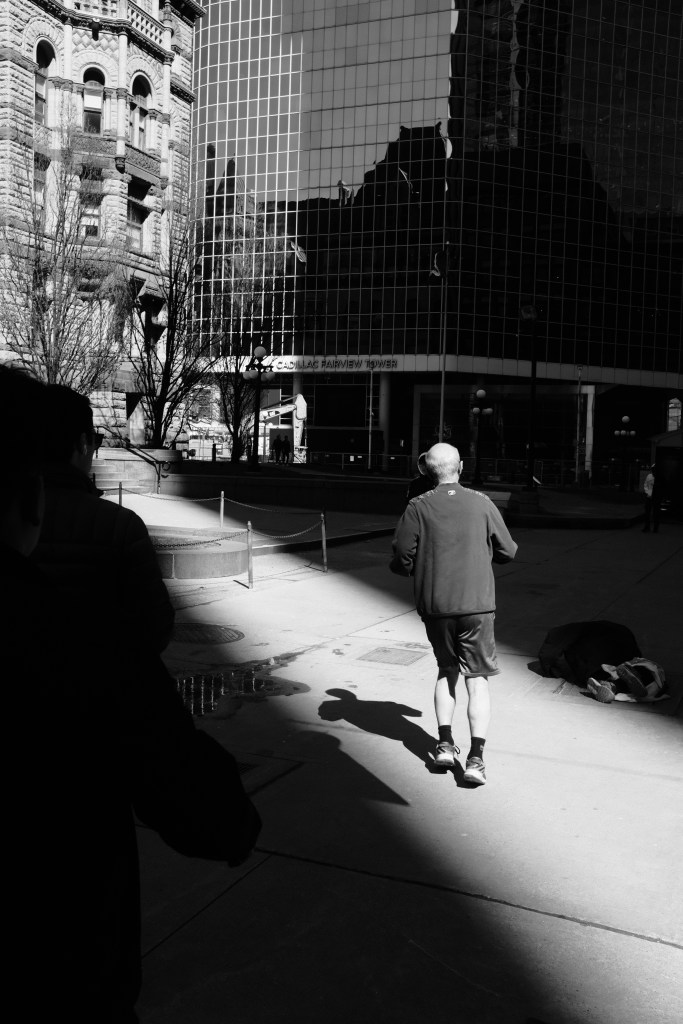
I made this image while out on my weekend photowalk. I’ve passed this same location hundreds of time since I’ve lived in Toronto. In what might become a semi-regular type of post, I wanted to write a bit about the backstory of the image. It was originally posted to Glass.
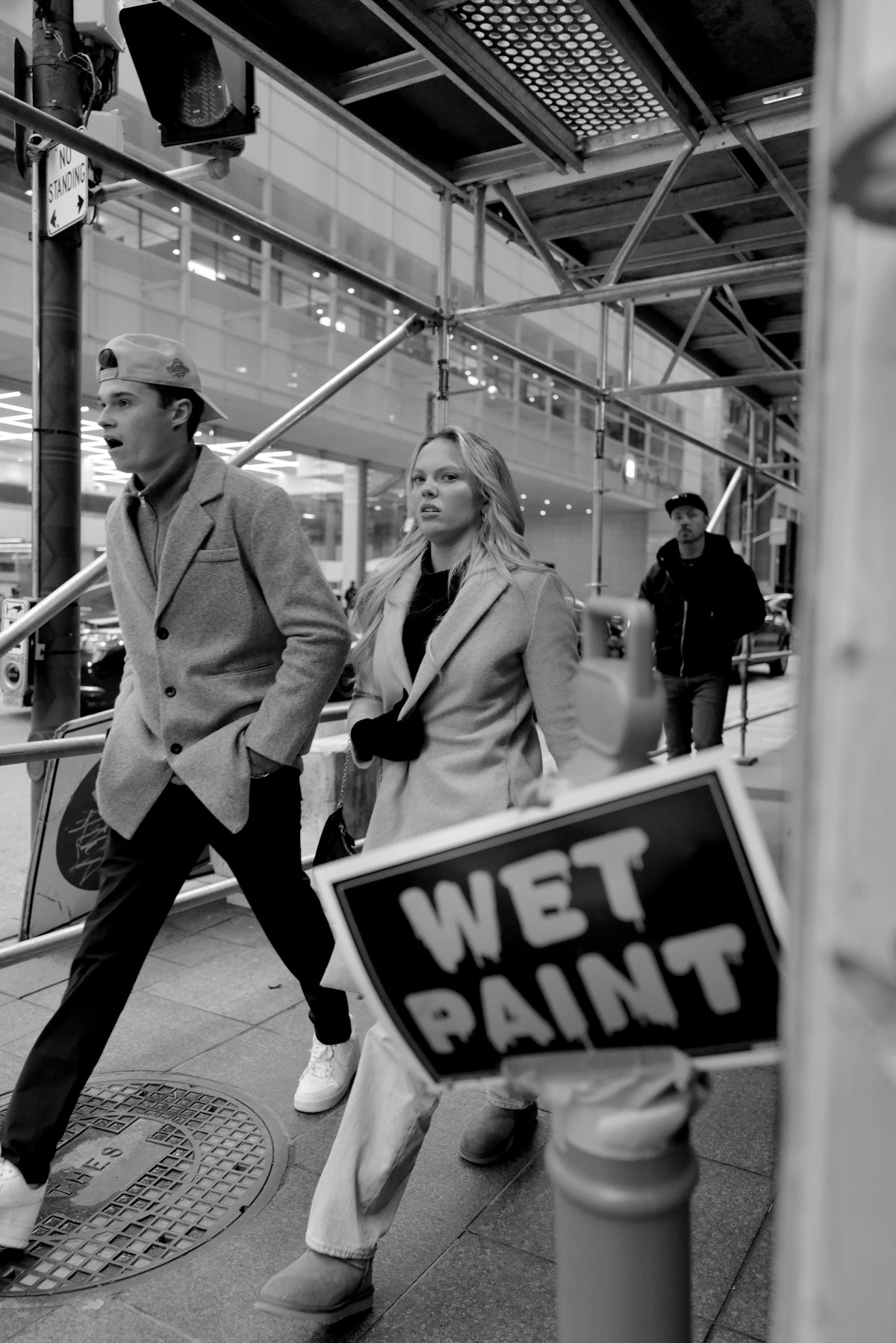
I was drawn to this scene, first, just because of how the light managed to slice through the shadows which were cast by the surrounding skyscrapers. After dialling the exposure to -1.3 I waited for some interesting characters to pass through the light.
It was only after taking a couple images that I really noticed how the unhoused person’s feet and legs were apparent. They were on grates that pass steam in the colder times of the year. Some of the unhoused use these grates to stay warm during the winter.
Still, the city—and especially the city core—does have a serious and growing housing issue. And so I ultimately decided to compose the scene with the hopes that it would show people noticing, but passing by, the individual on the street, as a kind of broader commentary of the social housing issues that exist in Toronto.
Compositionally the image is simple: a pair of men looking in the direction of the source of the light, and not towards the half shrouded person on the sidewalk, and moving towards the light. Behind them the aperture of the light beam starts to close, but the reader of the photograph can see the sparkle of youth (the new, glass, building) as juxtaposed agains the old (Toronto’s historical city hall). The young reflects the old, reminding us that youth is impermanent. As I said: it’s not a deep photograph nor are any particularly special tricks used to make it.
I often linger when I find light that I like for at least a couple minutes, to see if more interesting (or any interesting!) subjects come to fill the scene. Other times I’ll recompose and work the scene a little bit. But I have to admit that staying put is something that I need to get better with: it’s not enough to just linger for 5-10 minutes!
The above set of images aren’t touched up and are a few of the ‘raw’ versions of images I took and normally wouldn’t post (I took a total of about 20 frames before I settled on the one at the top of the post). I, personally, learn a lot from the older Magnum photos that include contact sheets.
While my rougher images aren’t the same, nor as descriptive, as contact sheets maybe they’ll be helpful to someone else when they are thinking of weighing a scene. Or maybe just to make clear that the admittedly very amateur images I make involve a lot more than just one lucky capture (with a handful of exceptions of course).
We got our first snow of the year on Sunday. I kept waiting for it to come and as soon as the snow started to fall I grabbed my Fuji X100F with a Cinebloom 10% attached and headed out to make some images.
I live in a densely populated section of Toronto. Notwithstanding the snow there were many people out and about when I first hit the streets. But it was as I moved to side streets, or into parts of the city that tend to be populated by tourists, that it was apparent that huge chunks of the city were largely depopulated as people decided to stay inside where it was warm and dry.
There were, of course, some people out even in the less populated parts of the city. They, however, tended to be trying to get out of the snow—which functionally turned into snow that was almost indistinguishable from rain towards the early evening—and generally wanted to just avoid getting wet or cold.
Somewhat surprisingly I saw almost no other photographers out and about. I’m sure they were there, somewhere. But, at the same time, I wonder how much the weather dissuaded them from getting out and shooting the streets or urban landscapes.
I will never be accused of babying my cameras. My Fuji X100F lacks the weatherproofing of the newest version and, so, when I’m out in the snow I tend to protectively place one hand over it’s screen and eyepiece, and keep the lens pointed downwards and slightly in towards my body. It doesn’t prevent all the precipitation from getting onto the camera but, along with brushing off water when it starts to gather on dials and such, has always seemed good enough to keep the equipment safe.
The mix of heavy coats and umbrellas is something that I’m always curious about, if only because I can’t recall ever seeing something similar while I was growing up or when I visit parts of the country (or world) that receive large volumes of snow. I don’t dispute the potential utility of an umbrella—it will, obviously, help to keep your head wet and my uncovered head certainly got soaked after 3-4 hours outside—but it always seems like an instrument that is out of place. Though they look very distinct in the snow and so I definitely took the chance to make images of people who were carrying them!
Though there were people out and about, and evidence in other cases of someone having been present recently, much of the city felt oddly solitary. When I make my photos I’m often trying to communicate a sense of, on the one hand, the press of other people around and upon us and, on the other, the loneliness or isolation experienced while being in these massive urban environments. Dismal weather almost always draws me to the latter and wanting to express how large our environments are and what they look like with few figures or, alternately, in the absence of humans entirely. What will the city look like when the humans are gone?
When I watched one of James Popsys’ videos recently he mentioned that, when taking his landscapes, he likes putting either a human or a human-made thing in his images. Doing so has the effect of communicating human presence and, often, what the natural environment looks in our absence. Human-made things, also, have the effect of drawing us into an image on the basis that we ‘see’ something of ourselves in the otherwise natural environment.
In an almost modernist way of thinking those solitary human-things have the effect of both showing the attempt to overcome, or start overcoming, nature while often simultaneously showcasing the majesty and longevity of nature against the transitory existence of human-made things. Or at least that’s how I see and study such images.
I don’t know how well I really captured ‘nature’ in my walk—save towards the very end of my walk—but Popsys’ words have resonated in my head for some time. For years when I’ve made images of the city it’s often been with a view that the humans are transitory; they move though the frame, they enter and exit the city, they live and die. The built infrastructure and the protected landscapes interspersed throughout the city, however, will (should?) persist for a far longer period of time. Yes, Toronto is a city undergoing profound construction but looking through historical photos of the city reveal that key things have remained for a century or more in spite of the changes.
Of course that isn’t to say that the old has stayed perfectly the same; the bridge I took the below image from is literally a bridge to nowhere that was disconnected from the surrounding roads in 1964. While there were plans to remove it, apparently it’s more affordable to do minimal maintenance on it than tear it down; it’s only a matter of time, though, until this economic calculus changes. The city keeps putting up fences and warnings to keep people off the bridge but there’s only been once in the past decade where the fences were intact and I was prevented from getting onto the bridge. In the summer you can regularly discover some pretty cool graffiti along its struts.
The bridge sits over the Don River and, looking south, you have a view of a highway that our municipal and provincial governments continue to pour money into, as well as industrial lands which have been in declining operation for a long time. While the specific buildings will almost certainly change—most likely to be replaced by condos—the character of the landscape should remain the same for decades insofar as the highway and walking path should persist. Though it may be that a similar image will only be accessible to those flying small drones when the economic calculus for maintaining the bridge changes.
I’ve spent a lot of personal time behind my cameras throughout 2021 and have taken a bunch of shots that I really like. At the same time, I’ve invested a lot of personal time learning more about the history of photography and how to accomplish things with my cameras. Below, in no particular order, is a list of the ways I worked to improve my photography in 2021.
Fuji Recipes
I started looking at different ‘recipes’ that I could use for my Fuji x100f, starting with those at Fuji X Weekly and some YouTube channels. I’ve since started playing around with my own black and white recipes to get a better sense of what works for making my own images. The goal in all of this is to create jpgs that are ‘done’ in body and require an absolute minimum amount of adjustment. It’s very much a work in progress, but I’ve gotten to the point that most of my photos only receive minor crops, as opposed to extensive edits in Darkroom.
Comfort in Street Photography
The first real memory I have of ‘doing’ street photography was being confronted by a bus driver after I took his photo. I was scared off of taking pictures of other people for years as a result.
Over the past year, however, I’ve gotten more comfortable by watching a lot of POV-style YouTube videos of how other street photographers go about making their images. I don’t have anyone else to go an shoot with, and learn from, so these videos have been essential to my learning process. In particular, I’ve learned a lot from watching and listening to Faizal Westcott, the folks over at Framelines, Joe Allan, Mattias Burling, and Samuel Lintaro Hopf.
Moreover, just seeing the photos that other photographers are making and how they move in the street has helped to validate that what I’m doing, when I go out, definitely fits within the broader genre of street photography.
Histories of Photography
In the latter three months of 2021 I spent an enormous amount of time watching videos from the Art of Photography, Tatiana Hopper, and a bit from Sean Tucker. The result is that I’m developing a better sense of what you can do with a camera as well as why certain images are iconic or meaningful.
Pocket Camera Investment
I really love my Fuji X100F and always have my iPhone 12 Pro in my pocket. Both are terrific cameras. However, I wanted something that was smaller than the Fuji and more tactile than the iPhone, and which I could always have in a jacket pocket.
To that end, in late 2021 I purchase a very lightly used Ricoh GR. While I haven’t used it enough to offer a full review of it I have taken a lot of photos with it that I really, really like. More than anything else I’m taking more photos since buying it because I always have a good, very tactile, camera with me wherever I go.
Getting Off Instagram
I’m not a particularly big fan of Instagram these days given Facebook’s unwillingness or inability to moderate its platform, as well as Instagram’s constant addition of advertisements and short video clips. So since October 2021 I’ve been posting my photos almost exclusively to Glass and (admittedly to a lesser extent) to this website.
Not only is the interface for posting to Glass a lot better than the one for Instagram (and Flickr, as well), the comments I get on my photos on Glass are better than anywhere else I’ve ever posted my images. Admittedly Glass still has some growing pains but I’m excited to see how it develops in the coming year.




 Excited Pixels