Categories
Aside Writing

2020.4.8

I really appreciate and respect the journalists who are trying to explain to their audiences why location tracking isn’t a panacea to Covid–19. But holy hell is it ever tiring to schedule multiple interviews a day to walk each of them—and their audiences—through the efficacy and human rights issues linked with such surveillance.

Mobile device tracking only starts being a real possibility when absolutely massive testing is possible, especially when up to 50% of asymptotic persons can spread the disease without knowing they are infected. And even then there are strong indications—such as from Korea—that a multifaceted approach is required that needs to be pre-planned and -coordinated before an outbreak.

Diverting telecommunications engineers, now, from better securing networks or bringing networking capacity online towards developing surveillance systems of limited effectiveness is about the worst idea that could be promoted right now. Unless, as a society, we really want to develop superior surveillance systems that will certainly be repurposed by law enforcement and security agencies, that is.

Categories
Links Photography Roundup Writing

The Roundup for March 24-30, 2018 Edition

From the Deep by Christopher Parsons

This has been a particularly grey week — the weather has been mostly overcast and slightly rainy — and it’s had all the hallmark effects on my mood and attitude as it did when I lived on the west coast of Canada. With hindsight, I can see that some of the depressive funks I fell into while doing my PhD were the result of the weather, combined with diet and work/life imbalance. And when I was on the west coast, I discovered that getting in some significant amount of walking each day was what it took to fight through those funks.

Cue this week, and the solution has been getting into an exercise room and just doing work I didn’t really want to do, but which I intellectually knew would improve my perspective on life as soon as I was done my circuit. Unsurprisingly, each day that I dragged myself to exercise helped to improve my next day. In the UK, this has been taken a step further, and persons who are experiencing seasonal affective disorder, anti-social behaviour, or other mental health challenges are being prescribed exercise, socialization, and related activities that are meant to naturally modify the chemistry of their bodies and brains. No pills or drugs required.

It strikes me that such prescriptions could have a range of positive outcomes. First and foremost, for those who ‘fill’ the scripts, they might derive relief from the symptoms affecting them. That’s a clear win. But, second, it would have the effect of pushing people who might avoid certain kinds of physical activity to be there, with others, and realize that the portrayals of ‘fit’ or ‘active’ people in the movies and television tend to be drastically out of step with reality. I know that in my own case, I had this idealized idea of what people looked like when they exercised, how hard they worked, and so forth. But by going and exercising I’ve improved upon my own sense of my body by, first, doing some exercise but, second, seeing that the persons who are exercising look an awful lot like me.

In other words, developing a pretty regular exercise routine has had the dual effect of improving my mental health by just pushing my body, as well as improving my sense of bodily self-worth by destigmatizing my (pretty normal) body. I imagine that were more and more people gently pushed to get into workout rooms, running groups, or other socialized exercise spaced they, too, would experience that similarly destigmatizing experience.


New Apps and Great App Updates from this Week

Great Photography Shots

Unsurprisingly, I was crazy impressed by several of the images which were submitted to, and won at, the 2018 Sony World Photography Awards.

‘An unexpected meeting’ © Justyna Zdunczyk, Poland, Winner, Open Wildlife and Winner, Poland National Award, 2018 Sony World Photography Awards. I was about to leave the Sequoia National Park when from the corner of my eye I saw a beautiful clearing bathed in A fog. Without thinking too much, I ran with the camera to take some pictures. When I reached the clearing, I heard the crack of broken twigs and I can’t say, that I was not afraid since Sequoia National Park is a home for black bears and people are warned about it at every step. When I turned around, fortunately, there was not any bear, instead, I saw a curious mule deer walking towards me who cheerfully chewed his supper. Soon after other deer joined him and we just stood there together for a while and watched each other. It was one of the most beautiful moments during my trip thru California, this autumn.
‘Early autumn’ © Veselin Atanasov, Winner, Open Landscape & Nature and Winner, Bulgaria National Award, 2018 Sony World Photography Awards. The autumn has begun to decorate with its colors the woods of the Balkans. National Park – Central Balkan, Bulgaria.
‘The man and the mysterious tower’ © Andreas Pohl, Germany, Winner, Open, Architecture (Open competition), 2018 Sony World Photography Awards. Vertical wind tunnel built in the years 1934 to 1936 for aeronautical studies in Berlin-Adlershof. The photo was taken on 9th January 2017 at 4:26 pm when the dusk already set in. I took the photo because I had it in mind for more than 2 years without a chance…cause there is not much snow in Berlin.
‘Hayder museum’ © Abdulla AL-Mushaifri, Winner, Qatar National Award, 2018 Sony World Photography Awards. Hayder Cultural Center, Baku Azerbaijan
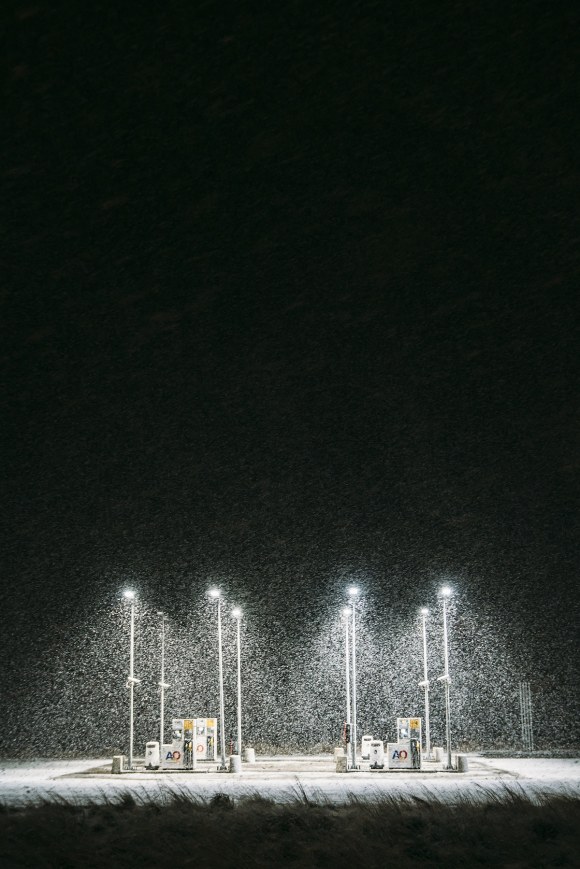
‘Gas Station’ © Chul-Ui Song, Winner, South Korea National Award, 2018 Sony World Photography Awards.

Music I’m Digging

Neat Podcast Episodes

Good Reads for the Week

Cool Things

Categories
Links Photography Roundup Writing

The Roundup for January 27-February 2, 2018 Edition

Sunset, 2018, Toronto by Christopher Parsons

I’ve been putting a lot of thought into how to structure my life, not just on a day to day basis, but with the intent of accomplishing something meaningful this year. Some of that relates to personal projects I want to pull off.1 But perhaps the most important thing I want to do this year is develop a really boring habit.

Mike Vardy wrote about his intent improve his personal fitness this year. His description of past attempts to become fit and how that differs from his current behaviours resonated with me. He wrote:

When I was trying to achieve a “body for life” before, I was single and doing it mainly to improve my physique for any potential ladies that I may wind up dating. I wasn’t really doing it for myself.

In contrast, this time he’s doing:

it for myself — and my family. My wife deserves to have a husband who’s in decent shape, and my kids deserve to have a father who can keep up with them. When my youngest turns thirteen, I’ll be fifty. I want to be able to roughhouse with him at that age and not feel it for weeks afterward. I’d also like to give myself the best shot at seeing my kids’ grandkids. Without exercise and proper diet, that just ain’t going to happen

In the past I tried to become more fit by taking it to the extreme. I also felt I had to hide what I was doing to avoid recriminations from family and people I lived with. I exercised when no one was around, or up, and hid the fact I was going on long challenging walks to avoid all kinds of hurtful commentary: getting fit was something that people were bemused about, at best, and openly mocked, at worst. I don’t have that kind of negative energy around me now and, instead, I have the support of people I love.2

I don’t know that my motives are quite the same as Mike: I’m not a father, and don’t intend to become one, nor am I doing this because I think someone else deserves my body in one format or another. No, I’m doing this purely because I would like to be in a situation where I can just say ‘sure, let’s climb that mountain’ and get going. I want to be able to hop on a bike and cycle across one of Canada’s smaller provinces because it would be neat to take that ride. And, more importantly, I want to get in the habit that regular active exercise is just so routine that it’s a normal, established, and boring part of my life.


Tim Cook was asked in the Apple earning call that took place in February about the company had considered whether, and if so how, their battery replacement program might affect replacement rates. The implied comment was the replacements might reduce the likelihood that consumers would upgrade to the new versions of devices, on grounds that some upgrades had historically taken place because people bought new phones as a result of their old ones slowing down or their batteries not providing adequate charge to get through a day. Cook responded that Apple:

did not consider in any way, shape, or form what it would do to upgrade rates. We did it because we thought it was the right thing to do for our customers. I don’t know what effect it will have for our customers. It was not in our thought process of deciding to do what we’ve done.

This is a great answer. Though I do suspect that the battery replacement program will delay some upgrades, I don’t know that such a delay would be inherently bad for the company. Jason Snell wrote that the iPhone 8 — not the X — was a really amazing phone for most people because they tended to be coming from devices that were release two or more years ago. As a result, people that were coming from iPhone 6, 6s, and 5s devices didn’t just get the updates of the iPhone 8 but also all the updates that came to the iPhone 7 and, in some cases, iPhone 6s.

In effect, people who waited three or more years to update ended up being wowed by all of the features in the new iPhone. These are everyday users who really do use words like ‘magic’ and literally utter ‘wow’ when things happen. They laugh with joy when Siri just does something right, or they have calendar items automatically added from their mail. These are the everyday consumers that Apple is making its money from.

These normal users are the ones that are going to be blown away whenever they do an upgrade, and are going to be especially appreciative of all the incremental updates that take place in the extra year they might delay an upgrade. They’re going to talk to their friends and family and co-workers. They might also talk about how the battery situation sucked while, simultaneously, mentioning how no other company offers a similar replacement program. Probably the only equivalent they’ll be able to think of was Samsung’s global recall of devices that were literally exploding in people’s hands.


Quotation of the Week

“By retreating into ourselves, it looks as if we are the enemies of others, but our solitary moments are in reality a homage to the richness of social existence. Unless we’ve had time alone, we can’t be who we would like to be around our fellow humans. We won’t have original opinions. We won’t have lively and authentic perspectives. We’ll be – in the wrong way – a bit like everyone else.”

Great Photography Shots

The best 40 photographs of 2017 which was compiled by My Modern Met is pretty stunning.

There She Waits on Her Throne of Ice by Kory Zuccarelli
Untitled by Nigel Hodson
California Summer Weekend Babe! by Niaz Uddin

Music I’m Digging

Good Reads for the Week

Cool Things

  1. I’ll update as I’m successful on those projects, instead of indicating what they are then failing to deliver.
  2. It also helps that my father died of a heart attack last year; getting fit isn’t just aimless or directionless, but it’s to reduce the likelihood of a similar event befalling me.
Categories
Roundup Writing

The Roundup for December 2-8, 2017 Edition

It feels like everyone I know has led a more stressful life this year. Beyond the chaos wrought on the global psyche by the American president, there have also been more deaths, serious illnesses, job losses, and emotional meltdowns than normal. In my own case, the death of two parents and ongoing revelations of sexual assaults and abuses near to my life have been incredibly challenging issues to deal with.

So it was with great interest that I read a piece by Ankita Rao on how she has turned dealing with her personal stress into a kind of science experiment. The tests and activities she points to reveal the number of factors in our lives that amplify underlying stress levels as well as the means we can use to reduce stress in our personal lives. I’ve made a commitment since mid-2017 to actively, and assertively, maintain a particular work-life balance. That involves taking on consulting clients only when the monetary outcome is necessary to address particular fiscal stresses (see: student loans) and ensuring that I actually spend time working out, taking photowalks, and letting myself engage in non-productive play.

I haven’t always been successful. But on the whole I’m exercising a lot more, have taken photos I’m incredibly happy with, and am overcoming a longstanding guilt that playing games is somehow undermining my productivity. I have a long ways to go to ensure the balance I’m trying to achieve is a permanent feature of my life but I feel like habits are starting to settle in, and my overall stress levels declining as a result.


Just prior to Netflix’s release of The Punisher some critics argued that the show had an opportunity to — and failed to — respond to the tragedy of gun violence in the United States. I haven’t quite finished the series but I tend to agree that the show is definitely not directly addressing that issue.

But the show isn’t about gun violence. It’s about what losing family means and drives a someone (read: white males) to do. It’s about the problems linked to how soldiers of all stripes are asked to endure physical and mental hardships and then return home without society acknowledging their sacrifices or providing support for their wounds. Or about how even when support is provided that there is no guarantee that those broken humans will ever be whole again. The show is about how fraught relationships become when we are separated from those we relate to, either by distance, by death, or by betrayal. Throughout the episodes I’ve watched a repeated motif, which does pertain to gun violence, is how firearms can prompt the aforementioned hardships, either by killing in the name of one’s country or in the name of one’s personal ideology or simply by accident when weapons are nearby.


I entered the workforce ‘late’ in terms of my ability to save for retirement. Since I went to school until my early 30s, and lived paycheque to paycheque to try and stay afloat, and have loan obligations, it’s not going to be until my late 30s or early 40s when I can ‘really’ save for my retirement. And that assumes that I save for retirement instead of for a home or condo that I own.1

So it was with interest, and trepidation, that I listened to a podcast put out by TVO entitled “Creating Retirement Security.” The conversation they had about people in their 30s was strange to my ears, with guests relying on different baseline facts for their assessments and recommendations. And significantly, not one of the guests recognized that loan payments for student debt are higher than with past generations, nor that repayment periods are longer now than in the past. Several of the guests held an assumption that persons would be saving in their early 20s. While this practice might be true for Canadian Pension Plan (CPP) contributions it’s presumably less the case for Register Retirement Savings Plans (RRSPs) that can grow significantly over the course of 40 years.

Each guest called frequently for ‘financial literacy’. While educational approaches matter and have merit, at the same time such calls assume that retirement decisions should be individualized. Does it fall to specific individuals to ensure that they are earning enough, saving enough, and investing wisely enough to be secure in their retirement? Or is retirement and aging a collective action problem that is best solved as a society as a whole?2

As with many areas of expert knowledge only the barest of basics of financial literacy are likely going to catch on with the general public. Were we, as a society, to take some of the lessons from behaviour economics we’d realize that experts are needed to develop appropriate ‘nudges’ to compel savings,3 while also updating savings models to recognize the precariousness of the labour market for those under 35. That constant threat of un(der)employment, need to service student debt, and potentially provide assistance to parents who have insufficiently saved for their retirement are all pressures on the largest generation now moving through the Canadian workforce. And that’s to say nothing of the need for people to decide if they want to save for their retirement or save for a home that they own. Until all those variables and conditions are appreciated any advice from experts seems to just fall flat.


Great Photography Shots

Flickr released the best 25 shots of 2017 and they’re pretty amazing. The ‘best’ in this case is derived from social and engagement metrics, combined with curation by Flickr’s own staff.

1-Iwona-Podlasinska-800x533
“Say Goodby…” by Iwona Podlasinka, at https://flic.kr/p/ZYM6Hd
6-Albert-Dros-800x534
“Mi Fuego” by Albert Dros at https://flic.kr/p/Tbcpio

Music I’m Digging

Neat Podcast Episodes

Good Reads for the Week

Cool Products

  1. I actually do save every month to the tune of about 10-15% of my paycheque, part for retirement and part for an emergency fund.
  2. Guests did spend some time talking about whether retirement savings should should be an individualized/collective problem. But the constant refrain that individuals need to be smarter means that individuals, first and foremost, are seen as the parties that have to assume responsibility for their futures and any collective action work is an idealized maybe-solution to aging in Canada.
  3. To be fair, nudges were discussed, but the hard lessons came down on individuals having to gain literacy to make their own decisions.
Categories
Links

Why wearable fitness trackers offer no weight-loss ‘advantage’

CBC:

Both groups had significant improvements in body composition, fitness, physical activity and diet, with no significant difference between groups, they said.

In total, 75 per cent of participants completed the study.

Estimated average weights for the group wearing trackers were 212 pounds at study entry and 205 pounds at 24 months, resulting in an average weight loss of about 7.7 pounds.

In comparison, those in the website group started out at 210 pounds when the study began and weighed in at 197 pounds at 24 months, for an average loss of 13 pounds.

Still, Jakicic said in an email: “We should not send the message that these wearable technologies do not help with weight loss — there were some in our study for whom it made a difference.

I would argue that the ‘advantage’ that the trackers offer is to motivate people who otherwise might be less mindful on a regular basis to increase their daily activity. The headline of the article directly contradicts the point made by the study’s author: that the message should not be that wearables do not help with weight loss.

Perhaps one of the broader issues is that weight loss is predominantly associated with dietary changes. Fitness trackers focus on activity. As such, meeting fitness tracker goals (absent food monitoring) can lead to reduced weight losses as compared to those engaged in more comprehensive health and diet tracking.

Categories
Links

McDonald’s recalls Happy Meal fitness trackers after they injure kids

McDonald’s recalls Happy Meal fitness trackers after they injure kids:

The wristband toys given away in the fast food chain’s signature Happy Meals were intended to help get kids moving. Instead, the toys have gotten company officials racing to issue a recall after the devices were found to burn and irritate kids’ skin. So far, there have been 70 reports of injuries from the colorful gadgets, including seven reports of blistering burns.

Even dedicated fitness tracker companies have problems with their trackers. Fitbit, as an example, had to recall their fitness trackers a few years back because of manufacturing problems.

So while we should wonder what happened in this instance, I’d bet that it’s a combination of the low cost of the fitness trackers linked with relatively little testing to ensure there wasn’t nickle or other allergetic materials.

Categories
Quotations

2013.5.25

Getting better at something without feedback is very hard. Imagine practising penalty kicks by kicking the ball and then turning around before you saw where it landed; a year or two later someone would visit you at home and tell you where your kicks ended up. This is the kind of feedback loop we contend with when it comes to our privacy disclosures.

Cory Doctorow, “Privacy, public health and the moral hazard of surveillance
Categories
Links Writing

Tower of Sleep: You’re Fucked, and You’re Probably to Blame.

karengregory:

In 2009, theChronicle of Higher Educationran an “advice” piece entitled “Graduate School in the Humanities: Don’t Go.” In the article, Professor William Pannapacker (ironically of Hope College) proceeded to get real and lay down some truth for aspiring seekers of higher education: there are no jobs, you will grow old trying to get one, you will be poor and in debt (and did we mention old, particularlywomen, who age so much more decisively, what with your womb clocks and all), and you will become angry and embittered by your failures to secure stable employment. This hit a nerve. And probably because that particular nerve rarely gets sleep and likes to wake many of us up at 4:15 in the morning, we are aware that Professor Pannapacker speaks a certain truth. The world that many graduate students are trying to enter is broken and there are no easy roads to security. Even if we manage to grab hold of a rare job, the future of working as an academic looks pretty bleak. So why don’t those of us who understand this pack up and leave?

If we listen to Rebecca Schuman, who recently updated Pannapacker’s screed for 2013 inSlate, it’s because we were too stupid to heed his message, suggesting that the original article “convinced no one.” And, as Schuman writes, “It certainly didn’t convince me! Why? Because Pannapacker is a tenured professor. He pulled it off, so why can’t you? After all, someone has to get these jobs.” Yes, perhaps we are stupid and optimistic and blind. In some situations, like when the world is going to shit, sometimes these aren’t the worst things to be. But I don’t think it’s that we’re all just sitting unaware that the sky is falling and hoping it won’t fall on us. Some of us, as Tressie Cottom suggests on her blog, are trying our best to be “brave” and we are trying to stick around in this shitstorm of terrible labor practices, endless competition for scarce jobs, nasty administrative choices (like the president of CUNY calling grad students “roaches” or, even worse, pepper spraying our undergraduates who have dared to question the vision for higher education in this country) because we care and we want to change it. Or, because even if the university succeeds in chasing us out, we haven’t failed by completing a PhD.

There are many reasons why these screeds of “Don’t go! Graduate School will ruin your life” leave me wanting to kick the wall. Yes, things suck. I make no bones about that, but these screeds overlook the work that students are doing to organize, agitate, and resist the restructuring of higher education. And this oversight raises the question: if you realized the Pannapacker “Truth,” then did you then get involved in your union, in an activist group, in an education alternative (like the Free University), or in a conversation with your students? When did you start realizing that a career in academics also means addressing the very conditions of our labor? What have you done besides comparing the kind of tenacity it takes to be a graduate student today to being a willful smoker who smokes “four packs a day” and hopes to not get cancer?

As someone who has had cancer, I’m a little offended, but I’m also deeply aware thatthere are no self-interested choices that can really save you. This is true in academics as well. We’re finding ourselves in a world where “doing the right thing,” including staying on the straight and narrow path that may or may not culminate in tenure, is not enough.There is a cold logic of privatization at work in these “don’t go” screeds. This logic foregrounds an “every man for himself” mentality, which mirrors the very toxic culture of academics that so closely binds self-worth and research production. To what degree have we internalized this toxicity when we suggest to others that they should “save themselves”? This is not to say that we should not be very angry about the state of the job market, but to ask how does such privatization lead us away from addressing larger, structural issues at play here?

In addition to this, everyone should readTressie’spost. It is smart, impassioned, and on the money response to these “reality checks.” Too many of “some” people have gone on to higher education, but too many others simply haven’t. What happens if “you can’t do better” than go to school? I agree with Tressie that the “Truth” of the “don’t go” advice is not entirely wrong and that we need to be very clear with prospective students about the road ahead of them and the placement of financial burden, but just because we may not see the future clearly for ourselves is no reason to throw the entire institution under the bus. Are we really ready to say that higher education is no longer a link to mobility?

If so, we have some serious thinking to do about what life is this country is about and what such a “no future” really looks like. I am not ready to accept that fate. Many of us are not, which is probably part of why we stick around in our adjunct positions.We know that when and if we leave, our students will be even more on their own—and we also know that the wolves are circling, ready to MOOC-ify the classroom, by which I mean get rid of it entirely and truly strip education down even further. This is really the big issue here, and I wish that more graduate students would realize that participating in the freakout over tenure is a drain on energy that would better be used to stand up to the larger forces that are eager to break the tie between education and mobility, particularly in the public university.

This is not to say don’t freak out, but send the energy outward. Make it social. Organize. Read the news and reject this bullshit mantra of private failure. My guess is that it is this type of mental resilience and recasting of shame (like we see happening around student debt) that will need regardless of where we work.

Also, grad students: If the following is true of your experience, where have you gone to graduate school and how do those very programs needs to be modified:

During graduate school, you will be broken down and reconfigured in the image of the academy. By the time you finish—if you even do—your academic self will be the culmination of your entire self, and thus you will believe, incomprehensibly, that not having a tenure-track job makes you worthless. You will believe this so strongly that when you do not land a job, it will destroy you, and nobody outside of academia will understand why. (Bright side: You will no longer have any friends outside academia.)

CUNY may be a rare case, but it has not been as lonely as this. Nor has it suggested to me that my entire selfismy research. Perhaps because we are public, scraping along, working full-time, parenting, and teaching, we are a little more pissed off then other graduate students? But students here talk to one another. They create community. If I had not gone back to school, I would not have had the chance to learn alongside of some of these truly brilliant, radical people.So, if you ask me about graduate school, I will tell you it sucks, but I will also say: Flock to the Public Universities. Demand access and entry to higher education. Nothing will be easy when you get there. But we cannot afford to leave the university to those currently in charge of it.PhDs, we need you.

This is why the fight for free education matters. Changing the discourse around education is crucial to changing the discourse (and the reality) of income inequality and social mobility in general.

I think that, intellectually, the desire to reform the academy is admirable.

But I can’t image it succeeding or, by the time that it does, it’s going to be pretty late for the entire massive set of graduates who are trying – still – to find marginally meaningful work. Is this a pretty individualistic and pessimistic view of things? Yep, totally. But the collective isn’t going to pay my rent. Or my cats’ vet bills. Or put food on my family’s table. From my position, based on being amongst grad students for going on 2 decades now (another discussion, but no, my parents aren’t professors or permanent staff), things aren’t measurably improving: the same problems are being discussed, but they’re more dire each and every year.

There are long-term fiscal challenges that are associated with a PhD, especially immediately after graduating from the academy. Most have to discover new networks. Even more have to convince those networks that they are capable despite often lacking the ‘basic skills’ needed for employment somewhere within ten miles of what they trained in. Note: by training I don’t mean literature, or economics, or whatever, but in reference to the core skills that PhDs are meant to develop: research, analysis, and whatever ‘fungible’ skills were developed in the PhD (e.g. discourse analysis, policy analysis, stats, etc).

Grad school is a terrific place to be. It’s intellectually stimulating and one of the most pleasant places to be while living close to – or well below – the poverty line. But the thing is, a lot of us are still at or below that line. The absence of tenure track positions, depreciation of pay in many universities for RA/TA and sessional work, and university’s failure to provide meaningful career counselling and training are significantly damaging the academy. And, what’s saddest, is I don’t really think the universities (or most faculty) give a damn because they can externalize or ignore most of these challenges and problems facing PhD students and candidates.

Is the state of the world in academe terminal? No, not necessarily. It’s entirely possible that things could be healed. But, at the same time, if I want to complete my degree in a timely basis (funding runs out!) and mitigate the accumulation of huge amounts of debt and do all the professional development things I need to do in my own time, I’m not going to be a hardcore activist on campus that tries to reshape academe. I appreciate the sentiment, but I think I have more effect changing politics outside the University that inside, and I’d rather spend my time working in a domain where change is more plausible. And, given that I’ll be thrust outside of the academe soon enough anyways, at least the stuff I do ‘outside’ provides a marketable set of ‘real work’ skills.

Tower of Sleep: You’re Fucked, and You’re Probably to Blame.

Categories
Writing

Google’s ‘Friendly Tracking’: Fitfully Creepy?

Kashmir Hill wrote an article last week about how Google Now is informing some Nexus owners of how active they have been over the past week. She rightfully notes that this is really just making transparent the tracking that smartphones do all the time, though putting it to (arguably) good and helpful use. This said, Google’s actions raise a series of interesting issues and questions.

To begin, Google’s actions are putting a ‘friendly face’ on locational tracking. Their presentation of this data also reveals some of the ways that Google can – and apparently is – using locational data: for calculating not just distance but, based on the rate of movement between locations, the means by which users are getting from point A to B. This isn’t surprising,given that Google has had to develop algorithms to determine if subscribers’ phones are moving in cars (in fast or slow traffic) for some of their traffic alerts systems. Determining whether you’re walking/biking instead of driving is presumably just a happy outcome of that algorithmic determination. That said: is this mode of analyzing movement and location necessarily something that users want Google to be processing? Can they have been genuinely expected to consent to this surveillance – barring in jargon-ridden Terms of Service and Privacy Policies – and, moreover, can Now users get both raw data and the categories into which their locational data has been ‘sorted’ by Google? Can they have both sets of data fully, and permanently, expunged from Google databases?

Friendliness – or not, if you see this mode of tracking and notification as problematic – aside, I think that Google’s alerts speak to the important role that ambient technology can play in encouraging public fitness. In the interests of disclosure, I’ve used a non-GPS-based system to track the relative levels of my activity for the past six or seven months. It’s been the single best $100 that I’ve spent in the past five years and led to very important, and positive, changes in my personal health. I specifically chose a non-GPS system because I worry about the implications of linking health/fitness information with where individuals physically move: I see such data as a potential gold mine for health insurers and employers. This is where I see the primary (from my perspective) concerns: how can individuals be assured that GPS-related fitness information won’t be made available to health insurers who are setting Android users’ health premiums? How can they prevent the information from leaking to employers, or anyone else that might have an interest in this data?

Past this issue of data flow control I actually think that making basic fitness information very, very clear to people is a good idea. A comfortable one? No, not necessarily. No one really wants to see how little they may have been active. But I’m not certain that this mode of fitness analysis is necessarily creepy; it can definitely be unpleasant, however.

Of course individuals need to be able to opt-out of this kind of tracking if they’d like. Really, it should be opt-in (from a privacy perspective) though from a public health perspective I can’t help but wonder if it shouldn’t be opt-out. This is an area where there are competing public goods, and unlike a debate around security and privacy (which tends to feature pretty drawn out, well entrenched, battle lines) I’m not sure we’ve had a good discussion about the nature of locational tracking as it relates to basic facets of public fitness and, by extension, public health.

In the end, this is actually a tracking technology that I’m largely on the fence about, and my core reason for having problems with it are (a) I don’t think people had any real idea that they had opted-in to the fitness analysis; (b) I don’t trust third-parties not to get access to this data for purposes at odds with the data subject’s own interests. If both (a) and (b) could be resolved, however, I think I’d have a much harder time disagreeing with such ‘fitness alerts’ being integrated with smartphones given the significant problems of obesity amongst Western citizens.

What are your thoughts on this topic?